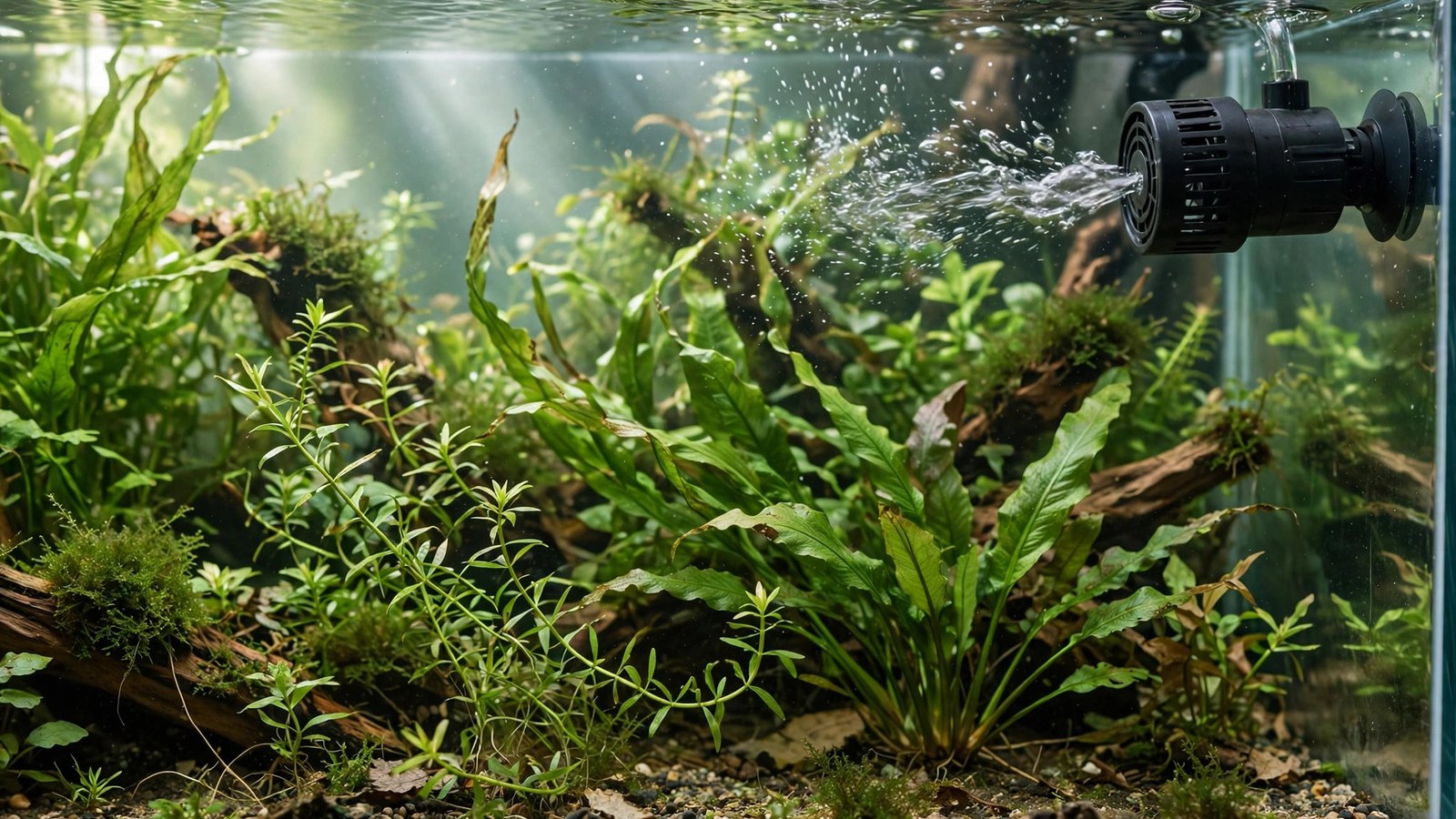
The fastest plant growth I ever saw came from a tank where nothing looked dramatic. The owner had tucked a small wavemaker for planted tank use behind the hardscape, and within six weeks his slow Monte Carlo carpet doubled in spread with no change to light, CO2, or fertilizer. The device didn't feed the plants — it just made sure every leaf met the food. This guide shows you how to do the same: when a wavemaker makes sense, how to size and place it, and how to schedule it so flow becomes a growth tool instead of a sand-blaster.
Why Plants Care About Flow More Than You Think
Leaves underwater don't breathe the way you might picture: each is wrapped in a thin, stagnant film of water — the boundary layer — where CO2 and nutrients deplete quickly. Without flow the film stays put and the leaf starves, even while water inches away is rich with CO2 setup distributes through flow from your diffuser. A gentle current constantly refreshes that layer, so uptake climbs without dosing a drop more.
Plant-dense areas slow water exactly where plants are thickest, so even high-tech tanks with big canister filters develop dead spots. Suspect one where mulm settles repeatedly, leaves stay dusty in one patch, or blue-green algae creeps across part of the carpet. This is also why fertilizer only works if flow delivers it — a premium all-in-one means little when it never reaches the far-side stems.
Choosing a wavemaker for planted tank setups: sizing and types
In a planted tank you want a broad, gentle stream — not a jet. Crossflow designs spread water in a wide sheet like a slow river; standard propeller powerheads concentrate it into a narrower cone. Nano units (1,000–3,000 L/h rated) suit most tanks under 60 gallons — for planted tanks, broad beats narrow every time.
Size to your tank, not your ambition. The table below assumes total turnover — filter output plus wavemaker — since the two work as a team. Check our filter guide for planted tanks first; many tanks are one filter upgrade away from not needing a wavemaker.
| Tank size | Recommended wavemaker | Starting flow setting |
|---|---|---|
| Under 20 gal (75 L) | None needed — filter output only | Filter at rated output |
| 20–40 gal (75–150 L) | One nano wavemaker, 1,000–1,800 L/h max | Lowest setting (~30% power) |
| 40–75 gal (150–280 L) | One crossflow or two small propeller units, 1,800–3,000 L/h each | 40–50% power |
| 75 gal+ (280 L+) | Two units on opposite ends, timed alternately | 50% power, opposite-phase pulses |
Always buy adjustable speed. A fixed powerhead is a blunt instrument — it blasts the foreground or stirs nothing.
Where to Place It
Mount the wavemaker on the side glass, in the upper third of the water column, aimed horizontally or slightly downward across the long axis. This sends water over the plant tops to rebound off the far glass, creating a slow gyre that reaches the bottom without blasting substrate. Keep 20–25 cm of clear water between the output and the nearest plants — flow needs distance to spread first.
Never aim a wavemaker downward at the carpet or directly at a stem bush — you'll uproot runners, strip leaves, and blow aquasoil across the scape. Let the stream pass near, not through, the CO2 diffuser's output: a gentle cross-current lengthens bubble contact time and improves dissolution.
In tanks over 4 feet, one unit rarely reaches the far end. Place a second, smaller unit on the opposite end glass, aimed back toward the first — the two gentle flows meet in the middle, creating the same gyre without a violent collision zone.
Timers, Pulse Modes, and Night Schedules
Constant gentle flow during the photoperiod is the baseline: that's when plants photosynthesize, so that's when delivery matters. Use pulse mode — alternating 30 seconds on/off at moderate power — only in established tanks, to keep the boundary layer from reforming and stop detritus settling. One rhythm that works well: steady flow for the first four hours of light, pulse for the rest.
At night, CO2 delivery no longer matters, so drop the wavemaker to minimum or cut power until an hour before lights-on. The quiet period settles suspended particles, leaving the water glass-clear by morning, and your filter alone handles nighttime oxygen.
Signs Your Flow Needs Adjusting
Your plants report on flow constantly. Turn flow up when: debris collects in the same corner after water changes in planted tanks, lower stem leaves melt while tops thrive, or thread algae grows in isolated stagnant patches. Turn it down when: carpets lean uniformly in one direction, sand dunes form under the stream, or fish hover in one corner avoiding the current.
New plantings are fragile and nutrient demand shifts weekly, so pair them with a weekly flow check using the first 90 days of a planted tank: glance at the sway, confirm no new dead spots, adjust one notch. Small, frequent corrections beat one big guess.
Frequently Asked Questions
Do I need a wavemaker if I already have a good filter?
Not always. A canister filter turning the tank over 5–6× per hour covers sparsely or moderately planted tanks. Add a wavemaker when the tank is densely planted, CO2-injected, or long enough that filter flow dies before the far end. It's a supplement, not a replacement.
Can a wavemaker hurt aquarium plants?
Only when it's oversized or aimed badly — a jet strips leaves, uproots runners, and erodes substrate. Run a broad, adjustable unit high on the side glass at 30–50% power, aimed across the tank with 20 cm of open water before the stream reaches plants. Used this way, flow visibly improves growth.
What does a "wavemaker for planted tank" setup cost?
A nano wavemaker with an adjustable controller costs $20–$45; crossflow models run $35–$70, and a two-unit setup with a timer stays under $120. Prioritize an adjustable unit with a magnetic mount — cheap fixed-flow models end up blasting or unused. They draw 5–15 watts, so running costs are pennies a month.
Should the wavemaker run 24/7?
Schedule it: gentle flow during the photoperiod, minimum or off overnight. Plants don't photosynthesize at night, so nutrient delivery no longer matters, and the quiet hours let suspended particles settle while fish rest in calmer water. Your filter's output covers nighttime oxygen. A plug-in timer or controller night mode handles the switch; have flow back on an hour before lights-on.
Where exactly should I mount the powerhead?
On the side glass, in the top third, aimed horizontally across the long axis. This creates a slow gyre: water crosses over the plant tops, hits the far glass, and returns along the bottom. In tanks over 4 feet, add a second small unit opposite, aimed back.
Flow Is the Quiet Multiplier
Flow won't fix weak light, absent CO2, or a missing all-in-one fertilizer dosing routine — but once those are right, flow is what lets them reach the leaves. Start with your filter, add one small adjustable unit if dead spots persist, aim it high and gentle, and let the plants' sway tell you when it's right. For a deeper look at circulation alongside equipment choices, the 2Hr Aquarist flow setup guide is a solid companion read.