Algae on the glass is an annoyance; algae on plant leaves is a threat. A leaf coated in algae can't photosynthesize properly, and once algae gets a real foothold on foliage, it spreads leaf to leaf faster than you'd expect. The good news: most leaf algae can be removed without harming the plant — if you match the method to the algae type and the leaf type. Scrub a delicate crypt leaf like you'd scrub glass and you'll shred it; ignore staghorn on anubias and you'll lose the leaf. Here's how to clean every common case.
First: Identify What You're Dealing With
Method follows diagnosis. The common leaf algae:
- Green spot algae: Hard, round green dots cemented to slow-growing leaves (anubias, java fern). Can't be wiped off — it's literally bonded to the leaf surface.
- Green dust / film: Soft green coating that wipes off easily. Common on all leaves during blooms.
- Thread / hair algae: Long green strands tangled around leaves and stems. Pulls off in clumps.
- Staghorn: Grayish branching tufts, often on leaf edges and filter outputs. Indicates CO2/flow issues.
- Black brush / beard algae (BBA): Dark tufts on slow growers and hardscape. The toughest customer — firmly attached.
- Diatoms (brown algae): Dusty brown coating, wipes off effortlessly. Almost universal in new tanks; usually transient.
- Blue-green algae (cyanobacteria): Slimy blue-green sheets with a distinctive smell. Technically bacteria — different treatment.
Also assess the leaf: tough leaves (anubias, java fern, swords) tolerate scrubbing and spot treatments; delicate leaves (crypts, fine stems, mosses) tolerate almost no mechanical cleaning — for these, trimming the affected leaf is usually better than trying to save it.
Mechanical Removal: The First Resort
Always try physical removal before chemicals. It's immediate, free, and can't overdose.
The finger-rub (soft algae)
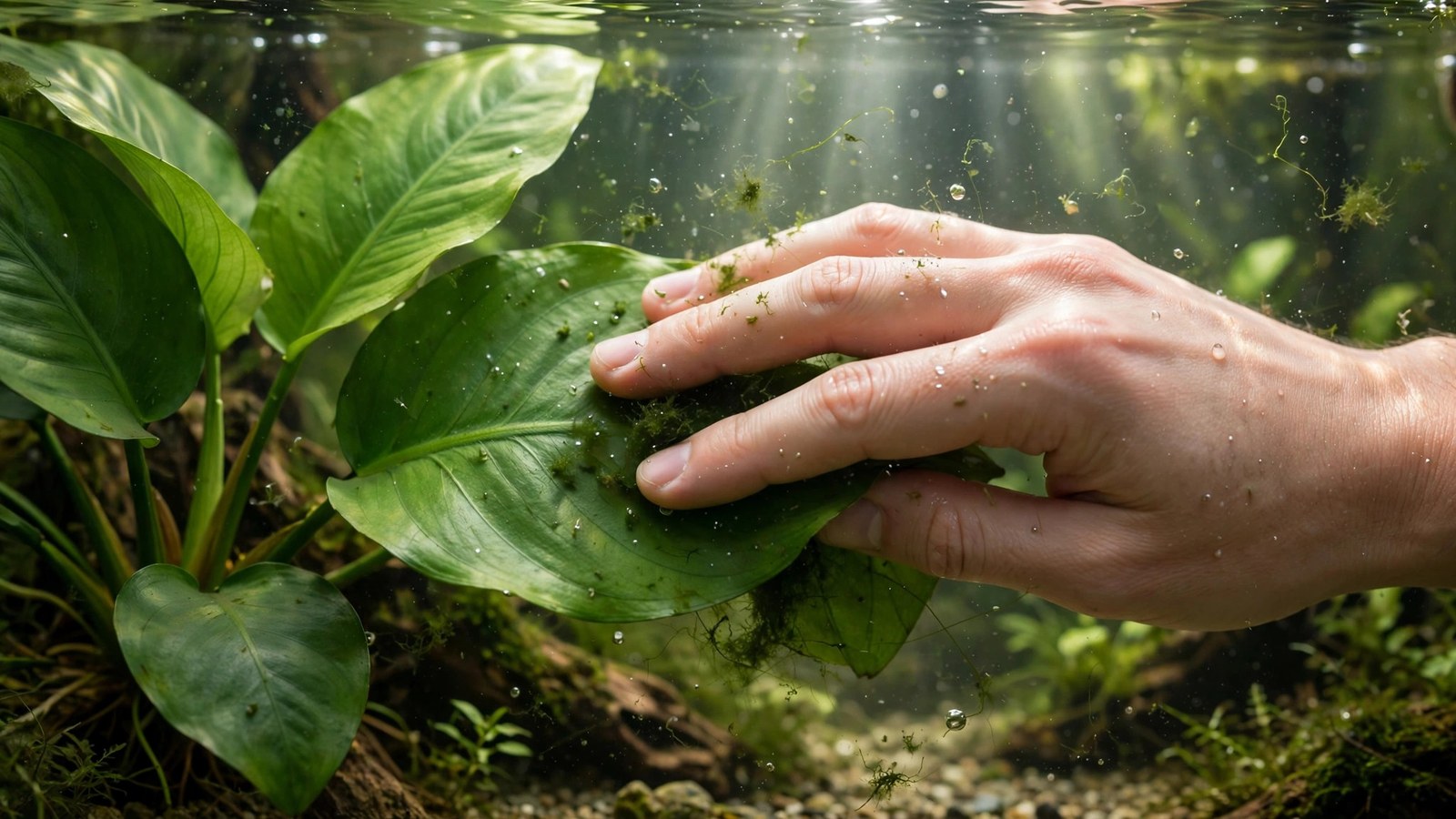
For green dust, diatoms, and early film algae on tough leaves: gently rub the leaf between thumb and forefinger underwater. Support the leaf from behind with one finger while the other wipes — unsupported rubbing tears leaves at the stem. Work leaf by leaf; it's meditative, not fast. Siphon out the dislodged algae as you go so it doesn't resettle.
The toothbrush (thread and staghorn)
A soft-bristled toothbrush (new, never used with toothpaste) twirls thread algae like spaghetti — rotate the brush and the strands wind on. For staghorn on tough leaves, gentle brushing dislodges tufts. Use light pressure on anubias and swords; skip the brush entirely on delicate leaves.
The trim (delicate leaves, heavy infestations)
Sometimes the leaf is a loss. If a delicate leaf is more algae than plant, or BBA has colonized an anubias leaf beyond spot-treatment, cut the leaf off at the base per our dead-leaf removal technique. A plant that keeps 80% healthy leaves and loses 20% sacrificed leaves recovers fast; a plant spending energy on algae-smothered leaves doesn't. This isn't defeat — it's triage, and it's the correct call more often than beginners think.
Suggest a floating magnetic cleaner for keeping the glass side of the problem under control while hand-cleaning leaves: magnetic aquarium algae cleaner.
Spot Treatments: Targeted Chemistry
When mechanical removal isn't enough — BBA, stubborn staghorn, green spot — spot treatment kills algae in place without dosing the whole tank.
Hydrogen peroxide spot treatment
Turn off filters and powerheads (still water keeps the treatment on target), fill a syringe with 3% hydrogen peroxide, and squirt it directly onto the algae — about 1–2 ml per affected area. Wait 5 minutes, then turn flow back on. The algae will turn pink/white and die off over 24–48 hours; shrimp and snails often eat the dying remains. Limit to ~1 ml per gallon of tank volume per day to stay safe for livestock. Full protocol in our hydrogen peroxide guide.
Liquid carbon spot treatment
Products like Seachem Excel (glutaraldehyde-based) work similarly: syringe-squirt onto BBA or staghorn with flow off. Very effective on BBA — it turns red/pink as it dies. Caution: liquid carbon melts vallisneria, can stress mosses and liverworts, and is toxic to some sensitive livestock at high doses. Spot-treat, don't broadcast-dose, and keep it away from vals.
Which for which algae
- BBA: Liquid carbon spot treatment (most effective) or peroxide. Then trim the worst leaves — dead BBA often stays attached as gray fuzz that looks bad even when dead.
- Staghorn: Peroxide spot treatment works well. Also fix the underlying cause (usually CO2 fluctuation or dead spots in flow).
- Green spot: Neither chemical removes established spots well — they're armor-plated. Prevention (adequate phosphate, not-too-long photoperiod) beats cure; for existing spots on old leaves, trim the leaf.
- Thread/hair: Manual removal first; peroxide for remnants. Thread algae often signals excess iron or ammonia — check dosing.
- Cyanobacteria: Siphon it out manually (it comes off in sheets), increase flow to the area, and address the underlying cause (low nitrates, poor circulation, excess organics). Spot treatments are secondary.
The Dip Option: For Badly Affected Plants
When a whole plant is coated — a new purchase covered in algae, or a tank-wide outbreak casualty — a dip treats the entire plant at once:
- Hydrogen peroxide dip: 1 part 3% H₂O₂ to 4 parts tank water, 3–5 minutes, then rinse. Good all-rounder for most algae on most plants. Details in our peroxide dip guide.
- Bleach dip: 1:20 bleach-to-water, 90 seconds to 2 minutes, then rinse thoroughly and dechlorinate. Stronger — better for BBA and stubborn cases, harsher on delicate plants. Full protocol in our bleach dip guide.
Dips are for removable plants (potted, rhizome-attached, floaters). You can't dip a rooted sword without uprooting it — for those, spot treatment in place is the answer.
Biological Cleanup Crews
The right livestock prevents leaf algae from establishing and cleans what manual methods miss:
- Amano shrimp: The gold standard — eat thread, hair, and film algae off leaves gently without damaging them. A crew of 6–10 transforms a 20-gallon's leaf cleanliness.
- Nerite snails: Excellent on green spot and film on tough leaves and glass. Won't touch thread algae much, but unmatched for spot algae.
- Otocinclus: Gentle diatom and soft-algae grazers, perfect for delicate leaves they'd never damage. Useless against BBA or established thread.
- Siamese algae eaters (true SAEs): One of the few fish that eat BBA and staghorn — but only when young and slightly hungry; adults get lazy. Verify it's a true SAE, not a flying fox.
Cleanup crews are maintenance, not treatment — they keep clean leaves clean but can't rescue a tank already overwhelmed. Add them to a tank you've already brought under control, per your weekly routine, not as a substitute for fixing the cause.
Fixing the Cause (or It Comes Back)
Cleaning algae off leaves without addressing why it grew is mowing weeds. The usual causes by algae type:
- Thread/hair algae: Excess dissolved organics, ammonia spikes, too much iron, or CO2 fluctuations. Check filter maintenance and dosing.
- BBA: Almost always CO2 instability or poor flow distribution. The most "cause-driven" algae — fix carbon and circulation, and BBA stops appearing.
- Staghorn: Similar to BBA — CO2 and flow, plus excess organics.
- Green spot: Too-long photoperiod, low phosphate relative to light, or simply old leaves at end of life (spot algae colonizes dying leaves first — sometimes the leaf was the problem, not the algae).
- Diatoms: New tank syndrome or silicates in tap water. Usually self-resolving; otos handle the interim.
- Cyanobacteria: Low nitrates, stagnant areas, excess dissolved organics. Increase flow, siphon detritus, ensure some nitrate is present.
After any major cleaning, do a water change — you've released a pulse of organics and possibly chemicals into the water. Then observe for two weeks: if the same algae returns to the same spots, you haven't found the cause yet.
Frequently Asked Questions
Will scrubbing damage my plants?
It depends on the leaf and your pressure. Tough leaves (anubias, java fern, swords) handle gentle rubbing and soft brushing fine. Delicate leaves (crypts, rotala, mosses) tear easily — for these, trimming affected leaves beats cleaning them. Always support the leaf from behind while cleaning, work underwater (leaves are more brittle in air), and when in doubt, sacrifice the leaf rather than the plant.
How do I clean algae off moss?
Carefully — moss is the hardest case. Thread algae tangled in moss usually can't be separated mechanically; try a peroxide dip of the whole moss portion (moss tolerates brief peroxide dips well) or, for severe cases, discard the affected patch and let clean moss regrow. Prevention (good flow through the moss, amano shrimp patrol) matters more for moss than any cure.
Is it safe to use hydrogen peroxide with shrimp in the tank?
Yes at spot-treatment doses (under ~1 ml per gallon per day, applied directly to algae with flow off). Peroxide breaks down into water and oxygen within minutes. Shrimp may briefly avoid the treated area but aren't harmed at these levels. Don't broadcast-dose the whole tank at high concentrations — targeted application is the entire point of spot treatment.
Why does algae keep coming back on the same leaves?
Because those leaves are the problem, not the victim. Algae preferentially colonizes old, damaged, or dying leaves — their weakened surfaces and leaking nutrients are ideal settlement. If the same anubias leaf gets green spot repeatedly while new leaves stay clean, that leaf is at end of life: trim it. Fighting to save a leaf the plant has already abandoned wastes effort.
Should I remove the plant from the tank to clean it?
For dips, yes — remove, dip, rinse, replant. For spot treatments and manual cleaning, work in place; uprooting stresses the plant and stirs the substrate. The exception: a plant so comprehensively coated that in-place work would take an hour — pull it, dip it, replant it. Just remember that uprooting restarts the establishment clock, so reserve this for genuinely bad cases.
Clean Leaves Are Healthy Leaves
The workflow is simple: identify the algae, try mechanical removal first, spot-treat what resists, trim what can't be saved, deploy a cleanup crew for maintenance, and fix the underlying cause so you're not doing it all again next month. Fold leaf inspection into your weekly routine and algae never gets past the "five-minute fix" stage — which is exactly where you want it.