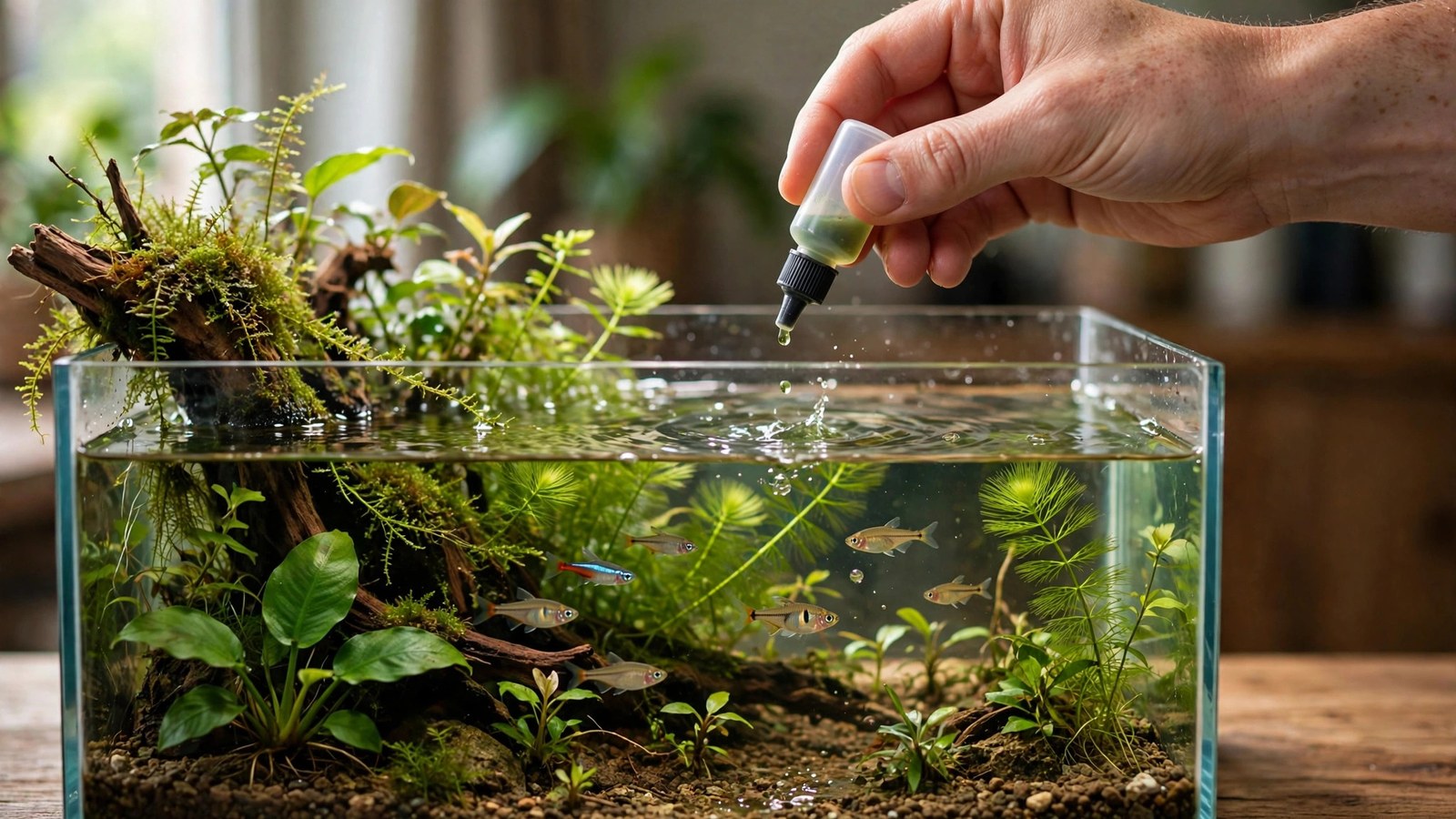
Walk into any aquarium shop and you'll find a wall of bottles promising complete plant nutrition in a single pump. All-in-one fertilizers — one bottle containing every macro and micronutrient your plants need — are the most popular way beginners fertilize, and honestly, they're a fine way for plenty of experienced keepers to fertilize too. But "all in one" doesn't mean "dose and forget." How much you dose, how often, and how you adjust the dose to your tank make the difference between a thriving garden and an algae farm in a bottle.
This guide covers how all-in-one fertilizers work, how to dose them correctly, when to deviate from the label, and how they compare to mixing your own with EI or PPS-Pro.
What "All-in-One" Actually Means
An all-in-one fertilizer contains nitrogen (N), phosphorus (P), potassium (K), iron, and the full suite of trace elements in a single solution. The manufacturer's chemists have balanced the ratios so that one pump delivers a sensible proportion of everything — you don't need to know what KNO₃ is or own a gram scale. Popular examples include NilocG Thrive, Aquarium Co-Op Easy Green, Tropica Specialised Nutrition, and APT Complete.
The engineering challenge these products solve is real: iron and phosphate want to precipitate when stored together in concentrated form. Manufacturers get around this with chelators (molecules that keep iron dissolved and available) and careful pH buffering. It's genuinely clever chemistry, and it's why all-in-ones cost more than dry salts — you're paying for someone else to solve the stability problem. Our dry vs. liquid fertilizer comparison breaks down exactly what that convenience costs per year.
What all-in-one does not mean: it doesn't mean the dose is automatically right for your tank. The label dose is calibrated for a hypothetical "average" planted tank. Your tank is not average. Learning to read your plants and adjust is still the core skill — the bottle just removes the mixing.
Position as the high-tech variant of the same line for tanks with strong light and CO2: NilocG Thrive+.
The Label Dose: Start Here, Don't Stay Here
Every reputable all-in-one gives a starting dose, usually expressed as pumps or milliliters per 10 gallons, dosed 1–3 times per week. Start exactly at the label dose. Not doubled because your plants "look hungry," not halved because you're cautious — the label, as written. Run it for two full weeks while keeping everything else stable (light, CO2, water changes).
Then read your plants:
- Steady new growth, good color, no algae surge: The label dose is right. Keep it. This is the most common outcome, and it's fine to stay here indefinitely.
- New leaves pale, older leaves yellowing, slow growth: You're under-dosing for your plant mass and light level. Increase by 50% (e.g., from 2 pumps to 3 pumps per dose) and observe for another two weeks.
- Algae increasing, especially thread or green dust on glass: You may be over-dosing relative to what plants can use — or your light/CO2 balance is off. Before cutting fertilizer, check the usual suspects: excessive light duration, inconsistent CO2. If those are fine, reduce the dose by a third.
- Specific deficiency symptoms (pinholes, twisted new growth): An all-in-one's fixed ratios can't fix every imbalance. Pinholes despite adequate dosing usually mean you need extra potassium beyond what the bottle provides — see our potassium guide. Pale new growth with green veins means extra iron on top of the all-in-one.
The adjustment rhythm is always the same: change the dose, wait two weeks, observe new growth (old damaged leaves don't heal — judge only fresh foliage). Our fertilizer schedule guide shows how to slot all-in-one dosing into a weekly maintenance routine.
Dosing Frequency: Why 2–3x Weekly Beats Once Weekly
Most labels suggest dosing 1–2 times per week, and many keepers just dump the whole weekly amount in after the water change. It works, but splitting the dose is better:
- Split into 2–3 smaller doses across the week (e.g., Monday/Thursday or Monday/Wednesday/Friday). Smaller, more frequent doses keep nutrient levels steadier and give algae fewer feast windows.
- Dose after water changes, not before. A water change removes a chunk of the water-column nutrients; dosing right after restores them. Dosing the day before a change just pours fertilizer down the drain.
- Dose when lights are on or just before they come on. Plants uptake nutrients during photosynthesis. Dosing at midnight into a dark tank gives algae (which needs less light to get going) first crack at the fresh nutrients.
If your product's label says "one pump per 10 gallons twice weekly" and you have a 20-gallon tank, that's 2 pumps Monday + 2 pumps Thursday. Simple, steady, effective.
Matching the Product to Your Tank
Not all all-in-ones are formulated identically, and the differences matter:
Complete vs. lean formulas
Some all-in-ones (NilocG Thrive, APT Complete, Tropica Specialised Nutrition) contain nitrogen and phosphorus — true "complete" nutrition for tanks where fish waste doesn't supply enough. Others (like Tropica Premium Nutrition or Seachem Flourish Comprehensive) are micro-plus-potassium formulas without nitrogen and phosphorus, built on the assumption that your fish provide the N and P.
- Heavily stocked tank, modest plant mass: Your fish supply plenty of nitrogen and phosphate. A micro+potassium formula avoids piling N and P onto an already rich system. Dose to the label and let the livestock handle the rest.
- Lightly stocked or shrimp-only tank, dense plants: You need the complete formula with nitrogen and phosphorus — there's no other meaningful N source. This is the most common beginner setup, and it's where complete all-in-ones shine.
- New aquasoil tank: Aquasoil leaches ammonia (nitrogen) and nutrients for the first month. Start with a micro+K formula or half-dose a complete formula, then switch to full complete dosing as the soil depletes — the full timeline is in our new aquasoil fertilizing guide.
High-tech vs. low-tech dosing
All-in-ones work in both, but the dose differs. In a CO2-injected, high-light tank, start at the full label dose and expect to increase — fast-growing stems under strong light are hungry. In a low-tech tank, start at half the label dose. Low-tech plants simply can't use full-bottle strength, and the surplus feeds algae. You can always increase; recovering from an algae bloom costs weeks. Our low-tech growing guide pairs a lean all-in-one routine with appropriate plant choices.
A reliable pick here is NilocG Thrive all-in-one fertilizer.
The Hidden Limitation: Fixed Ratios
Here's the honest trade-off nobody puts on the label: an all-in-one locks you into the manufacturer's nutrient ratio. If your tank needs more potassium but has plenty of nitrogen, you can't add just potassium with the bottle — increasing the dose raises everything, including the nitrogen you didn't need.
In practice, this matters in three situations:
- Potassium-hungry stem tanks develop pinholes even at generous all-in-one doses. The fix is a separate potassium supplement (potassium sulfate, cheap and easy) dosed alongside the all-in-one — not more all-in-one.
- Red-plant enthusiasts often find the bottle's iron insufficient for intense coloration. A dedicated iron supplement 2–3x weekly on top of the all-in-one is the standard approach.
- High-nitrate tap water or heavy stocking means the bottle's nitrogen pushes nitrates too high. Switch to a micro+K formula and let the fish supply nitrogen, rather than fighting your own fertilizer.
Think of the all-in-one as covering 90% of your needs with zero effort, and keep one or two targeted supplements on hand for the remaining 10%. That's still dramatically simpler than full EI or PPS-Pro mixing — and for most tanks, it's all you'll ever need.
Storage, Shelf Life, and Money
Practical notes that save money and headaches:
- Store cool and dark. Chelated iron degrades in heat and light; a bottle on a sunny windowsill loses potency in months. A cabinet is fine — no refrigeration needed.
- Watch for precipitation. If your bottle develops crystals or cloudy sediment that shaking doesn't resolve, the formula has broken down. Don't dose sludge — replace the bottle.
- Shelf life is typically 2–3 years unopened, ~1 year opened. Buying the giant economy bottle for a single nano tank is false economy if half of it expires.
- Cost reality: A 500 ml bottle (~$20–25) dosed at label rates lasts a 20-gallon tank roughly 3–4 months — so $60–100/year. Dry salts for the same tank run under $20/year. You're paying for convenience, and for one or two tanks it's a fair trade. At five tanks, the math starts screaming "mix your own."
- Pump accuracy matters. Cheap pump tops can deliver inconsistent volumes as the bottle empties. If you're calibrating carefully, dose with a measured syringe instead — it's the same ten seconds with better precision.
When to Graduate Beyond the Bottle
All-in-ones are not a beginner-only product — plenty of advanced keepers use them happily for years. But consider graduating to dry-salt methods (EI or PPS-Pro) when:
- You're running 3+ tanks and the bottle bill is getting silly
- You want independent control of individual nutrients (e.g., high potassium without high nitrogen)
- You're pushing high-tech growth rates and the label dose is perpetually "not quite enough"
- You enjoy the chemistry and want the absolute cheapest per-dose cost
Until then, there's no shame in the pump bottle. The best fertilizer method is the one you'll actually dose consistently — and "squeeze, done" has a consistency advantage that's hard to beat.
Frequently Asked Questions
Can I overdose an all-in-one fertilizer?
Mild overdosing (up to ~2x the label dose) is generally safe for fish and shrimp — these products are formulated with wide safety margins. The real risk of overdosing isn't livestock harm, it's algae: excess nutrients that plants can't use become algae food, especially if light is strong. If you accidentally double-dose, do a water change and carry on; it's not an emergency.
Should I still do water changes if I use an all-in-one?
Yes. Fertilizer doesn't replace water changes — it doesn't remove the organic waste, hormones, and dissolved organics that accumulate from fish and decaying plant matter. Most all-in-one routines pair with a weekly 25–50% change. See our guide to water changes for planted tanks for the technique that keeps both plants and parameters happy.
Do I need root tabs too if I use liquid all-in-one?
For most setups, no — a good all-in-one feeds the water column and heavy root feeders like swords and crypts can uptake through leaves as well. But in inert substrates (plain sand or gravel), adding root tabs under heavy root feeders gives noticeably better growth. It's a both/and situation, not either/or — the two delivery methods complement each other.
Why are my plants still deficient if I'm dosing the full label amount?
Four usual suspects: (1) your plant mass and light level genuinely need more than the label assumes — increase the dose; (2) CO2 or light is the actual limiting factor, and no amount of fertilizer fixes a carbon shortage; (3) your tap water is extremely soft and the real deficiency is calcium/magnesium, which all-in-ones don't supply; (4) the bottle is old and the chelated iron has degraded. Check in that order.
Can I use an all-in-one in a shrimp tank?
Yes. Reputable all-in-ones are shrimp-safe at label doses — the copper content in the trace package is chelated and minuscule, far below harmful levels. Dose conservatively (start at half label) in new shrimp tanks, keep your water change routine stable, and the colony will be fine. Many dedicated shrimp breeders fertilize their planted shrimp tanks with all-in-ones routinely.
Simple Doesn't Mean Careless
The all-in-one bottle is the closest thing this hobby has to a "just add water" solution, and used thoughtfully it's genuinely excellent: start at the label dose, split it across the week, read your plants for two weeks, adjust once, and then enjoy the easiest fertilizing routine in the hobby. The keepers with the best-looking low-maintenance tanks usually aren't running exotic dosing schemes — they're running a pump bottle, consistently, with their eyes open.