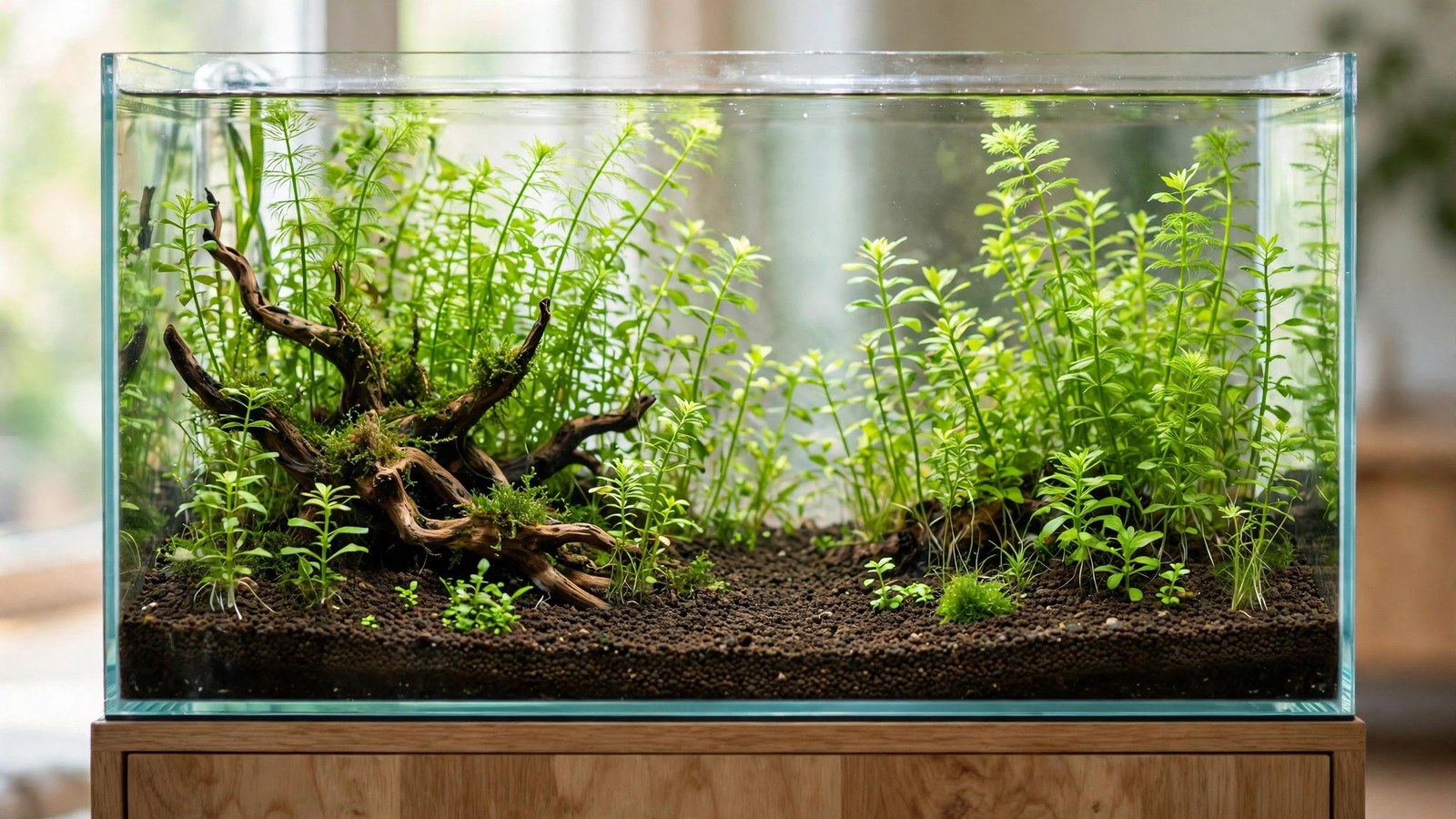
Fertilizing on day one is one of the most common mistakes in a new planted tank — and waiting too long is the other one. Get when to start fertilizing a planted tank wrong in either direction and you get the same green headache: algae coating your new leaves before your plants ever had a chance. This guide gives you the exact week-by-week timeline for both aquasoil and inert-substrate tanks, and how much to dose while everything is still settling in.
The Short Answer
The reason beginners get conflicting advice is that both camps are describing different setups. "Wait three weeks before fertilizing" is good advice for a fresh aquasoil tank and terrible advice for a sand-bottom tank, where a month without nutrients means stalled, melting plants. Match your start date to your substrate and you avoid both problems.
Aquasoil (nutrient-rich) tanks: start in week 1–2
Aquasoils like ADA Amazonia, Tropica Aquarium Soil, and Fluval Stratum come loaded with ammonia and nutrients. In the first 2–4 weeks they release a heavy stream of nitrogen into the water — more than your young plants can possibly use. Adding a full dose of liquid fertilizer on top of that is like pouring syrup into an already-sweet drink: it fuels algae, not plants.
Start liquid fertilizer in week 1 or 2, at one-quarter of the label dose, after your first couple of large water changes have flushed the initial ammonia spike. Then raise the dose gradually as the soil's own nutrient release tapers off around week 4–8.
Inert substrate tanks (sand, gravel, plain): start on day 1
Plain sand, gravel, and decorative substrates release no nutrients, so every element your plants need must come from the water column from day one. Dose at planting at half the label dose, 2–3 times per week, and reach the full label dose by week 3 or 4. If you also use root tabs for heavy root feeders, the liquid fertilizer vs root tabs breakdown shows how the two strategies work together without overlapping.
Why Timing Matters More Than the Product
Brand matters far less than when and how much you dose in the first month, because a new tank is biologically different from an established one: unstable bacteria, leaching substrate, and plants that haven't grown roots yet.
Aquasoil releases ammonia — and that changes everything
During the first weeks, a fresh aquasoil tank is effectively a nutrient soup. Ammonia can read 2–4 ppm or higher, and your filter's bacteria haven't colonized enough to process it. This is why the first month of an aquasoil tank demands aggressive water changes: two 30–50% changes per week flush the excess before algae colonizes it. Dosing liquid fertilizer before those changes have done their work adds nitrogen to water that already has too much — the classic route to green dust algae on the glass by day ten.
The beginner's dilemma: algae vs deficiency
Both fears are real, but they aren't equal: in a new tank, algae is far harder to reverse than deficiency. An algae bloom smothers leaves and kills the plants you're trying to feed, while a deficiency takes weeks to become serious and is fixed by simply adding fertilizer. Beginning at a quarter dose and ramping up weekly means you may slightly underfeed for a week or two — harmless — while never creating the conditions that let algae explode. You can always add more; you can't un-algae a tank quickly.
Week-by-Week Timeline: New Aquasoil Tank
This schedule assumes a typical aquasoil tank with moderate planting and a standard all-in-one liquid fertilizer. Adjust proportionally if your bottle's label dose differs.
| Week | Liquid fertilizer | Water changes | What to watch for |
|---|---|---|---|
| 1 | None until day 5–7; then ¼ label dose, twice | 50%, twice (day 2 and day 5) | Ammonia spike; diatoms and some melt are normal |
| 2 | ¼ dose, 3× per week | 50%, twice | Plants should start showing new growth tips |
| 3 | ½ dose, 3× per week | 30–50%, once or twice | Ammonia dropping; watch for early deficiency on fast growers |
| 4 | ½–¾ dose, 3–4× per week | 30%, weekly | Soil release tapering; plant mass visibly increasing |
| 5–6 | Full label dose | 30%, weekly | Steady-state routine begins; prune and replant trimmings |
| 8+ | Full dose; adjust by plant response | 30%, weekly | Heavy root feeders may need root tab refresh at month 3 |
Note that the first two weeks are really about timing your plant additions and water changes — the fertilizer schedule is deliberately boring at this stage. It slots into the week-by-week structure of a proper first-90-days new tank routine.
The Same Timeline for Inert Substrates
No soil ammonia means no reason to hold back — but your plants still need time to grow roots and build the plant mass that justifies a full dose. The ramp is shorter, not absent:
| Week | Liquid fertilizer | Water changes | What to watch for |
|---|---|---|---|
| 1 | ½ label dose, 3× per week, from day 1 | 30%, once or twice | Some melt is normal — plants adapting, not starving |
| 2 | ¾ dose, 3× per week | 30%, weekly | New root growth and fresh leaves on stems |
| 3 | Full label dose | 30%, weekly | If growth stalls now, check light and CO2 before adding more fert |
| 4+ | Full dose; adjust by plant response | 30%, weekly | Root tabs refresh every 2–3 months for heavy root feeders |
One difference worth remembering: because the substrate contributes nothing, inert-substrate tanks depend entirely on your dosing consistency. Miss a week in month two of a sand tank and your plants notice. Set a phone reminder or switch to a fertilizer dosing calendar for your tank type until the habit sticks.
How Much to Dose: Rules by Tank Type
Label doses are calibrated for established, moderately planted tanks — which a new tank is not. Use these starting points, all expressed as fractions of the bottle's recommended dose, and ramp up as plant mass increases:
| Tank type | Starting dose (week 1–2) | Target (week 4–6) | Notes |
|---|---|---|---|
| Low-tech, no CO2 | ¼–½ label dose | ½–¾ label dose | Slow growth = low appetite; full dose often unnecessary even long-term |
| High-tech with CO2 | ¼ label dose | Full label dose | CO2 ramps appetite fast; watch for deficiencies by week 3 |
| Shrimp tank (any setup) | ¼ label dose | ½–¾ label dose | Use a shrimp-safe formula (low copper, within safe limits for colonies) |
| Nano tank (under 40 L) | ¼ label dose | ½–¾ label dose | Small water volume magnifies every error — measure with a syringe |
| Densely planted from day 1 | ½ label dose | Full label dose by week 3 | Big plant mass = big appetite from the start |
If you're choosing between product types, an all-in-one formula is the simplest start — how to dose all-in-one fertilizers correctly matters more than which brand is in the bottle. Dry powders are cheaper long-term (dry vs liquid fertilizer compared), and structured methods like EI dosing or PPS-Pro are excellent once the tank is mature. Keep month one simple with a single all-in-one.
Root Tabs: When to Start
Root tabs are the exception to every "wait" rule on this page: place them at planting time, on day one, in both substrate types. They sit in the substrate, release nutrients slowly right where roots are growing, and barely affect the water column — so they carry essentially zero algae risk during the critical first weeks.
Place one tab every 10–15 cm in a grid under heavy root feeders (swords, crypts, vallisneria, carpeting plants), pushed 3–5 cm deep with tweezers so they don't surface. Skip them under stems that feed mainly from the water column — liquid fertilizer covers those. See the root tab placement guide for specifics, and plan to replace tabs after 2–3 months.
How to Read Your Tank: Signs to Adjust
Your tank tells you when the schedule needs tweaking. The trick is knowing which signals mean "add fertilizer" and which mean "change something else," because most early problems in a new tank are not deficiencies at all:
- Brown dust on leaves and glass (weeks 1–3): diatoms. Normal, harmless, temporary. Wipes off easily and fades as the tank matures. Do not increase fertilizer because of diatoms.
- Old leaves melting while new growth looks healthy: transplant shock. The plant is shedding emersed-grown leaves and building submersed ones. Wait, don't dose more.
- New leaves pale or yellow with green veins (from week 3+): iron deficiency. This is a genuine "add more" signal — and worth reading the iron dosing guide before correcting.
- Holes in older leaves with yellow edges: potassium deficiency. Increase your all-in-one dose slightly or supplement potassium.
- Green dust or thread algae spreading: too much light or nutrients relative to plant mass — cut the dose, shorten the photoperiod, and clean, rather than adding more.
- Stunted new growth, tiny curled leaves: often calcium/magnesium or CO2 limitation rather than fertilizer. Check your RO water remineralization if you use RO, and verify CO2 levels before blaming nutrients.
The golden rule of adjustment: change one variable at a time, wait 7–10 days, and photograph your plants weekly under the same light so you can compare. Guessing-and-dumping is how tanks end up worse than before.
Different Soils, Different Leaching
- ADA Amazonia (and v2): the heaviest leacher — follow the full conservative schedule. Amazonia's ammonia pulse is legendary; respect it.
- Tropica Aquarium Soil: moderate leaching; the schedule works as written, possibly graduating a few days early.
- Fluval Stratum: lighter leaching; you can often start quarter-strength complete (not just micros) in week 2.
- UNS Controsoil: moderate; follow the standard schedule.
- "Complete" or buffered inert substrates (Eco-Complete, Flourite): minimal leaching — treat more like inert substrate with root tabs from day one, not like true aquasoil.
When in doubt about your specific soil, test ammonia daily for the first two weeks — the test kit tells you exactly how aggressive your leaching is, and you calibrate the schedule to reality instead of the label.
Months 2–3: The Soil Settles Into Its Long-Term Role
By month two, the dramatic phase is over — ammonia leaching has stopped, the initial nutrient flood has been consumed or exported, and the aquasoil transitions from "active leacher" to "slow-release reservoir." Your job changes accordingly:
- Stay on full-strength fertilizing. The water column is now the primary nutrient delivery system; the soil contributes a steady background trickle. Don't taper fertilizer "because the soil provides" — the soil's easily-available nutrients are largely spent, and what remains releases too slowly to carry the tank alone.
- Watch heavy root feeders specifically. Swords and crypts were feasting on the fresh soil; as it settles, they're the first to show hunger (smaller new leaves, slower growth). This is normal and expected — it's the early signal that root tabs will eventually be needed, though usually not until month 4–8.
- Keep water changes at your method's normal rate. The emergency 2–3x weekly schedule ends after month one. Drop to your long-term routine (50% weekly for EI, 25–30% for gentler methods) — the tank is stable enough now that extra changes just waste fertilizer.
- Don't disturb the substrate. The soil granules are still structurally intact but softening; aggressive gravel-vacuuming crushes them into mud prematurely. Surface-hover only, as described in our water change technique.
Think of month one as the soil shouting and months two-plus as the soil whispering. Your fertilizing program speaks at normal volume throughout — the soil just stops drowning it out.
A reliable pick here is NilocG Thrive+.
Root Tabs and New Aquasoil: Don't
New aquasoil needs no root tabs — it's already richer than any tab. Adding tabs to fresh aquasoil risks localized ammonia spikes and is simply redundant. Start tabbing around month 4–8, when you notice growth slowing despite good water-column dosing — that's the soil's initial charge depleting. Mark it on a calendar; "the soil is probably tired by now" is how old tank syndrome starts.
Frequently Asked Questions
Can I just wait a month before fertilizing at all?
In an aquasoil tank with moderate planting, yes — the soil carries you for 3–4 weeks, so starting liquids in week 2–3 is fine. In an inert-substrate tank, no: sand and gravel contribute nothing, so a month without water-column fertilizer means starved plants and melt that a late start won't reverse.
Should I fertilize before or after a water change?
Always after. Water changes remove nutrients from the water column, so dosing right after replenishes them to your target level — dosing before just washes part of the dose away. If you dose daily, skip the dose on water-change day until the change is done.
Do I need to fertilize if I have a lot of fish?
Fish waste supplies nitrogen and phosphorus but almost no potassium, iron, or trace elements. Many aquarists dose leaner on nitrogen with heavy stocking, but keep a complete fertilizer at a reduced rate so the micros don't run out. If new leaves stay green and healthy, your reduced dose is working.
My plants are melting — should I add more fertilizer?
Almost certainly not. Melting in the first 2–3 weeks is transplant shock: emersed-grown farm leaves die off while the plant grows submersed ones. Extra fertilizer doesn't speed this up, and in an aquasoil tank it feeds algae. Keep the schedule, keep up water changes, and judge by the new growth.
Can I use root tabs instead of liquid fertilizer in a new tank?
Not as a complete replacement. Root tabs feed the substrate zone well — perfect for swords, crypts, and carpets — but stems, mosses, ferns, and floaters feed from the water column and get nothing from tabs. New tanks do best with both: tabs for root feeders from day one, plus a lean liquid dose for everything else.
When do I switch from the "new tank" schedule to a normal routine?
When ammonia and nitrite read zero consistently, the tank is past week 6–8, and plant mass is clearly increasing. Then move to your regular beginner fertilizer schedule — typically a steady near-full dose with weekly 30% water changes — and adjust based on plant response.
Can I add fish during the first month with aquasoil?
Wait until ammonia reads zero consistently — usually week 3–4 with the aggressive water change schedule. The leaching ammonia is toxic to fish; plants tolerate (and consume) it, fish don't. Heavily planted tanks process ammonia fast, but "the plants will handle it" isn't a reason to subject fish to 2 ppm ammonia. Patience for a month buys a stable tank for years.
Should I use ammonia-removing filter media with new aquasoil?
Generally no — the ammonia feeds your developing biofilter and your plants. Stripping it with zeolite or similar starves the cycle you're trying to establish. The water changes manage the levels; let the biology do its job. Exception: if ammonia spikes dangerously high (>4 ppm) despite water changes, a temporary ammonia-absorbing media as a safety net is reasonable.
My aquasoil dropped my pH to 6.0 — is that a problem?
No — it's the soil doing its job. Aquasoils strip KH and release humic acids, settling pH around 6.0–6.8 depending on your source water. Most tropical plants and fish thrive in this range; it's actually ideal for many species and for nutrient availability (iron stays available longer at lower pH). Don't fight it with buffers — you'll exhaust the soil's buffering capacity prematurely. It stabilizes over months.
When does aquasoil "run out" of nutrients?
The ammonia pulse ends in weeks; the general nutrient charge lasts roughly 6–18 months depending on brand, depth, plant mass, and water change habits. You'll know it's depleting when growth slows despite correct water-column dosing — that's the signal to start root tabs. The soil's physical structure and CEC (nutrient-holding capacity) persist far longer than its initial charge, which is why old aquasoil + tabs outperforms plain gravel indefinitely.
Can I cap aquasoil with sand to reduce leaching?
You can, and it modestly slows ammonia release — but it also complicates planting (stems through two layers), traps detritus at the interface, and makes future rescaping messy. Most experienced keepers run aquasoil uncapped and manage leaching with water changes. Capping is a valid choice for specific aesthetics (sand foregrounds), not a leaching solution per se.
Your First Month, Simplified
New-tank fertilizing comes down to three moves: start lean, ramp with your plant mass, and let water changes do the heavy lifting while the tank matures. Aquasoil tanks start liquids in week 1–2 after the ammonia flush; inert-substrate tanks start on planting day at half dose; root tabs go in on day one either way. Photograph your plants weekly so you can actually see progress, and resist fixing slow growth by dumping in more — patience grows better plants than fertilizer does. The aquarium plant fertilizer schedule for beginners picks up where this guide leaves off.
Want the theory behind the numbers? The 2Hr Aquarist's fertilizer dosing guide explains how weekly nutrient targets translate into real dosing — including why a stable, leaner dose often beats a rich one in a young tank.