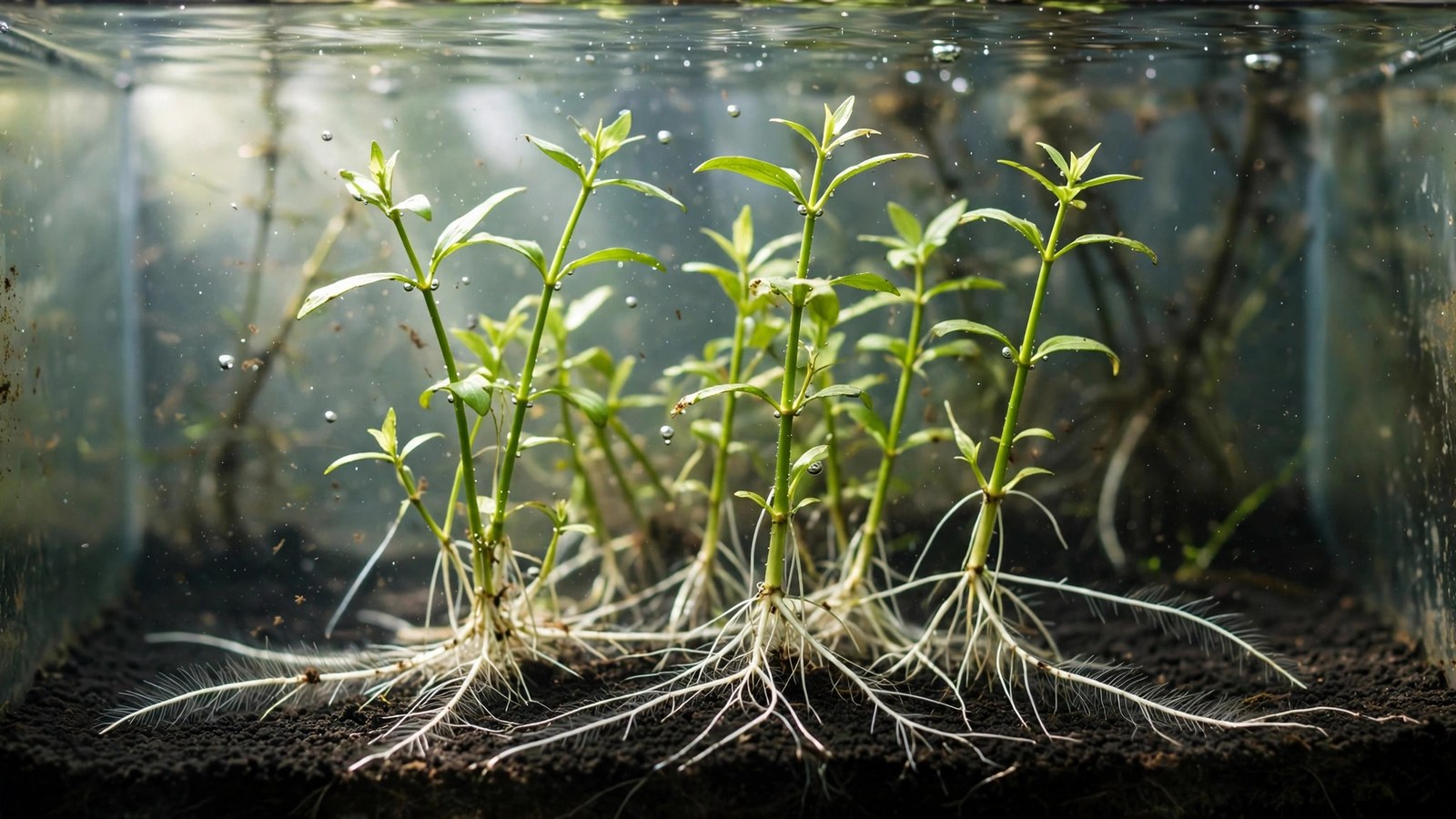
You've just planted your new aquarium plants, they look perfect — and the next morning half of them are floating at the surface. Before you replant everything for the third time, know this: roots need time, and you're asking the right question: how long does it take aquarium plants to root? The honest answer is "it depends on the plant type," and the timelines below will tell you whether yours are on schedule or genuinely stuck.
How Long Does It Take Aquarium Plants to Root? The Honest Timelines
The short version: most aquarium plants start anchoring within the first week, but a root system that holds through a water change takes 2–4 weeks. The timeline depends heavily on growth type. First, make sure they went in correctly — how to plant aquarium plants in substrate gives every timeline below its best chance.
| Plant type | Typical rooting time | What to expect |
|---|---|---|
| Stem plants (Rotala, Ludwigia, Bacopa) | 5–10 days to grip, 2–3 weeks to anchor firmly | Root hairs appear along the buried stem; white aerial roots may sprout too |
| Rosette plants (Cryptocoryne, Amazon Swords) | 2–4 weeks | Crypt melt is common in weeks 1–2; new leaves emerge once roots establish |
| Carpeting plants (Monte Carlo, Dwarf Hairgrass, HC Cuba) | 2–3 weeks to root, 6–8 weeks to spread | Runners shoot out horizontally once roots take hold |
| Epiphytes (Java Fern, Anubias, Bucephalandra) | 2–4 weeks to grip hardscape | Brown rhizome roots wrap around wood or rock; never bury the rhizome |
| Bulbs (Aponogeton, Tiger Lotus) | 1–2 weeks to sprout roots | Roots emerge from the base first, then leaves unfurl fast |
| Tissue culture plants | 5–14 days to start, 2–3 weeks to settle | Pest-free but fragile at first; roots fastest once leaves toughen |
Two things stretch every timeline: poor light and a nutrient-starved substrate. Plants root toward what they need — if the substrate offers nothing and the water column is empty, there's little reason to grow roots at all.
Why Your New Plants Melt First (And Why That's Normal)
If your crypts dissolve into mush days after planting, you didn't kill them — you watched them transition. Nursery plants are typically grown emersed (out of water, in humid air), and when submerged, old leaves die back while new submerged leaves grow. Roots are usually still alive underneath. How to acclimate new aquarium plants and avoid melting covers this in depth, but the key rule is simple: don't pull up a melting plant to "check on it." Every uprooting resets the rooting clock to zero.
A melting plant is only dead if the crown or rhizome turns to mush too. If the base feels firm with even one tiny new leaf bud, leave it alone — it's on schedule.
How to Tell Your Plants Have Rooted
There are three reliable signs your plants are established, and you don't need to dig anything up to read them:
- The gentle tug test. Grip the plant near its base and pull very lightly — no harder than you'd tug an earring. Resistance means roots are holding. Sliding straight out with zero resistance means not yet. Replant gently and give it another week.
- New growth at the top. Fresh, healthy leaves appearing means the plant is photosynthesizing and pulling nutrients — only possible with a functioning root system. Your best confirmation signal.
- Roots visible at the surface or through the glass. White, hair-thin roots creeping along the substrate or pressed against the front glass prove an active root system. Stem plants also grow aerial roots, which usually means a healthy but hungry plant — and those root nodes are exactly what you use to propagate aquarium plants from cuttings.
If weeks pass with no new growth and every plant lifts out effortlessly, you don't have a patience problem — you have a conditions problem. Run through the 9 growth levers that actually work before replanting for the fourth time.
Help! They Keep Floating Up
Some plants refuse to stay down, and there's always a mechanical reason. The usual culprits, in order of frequency:
- Planted too shallow. Stem cuttings need at least 2–3 cm of stem buried, and the substrate around them should be firmed down gently. The exact depth varies by plant type — see the aquarium plant planting depth guide for the per-type numbers.
- Buoyant stems or big leaves. Air-filled cuttings and broad rosettes that catch the current act like sails. Plant deeper and reduce filter flow for the first week.
- Fish with opinions. Goldfish, cichlids, and enthusiastic loaches uproot fresh plants. Plant densely, add rocks around bases, or keep the tank low-stocked for the first month.
- Gravel too coarse. Stems in chunky gravel never get a grip. Fine gravel or sand 5–7 cm deep gives roots something to bite into.
If everything still pops up, stop fighting the substrate and use temporary anchoring — plant weights or small stones hold stems down while roots develop. How to anchor aquarium plants covers every method, including which to avoid long-term.
Feeding Young Plants: What Actually Speeds Up Rooting
Healthy, well-fed plants root noticeably faster than starving ones, but "more fertilizer" isn't the answer for fresh plantings. Root tabs under heavy root feeders (swords, crypts) give new roots a nutrient target to grow toward, genuinely shortening establishment. Liquid fertilizers feed through the leaves and help new growth, but won't anchor anything. Liquid fertilizer vs root tabs breaks it down by plant type.
Go easy on liquid fertilizer in a brand-new tank with barely-rooted plants — full-strength dosing often feeds algae faster than plants. Start at half dose for the first two weeks, especially in a low-tech or low-light tank where metabolism is slower.
Frequently Asked Questions
How long do stem plants take to root?
Stem plants like Rotala, Ludwigia, and Bacopa grip the substrate within 5–10 days and anchor firmly within 2–3 weeks. White root hairs form along the buried stem first. Plant 2–3 cm deep, keep filter flow moderate for the first week, and don't pull them up to check — every uprooting restarts the timeline.
Why are my new plants floating up?
The most common causes are shallow planting, buoyant air-filled stems, strong filter current, coarse gravel that gives no grip, or fish that uproot fresh plants. Replant 2–3 cm deeper, firm the substrate around the stem, and reduce flow for the first week. Temporary plant weights or small stones can hold stubborn stems down until roots develop in 1–2 weeks.
How long before carpeting plants spread?
Carpeting plants like Monte Carlo and dwarf hairgrass root in about 2–3 weeks, but a real carpet takes 6–8 weeks under moderate light (longer in low light). Plant small clumps 2–3 cm apart rather than one big mat — more edges mean more runners. Runners spreading horizontally is your sign rooting is complete.
Do tissue culture plants root faster?
Often yes — once established, tissue culture plants root within 5–14 days because they're pest-free and disease-free. The catch is week one: grown in sterile gel, their leaves are delicate and melt readily when submerged. Rinse the gel off thoroughly, plant small portions, and expect 2–3 weeks before they're fully settled and growing.
How can I tell if my plants have rooted?
Use the gentle tug test: pull lightly near the base — resistance means roots are holding, sliding out means not yet. Better signs are new leaf growth up top and white hair-thin roots visible on the substrate or glass. Never dig a plant up to check; uprooting resets the rooting clock.
Give Them Time — Then Enjoy the Growth
Rooting is the invisible half of planted-tank success: two to four quiet weeks of settling in, then suddenly it's growing and needing its first trim. Resist the urge to fiddle — most "failing" plants in the first month just need another week. Plant at the right depth, feed the roots, leave them alone. Tropica's planting guides and the Aquarium Co-Op blog's beginner planting articles are both worth bookmarking.