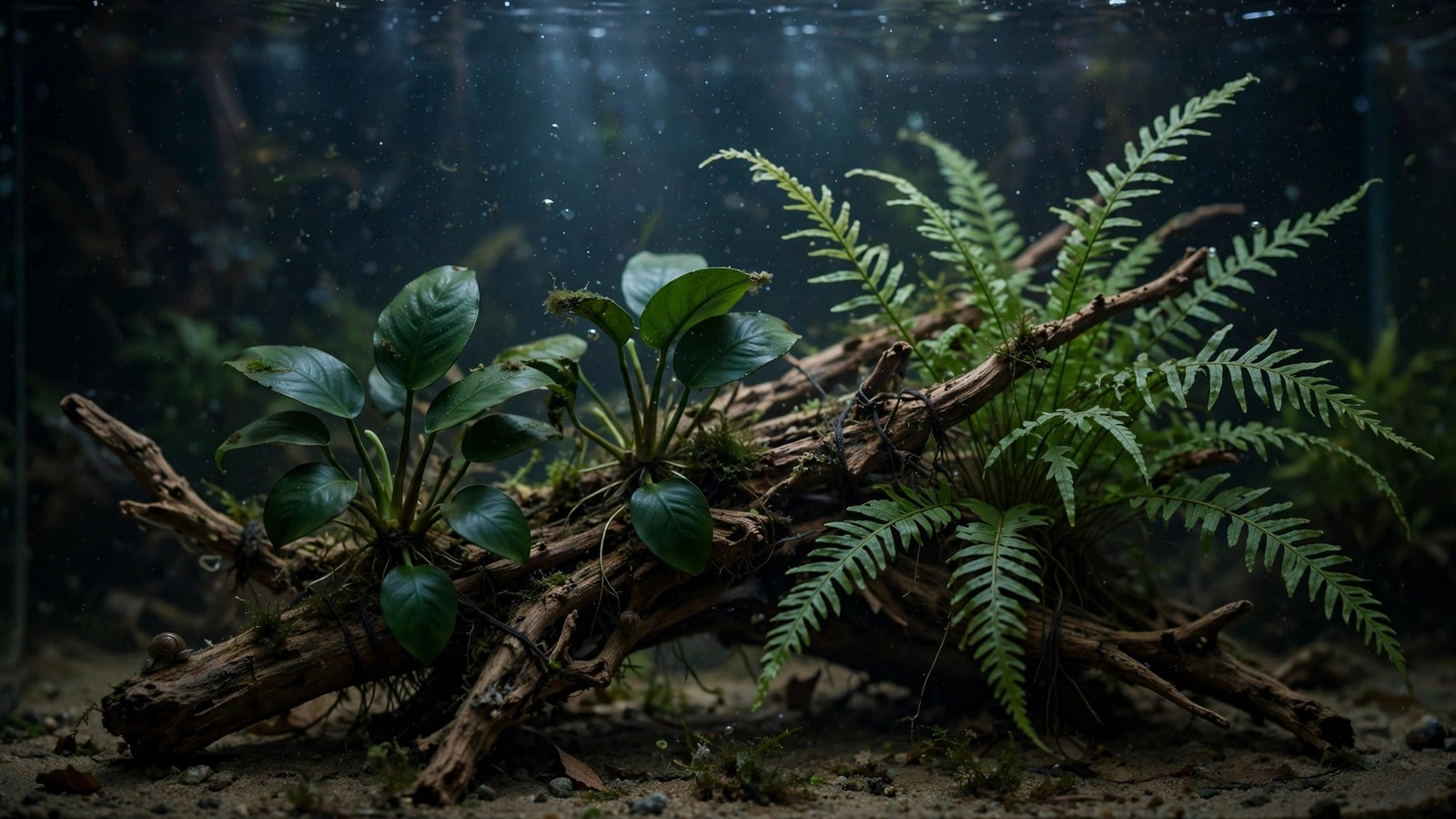
Most low-tech tank owners dose the label amount and watch their Anubias smother in green dust algae. So do low light plants need fertilizer? Yes — just far less than the bottle assumes. Low light means slow photosynthesis and slow nutrient uptake, so the standard dose is an overdose. Below: the dosing logic for low-light tanks, how little you actually need, and how to tell when you've crossed into algae territory.
If you're still dialing in your routine, start with our beginner aquarium plant fertilizer schedule, then apply the reduced-dose rules below to adapt it for low light.
Do Low Light Plants Need Fertilizer? The Short Answer
Yes. Low light only throttles the rate at which nutrients are consumed — a Java Fern under dim light still photosynthesizes daily, just building tissue far slower than under CO2 and high light. Without external nutrients, plants eventually stall, and leaves go pale or holey as the plant cannibalizes older foliage for mobile nutrients like nitrogen and potassium.
But a low-tech tank also gets a nutrient trickle from fish waste, uneaten food, and tap water — so your dosing should look nothing like the label. Learn how to dose all-in-one fertilizers correctly, then scale down using the rules below.
Why Low Light Changes the Dosing Math
Think of light as the accelerator pedal and fertilizer as fuel. In a high-tech tank the pedal is floored, so heavy dosing is required to keep up; in a low-light tank it's barely pressed, and nutrients that would be absorbed in 48 hours sit unused for a week — feeding algae, which photosynthesizes happily in light far dimmer than your plants can use. The core rule: dose to the demand, not to the label. If algae is already blooming, check the signs of over-fertilizing to confirm excess nutrients are the cause.
| Dosing parameter | Low-tech / low-light tank | High-tech / CO2 tank |
|---|---|---|
| Typical growth rate | New leaves weekly to monthly | New leaves every few days |
| All-in-one dose | 1/4–1/2 label rate, 1–2× per week | Full label rate, 3× per week (EI-style) |
| Root tabs | Every 3–6 months, fewer tabs | Every 2–3 months, full rate |
| Weekly water change | 20–30% (also resets nutrients) | 50% (resets EI accumulation) |
| Main dosing risk | Overdosing → algae | Underdosing → deficiencies |
| Iron/micros need | Lower; often monthly is enough | High; iron dosed separately |
The 1/4-Dose Rule: A Concrete Dosing Schedule
Take whatever the label says and cut it to one quarter, dosed once a week after your water change. For a 20-gallon tank labeled at 10 mL, that's roughly 2.5 mL weekly — small, but it matches the uptake of slow-growing epiphytes and crypts well. Watch for two weeks: pale new leaves or pinholes means nudging up to half dose or a second weekly dose; algae on leaves means stretching to every ten days. No universal number exists — fish load, plant mass, and tap water all shift it.
What to Dose in a Low-Tech Tank (and What to Skip)
Lean toward products formulated for low energy. NilocG Thrive C is genuinely well matched here — an all-in-one designed specifically for low-tech tanks, with lower nitrate and phosphate levels than the flagship Thrive formula, so it feeds plants without dumping more macros than slow growth can absorb. Dose it per the quarter-dose rule rather than the full label.
Seachem Flourish is another solid pick: primarily a micros and trace-element blend with very little macronutrient content, which suits a tank where fish waste already supplies nitrogen and phosphorus. See our roundup of the 6 best liquid fertilizers for aquarium plants for more low-tech-friendly options — and skip dry EI salts and "growth boosters" (the dry vs liquid comparison explains why) since photosynthesis here is capped by photons, not carbon. For rooted plants like Cryptocoryne and swords, a root tab every three to six months is often all they need — the liquid vs root tabs guide shows how to combine both without doubling up.
Deficiency vs Excess: Reading Your Plants
Always read new growth, not old leaves. Plants cannibalize mobile nutrients (nitrogen, potassium, magnesium) from old foliage when supplies run short, and slow growers do this visibly. If new leaves emerge green and healthy, your dosing is fine regardless of what the older leaves look like.
- Under-dosing: pale new leaves with darker veins (iron), pinholes in older leaves (potassium), or stalled, translucent new growth.
- Over-dosing: algae colonizing plant leaves faster than glass, hair algae on leaf edges, or green dust returning days after cleaning. Plants look fine; the tank looks dirty.
- The tell: algae winning? Cut nutrients first. Plants pale and algae absent? Feed more. Never increase fertilizer to "outgrow" algae — in low light, the algae will spend the extra nutrients first.
One honest exception: some bulletproof species — Java Fern, Anubias, and similar low-demand plants — can scrape by for months on fish waste alone. Fertilizer still makes them grow fuller, but they're the closest thing to "no" on this question. And be patient: low-light plants take longer to root, so don't read the first month's sluggish growth as a nutrient problem — give any dosing change three weeks before judging it.
Frequently Asked Questions
Can low-light plants survive with no fertilizer?
For a while, yes — especially slow-growing epiphytes like Anubias and Java Fern in a stocked tank, where fish waste supplies nitrogen and phosphates. But "survive" isn't "thrive": without supplemental iron and trace elements, growth stalls within months and new leaves come in pale or deformed. A quarter-dose of a lean all-in-one prevents this with almost zero algae risk, so dosing nothing at all rarely makes sense.
How much fertilizer does a low-tech tank need?
Start at one quarter of the label dose, once weekly after your water change — in a 20-gallon tank labeled at 10 mL, that's roughly 2.5 mL. Watch new growth for two to three weeks: pale new leaves or pinholes mean raising toward half dose or dosing twice weekly; algae on leaves means cutting back. Treat the label as a ceiling, not a target — fish load and tap water shift it.
Will fertilizer cause algae in a low-light tank?
Only if you overdose. Fertilizer itself doesn't cause algae — unused fertilizer does. In low light, plants absorb nutrients slowly, so a full label dose leaves a surplus that algae exploit. At quarter to half dose, nutrient levels stay matched to actual uptake and algae risk stays minimal. The most common real cause of algae in low-light tanks is over-dosing, not fertilizing at all.
Do Anubias and Java Fern need fertilizer?
They need very little. Both are slow-growing epiphytes that feed from the water column, and fish waste covers much of their macronutrient needs. A lean micro-nutrient dose — Seachem Flourish at quarter to half dose, or a low-tech all-in-one like NilocG Thrive C — covers the iron and traces fish waste can't supply. Skip heavy macro blends; they mostly feed the algae that loves to grow on Anubias leaves.
Should I dose less in a new low-light setup?
Yes — dose half your normal reduced amount for the first three to four weeks. Newly planted tanks hold stressed, not-yet-rooted plants that absorb almost nothing, while fresh substrate releases its own nutrient pulse. Combining full dosing with that startup pulse is a classic recipe for a first-month algae bloom. Wait for the first healthy new leaves, then bring dosing up to your normal reduced level.
Bottom Line: Feed the Growth Rate You Actually Have
Low-light plants need fertilizer — just at a fraction of what the bottle assumes. Start at a quarter dose weekly, read your new leaves for two or three weeks, adjusting one variable at a time. Master that feedback loop and your low-tech tank gets deep green growth without the algae tax. For deeper reading, the NilocG dosing guides and Tropica's plant nutrition articles are authoritative starting points.