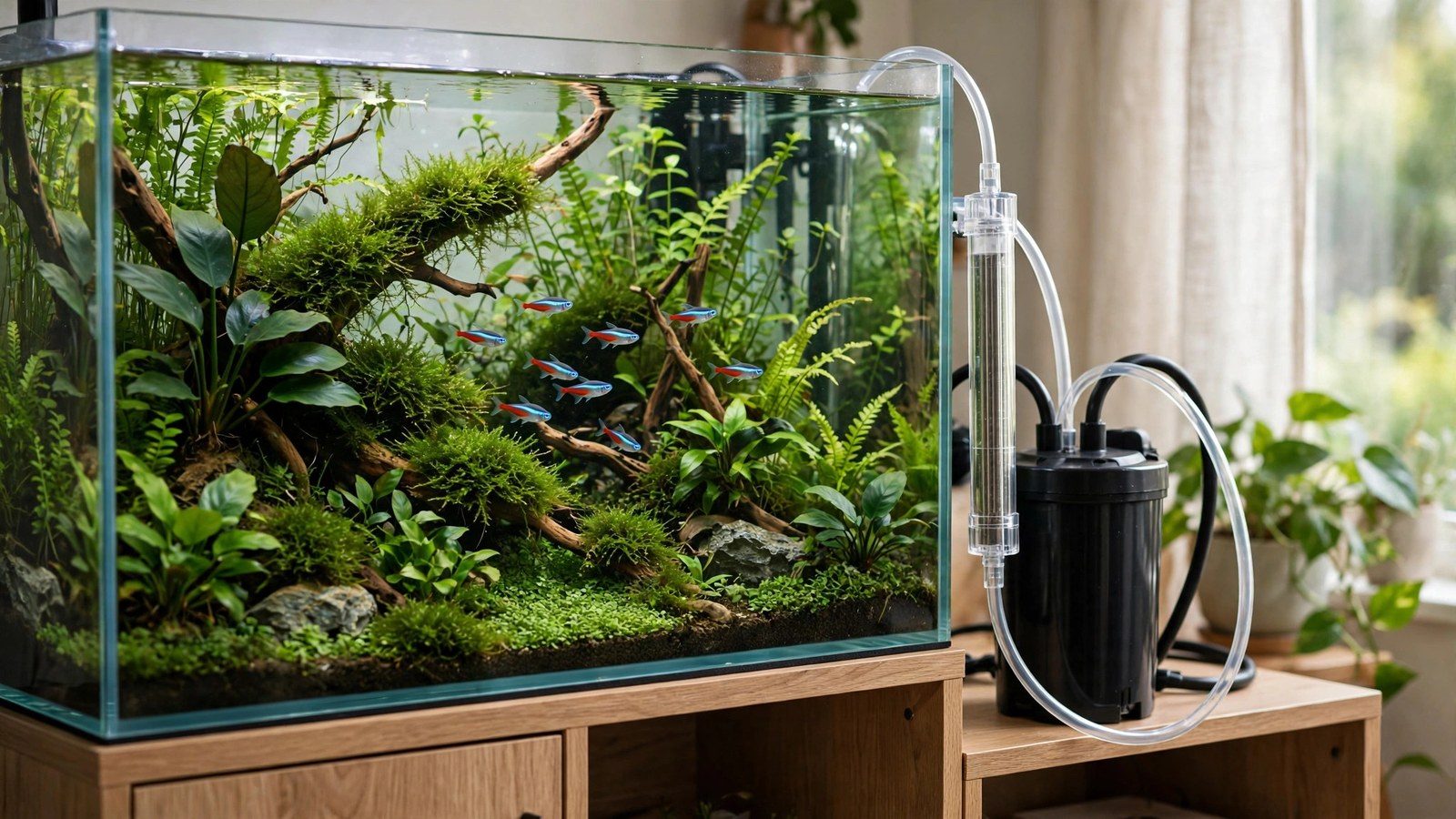
A heater glowing inside the display tank ruins the aquascape illusion — and leaves pressed against a hot glass tube can scorch. The inline heater planted tank approach moves heating into the canister filter's outflow hose, so warm water arrives already mixed with the filter's current. Below: which inline heaters are reliable, how to size one, where it goes on the return line, and why an external controller is worth it. Still weighing heater styles? See our guide to heater choices for planted tanks first.
Do inline heaters work for planted tanks? Yes. An inline heater such as the Hydor ETH connects into the canister filter's outflow tubing and heats water on its return, keeping the display equipment-free. Size from 1 watt per liter (roughly 3–5 watts per gallon), adjusted for cold rooms. The ETH line uses a self-limiting PTC element, commonly in 200 W and 300 W models with 12 mm or 16 mm fittings — confirm the current spec sheet before ordering.
What an inline heater actually is
A standard heater is a glass or titanium tube suction-cupped inside the tank. An inline heater is a sealed chamber with hose barbs on both ends: cut the canister's outflow tubing, join both ends to the heater, and filtered water warms as it passes through. The thermostat dial sits on the external body, outside the water.
Because heated water returns via the lily pipe or spray bar, heat distributes evenly instead of radiating from one corner. Most tropical aquarium plants grow best with stable temperatures, and an in-tank heater's localized hot spot can stress nearby stems.
Inline heater planted tank sizing rules
The standard starting point is 1 watt per liter (about 3–5 watts per US gallon), assuming a 20–22 °C room and a 24–26 °C target. In a cold room, step up one size so the heater runs shorter cycles instead of straining all day. Re-check sizing in your seasonal care adjustments as room temperatures drop.
| Tank volume | Rule-of-thumb | Practical inline pick |
|---|---|---|
| 60 L (15 gal) | ~60 W | 200 W ETH is oversized — fine with a controller |
| 120 L (30 gal) | ~120 W | 200 W ETH (retailers list it for 100–200 L) |
| 200 L (50 gal) | ~200 W | 200 W or 300 W ETH, room-dependent |
| 300 L (80 gal) | ~300 W | 300 W ETH (retailers list it for 200–300 L) |
Inline models usually start at 200 W, so small tanks end up oversized — acceptable, since an oversized heater with an accurate controller holds temperature more steadily than an undersized one running flat out. Treat these as starting points and check the manufacturer's spec sheet.
Hydor ETH vs Schego titanium: the two serious options
The Hydor ETH is the purpose-built inline heater: a self-limiting PTC element in a flow-through body, an external dial (typically 18–34 °C), a molded flow-direction arrow, and dry-run shutoff. It is the unit most aquascapers mean by "inline heater."
Schego makes titanium heating elements — rugged bare rods usually run in a sump or in-tank, sometimes in DIY inline housings. They suit sump systems and controller-driven redundancy, but are not a drop-in inline product like the ETH.
| Hydor ETH | Schego titanium | Standard in-tank | |
|---|---|---|---|
| Form | Inline body with hose barbs | Bare element; sump, in-tank, or DIY housing | Glass tube with suction cups |
| Wattages | 200 / 300 W (check spec sheet) | Various (check spec sheet) | 25–300 W |
| Thermostat | Built-in dial, ~18–34 °C | Model-dependent, often controller-driven | Built-in dial |
| Best for | Clean aquascape on canister outflow | Sump systems, backup heating | Budget, simple setups |
For a classic canister-filtered aquascape, the ETH is the straightforward pick. Read the Hydor ETH installation guidance before cutting any tubing.
The Hydor ETH is the article's named reference inline model for 100-200L tanks: Hydor ETH 200 ★3.8.
Plumbing order on the return line
The widely used order is: canister outflow → inline heater → inline CO2 atomizer → tank. The heater gets full steady flow for accurate readings; the atomizer goes last so dissolved CO2 travels the shortest distance with minimal off-gassing. Mount vertically, arrow toward the tank — trapped air can damage the element.
Match barb sizes with proper step-down adapters; never force tubing. Every device on the return line — heater, atomizer, inline UV sterilizer — adds slight restriction, so size the canister with headroom. Never plumb the heater into the filter's intake line.
Reliability, failure modes, and what actually goes wrong
Stuck-on (welded relay or thermostat) overheats the tank — the dangerous failure an external controller guards against. Stuck-off lets the tank drift to room temperature; temperature swings stress aquarium plants more than most keepers expect, stalling growth and melting sensitive species. Seal leaks at the hose barbs are the inline-specific risk: a slow drip can soak a cabinet floor over days, so check connections 24 hours after install, then monthly.
Weak canister flow makes water linger in the chamber and exit hotter, confusing the thermostat into short-cycling. Keep the filter maintained and the chamber air-free, and an inline heater behaves like any quality heater — just an invisible one.
Why an external controller is close to mandatory
A controller like the Inkbird ITC-308 sits between outlet and heater: its probe goes in the tank and it cuts power at the set temperature, independent of the heater's thermostat. With the heater's dial ~1 °C above the controller's target, the controller handles every cycle and the heater's thermostat only intervenes if the controller fails closed — two shutoffs, a digital readout, and high/low alarms.
It is the standard answer to the stuck-on failure mode and costs far less than a cooked tank. Check Inkbird's official ITC-308 page for current specifications before buying.
Inline vs in-tank: the honest trade-offs
| Inline heater | In-tank heater | |
|---|---|---|
| Display | Nothing visible | Tube, dial, and cable visible |
| Heat spread | Even — mixed into filter outflow | Localized hot spot |
| Leak points | Hose barbs outside the tank | None extra |
| Cost / service | Higher; stop filter to service | Lower; lift out any time |
| Fit | Needs canister filter or sump | Any tank |
Inline wins on aesthetics and even heating. In-tank wins on simplicity and cost — for low-tech planted tank setups without a canister filter, it is often the sensible choice.
Frequently Asked Questions
Can I use an inline heater with a hang-on-back filter?
Not practically. Inline heaters need a sealed, pressurized hose run, which hang-on-back filters don't provide. They are built for canister filters and sump returns. On a HOB-filtered tank, use a quality in-tank heater with an external controller instead for the same safety margin.
Should the inline heater go before or after the CO2 atomizer?
Before. The standard order is canister outflow, then inline heater, then inline CO2 atomizer, then tank. The heater gets steady flow for accurate readings, and the atomizer sits last so dissolved CO2 travels the shortest distance into the tank before entering the water column.
What size inline heater does a 60-liter planted tank need?
The 1-watt-per-liter rule suggests around 60 watts, but inline models usually start at 200 W. A 200 W unit is oversized for 60 liters, which is fine — set its thermostat slightly above an external controller's target and let the controller handle switching.
Is an external temperature controller really necessary?
Not strictly, but it is the cheapest insurance available. A controller like the Inkbird ITC-308 gives an independent shutoff if the heater's thermostat ever sticks on — the failure that cooks tanks. Set the heater's dial about 1 °C above the controller target.
The bottom line
An inline heater suits a canister-filtered planted tank that must look equipment-free and heat evenly: vertical in the outflow, sized from 1 watt per liter, atomizer downstream, controller in charge of switching. Check the spec sheet before ordering and inspect the barbs monthly.