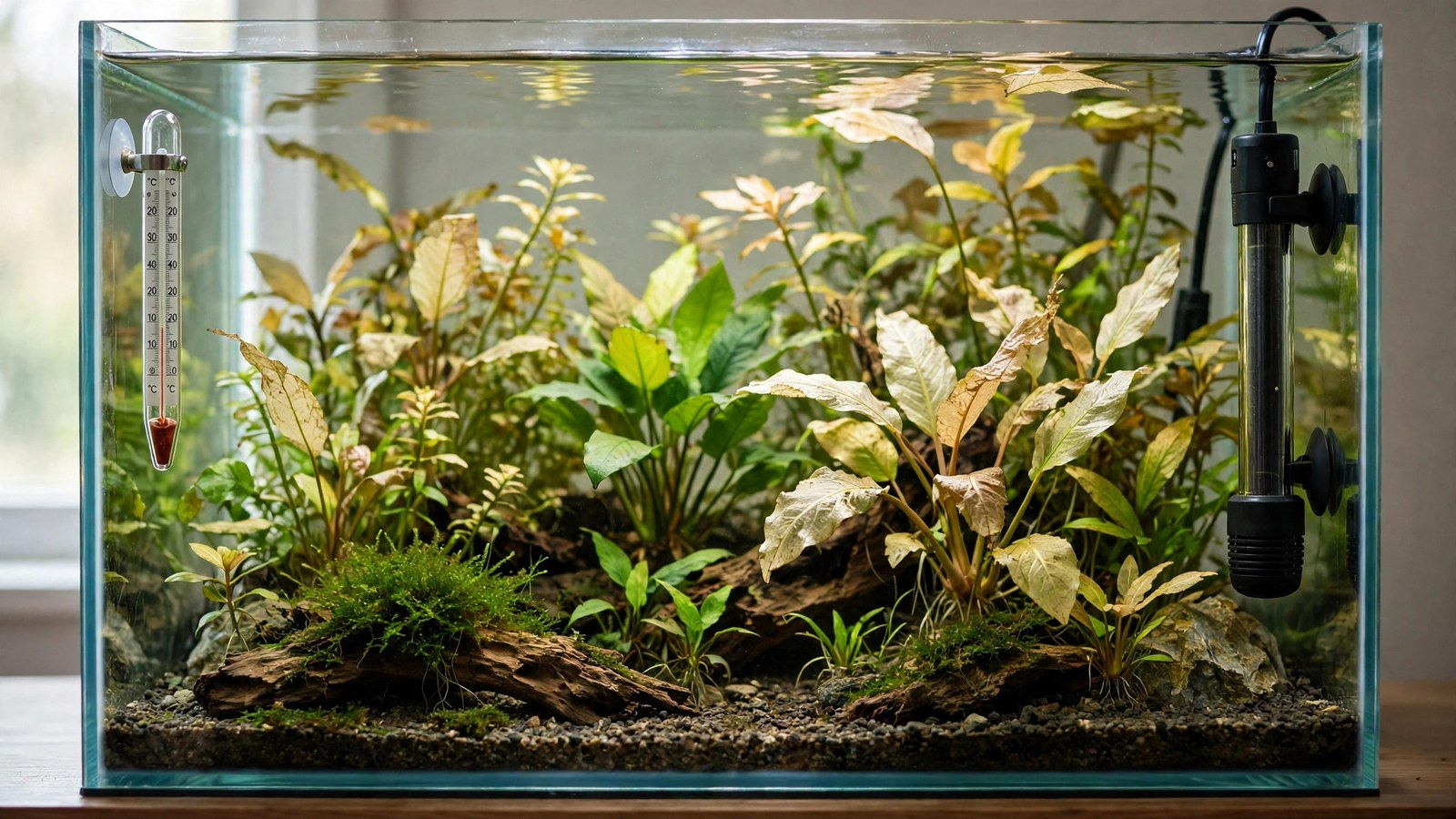
Plants don't feel temperature the way we do — they are temperature, metabolically speaking. Every enzyme driving photosynthesis, nutrient uptake, and growth runs at a speed set by the water around it. That's why temperature swings — not just wrong temperatures, but changing temperatures — stress aquarium plants in ways that a stable-but-imperfect temperature never does. A tank held steady at 80°F grows fine; a tank bouncing between 74°F and 82°F melts crypts and invites algae. Stability is the parameter.
Why Swings Hurt More Than Absolute Temperature
Most tropical aquarium plants tolerate a wide range — roughly 68–82°F (20–28°C) — if the temperature is stable. Within that range, plants adjust their enzyme systems to the prevailing temperature over days. A swing forces readjustment:
- Metabolic whiplash. Photosynthesis, respiration, and nutrient uptake all shift with temperature. A rapid swing desynchronizes these processes — the plant is photosynthesizing at one rate and respiring at another, wasting energy.
- Membrane stress. Cell membranes change fluidity with temperature. Rapid shifts damage membrane integrity, causing the translucent, "cooked" look of heat-shocked leaves or the limp collapse of cold-shocked ones.
- Oxygen disruption. Warm water holds less dissolved oxygen. A rapid warm swing can drop oxygen faster than plants and livestock adjust — the overnight oxygen crash after a hot day is a real killer in heavily planted tanks.
- CO2 solubility shifts. CO2 dissolves less readily in warm water. A temperature swing alters dissolved CO2 levels even with the bubble rate unchanged — a hidden fluctuation that triggers CO2-sensitive algae like BBA.
The practical threshold: swings under 2°F (1°C) in 24 hours are harmless; swings of 4°F+ (2°C+) stress plants; swings of 8°F+ (4°C+) can trigger melt events. Rate matters as much as magnitude — 4°F over a week is nothing; 4°F in an hour is a shock.
Common Causes of Temperature Swings
- Undersized or failing heaters. A heater too small for the tank cycles constantly, creating saw-tooth temperature graphs. A failing heater sticks on (overheating) or off (chilling) — both catastrophic. Heaters are the #1 swing source.
- Direct sunlight. A tank catching afternoon sun through a window can swing 6–10°F daily — hot afternoons, cool nights. See our seasonal care guide for the summer version of this problem.
- Room temperature swings. Tanks in rooms with aggressive AC cycling, near exterior doors, or in uninsulated spaces follow the room. Small tanks (<10 gallons) track room temperature within hours; large tanks buffer for much longer.
- Water changes with mismatched temperature. A 50% change with water 6°F colder than the tank is a temperature swing — instant, tank-wide. Our water change technique covers matching.
- Equipment heat. High-powered lights, especially older metal halides or enclosed LED fixtures sitting on the rim, heat the water during the photoperiod and let it cool overnight — a daily cycle.
- Power outages. No heater, no filter, no light — temperature drifts toward room temperature over hours. Duration determines severity.
- Seasonal transitions. The first cold snap after summer, or the first heat wave after spring, catches heaters/fans unprepared. Our seasonal guide covers the anticipatory fixes.
Recognizing Temperature Stress in Plants
Heat stress (too warm, or warmed too fast)
- Leaves turn translucent and limp — the "cooked" look, especially in crypts and fine stems
- Accelerated melting beyond normal transition melt
- Increased algae (warm water accelerates everything, including algae)
- Plants "shutting down" — growth stalls despite good light and nutrients
- Morning fish gasping (overnight oxygen depletion in warm water)
Cold stress (too cool, or cooled too fast)
- Growth slows dramatically or stops — tropical plants below ~65°F (18°C) essentially hibernate
- Leaves darken, then melt from the edges inward
- Crypt melt — crypts are famously cold-shock sensitive; a sudden chill melts them reliably
- Increased susceptibility to everything else — cold-stressed plants get algae, fungus, and deficiencies more easily
The swing signature
What distinguishes swing damage from steady-wrong-temperature damage: it correlates with events. Melt starting the day after a cold water change, algae blooming the week the AC started cycling, crypts collapsing after a sunny afternoon — the timing tells the story. If problems track events rather than persisting steadily, suspect swings.
Prevention: Building Temperature Stability
Heater strategy
- Size correctly: ~3–5 watts per gallon (more for cold rooms or large tanks). An undersized heater working at 100% constantly has no headroom and cycles harshly.
- Use a separate temperature controller (Inkbird-style, ~$35) as a failsafe — it cuts power if the heater's internal thermostat sticks on. Heater-stuck-on is the most common catastrophic failure; a $35 controller prevents it.
- Two smaller heaters > one big one for tanks 40+ gallons — redundancy plus more even heat distribution. If one fails off, the other holds; if one sticks on, it's only half the wattage cooking the tank.
- Replace heaters every 2–3 years proactively. They're cheap; tank crashes aren't. Our seasonal guide recommends pre-winter replacement.
Placement and insulation
- Keep tanks away from windows (sun + drafts), exterior doors, and HVAC vents — the three swing generators.
- Larger tanks are inherently more stable — thermal mass resists change. Nano tanks need more careful placement because they track the room.
- A lid reduces evaporative cooling (which swings temperature as room humidity changes) and insulates slightly. Open-top tanks look great but are thermally volatile.
- In unheated rooms, foam insulation board on the back and sides of the tank measurably stabilizes temperature.
Water change discipline
- Match replacement water within 2°F (1°C) — non-negotiable, per our water change guide.
- For large changes (50%+), consider splitting into two smaller changes hours apart rather than one big thermal event.
Responding to a Temperature Emergency
Overheating (heat wave, stuck heater)
- Unplug the heater immediately if it's the cause. Verify with a thermometer — don't trust the heater's dial.
- Float frozen water bottles — rotate 2–3 through the tank. This buys 2–4°F of cooling. Don't dump ice directly (localized freezing shocks).
- Maximize evaporation: fan across the surface, lid off. Evaporative cooling is surprisingly effective.
- Reduce light to 6 hours or off for a day — the fixture adds heat and stressed plants can't use the light anyway.
- Increase surface agitation — warm water's oxygen problem is the acute danger. Air stone on full.
- Cool gradually. Dropping 10°F in an hour trades heat shock for cold shock. Aim for 2–3°F per hour maximum.
Chilling (heater failure, power outage, cold snap)
- Insulate: blankets/towels around the tank slow heat loss dramatically. Cover the top (leave a small air gap).
- Warm water bottles (not boiling — hot tap water in sealed bottles) floated in the tank add heat gently.
- Don't do a water change with cold tap water "to help" — it makes things worse.
- When power returns: let the heater bring temperature up gradually. Don't crank it to maximum — 2–3°F per hour.
- Expect some melt in the following week, especially crypts. Remove dead material, keep conditions stable, wait for regrowth.
Long-Term: Choosing Plants for Your Thermal Reality
If your situation guarantees some temperature variability (unheated room, hot climate, frequent travel — see our vacation guide), choose plants with wide thermal tolerance:
- Very tolerant: anubias, java fern, java moss, hornwort, guppy grass, duckweed — survive remarkable abuse.
- Moderately tolerant: most hygrophila, bacopa, ludwigia repens, vallisneria, Amazon swords — handle normal household variation fine.
- Sensitive: many crypts (melt at swings), HC Cuba and delicate carpets, high-end rotala variants, bucephalandra (expensive and fussy — a bad combination for unstable temps).
Matching plants to your thermal reality isn't settling — it's the same principle as matching plants to your light. The right plant in the right conditions always outperforms the "better" plant fighting its environment.
Frequently Asked Questions
What's the ideal temperature for a planted tank?
74–78°F (23–26°C) suits the vast majority of tropical aquarium plants and community fish. Cooler (70–74°F) favors mosses, crypts, and cold-water species; warmer (78–82°F) suits discus tanks and heat-lovers. But the ideal stable temperature beats the ideal number — a steady 80°F grows better plants than a swinging 74–80°F.
Will a 3°F swing kill my plants?
No — 3°F over the course of a day is within normal tolerance for established plants. The concern starts at 4–5°F rapid swings (melt risk in sensitive species) and becomes serious at 8°F+ (genuine shock). Gradual seasonal drift of even 5–8°F over weeks is harmless — it's the rate that matters. Don't panic over normal day/night variation of a degree or two.
Do I need a heater if my room stays 72°F?
Probably yes, as a stabilizer rather than a heater. Room temperature fluctuates (night setback, weather, AC), and the heater's job is holding the line against those fluctuations, not raising the baseline much. A heater set to 74°F in a 72°F room barely runs — but it prevents the 3 AM dip to 68°F that melts your crypts. The controller-plus-heater combo is cheap insurance.
Can temperature swings cause algae directly?
Indirectly but reliably. Swings stress plants (weakening their competitive edge), alter CO2 solubility (fluctuating carbon triggers BBA and staghorn), and disrupt oxygen levels — all of which favor algae. A tank with mysterious recurring algae and a heater that's audibly clicking on/off all day has a temperature story worth investigating. Stable temperature is unglamorous algae prevention.
My power went out for 12 hours — what should I do now?
First, don't panic — 12 hours is survivable for most setups. Insulate the tank (blankets), don't feed, and when power returns, verify all equipment restarts (filters often need repriming, heaters need checking). Do a 25–30% water change within a day (waste accumulated without filtration), remove any melt over the following week, and watch for a mini-cycle (test ammonia for a few days — the biofilter may have weakened). Most tanks bounce back fully within 2 weeks.
Stability Is the Parameter
The temperature lesson distills to one sentence: pick a reasonable number and hold it. Size the heater right, back it with a controller, place the tank away from swing generators, match water change temperatures, and respond to emergencies gradually. Plants forgive a degree too warm or a degree too cool indefinitely — what they never forgive is the rollercoaster. Give them flat road and they'll grow like it.