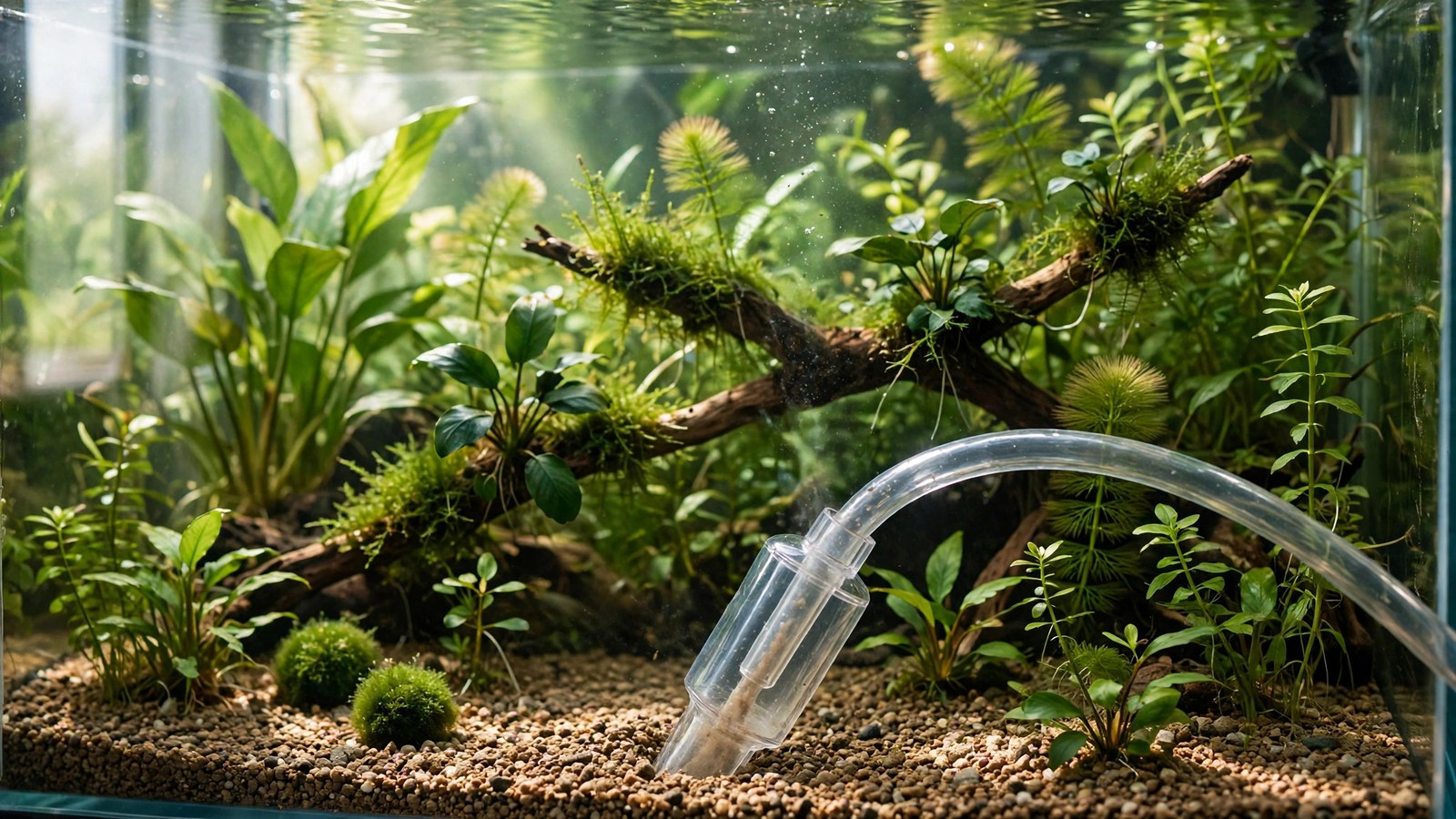
Every planted tank keeper has watched it happen: you push a vacuum into the substrate, the siphon catches, and a carpet of Monte Carlo floats up like a green rug. Picking the best substrate vacuum for planted tank maintenance isn't about suction power — it's about control. The right tool lifts waste off the surface without tearing roots or crumbling aquasoil.
Before choosing hardware, learn the motion — our guide on gravel vacuuming a planted tank without uprooting plants pairs with this one.
How to vacuum a planted tank without uprooting plants
Forget the fish-only method of stabbing the tube deep into the gravel and churning — in a planted tank that severs roots and clouds the water for hours. Instead, hover-don't-plunge: hold the tube half an inch above the substrate and let suction lift loose waste while heavier grains fall back out. Need more bite? Crimp the hose with your free hand to throttle flow until you find the sweet spot — enough suction for detritus, not enough for grains or roots.
Know the difference between mulm and detritus. Mulm, the brown sludge between plants, is partly digested matter your roots feed on. Detritus in open, unplanted zones rots into nitrates — that's what you vacuum. Clean the open areas weekly and leave planted-zone mulm alone. Pair it with removing dead plant leaves by hand, which lifts the biggest source of new waste before it sinks.
Substrate compatibility: sand vs gravel vs aquasoil
Each substrate behaves differently under suction. Sand traps waste on the surface — easy to clean, but light grains climb the tube, so use a narrow tube, hover close, and never plunge (churning buried sand releases anaerobic pockets). Gravel is the most forgiving: waste falls between the stones and a wide-mouth tube can plunge into open gravel, though you should still hover around roots.
Aquasoil (ADA Amazonia, Fluval Stratum, UNS Controsoil) is the delicate one. These baked-soil granules are soft, nutrient-rich, and crumble under mechanical stress — plunging breaks them into mud that clouds water and degrades the soil early. Hover only, always. If you're still choosing, read our guides to the best substrate for planted tanks and the best aquasoils for planted tanks first — maintenance burden differs more than most expect.
How to choose the best substrate vacuum for planted tank maintenance
Match the vacuum to your substrate first, your tank size second, and your patience with buckets third.
| Pick | Best for | Type | Tube | Why |
|---|---|---|---|---|
| Python Pro-Clean siphon | Gravel tanks | Manual | 10–20 in. | Precise hand control of suction |
| Fluval gravel vacuum (small) | Sand tanks | Manual | ~12 in. narrow | Thumb valve, gentle on sand |
| Hygger electric cleaner | Convenience / deep tanks | Electric | Extendable | Adjustable flow, no bucket |
| Laifoo battery vacuum | Nano tanks | Battery | 2 in. mini | Fits between plants |
| Aqueon mini siphon | Small tanks / budgets | Manual | 1–1.5 in. | Cheap, easy to crimp |
Python Pro-Clean — best for gravel planted tanks
The Python Pro-Clean is the hobby standard: a simple tube-and-hose siphon with no motor to fail. The medium tube (extension options fit tall tanks) cleans open gravel zones fast, and since suction comes from gravity, you control it precisely by crimping the hose. Tradeoff: no flow valve on the base model, so beginners can blast loose carpeting until they learn the crimp.
Fluval gravel vacuum (small) — best for sand
Sand is where the small Fluval earns its keep. The narrow tube limits how much substrate can climb, and the thumb-operated valve lets you feather suction right at the sand surface. Tradeoff: a narrow tube cleans large tanks slowly, and the plastic valve needs gentle handling.
Hygger electric gravel cleaner — best electric option
The Hygger's appeal: no priming, no buckets, no siphoning. Water circulates through a filter bag and returns to the tank, and the adjustable flow head is the key feature — dial it down near aquasoil or carpet plants. Tradeoffs: bulky in densely planted nano tanks, and the filter bag clogs quickly in dirty tanks (rinse it mid-job). Worth it when buckets become the bottleneck.
Laifoo battery vacuum — best for nano planted tanks
In nano tanks (under 10 gallons) a standard siphon drains the tank in seconds. The Laifoo's 2-inch mini tube and battery pump reach planted corners without relocating the scape, and the filter cartridge returns water to the tank. Caveats: battery models move less water than gravity siphons, and cartridges clog and need replacing.
Aqueon siphon vacuum (mini) — best budget pick
Sometimes the honest answer is the cheapest one. The Aqueon mini costs less than a bag of fish food and works fine in small planted tanks — its thin hose is easy to crimp for fine suction control. It clogs faster in heavy waste and you'll empty a small bucket more often. But in a 10-gallon planted tank with weekly cleaning, it does 90% of what expensive options do.
How often should you vacuum a planted tank?
Open substrate zones — the foreground path, around hardscape, anywhere unplanted — get a surface vacuum every 1–2 weeks during your water change, matching Algone's recommended aquarium maintenance schedule. Planted zones get hovered only when waste visibly collects on the carpet; dense plant forests can go a month or more. In new tanks (first 6–8 weeks), vacuum even less — the substrate is still cycling and plants are still rooting. This echoes what Aquarium Science's maintenance analysis argues: lightly stocked, plant-heavy tanks generate less waste, so the vacuum's job shrinks to surface tidying. Combine light vacuuming with trimming — trimming carpeting plants floats clippings that one hover pass cleans up.
Frequently Asked Questions
Do I even need to vacuum a planted tank?
Not in the fish-only sense. Plants consume fish waste as fertilizer, so planted tanks need far less vacuuming. But open areas still collect detritus that rots into nitrates and feeds algae. A light surface pass every week or two on unplanted zones keeps water clear while the root-zone ecosystem stays intact.
Can I vacuum aquasoil without destroying it?
Yes, if you hover and never plunge. Aquasoil granules crumble under mechanical stress, so keep the tube mouth at least half an inch above the surface and use just enough suction to lift loose waste. Crimp the hose to dial the flow down — heavy carpet rooting actually protects the soil while you hover above the leaves.
Why does my sand keep disappearing into the siphon?
Too much flow, too wide a tube, or holding the tube too close. Switch to a narrow-bore tube (around 1 inch), keep a full inch of clearance, and pinch the hose. Sand grains should tumble briefly and fall back out while waste rises past them. A thumb-operated flow valve makes this much easier to dial in.
How do I vacuum around delicate carpeting plants?
Use your smallest tube, reduce flow to a gentle pull, and hover over the carpet canopy without touching it. A slow swirling motion lifts trapped waste while the root mat holds plants down. Never push the tube into the carpet — Monte Carlo and hairgrass tear loose as a sheet. Replant any lifted patch immediately; carpets usually recover within a week.
Keep it gentle and your plants will thank you
The right vacuum for a planted tank is the one that lets you clean with finesse, not force. Start with a simple manual siphon matched to your substrate — narrow for sand, wide for gravel — and spend on electric power only when buckets become the bottleneck. A lightly vacuumed, lightly mulched substrate grows better plants than a sterilized one. If plants still struggle, see our guide to reviving dying aquarium plants — the problem is usually nutrients or light, not dirt.