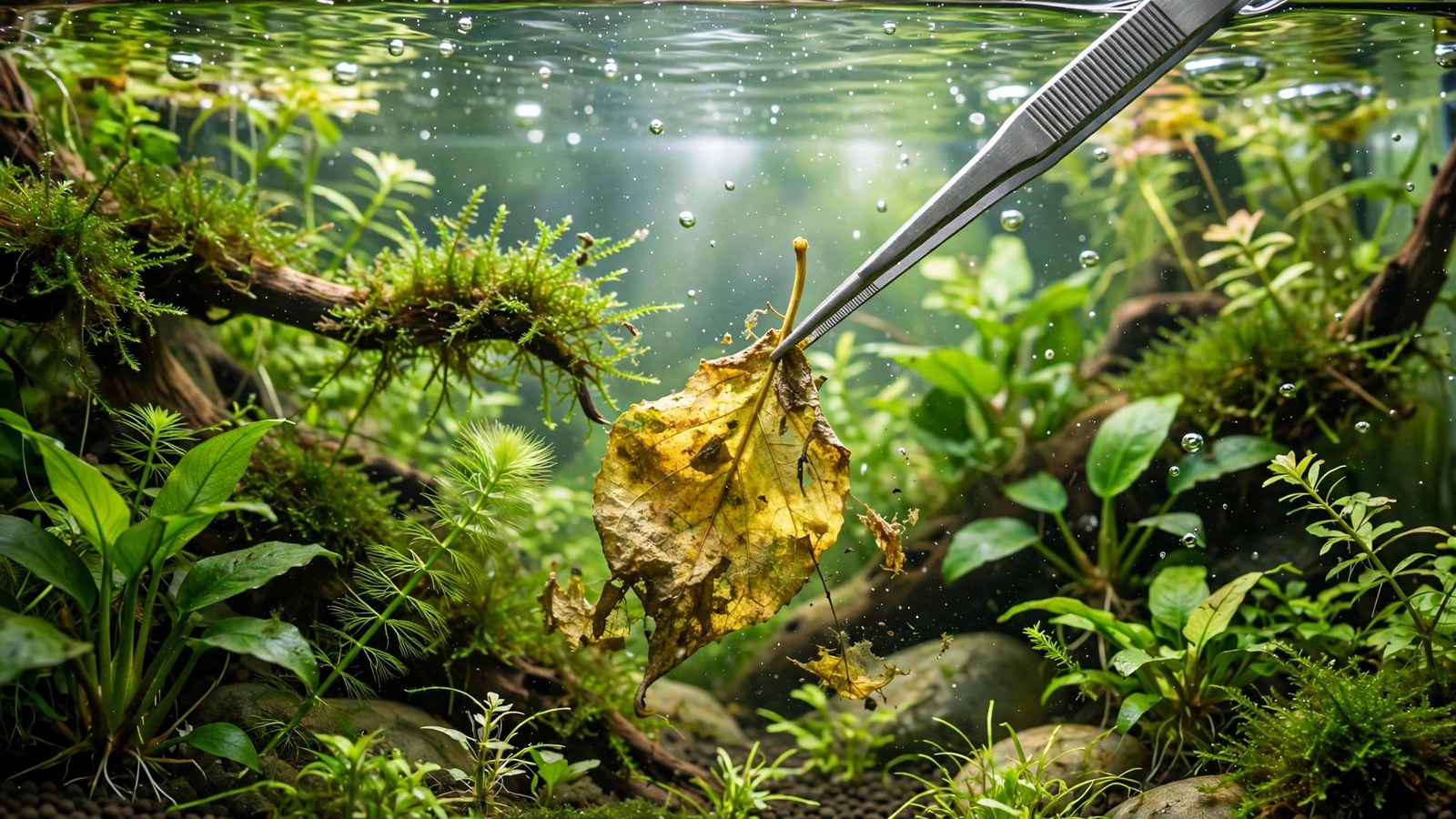
It's the least glamorous job in the hobby and one of the most impactful: removing dead plant leaves. A melting leaf left in the tank doesn't just look bad — it rots, releases ammonia, grows fungus that spreads to healthy tissue, shades the growth below it, and hands algae a perfect colonization surface. Five focused minutes a week with tweezers prevents all of that. This is the complete guide to the habit: what to remove, what to leave, the technique, and the tools.
Why Dead Leaves Can't Stay
A dying leaf is a liability in four ways:
- Ammonia release. Decaying plant matter produces ammonia just like decaying food or waste. A few leaves are trivial; a tank-wide melt left to rot can measurably spike ammonia — in a new tank, enough to stall the cycle.
- Fungal spread. The white fuzz on rotting leaves is saprophytic fungus. It's mostly harmless to healthy tissue, but it can colonize stressed or damaged neighboring leaves, turning one dead leaf into three.
- Algae substrate. Algae colonizes dying leaves first — their weakened surfaces leak nutrients that algae loves. Every dead leaf left in place is an algae nursery. (See cleaning algae off leaves for what happens when you don't.)
- Light theft. A dead leaf hanging over healthy growth shades it for zero benefit. The plant already abandoned that leaf — it's not photosynthesizing, just blocking light from leaves that are.
The plant has already written the leaf off — it's withdrawing mobile nutrients (nitrogen, potassium, magnesium) from it to feed new growth, which is why dying leaves yellow first. You're not "hurting" the plant by removing a leaf it's already abandoning. You're doing its janitorial work.
What to Remove vs. What to Leave
Remove now
- Mushy or translucent leaves — fully dead, decomposing. These come out immediately, always.
- Leaves more than half yellowed or browned — the plant has extracted what it can; the remainder is just decay in progress.
- Leaves with heavy algae that won't clean off — if cleaning failed, the leaf is a lost cause taking up space.
- Melted emersed leaves on new plants — during acclimation, remove dissolving emersed foliage promptly so it doesn't foul the tank while replacements grow.
- Detached floaters — any dead leaf drifting around or caught in the filter intake. Check pre-filter sponges weekly; a clogged intake from dead leaves silently kills flow.
Leave alone (for now)
- Slightly yellowing tips on old leaves — the plant is still extracting nutrients. Removing too early robs the plant of recycled nutrition. Wait until it's clearly more than half gone.
- A single yellow leaf on an otherwise thriving plant — normal senescence, not a crisis. Remove it during the weekly routine, not as an emergency.
- New growth that looks pale — that's not a dead leaf, that's a deficiency symptom or new-leaf coloration. Removing it removes the diagnostic evidence and the plant's future. Diagnose first (see our iron guide and potassium guide).
- Ugly-but-alive leaves on a recovering plant — a crypt regrowing after melt needs every photosynthesizing leaf it has, even ratty ones. Don't strip a recovering plant bare; remove the worst offenders and let the rest fuel recovery.
The judgment call: if the leaf is still more than half green and firm, it stays; if it's more than half gone, soft, or mushy, it goes. When uncertain, wait a week — a truly dead leaf will make the decision obvious soon enough.
Technique: How to Remove Leaves Without Damaging the Plant
Stem plants
Pinch the dead leaf at its base where it meets the stem and pull gently sideways — dead leaves detach easily. If a leaf resists, it's not dead enough; leave it. For a heavily affected stem section, trim the whole stem above the damage per our trimming guide rather than picking it leaf by leaf.
Rosette plants (swords, crypts, vallisneria)
Trace the dead leaf down to the crown and pull from the very base with tweezers, using a gentle twisting motion. Rosette leaves detach cleanly at the crown when truly dead. Never yank from mid-leaf — you'll tear the leaf and leave a rotting stub at the crown, which is worse than the original leaf. If the base resists, cut it flush at the crown with scissors instead of pulling.
Rhizome plants (anubias, java fern, bucephalandra)
Cut dead leaves at the rhizome with scissors — don't pull. Pulling risks tearing the rhizome itself, and rhizome damage can kill the whole plant. Cut cleanly at the leaf stem's base, leaving no stub to rot.
Carpeting plants
The fiddliest case. Use fine tweezers to pluck dead blades from dwarf hairgrass or micro sword carpets — work in small sections. For widespread carpet melt, sometimes the fastest fix is trimming the whole carpet short (it regrows from the base) rather than plucking hundreds of blades. Siphon up everything you dislodge.
Floating plants
Scoop dead floaters with a net — they decompose fast on the surface and rain detritus down. Thin aggressively while you're at it; see managing floating plants.
Tools That Make It Painless
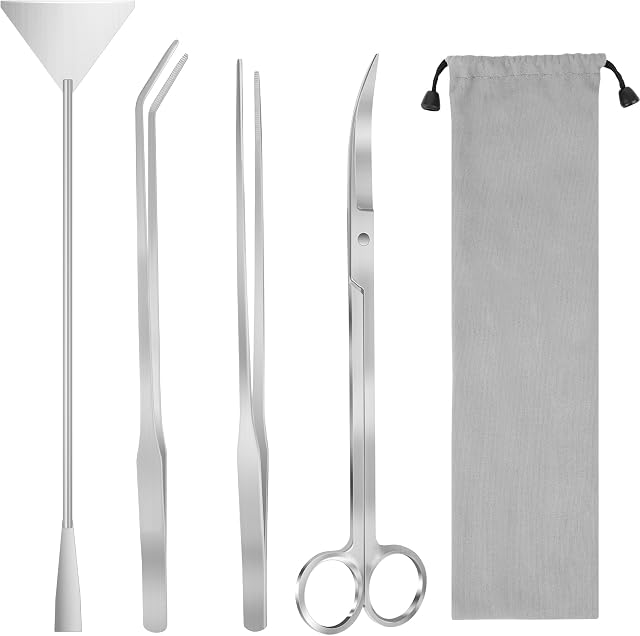
- Long aquascaping tweezers (12-inch): The essential tool. Reaches the back of the tank without submerging your arm, grips precisely, pulls cleanly. Straight tips for general use; curved tips for tight spots.
- Spring scissors: For cutting at crowns and rhizomes where pulling is risky. The spring action is effortless for repetitive snipping.
- A small net: For scooping floaters and catching leaves that escape the tweezers mid-removal.
- A turkey baster or large pipette: Blast detritus out of dense plant bases and suck it up — dead leaf fragments collect in crowns and crotches where tweezers can't reach.
Keep these in a caddy at the tank. The habit lives or dies on friction — if the tweezers are in a drawer across the room, the dead leaves stay in the tank.
Fine-tipped tweezers lift dead leaves without tearing healthy tissue — the kit covers every tool in this section: aquascaping tool kit.
 ★4.7
Liveek 4-in-1 Aquascaping Tool Kit
Check Price on Amazon ★4.7When Dead Leaves Signal Something Bigger
A few dead leaves weekly is normal senescence — plants constantly retire old foliage. But patterns deserve investigation:
- Sudden mass leaf loss: Think recent changes — new fertilizer dose, CO2 adjustment, temperature swing, new livestock, medication. See temperature swings and CO2 acclimation.
- One species melting while others thrive: Usually that species' specific need isn't met (or it's still in transplant melt). Not a tank-wide problem.
- Old leaves dying faster than new growth replaces them: The plant is in net decline — a mobile-nutrient deficiency (nitrogen, potassium, magnesium). Check your fertilizer program; the potassium guide's pinhole test is the quickest diagnostic.
- New growth dying: Not senescence — something acute. Test ammonia/nitrite immediately, check for medication or contaminant exposure, verify CO2 isn't overdosed.
Normal background leaf death: a few leaves per week across the whole tank, oldest leaves first, steady new growth replacing them. Anything dramatically beyond that is the tank telling you something — listen.
Frequently Asked Questions
Can I leave dead leaves for shrimp and snails to eat?
Partially. Shrimp and snails do graze decaying leaves, and a small amount of leaf litter is natural and beneficial (biofilm grows on it). But cleanup crews can't keep up with heavy melt, and they don't prevent the ammonia release or fungal issues. Let them handle the occasional leaf; you handle the rest. Don't use "the shrimp will eat it" as an excuse to skip the weekly once-over.
Should I remove yellowing leaves or wait until they're brown?
Wait until they're more than half gone. A yellowing leaf is still exporting nutrients back to the plant — removing it early wastes that recycling. The exception is leaves yellowing from algae or damage rather than natural senescence; those aren't recycling usefully and can come out sooner. Judge by texture too: firm and yellowing = still working; soft and yellowing = done.
Do dead leaves really cause ammonia spikes?
A few don't. But scale matters: a tank-wide crypt melt with fifty rotting leaves absolutely can — decaying plant matter is nitrogen-rich, and in a new or heavily stocked tank the bacterial filter may not absorb the pulse. This is why prompt removal during melt events (new plants, rescapes, parameter swings) matters more than the routine weekly tidying. When in doubt, remove more.
What's the white fuzz on dead leaves?
Saprophytic fungus or water mold feeding on the decaying tissue — normal decomposition, not a plant disease. It's harmless to healthy leaves but unsightly, and it can spread to already-stressed tissue. Remove fuzzy leaves promptly. If fuzz appears on healthy leaves, that's unusual and worth investigating (usually indicates the leaf was damaged first).
How do I clean dead leaves out of a dense carpet without wrecking it?
Two methods: for light debris, hover a siphon just above the carpet during a water change — the flow lifts loose dead blades without uprooting runners. For embedded dead material, use fine tweezers and accept it's slow work, or trim the carpet short (down to ~1 inch) and let it regrow — faster than plucking, and carpets bounce back vigorously from a hard trim.
Five Minutes, Every Week
Fold dead-leaf removal into your weekly routine — tweezers in hand, a slow lap around the tank, out come the goners. It's unglamorous, it's repetitive, and it's one of the highest-return habits in the hobby. The tanks that always look pristine aren't the ones with the most expensive gear; they're the ones where somebody spends five minutes a week doing the janitorial work.