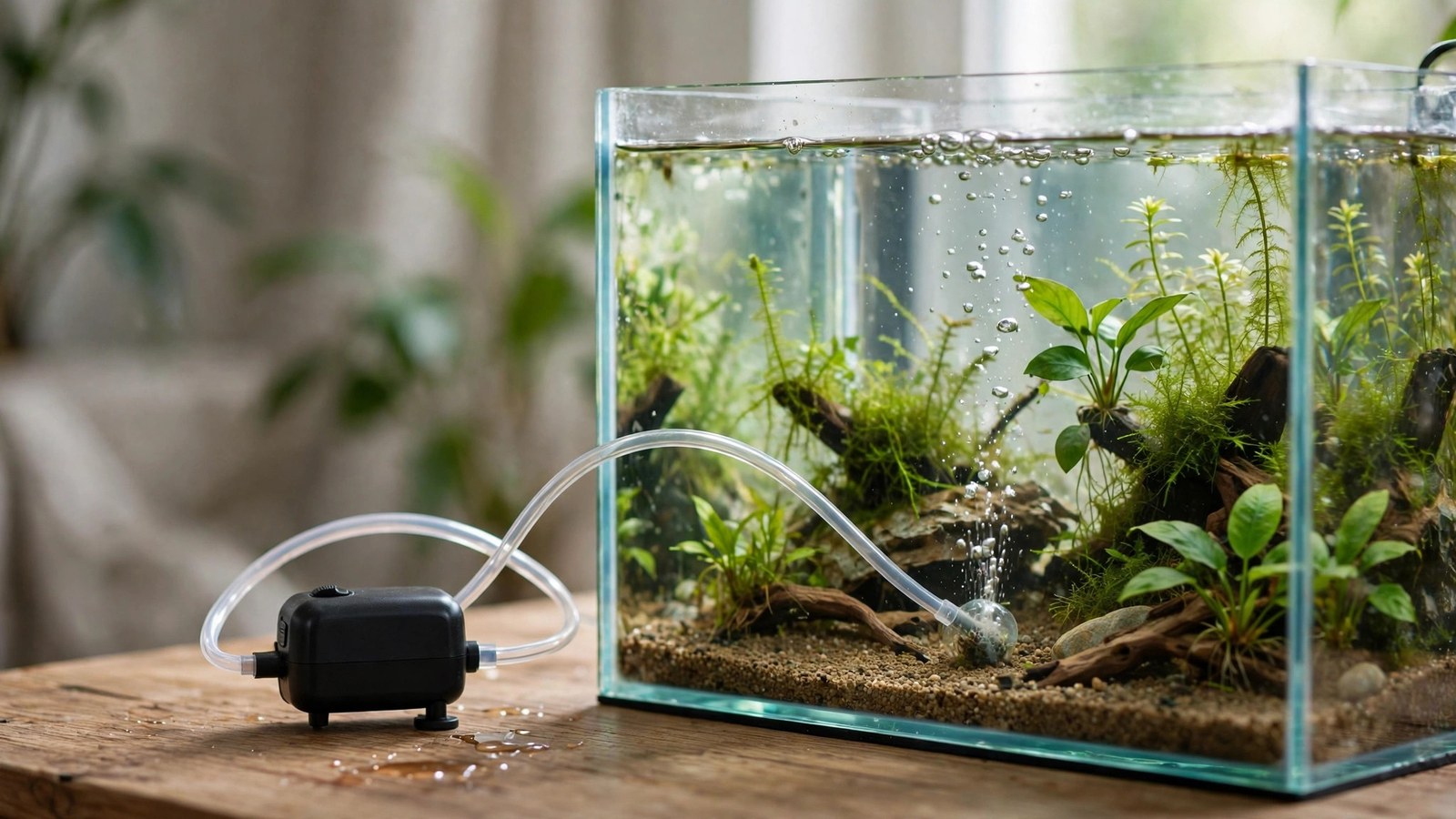
It's 2 a.m., your planted tank sits three feet from your pillow, and the air pump hums like a refrigerator that never sleeps. Most of us buy a pump for its price tag and regret it for its noise profile. Finding the best quiet air pump for aquarium use isn't about the word "silent" on the box — it's about matching the right pump to your room, your tank depth, and your plants.
One twist beginners miss: plants consume oxygen at night, when photosynthesis stops. And whether planted tanks need an air stone depends on stocking, surface agitation, and CO2 setup. Start the decision there, not in the checkout cart.
How We Chose the Best Quiet Air Pump for Aquarium Setups
Packaging noise claims are nearly useless — manufacturers test under ideal conditions that match nobody's bedroom. We ranked pumps the way an experienced hobbyist would: motor vibration (does hum transfer into the stand?), adjustability (can you dial airflow down so bubbles stop rattling?), pressure at depth (tall tanks need real diaphragm power), and planted-tank fit (it shouldn't blast CO2 out at noon).
One honest caveat: "quiet" means quiet in context. A pump whispering on a foam pad at one meter becomes a drone bolted to a hollow wooden stand. Every pick below earned its spot through long-term hobbyist consensus — not marketing copy.
The 5 Quietest Picks, One by One
Each pick owns one scenario.
| Pick | Best for | Outlets | Standout feature | Watch out for |
|---|---|---|---|---|
| Tetra Whisper | Bedrooms | 1–2 (by size) | Sound-dampening dome, suspended motor | Louder on hard surfaces |
| Aquarium Co-Op | Power cuts | 1–2 | Built-in battery, 43.5 dB rated | Needs recharging discipline |
| Fluval Q series | Deep tanks | 2 (Q2) | High-pressure diaphragm output | Low hum under heavy load |
| Aqueon QuietFlow | Value buyers | 1 | Compact, rubber feet | Mid-pack noise in deep water |
| Hygger mini | Nano / desk tanks | 1 | USB-powered, tiny | Too weak for tall tanks |
1. Tetra Whisper — best for bedrooms
The Whisper is the classic answer for a reason: the domed housing and sound-dampening chambers take the edge off motor buzz, and rubber feet plus a wide footprint stop it skittering across the stand. Buy the smallest size your tank needs — an oversized Whisper defeats its own design. Pros: proven, cheap parts, sizes from nano to 100 gallons. Cons: hums on hard wood or glass; included tubing and check valves are basic.
2. Aquarium Co-Op Air Pump with Battery Backup — best for power cuts
This is the one to buy if outages worry you. It runs on USB-C and switches automatically to its built-in lithium battery when the mains die — about 20 hours continuous, up to 40 in power-save mode (15 seconds on, 15 off). Rated at 43.5 dB, with the bubbles usually louder than the motor. Five flow levels quiet the bubble stream itself. Pros: automatic backup, strong deep-tank pressure, adjustable. Cons: pricier than basic pumps; a dead battery helps nobody, so keep it plugged in. Specs are on the manufacturer's own product page.
3. Fluval Q Series — best for deep tanks needing pressure
Tall tanks punish weak pumps: air must overcome the water column, and an underpowered pump wheezes loudly trying. The Q1 and dual-outlet Q2 hold output at depth without that strained whine. Pros: steady pressure for deep sponge filters and tall aquascapes; dual outlets on the Q2. Cons: a bigger, stronger pump carries a low hum under heavy load — give it a foam pad.
4. Aqueon QuietFlow — best value all-rounder
A straightforward, compact pump with rubber feet and a single outlet. Sized correctly for a standard community planted tank, it stays unobtrusive — and its reliability matters if you're traveling and following a vacation plant care routine. Pros: inexpensive, easy to find, hides behind the stand. Cons: works harder — and sounds it — in deep water; no flow adjustment on smaller models.
5. Hygger Mini USB Pump — best for nano and desk tanks
For a 5–10 gallon desk scape, a full-size pump is overkill — and overkill is noisy. This pocket-size USB pump sips power, takes almost no space, and moves enough air for a nano sponge filter. Handy when moving a planted aquarium, too, since it runs off a portable battery bank. Pros: near-silent, truly tiny. Cons: too weak past about 12 inches of depth.
Quiet, Not Silent: Setting Realistic Expectations
The number nobody prints on the box: most mainstream pumps land in the low 40s decibels at a meter (Aquarium Co-Op publishes 43.5 dB), roughly as loud as a hushed library. What usually wakes you isn't the motor; it's vibration and bubbles.
Three tricks beat any upgrade. First, decouple the pump: rest it on foam, never on the stand or touching tank glass — wood and glass amplify hum. Hanging it from its cord works even better. Second, shorten and straighten the airline; long, kinked runs make the pump strain. Third, dial airflow down with an adjustable pump or gang valve so bubbles stop rattling the lid.
Air Pumps vs CO2 in Planted Tanks: The Honest Version
Daytime surface agitation drives dissolved CO2 out of the water — a bubbler at noon fights your CO2 system and starves your aquarium plants for fish tanks of carbon. At night the script flips: plants switch to respiration and consume oxygen while CO2 injection should be off anyway. That's when aeration earns its keep.
The standard high-tech routine: CO2 on with the lights, off an hour before lights-out; air pump on a timer from lights-out to lights-on. If you're setting up a CO2 aquarium for the first time, build the timer schedule into the plan. After a high-tech to low-tech transition, gentle 24/7 aeration makes more sense, since no injected CO2 remains to off-gas.
Frequently Asked Questions
Do planted tanks actually need an air pump?
Not always. A lightly stocked tank with good filter-driven surface agitation usually holds enough oxygen on its own. Air pumps matter most at night in CO2-injected tanks, in warm water (warm water holds less oxygen), and during power cuts or medication treatments.
Will an air pump cancel out my CO2 injection?
Only if it runs during the CO2 window. Surface agitation accelerates gas exchange, which drives injected CO2 out of the water. Run aeration at night when the CO2 is off, and daytime injection stays efficient while livestock gets oxygen after lights-out.
How do I make my current pump quieter without buying a new one?
Rest it on foam, hang it instead of sitting it on the stand, keep the airline short and unkinked, and reduce airflow with a gang valve. These steps cut perceived noise more than swapping brands usually can. Remember: most of what you hear is vibration, not the motor.
Do I really need a check valve?
Yes, if the pump sits below the water line. During a power cut, water can back-siphon down the airline, destroying the pump and possibly flooding the floor. Above the water line, gravity prevents back-siphon. Check that the valve arrow points toward the tank.
Can I run an air pump on a timer?
Absolutely — and in planted tanks you should. A simple outlet timer runs the pump overnight when plants consume oxygen, leaving daytime CO2 injection undisturbed. Set the timer to start exactly at lights-out. Battery-backup pumps switch modes automatically during outages.
The Bottom Line: Match the Pump to the Room
Pick for your scenario — bedroom, outage-prone area, tall tank, tight budget, or nano desk — then spend five minutes on foam, placement, and a check valve. A mid-priced pump installed well beats an expensive pump on a hollow stand. Your plants get nighttime oxygen, your CO2 stays put by day, and you get your 2 a.m. quiet back.