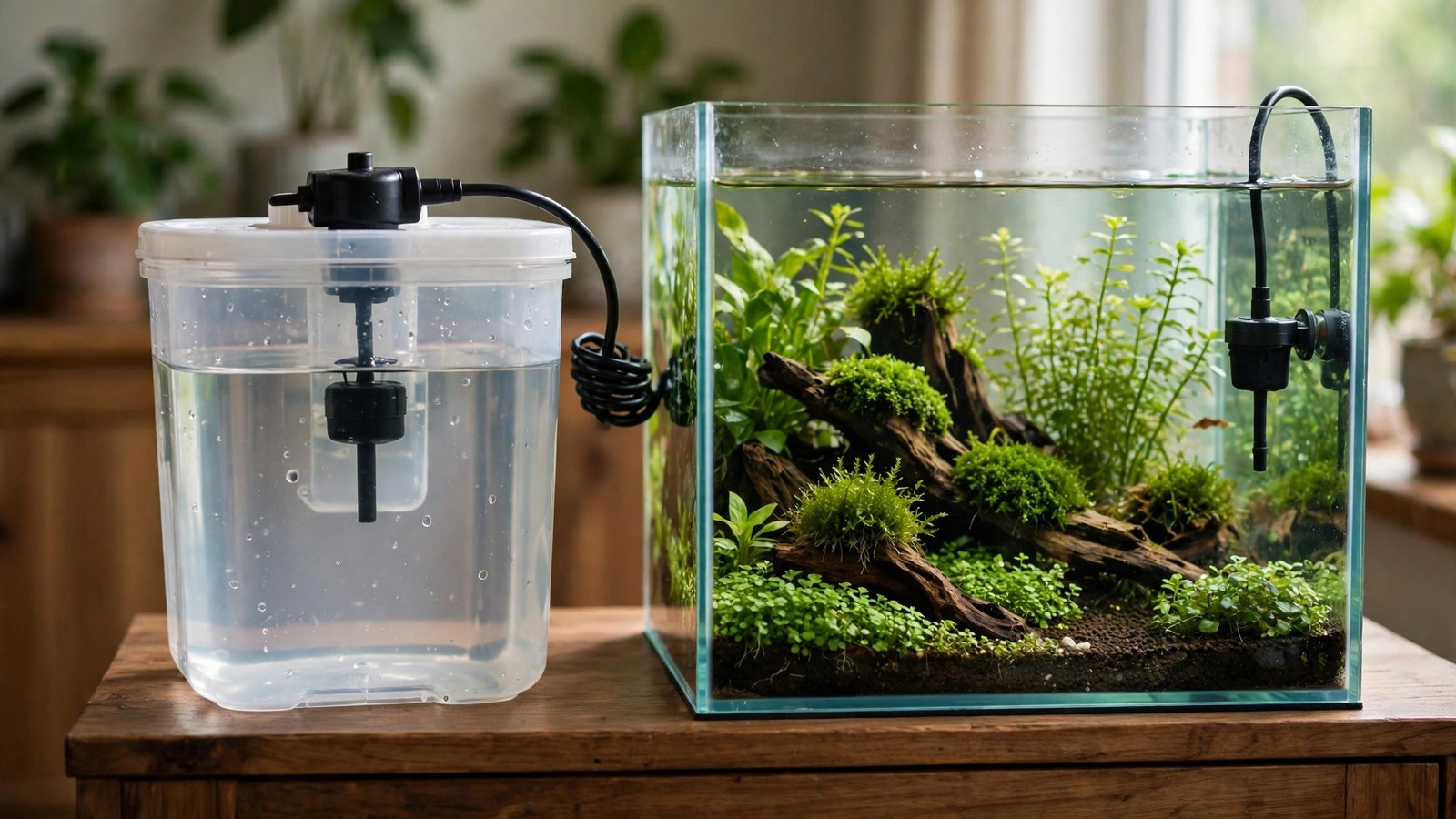
Almost every auto top off roundup on the internet is written for reef tanks — salinity probes, kalkwasser dosing, sumps. If you run a planted freshwater tank, that advice misses the point: evaporation leaves all the dissolved solids behind, so your TDS, GH, and fertilizer concentrations creep upward every single day. This guide rounds up the best auto top off aquarium systems for freshwater planted setups — how each sensor technology behaves in a scaped tank, and which unit keeps your parameters boringly stable.
This is the buying decision. For the installation walkthrough, see our Auto Top Off for Aquariums: ATO Setup Guide for Planted Tanks, which covers reservoir placement, plumbing, and calibration step by step.
Why a planted tank needs an ATO more than you think
Evaporation is selective. When half a liter vanishes from your 20-gallon tank, the water leaves and the minerals do not. Top up manually once a week and you get a sawtooth: concentrations drift upward all week, then crash downward with each top-up. Plants read that as instability, and many "mystery algae" episodes in planted tanks — green dust and thread algae appearing after months of calm — trace back to this pattern rather than to light or CO2.
An ATO removes the sawtooth, trickling pure water in continuously. If you are serious about managing TDS in a planted tank, an ATO is the second most impactful tool you can buy after the TDS meter itself. And it fits the philosophy of a low-tech planted tank setup perfectly: slow, consistent conditions beat dramatic interventions.
What to look for: the best auto top off aquarium sensors and fail-safes
Every ATO does the same job — detect low water, run pump, stop at the target level. Units differ only in reliability and failure handling. Judge every candidate on four points:
- Sensor type. Optical sensors read the waterline through infrared and have no moving parts to jam. Float switches crust up in hard water and algae film. Optical is strongly preferred for planted tanks; the best units add a float-switch backup that cuts power if the level rises too high.
- Fail-safes. At minimum: dry-run cutoff so the pump never runs dry, a maximum runtime per fill cycle, and a high-level alarm. Three independent protections is the standard on good units.
- Pump voltage. Insist on low-voltage DC pumps (12V or 24V). Mains-voltage AC pumps in a reservoir are a relic — noisier, hotter, harder to justify.
- Mounting and reservoir size. In freshwater planted tanks the sensor usually lives in the display tank or a hang-on-back filter chamber, not a sump. Look for compact magnetic mounts, and size the reservoir so a full runaway fill raises the tank by about an inch.
The units: honest comparison
| Unit | Sensor system | Fail-safes | Best for |
|---|---|---|---|
| Tunze Osmolator Universal 3155 | Optical primary + float backup | Dry-run cutoff, runtime limit, high-level alarm — the most redundant in the category | The "buy it once" pick for tanks 20 gallons and up |
| XP Aqua Duetto ATO | Dual optical sensors, zero moving parts | Dry-run cutoff, runtime limit | Nano and rimless planted tanks where a compact sensor matters |
| FZONE ATO | Optical + float dual sensor (varies by listing — check your model) | Dry-run cutoff on most models | Budget pick for small tanks; wipe the sensor weekly |
Tunze Osmolator Universal 3155 — the reliability benchmark
The 3155 is the unit every other ATO gets compared to. The optical sensor is the primary eye; a magnetic float switch above it cuts the pump if the level ever rises past the target. Its metering pump doses top-up water slowly, so no local parameter swing forms where the hose discharges. Premium-tier pricing, but the most likely unit here to still be running in ten years.
XP Aqua Duetto — the nano-tank specialist
Two optical eyes and zero moving parts — nothing to jam, nothing to crust. In a 5- or 10-gallon where every inch of glass is visible, the Duetto's compact sensor head is dramatically easier to hide than the 3155's sensor-and-float assembly. You give up the float backup and the metering pump versus the Tunze, so this is the nano pick rather than the large-tank pick. Mid-tier pricing makes it the value sweet spot for tanks under about 20 gallons.
FZONE ATO — the budget option with an asterisk
Budget dual-sensor ATOs put optical-plus-float sensing in reach of price-sensitive buyers, and the core function works. The asterisk is maintenance: budget sensors foul faster in hard water and algae-heavy tanks, so expect weekly lens wipes rather than monthly. Skip any ultra-cheap listing with a single float switch and no dry-run protection — that is the failure profile this guide steers you away from.
Dual optical sensors in the smallest package with overfill protection — ideal for rimless nano planted tanks: XP Aqua Duetto 2 ★4.3.
Reservoir water: use RO, not tap
Top-up water must be pure RO/DI or distilled — evaporation removed pure water, so the replacement must be pure too. Top up with tap and you add minerals with every fill, slowly raising GH and TDS. Dose fertilizers on their own schedule rather than through the ATO line; pre-mixing ferts makes concentrations swing with evaporation rates. If you run an automatic fertilizer doser, keep its line separate from the ATO output. For the broader freshwater philosophy, the complete guide to freshwater aquarium plants is the right next read.
Frequently Asked Questions
Do I need an auto top off on a small planted tank?
Usually yes. Small tanks evaporate proportionally faster — a 10-gallon can lose 5–10% of its volume in a hot week — which concentrates TDS and GH quickly. A compact dual-optical unit like the XP Aqua Duetto is nearly invisible on a nano and removes the daily pitcher ritual.
Can an auto top off flood my tank?
Only if it has no fail-safes. Every unit here cuts the pump when the reservoir runs dry and limits how long a single fill cycle can run. The decisive habit is reservoir sizing: keep it under 10% of tank volume so even a stuck sensor adds only about an inch of water.
Should the ATO add fertilizer to the top-up water?
No. Evaporation removes pure water, so the replacement should be pure RO or distilled. Adding ferts to the reservoir doses inconsistently — more in hot weeks, less in cool ones — and fights your testing schedule. Keep fertilization on its own measured routine or a dedicated doser.
How often do ATO sensors need cleaning in a planted tank?
Monthly for quality optical sensors, weekly for budget units in hard or algae-heavy water. Biofilm on the lens causes false readings — the most common "my ATO acts weird" complaint. A 30-second wipe with a soft cloth during weekly maintenance prevents it entirely.
Is the Tunze Osmolator worth the premium over budget ATOs?
On tanks 20 gallons and up, or any tank with livestock or rare plants you care about, yes. The float backup, runtime limit, metering pump, and dry-run protection are four independent failure guards where budget units have one or two. Reliability you never think about is what the premium buys.
The bottom line
Reef roundups will keep recommending ATOs for salt creep. For your planted tank, the best auto top off aquarium system is the one whose sensors you never think about: optical sensing with a backup, a low-voltage pump, and a reservoir too small to hurt you. Pick the Tunze Osmolator 3155 for large tanks, the XP Aqua Duetto for nanos, or a budget dual-sensor unit if you commit to weekly sensor wipes — then let your parameters do what planted tanks do best when left alone: stay boring.