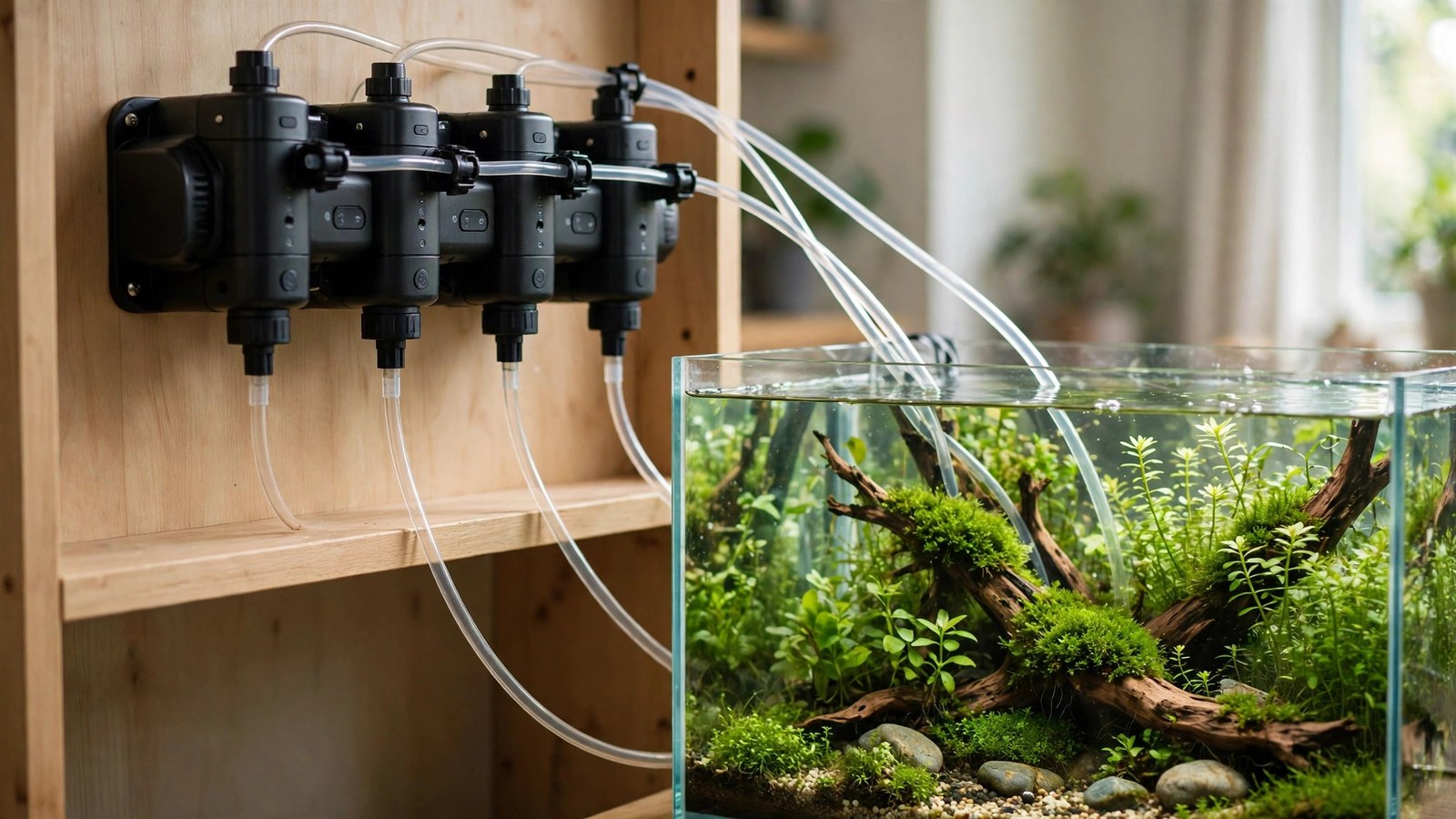
The number one reason planted tanks stall isn't the wrong fertilizer — it's inconsistent dosing. You nail the schedule for two weeks, then life happens: a missed Monday, a double dose on Friday, and suddenly your rotala melts while green dust algae throws a party. An aquarium dosing pump fertilizer setup removes you from the equation, delivering the same milliliters at the same time every day. By the end you'll know which pump fits your tank, how to calibrate and program it in 45 minutes, and which fertilizers must never share a bottle.
Why Manual Dosing Fails Your Plants
Your tank doesn't care about your intentions — it responds to what lands in the water. Aquatic plants like rotala and monte carlo consume nitrate, phosphate, potassium, iron, and trace elements continuously through every photoperiod. A high-tech 20-gallon tank burns roughly 1–3 ppm of nitrate and 0.1–0.3 ppm of iron per day. When you dose Monday and forget until Thursday, plants ride a feast-famine roller coaster: pinholes in older leaves (potassium), pale new growth (iron), stunted tips — symptoms that take 2–3 weeks of perfect dosing to correct.
Worse, algae exploit the dips: thread algae and staghorn appear almost on cue when nutrient levels swing. A dosing pump doesn't improve your fertilizer — it removes the human variable from delivery, which is almost always the real failure point. Nobody enjoys measuring 0.7 ml of trace solution every morning; a pump dispenses it at 8:00 AM while you sleep. And when you travel, your tank keeps getting fed while everything else runs itself.
How Peristaltic Dosing Pumps Work
Nearly every aquarium dosing pump is peristaltic: small rollers rotate around a flexible silicone tube, squeezing a fixed volume of liquid forward with each pass — precise to fractions of a milliliter. Only the tube's inside touches your fertilizer: no seals to corrode, no impellers to clog.
Programming is straightforward: you set each head with the number of daily dosing events and the milliliters per event. Most pumps handle 1–24 events per day at 0.1–99 ml each (precision models go to 0.01 ml for nano tanks) — for example, four 2 ml doses spaced 6 hours apart, totaling 8 ml of macro fertilizer per day.
Multi-head pumps are the planted-tank standard: they keep incompatible fertilizers physically separate. Iron (Fe) and phosphate (PO4) react in concentrated form to create iron phosphate — an insoluble white precipitate your plants can't absorb. Dosing them from separate heads at different times (macros morning, micros/iron evening) keeps the chemistry clean. The classic 4-head layout: macros, micros, iron booster, and a spare for extra potassium or water-change-day GH booster.
Choosing the Right Aquarium Dosing Pump Fertilizer Setup
Match the pump to your dosing needs, not a feature list. One head works with a single all-in-one fertilizer; two heads cover the classic macro/micro split; three to four give you macros, micros, iron, plus a spare. What matters most is minimum dose precision, not power. If your nano tank needs 0.5 ml of iron daily and the pump's minimum is 1 ml, you'll overdose by double — 0.1 ml increments suit most setups, 0.01 ml is ideal for nanos. Wi-Fi models earn their premium through schedule flexibility: different water-change-day doses, paused schedules during rescapes, ramped-up dosing as a new tank matures.
Dosing Pump Comparison
| Pump | Channels | Min. dose | Programming | Typical price | Best for |
|---|---|---|---|---|---|
| Jebao DP-4 | 4 | 0.1 ml | Button + LCD | $75–$95 | Budget 4-channel workhorse; the default pick for most tanks |
| Jebao DP-2 | 2 | 0.1 ml | Button + LCD | $50–$65 | budget macro/micro split |
| Kamoer X4-class Wi-Fi | 4 | 0.01 ml | Wi-Fi app | $230–$260 | nano precision + dose logging |
| Kamoer F1 single-head | 1 | 0.01 ml | Wi-Fi app | $90–$110 | single all-in-one dosing |
| Bubble Magus BM-T01 | 3 | 0.1 ml | Button + LCD | $90–$120 | quiet, proven design |
| Generic timer-plug doser | 1 | 1 ml | Timer plug | $25–$45 | cheap but too crude |
For most keepers, the real decision is the Jebao DP-4 versus a Wi-Fi Kamoer-class unit. The Jebao costs about a third as much, its heads are cheap and replaceable, and it has a decade of community use behind it. Weaknesses: fiddly button programming and heads that occasionally need manual cycling if left idle. The Kamoer is quieter with two-minute app programming — you pay for polish. Skip the generic timer-plug heads: 1 ml minimum doses and no multi-event scheduling defeat precision auto-dosing.
The 4-Step Setup
Step 1 — Calibrate every head
The step everyone wants to skip and nobody should. The same programmed "5 ml" can deliver 4.6 ml on head one and 5.4 ml on head two, because tubing thickness and roller tension vary. Per head: run the pump's calibration routine into a graduated cup, measure what actually lands versus the programmed 10 ml, and enter the correction factor. Repeat until output is within 0.2 ml of target, then spot-check every 2–3 months as tubing wears.
Step 2 — Mount above the tank rim
Position the pump higher than the water surface, with output tubing routed over the rim so tube ends stay above the waterline — never submerged. If power fails mid-dose, a submerged line can siphon the entire reservoir into the tank; peristaltic heads resist siphoning when parked, but they're not guaranteed check valves. Tank water creeping back up the tube also grows biofilm inside the line. If your layout can't place the pump above the tank, inline check valves on every output line are mandatory.
Step 3 — Program the daily schedule
Split each day's total into 3–4 small events rather than one big dose — flat nutrient levels beat spikes. Stagger incompatible fertilizers by 30–60 minutes: macros in the morning, micros/iron in the evening, timed for the photoperiod when plants uptake nutrients. On button-programmed pumps, write your program on paper first — a written plan turns 20 minutes of button-mashing into a five-minute setup.
Step 4 — Verify output for a week
Calibration is theory; verification is proof. For the first week, mark each reservoir's starting level with tape and confirm bottles drop by roughly the programmed amount daily. If one isn't moving, check for kinked tubing or an air bubble at the intake. Also test your water on day 1 and day 7: if nitrate climbed 15 ppm when your target was +5, trim the program. A week of verified output buys months of trust.
Dosing Schedule Example: 20-Gallon High-Tech Tank
A working schedule for a 20-gallon (75 L) high-tech tank — high light, injected CO2, moderate density — with a 4-head pump and EI-style dry salts — cut volumes 30–50% for medium light. New to the method? Read the EI dosing guide for beginners first.
| Head | Contents | Daily total | Events | Times |
|---|---|---|---|---|
| 1 — Macros | KNO3 + KH2PO4 + K2SO4 (500 ml stock) | 8 ml | 4 × 2 ml | 9:00, 12:00, 15:00, 18:00 |
| 2 — Micros | CSM+B trace mix (500 ml stock) | 4 ml | 2 × 2 ml | 9:30, 15:30 |
| 3 — Iron | DTPA iron chelate 11% (250 ml stock) | 2 ml | 2 × 1 ml | 12:30, 18:30 |
| 4 — Potassium | K2SO4 solution (250 ml stock) | 3 ml | 3 × 1 ml | 10:00, 14:00, 17:00 |
Iron doses land 30 minutes after the nearest macro dose — never simultaneously. Weekly totals: 56 ml macros, 28 ml micros, 14 ml iron, 21 ml potassium. A 500 ml macro reservoir lasts about 9 weeks; the 250 ml iron bottle lasts over 4 months. If you mix your own stock, learn how to mix dry fertilizers safely first — a concentration error at the mixing stage gets multiplied by automation. For bottled all-in-one liquids (like Tropica's liquid fertiliser range), a single head works: program your total daily dose split into 2–3 events, since commercial all-in-ones are formulated to stay stable in one bottle.
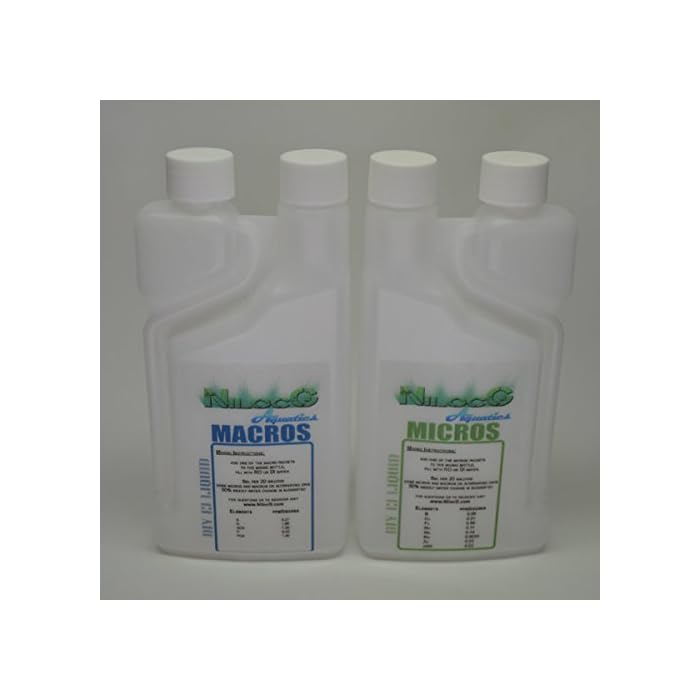
NilocG Aquatics Liquid Refill Set
Check Price on AmazonWhat to Mix — and What to Keep Separate
The cardinal rule of auto-dosing: iron and phosphate live in different bottles and dose at different times. In concentrated stock they form iron phosphate — an insoluble precipitate that coats tubing white and starves plants. The pump doses faithfully while half the iron never arrives.
| Safe together in one bottle | Keep separate (own bottle + head) | Why |
|---|---|---|
| KNO3 + KH2PO4 + K2SO4 (macro mix) | — | N, P, K are stable together |
| CSM+B / commercial trace mixes | Iron (DTPA/EDDHA) boosters | extra iron + phosphate traces precipitate |
| GH booster (CaSO4 + MgSO4) | Carbonate buffers (KHCO3) | dose only on water-change days |
| — | Glutaraldehyde / liquid CO2 | never auto-dose — needs supervision |
Commercial trace mixes already contain chelated iron and stay stable because their phosphate content is near zero. The precipitation risk explodes when you add extra iron to a bottle that also contains phosphate — so use a proven all-in-one for single-bottle dosing rather than improvising. Many keepers run a dedicated separate iron dose for redder plants — that's exactly what the third head is for.
What NOT to Auto-Dose
Rule of thumb: wasteful overdoses (extra potassium, micros) are pump-safe; dangerous ones stay in your hands.
- Glutaraldehyde "liquid CO2" (Excel, EasyCarbo). Effective and harmful doses sit close together — a stuck head means dead shrimp. Dose by hand, eyes on the tank.
- Algaecides and medications. A pump can't notice gasping tetras — dose treatments by hand.
- pH buffers and acids. Without a calibrated probe feedback loop, this is how tanks crash to pH 5 overnight.
- Water conditioners and bacterial starters. These are event-driven, not daily-driven — keep them on your maintenance calendar.
- Root tabs. Rooted heavy feeders like swords still benefit from root tabs in an auto-dosed tank.
Maintenance: Keeping the Pump Honest
Tubing is the wear item: silicone slowly deforms where rollers pinch it, and output drifts downward over 6–12 months. Replace tubing annually (or when calibration shows >10% error) and mark the install date on the pump with tape. Replace the whole head when rollers feel gritty or the tubing seat is visibly grooved.
Check valves deserve a quarterly glance — crystallized fertilizer can stick them open. Blow through each both ways (air passes one direction only); soak sticky ones in warm water. Inspect reservoirs for slime; micro solutions with organic chelates can grow biofilm in warm cabinets, so mix fresh stock every 2–3 months.
Decent pumps keep their schedule on internal memory or a button-cell backup through outages — the clock may drift, but the program survives. After any outage over an hour, check the pump's displayed time against your phone and run one manual cycle. Frequent outages? A $40 UPS on the pump and filter is cheap peace of mind.
Frequently Asked Questions
Do I need a dosing pump for a low-tech tank without CO2?
Usually not. Low-tech tanks consume nutrients slowly — a weekly manual all-in-one dose is plenty, and overdosing is the bigger risk. A pump pays off when your tank needs daily precision: high-tech CO2 setups, tanks over 50 gallons, or any tank left unattended for days. If weekly dosing works, skip the pump.
Can one pump head dose two fertilizers if I mix them?
Only if chemically compatible. Mixing KNO3, KH2PO4, and K2SO4 into one macro stock is standard on a single head. But never mix iron with phosphate in the same bottle — it precipitates, clogging tubing and starving plants. When in doubt, give each fertilizer its own head — heads are cheap, crashed tanks are not.
How accurate are budget pumps like the Jebao DP-4?
After calibration, within about ±0.1–0.3 ml per dose — plenty for planted tanks. The inaccuracy reputation comes from skipping calibration — uncalibrated heads can differ 10–20%. Calibrate each head with a graduated cup, recheck every few months as tubing wears, and an $80 Jebao delivers the same practical precision as pumps costing three times more. Premium models mostly buy quieter operation and app convenience.
Will a dosing pump work with dry fertilizers?
Pumps only move liquids, but dry-fertilizer users dissolve salts into stock solutions first — then the pump meters them out. That's the standard EI and PPS-Pro approach: mix separate bottles, then let the pump meter milliliters daily. It's far cheaper than bottled liquids with full control over ratios. Never put dry powder directly in a reservoir.
What if a line clogs while I'm on vacation?
A clogged line means that channel silently under-doses — the pump runs, but nothing reaches the tank. For a one- to two-week trip, healthy plants tolerate a missed channel far better than having no system at all. The bigger risk is a siphon event dumping a reservoir, which is why above-the-rim mounting is non-negotiable. Do a full calibration and line check the day before departure.
Can I use a dosing pump for automatic water changes?
Technically yes, but water changes need liters per event, not milliliters. Use a dedicated auto-top-off or water-change pump for that, and keep dosing heads for nutrients only. Cross-contamination would ruin your calibration, and the volumes are orders of magnitude off.
Your Tank, Fed Like Clockwork
An aquarium dosing pump for fertilizer changes how the hobby feels: the daily chore disappears, nutrients flatten into the stable band plants crave, and algae loses its favorite weapon. Calibrate a multi-head unit, keep iron away from phosphate, mount everything above the rim, and verify output for a week. Pair it with a properly cycled tank and lighting matched to your goals. The pump does the remembering; you do the aquascaping.