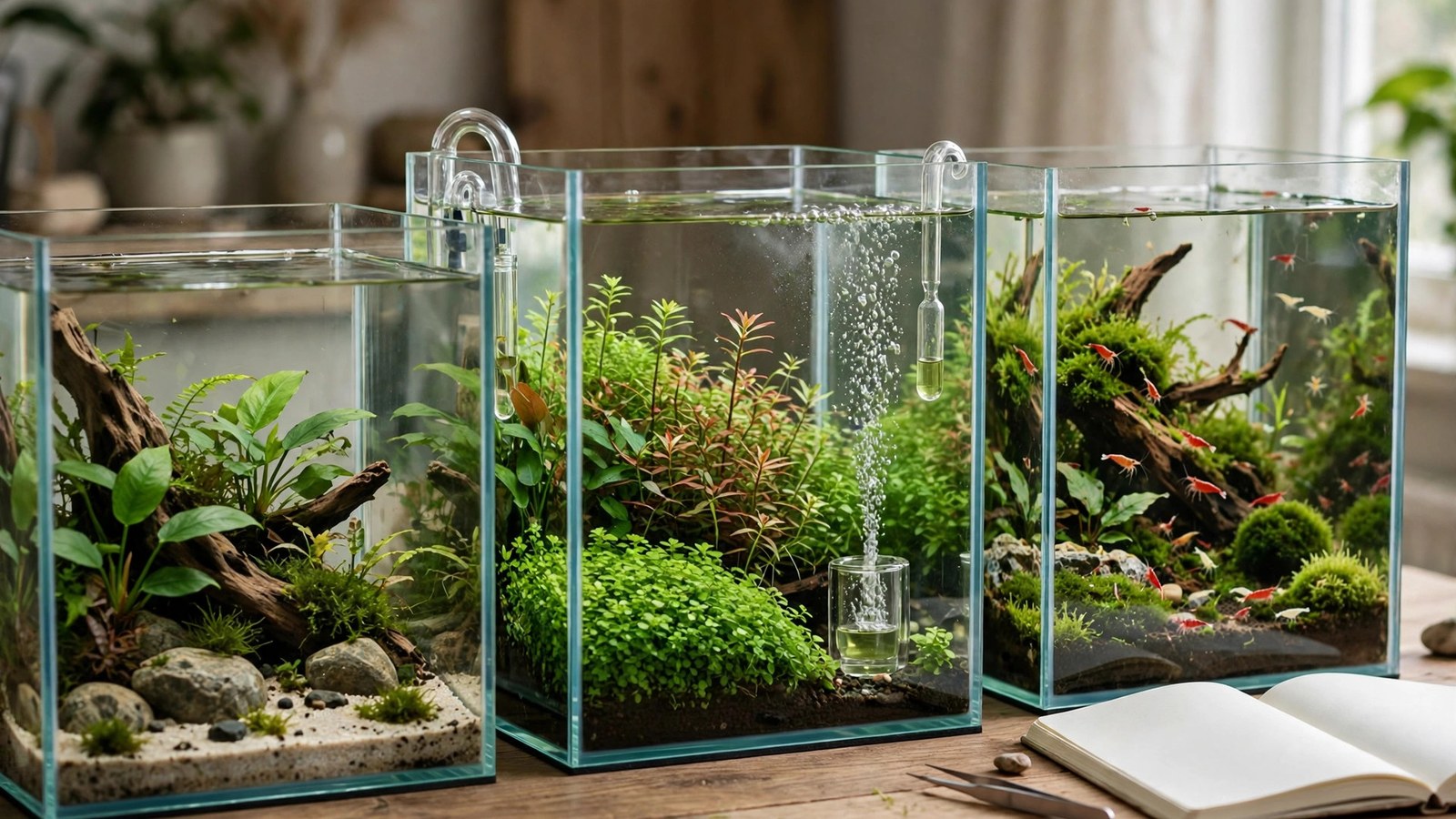
Most planted tanks fail in the first six weeks, and the number-one reason isn't bad luck — it's random fertilizing. Ask around and you'll hear the same story: a squirt of liquid fertilizer whenever someone remembered, a different product every month, and no record of what went in the water. A fertilizer dosing calendar by tank type fixes all of that in one sitting: pick your column — low-tech, high-tech CO₂ with alternating macro and micro days, or shrimp-safe — then decide what goes in, on which days, at which ml-per-10-gallon dose, and stop thinking about it for a month.
Why your tank needs a calendar, not a habit
Plants don't read fertilizer labels — they respond to stability. A consistent low dose delivered on the same days every week grows dramatically healthier plants than a generous dose delivered whenever the bottle catches your eye, because every enzyme, pigment, and new leaf they build depends on nutrients arriving predictably.
The second reason a schedule matters is troubleshooting. When green spot algae appears on your anubias leaves two weeks from now, a calendar lets you look back and see exactly what changed — "I added an extra Thursday dose" is a diagnosis, while "I think I dosed more lately" is a guess. Fold your dosing days into a weekly plant care routine alongside trimming and water changes, and fertilizing becomes automatic instead of a chore you remember at midnight.
The three-tank rule: which schedule are you?
Every freshwater planted tank falls into one of three dosing personalities, and the right schedule follows the tank's energy, not its size. A 10-gallon jungle of slow anubias needs a fraction of what a 10-gallon high-light carpet demands. Pick the description that matches your setup and commit to it.
Low-tech means moderate or lower light, no injected CO₂, and undemanding species. Growth is slow, so nutrient demand is low and stability matters more than volume. Your biggest risk here is overdosing out of impatience — plants that grow an inch a month cannot drink a high-tech dose, and the excess feeds algae instead.
High-tech means bright light plus injected CO₂, usually with fast stem plants or carpets that can double in size within weeks. Here the failure mode flips: plants can out-eat a lazy schedule in days, and the classic symptom is underdosing — pale, stunted new growth. If you just added CO₂ to an established tank, expect your old schedule to become inadequate within two to three weeks; the jump to an injected system roughly triples nutrient demand. A fast-growing plant list is the clearest signal you belong in this category.
Shrimp tank is its own category regardless of light level, because livestock sensitivity outweighs plant appetite. Dwarf shrimp are far more sensitive to sudden parameter swings than any fish, so this schedule prioritizes gentle, gradual dosing. Check any planned fertilizer against a shrimp-safe fertilizer checklist before buying it.
Your weekly fertilizer dosing calendar by tank type
Here is the full week at a glance. The low-tech and shrimp columns use a single all-in-one liquid fertilizer dosed conservatively; the high-tech column alternates separate macro and micro bottles. Everything is anchored to your water-change day: a weekly reset keeps a near-daily high-tech schedule from accumulating to dangerous levels.
| Day | Low-tech (no CO₂) | High-tech (injected CO₂) | Shrimp tank |
|---|---|---|---|
| Monday | Macros + micros (all-in-one), ~1 ml per 10 gal | Macros (NPK), ~2 ml per 10 gal | — |
| Tuesday | — | Micros (traces/iron), ~2 ml per 10 gal | — |
| Wednesday | — | Macros (NPK), ~2 ml per 10 gal | Copper-free all-in-one, ~0.5 ml per 10 gal |
| Thursday | Macros + micros (all-in-one), ~1 ml per 10 gal | Micros (traces/iron), ~2 ml per 10 gal | — |
| Friday | — | Macros (NPK), ~2 ml per 10 gal | — |
| Saturday | — | Rest day (observe plants) | Copper-free all-in-one, ~0.5 ml per 10 gal |
| Sunday | 30–40% water change | 50% water change, then macros | 20–25% water change |
Two things deserve emphasis. First, the doses above are starting points at roughly half to two-thirds of typical label recommendations — start low and observe your livestock before increasing. Labels are written for the maximum a tank could need; most tanks need less, and fish and shrimp always matter more than plants. Second, the high-tech Sunday pattern — water change, then a macro dose into fresh water — is the only schedule where you dose on water-change day, and it exists because a 50% change strips dissolved nutrients that fast-growing plants will miss by Tuesday. For the shrimp schedule, never dose immediately after a water change; wait a day so parameters settle first.
The alternating macro/micro schedule needs both bottles on hand: a macro + micro refill set like NilocG's.
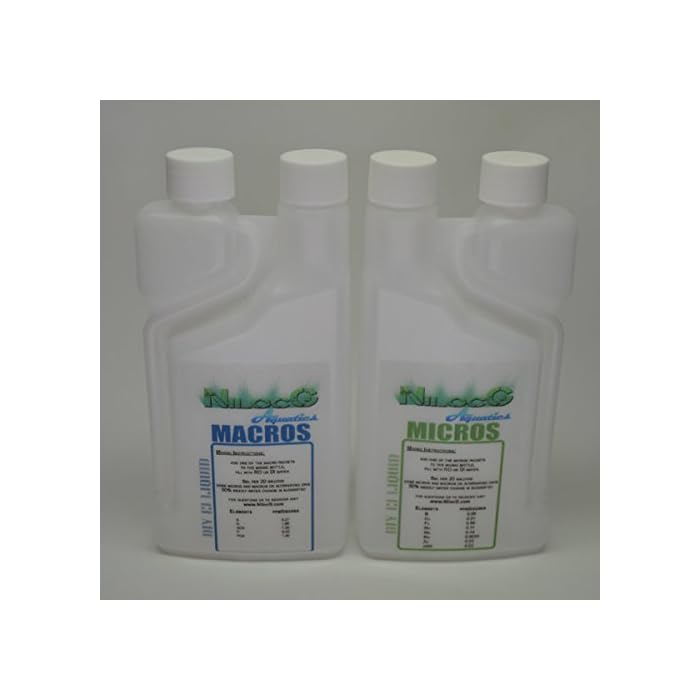
NilocG Liquid Refill Set
Check Price on AmazonHow to dose: the ml-per-10-gallons method
Think in ml per 10 gallons — it's the only way to scale a schedule to your actual tank. A 5-gallon tank gets half the listed dose, a 40-gallon breeder gets four times it. A standard 1 ml syringe from any pharmacy makes measurement exact; the "capful" on most bottles is 5 ml, which is already too much for a nano tank.
For low-tech tanks, begin at 1 ml per 10 gallons of all-in-one fertilizer, twice weekly, and hold for four weeks. If new growth is pale while old leaves look fine, nudge to 1.5 ml; if thread or green-spot algae appears, drop back or stretch the interval to every five days. The right dose for your tank will reveal itself within that month and stay roughly stable as long as your light and plant mass don't change.
For high-tech tanks with separate macro and micro bottles, begin at 2 ml per 10 gallons of each, on alternating days (three macro days, two micro days). Macros and micros land on separate days for a practical reason: iron in micro mixes can bind with phosphate in macro mixes and fall out of solution as a useless precipitate if dosed together. The Estimative Index approach uses this same alternating rhythm — this calendar is simply EI trimmed to conservative doses with a proper water-change reset. If you mix your own salts, the calendar still applies; the PPS-Pro dosing walkthrough gives the dry-salt amounts that match these daily rhythms.
Root tabs are the quiet partner of every liquid schedule. Heavy root feeders — swords, cryptocorynes, vallisneria — pull most nutrition from the substrate, so press one tab near each large plant every two to three months regardless of which calendar column you follow.
Shrimp-safe adjustments
Shrimp change the risk calculus. A dose that's perfectly safe for plants and fish can stress dwarf shrimp if it swings total dissolved solids too fast, and copper — present in trace amounts in many trace-element mixes — accumulates in invertebrate tissue over time. None of this means planted shrimp tanks can't be fertilized; the schedule just needs three modifications.
First, choose a fertilizer explicitly labeled safe for shrimp and invertebrates, then dose at 25–50% of the low-tech strength — roughly 0.5 ml per 10 gallons, twice a week. Start at the lower end and watch your colony for a week: active foraging and normal molting mean you're fine; hiding, failed molts, or deaths within 48 hours of dosing mean you should dilute further or switch products.
Second, separate dosing day from water-change day by at least 24 hours. A water change plus a fertilizer dose on the same day is two parameter swings at once; shrimp tolerate gradual change and hate stacked changes. Dose Wednesday and Saturday when your water change is Sunday, and the tank never experiences more than one event per day.
Third, skip "red plant booster" additives in shrimp tanks unless the product is invertebrate-rated. Red coloration is driven more by strong light and mild nitrate limitation than by iron anyway — iron dosing for redder plants is a fish-tank game, not a shrimp-tank one.
Gentle liquid fert at reduced strength for shrimp tanks: a gentle liquid fertilizer like API Leaf Zone.
Reading your plants: signs of over- and under-dosing
Your plants report on your schedule constantly — you just need to know the language. Check new growth for deficiency and old leaves for excess: mobile nutrients (nitrogen, potassium, magnesium) are cannibalized from old leaves to feed new ones, while immobile nutrients (iron, calcium) show their absence in the newest growth first.
Signs you're under-dosing:
- Pale, yellowish new leaves while old leaves stay green — nitrogen shortage. Nudge your macro days up slightly.
- Pinholes in older leaves with yellow edges — classic potassium deficiency. Increase the macro dose.
- New leaves yellow with green veins — iron deficiency. Confirm macros and micros land on different days so iron stays available.
- Stunted, twisted new tips — often calcium, especially in very soft or RO water. Remineralize water changes slightly rather than adding more fertilizer.
Signs you're over-dosing:
- Algae blooming within days of increasing a dose — the most reliable signal there is. Return to the previous dose and hold for two weeks.
- Brown, burnt leaf edges after switching products — back off and do an extra water change.
- Livestock behaving oddly — fish gasping or shrimp going still after dosing. Do a 30–50% water change immediately; livestock always outranks plants.
- TDS climbing week over week with no reset — your schedule has no release valve. Add a bigger weekly water change or cut doses.
The adjustment rule is always the same: change one variable, wait two to four weeks, then evaluate. Changing the dose, the product, and the schedule in the same week teaches you nothing. When your substrate is fresh aquasoil, run a lighter schedule for the first month or two — the soil releases its own nutrients — as covered in the guide to fertilizing a new aquasoil tank.
The EI Dosing Schedule (High-Tech Tanks)
Estimative Index (EI) dosing takes the opposite approach from lean dosing: instead of carefully matching nutrients to uptake, you deliberately overdose everything so nutrients are never the limiting factor, then reset with a 50% weekly water change. It sounds reckless; it’s actually the most algae-resistant high-tech method because plants never experience the deficiency fluctuations that trigger algae.
The weekly EI rhythm
- Monday: Macros (nitrogen, phosphorus, potassium) — full EI dose
- Tuesday: Micros (iron, trace elements) — full EI dose
- Wednesday: Macros
- Thursday: Micros
- Friday: Macros
- Saturday: Micros
- Sunday: 50% water change, no dosing
The cardinal rule: never dose macros and micros on the same day — iron and phosphate react in concentrated form and precipitate out, making both unavailable. Alternating days keeps them apart.
EI demands the weekly 50% change — without the reset, nutrients accumulate to genuinely problematic levels. If you can’t commit to that water change, don’t run EI; run a leaner schedule instead. See our dry vs liquid fertilizer comparison for the cheapest way to mix EI solutions.
A reliable pick here is NilocG Thrive+.
The PPS-Pro Schedule (Precision Low-Dose)
PPS-Pro (Perpetual Preservation System) is EI’s disciplined sibling: daily micro-doses calibrated to actual plant uptake, with no weekly reset required. You dose small amounts of macros and micros every day before lights-on.
- Daily: 1ml per 10 gallons of macro solution + 1ml per 10 gallons of micro solution (dosed separately, minutes apart)
- Water changes: normal schedule — no mandatory 50% reset
- Best for: tanks where huge weekly water changes are impractical, and hobbyists who prefer daily routine to weekly drama
PPS-Pro requires more upfront calibration (you adjust doses based on plant response over weeks), but once dialed in it’s the most stable long-term method. It’s particularly good for shrimp tanks, where the massive EI water changes can stress sensitive species.
Why "After the Water Change" Is the Golden Rule
Timing within the day matters less than timing relative to maintenance. Always dose after your water change, not before: a 40% change dilutes whatever is in the water column, so dosing first means siphoning fertilizer straight into the bucket. The rhythm for most keepers: do the water change (say, Sunday morning), dose immediately after refilling, then add mid-week doses (Wednesday) if you're on a 2–3x schedule — no water change needed.
As the folks on the Seachem dosing forum note, consistency of day matters more than the exact hour. Plants respond to steady availability, not precision timing.
Liquid Fertilizer vs Root Tabs: Different Clocks
Liquids and root tabs run on completely different schedules, and mixing them up is the most common dosing error. Your liquid fertilizer vs root tabs choice shapes the whole routine — many tanks use both on separate cadences. Water-column feeders (stem plants, floaters, mosses) need scheduled liquids; root feeders (Amazon swords, crypts, vallisneria) need tabs in the substrate. See whether your stem plants need root tabs — it differs by species.
Root tabs dissolve gradually, so they need no weekly attention. A standard schedule is one tab per plant every 4–6 weeks, pushed into the substrate near the roots — low-light plants stretch that to 6–8 weeks. If a sword that was thriving suddenly stalls with pale new leaves around week five, that's your tab running out: don't increase liquid dosing, replace the tab.
Frequently Asked Questions
Should I dose fertilizer on water-change day?
For high-tech tanks, yes — dose macros right after the 50% change, because fresh water is stripped of nutrients your fast growers need by Tuesday. For low-tech and shrimp tanks, no: dose on your regular schedule days instead, and in shrimp tanks wait at least 24 hours after a water change so livestock never face two parameter swings in one day.
Can I just use one all-in-one fertilizer instead of separate bottles?
Absolutely, and for low-tech and shrimp tanks you should — one bottle dosed twice a week is the whole schedule. All-in-ones only become limiting in high-tech tanks, where fast growth can demand more nitrogen or potassium than the fixed ratio in the bottle provides. If a high-tech tank stalls on an all-in-one, that's your signal to graduate to separate macro and micro bottles on the alternating-day calendar.
How long before I see results from a new dosing schedule?
Give any schedule a full four weeks before judging it. New leaves take 10–21 days to emerge, and old deficiency marks rarely heal — watch the new growth. Algae responds faster (often within a week), which is why overdosing shows itself first. Never change the dose, the product, and the timing in the same week.
Is it safe to dose liquid fertilizer with cherry shrimp and snails?
Yes, provided you use a shrimp-safe (copper-free or minimal-copper) formula at 25–50% of the standard low-tech dose and never dose on water-change day. Thousands of hobbyists run heavily planted shrimp colonies on exactly this schedule. Watch the colony for a week after starting: normal foraging and molting mean you're fine, while hiding or deaths within 48 hours of dosing mean you should dilute further or change products.
Do I need to dose if I have aquasoil and fish?
For the first 4–8 weeks in fresh aquasoil, run light — one low-tech dose per week — since the soil releases its own ammonia and nutrients. Increase to the full calendar as the soil depletes, usually around month two or three. Tanks with inert gravel and fish alone need the full schedule from day one, since there's no nutrient bank in the substrate.
My plants are pearling but still have algae — is my dosing wrong?
Not necessarily. Pearling means photosynthesis is strong; algae on top of that usually means light is outpacing what your plants can use. Check your schedule first — are you dosing on the same days each week, or doubling up after forgetting? If the calendar is honest, reduce light intensity or photoperiod by 10–20% before touching fertilizer doses.
Can I dose everything once a week instead of spreading it out?
You can, but plants prefer steady availability to feast-and-famine cycles. Single weekly mega-doses also spike nutrient levels right after dosing — exactly when algae are watching for an opening. Split dosing (2–3x weekly minimum) gives better results with the same total amount.
How do I know if I’m overdosing?
The plants tell you: persistent thread/hair algae despite correct light and CO2, or green dust algae that returns within days of cleaning, often signals excess nutrients relative to plant uptake. Cut doses by a third, wait two weeks, and reassess. Underdosing shows as deficiencies (see our deficiency guide); overdosing shows as algae.
Whether you run the beginner weekly rhythm, full EI, or daily PPS-Pro, the principle is identical: feed consistently, observe the plants, and adjust gradually. It takes about thirty seconds on dose days, costs a few dollars a month, and removes the guesswork that stalls so many planted tanks. Pair your schedule with a sensible light schedule and regular water changes, and your plants get the one thing they want most from you: consistency.