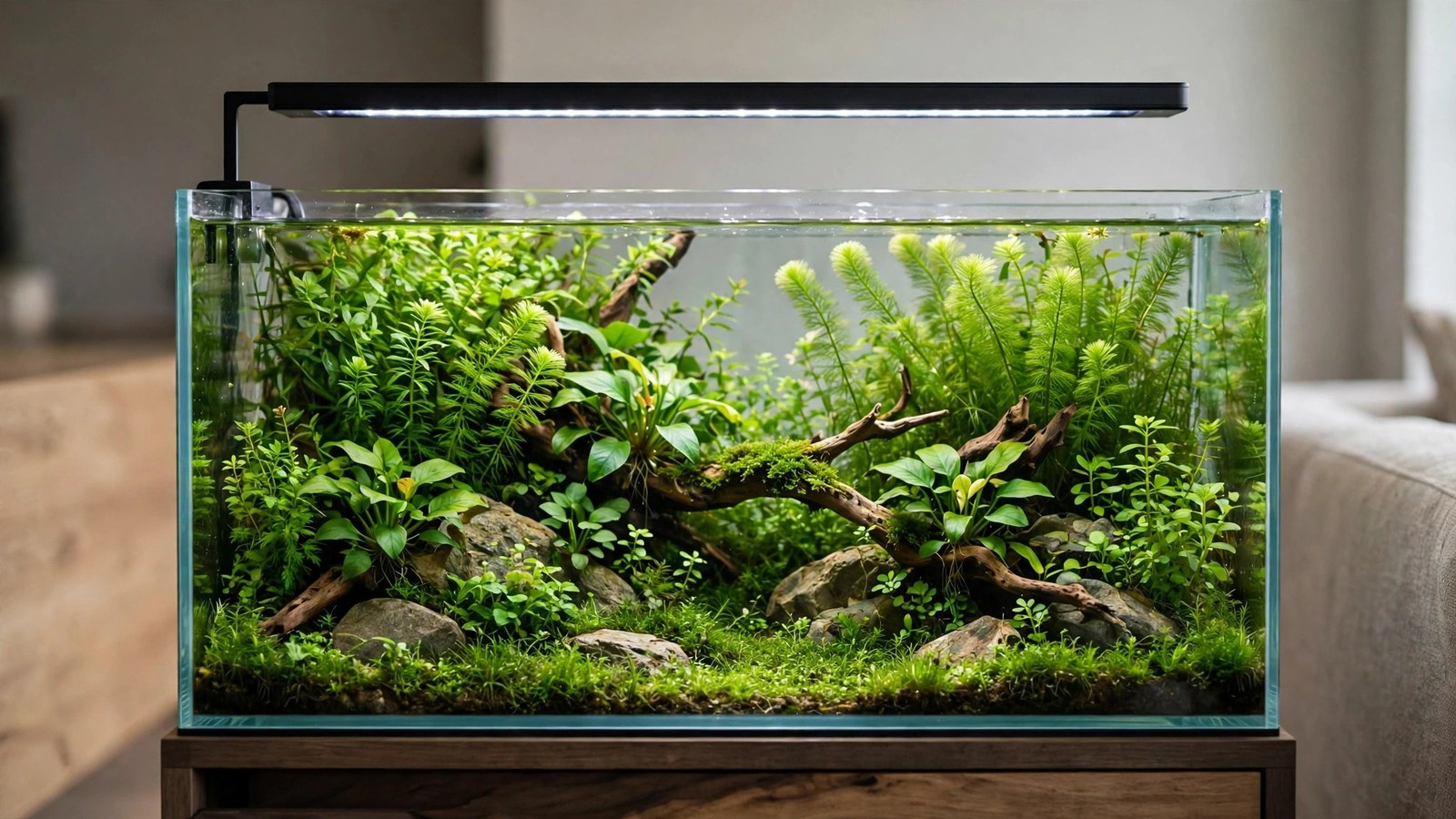
Ask ten aquascapers what light hangs over their contest tanks and half will name the same brand — a Chihiros aquarium light is where serious spectrum and app control stopped costing four figures. Chihiros built its name on lights that render reds like units triple the price, with channel-by-channel RGB control you set from your phone instead of a fiddly remote. This guide maps the full lineup (A II, C II, WRGB II, WRGB II Slim, Vivid II, Z Light), matches each to tank size and tech level, and walks through app setup and the intensity schedule that grows plants instead of algae.
The Chihiros Model Lineup, Explained
Chihiros numbers its lights by tank length in centimeters — a 60 fits a 60 cm / 24-inch tank, a 90 fits a 90 cm / 36-inch tank — with adjustable stainless feet that stretch the fit a little. Sizes run 30, 45, 60, 80/90, and 120; get the tier right first and the size second.
A II — the budget workhorse
The A II is the entry point: white-heavy LEDs with a built-in seven-step dimmer — no Bluetooth, no per-channel color control. The 60 cm version runs around 40–45W, plenty for low-tech setups growing Anubias, Java fern, Crypts, and other easy species.
Choose the A II as your first real upgrade from a kit hood light, or for grow-out tanks where color rendering isn't the point. Skip it for red plants — without dedicated red LEDs, crimson stems render flat.
C II RGB — the nano specialist
The C II RGB is built for small tanks: a compact full-RGB array with built-in Bluetooth app control in sizes covering 20–45 cm tanks. Its color rendering punches well above its price class — exactly what you want on a nano where every stem is close enough to inspect. Compare it with other small-tank options in our roundup of the best aquarium lighting for planted tanks.
WRGB II — the sweet spot
The WRGB II is the heart of the lineup and Chihiros's best-selling planted-tank light. RGB 3-in-1 LEDs mix red, green, and blue per channel from the My Chihiros app, with output stepping from roughly 33W (30 cm) up to 130W (120 cm). Chihiros publishes conservative real-world output figures rather than inflated ones, and the cool ~12,000–15,000 K color temperature reads crisp to the eye while the RGB channels do the growth and color work.
The 60 cm WRGB II is arguably the best value in planted-tank lighting: enough power for a CO2-injected 60 cm tank yet equally at home dimmed for low-tech duty, Bluetooth scheduling and ramps included.
WRGB II Slim — same brain, slimmer body
The WRGB II Slim packs the same app control and channel tuning into a 1.8 cm tall low-profile black body. Specs track the standard WRGB II size for size — pick it for rimless tanks where you want the hardware to disappear.
WRGB II Pro — for high-tech and deep tanks
The Pro pushes roughly 40–50% more output than the standard WRGB II using a WRGB 4-in-1 LED arrangement with stronger photosynthetic red and blue peaks, in sizes up to 120 cm with 12 mm glass compatibility. Chihiros's answer to ADA Solar territory: serious PAR for 50 cm-plus deep tanks, dense carpets, and high-light red stem gardens.
Choose the Pro only if you run pressurized CO2 and consistent dosing — on a low-tech tank it will spend its life dimmed or grow algae. Confirm your gas levels justify the tier with our CO2 drop checker guide.
Vivid II — the pendant showpiece
The Vivid II is Chihiros's hanging pendant: a round, spotlight-style fixture with very high output and app control, for tanks from about 45 to 120 cm. It renders colors beautifully and throws an intense cone of light that suits island-style aquascapes — but a single pendant over a 120 cm tank leaves the ends dim, so budget two for long tanks. Hanging height is your intensity control — see our hanging light height guide for starting heights.
Z Light — the minimalist
The Z Light is a slim bar for simple setups and shallow tanks, with clean lines and straightforward control — think of it as a refined A-series philosophy: easy, attractive, uncomplicated. Fine for low-tech displays, not a color-contest tool.
Model-by-Tank-Size Cheat Sheet
The table covers the most common sizes:
| Tank length | Typical volume | Low-tech pick | CO2 / high-tech pick |
|---|---|---|---|
| 20–30 cm (nano) | 3–10 gal | C II RGB | C II RGB (dimmed) or Vivid II pendant |
| 45 cm | ~10–15 gal | A II 45 or WRGB II 45 (dimmed) | WRGB II 45 |
| 60 cm (24") | ~20 gal | A II 60 or WRGB II 60 (dimmed) | WRGB II 60 / Pro 60 |
| 90 cm (36") | ~50 gal | WRGB II 90 (dimmed) | WRGB II Pro 90 |
| 120 cm (48") | ~65+ gal | WRGB II 120 (dimmed) | WRGB II Pro 120 or 2× Vivid II |
Two notes. On a 60 cm tank, the WRGB II 60 is the "buy once" choice: low-tech dimmed today, headroom for CO2 later. On 90 cm and up, deep tanks (50 cm+) deserve the Pro. Our best LED lights for low-tech planted tanks calibrates what "enough" looks like.
My Chihiros App: Control Without a Commander
Older Chihiros lights needed a separate Commander 1 or 4 controller for scheduling; current WRGB II-series lights have Bluetooth built in and pair directly with the free My Chihiros app — the light's real value. The app gives you three independent channels (red, green, blue) per time slot, a daily schedule with multiple phases, and automatic sunrise/sunset ramping between them.
Setup is simple: download the app, power the light, and pair over Bluetooth (phone within a few meters of the tank). A typical first schedule: 30-minute sunrise ramp, midday plateau, 30-minute sunset ramp, then off. The schedule saves to the light itself, so it survives phone reboots. Hold off on fine-tuning per-channel intensity until you understand what each channel does — covered next.
What the RGB Channels Actually Do
Chihiros's per-channel control is its edge over budget lights — but only if you understand the levers:
- Red channel: drives photosynthesis (the ~660 nm peak is the most efficient band) and reveals red coloration — red plants look red under strong red output, brownish-green without it. See our light spectrum guide for the biology.
- Green channel: mostly for your eyes — little photosynthesis, but lush-looking greens. Running green at 80–90% of red/blue deepens the "contest photo" look.
- Blue channel: drives photosynthesis at ~450 nm and gives water a crisp look. Most aquascapers run blue slightly below red so fish colors don't wash out.
The default "all channels 100%" grows plants fine — for display work, try red 100, green 80–90, blue 90 — the plants get what they need while colors pop. Keep a note of your working recipe; you'll want it back after every reset.
PAR Targets: Low-Tech vs. High-Tech
Lumens sell lights, but PAR — photosynthetically active radiation at the substrate — grows plants. These are practical starting targets; LED optics, tank depth, and water tint all reshape real PAR:
- Low-tech (no CO2): roughly 30–50 µmol/m²/s at the substrate. Most Chihiros models deliver this at 50–70% intensity — which is exactly why starting dimmed matters.
- High-tech (CO2-injected): roughly 80–120+ µmol/m²/s for demanding carpets and red stems. This is where the WRGB II Pro and Vivid II earn their keep on deeper tanks.
No PAR meter? Calibrate by observation: steady new growth with zero algae over two weeks means your level is right. Green dust on glass or hair algae on slow growers is your cue to back off — see our guide to raising light intensity safely.
Mounting: Legs, Hanging, and Splash Protection
Most Chihiros models ship with adjustable steel legs sized for typical rims — spec sheets list maximum glass thickness (usually 10 mm on smaller models, 12 mm on larger ones), so check yours before buying.
Hanging kits lift the light above the tank — height becomes a physical dimmer, since every few centimeters meaningfully drops PAR at the substrate. This is the cleanest fix for an overpowered light on a low-tech tank.
For hardscapes that suit open-top tanks — including terracotta pots, which work well above and below the waterline — a rimless Chihiros setup doubles as a display choice, not just a safety one.
Photoperiod Setup: The Schedule That Works
The most common mistake new Chihiros owners make is 10–12 hour days at full power because the app makes it so easy. Don't — 6–8 hours grows everything a 10-hour day does, with far less algae, since plants hit useful light saturation well before hour eight while algae keeps gaining ground.
Build your schedule like this: 20–30 minute sunrise ramp, 6–7 hours of plateau, 20–30 minute sunset ramp, then dark. The gradual transition spares fish and shrimp the shock of instant full brightness — see our sunrise/sunset ramping guide. For the reasoning, read our photoperiod duration guide. Keep the schedule identical every day; consistency matters more than the exact hours. For full scheduling templates, see our aquarium light schedule guide.
Chihiros Aquarium Light vs. the Competition
- vs. Twinstar: Twinstar's S Line wins on sheer output at the top end, but costs more per centimeter and its Bluetooth features need optional controllers. Chihiros wins on value and built-in control — a WRGB II 60 out-features a Twinstar E Line for less money.
- vs. Week Aqua: a close fight on spectrum and build — many hobbyists pick by local availability. Week Aqua often ships more premium mounting hardware; Chihiros wins on the larger owner community and tutorial library.
- vs. ONF and ADA: genuine luxury lighting with luxury price tags, bought for design and brand prestige. A WRGB II gets you most of the planted-tank result for a fraction of the cost.
- vs. budget white LEDs: a $40 generic bar keeps plants alive but can't do channel mixing, scheduling, or sunrise ramps.
Known Quirks Worth Knowing
- Algae if overdriven: full intensity over an unbalanced tank equals green dust and hair algae within days. The fix: drop to 50–60% intensity, shorten to 6 hours, rebalance CO2 and ferts.
- Bluetooth range is short: pairing needs your phone near the tank. If the app won't connect, check no other device is holding the connection.
- No commander needed anymore: the old Commander 1/4 controllers were only for first-generation lights. Don't buy one for a WRGB II — it adds nothing.
- IP43, not waterproof: splash-proof only. Wipe hard-water creep off regularly and never submerge the housing.
Before you buy, confirm the current edition's output figures on the official Chihiros WRGB II product page — Chihiros revises specs between editions, and retailers don't always update their listings.
Frequently Asked Questions
Which Chihiros light should I buy for a 60 cm tank?
For most hobbyists, the WRGB II 60: Bluetooth app control, per-channel RGB tuning, and enough output for low-tech (dimmed) or CO2-injected duty. Pick the A II 60 if the budget is tight and the tank is low-tech only; step up to the WRGB II Pro 60 for deep tanks with high CO2 and demanding carpets.
Do I need a separate controller or commander for Chihiros lights?
Not on current models. WRGB II-series lights have Bluetooth built in and pair directly with the free My Chihiros app for scheduling, dimming, and channel control. The A II uses a simple built-in button dimmer with seven intensity steps instead of an app.
Is a Chihiros WRGB II too much light for a low-tech tank?
At full output, often yes — it can deliver high-tech-level PAR over a shallow tank without CO2. But it's an excellent low-tech light dimmed: start at 50–60% intensity with a 6-hour photoperiod and sunrise/sunset ramps, then raise gradually over several weeks as plants establish. Dimmed power you own beats full power you don't have.
Can Chihiros lights grow red aquarium plants?
Yes — the dedicated RGB channels are exactly what red plants want. The red channel's ~660 nm output drives photosynthesis while making red coloration visible, so reds render vividly where they'd look muddy under plain white LEDs. The deepest reds still need high light plus CO2 and balanced nutrients; the light enables them but doesn't create them alone.
How long should I run my Chihiros light each day?
Start at 6 hours including your sunrise/sunset ramps, then add 30 minutes per week up to 7–8 hours once plants are growing and algae is absent. A consistent daily schedule matters more than the exact hour count, so use the app scheduler rather than switching manually.
Are Chihiros lights waterproof?
No. Chihiros fixtures are IP43 splash-proof: fine for occasional splashes above an open tank, but not submersible, and sealed lids can cause condensation that corrodes the light. For covered tanks, use a mesh lid with an air gap above the waterline instead.
The Bottom Line
Pick the tier by tech level — A II for budget low-tech, WRGB II for the do-everything sweet spot, Pro for deep CO2-driven tanks — then the size by tank length. Pair it with the My Chihiros app, set your RGB recipe, and start dimmer and shorter than your instincts say: 6 hours at 50–60% with proper ramps. Let new growth and clean glass earn every increase.