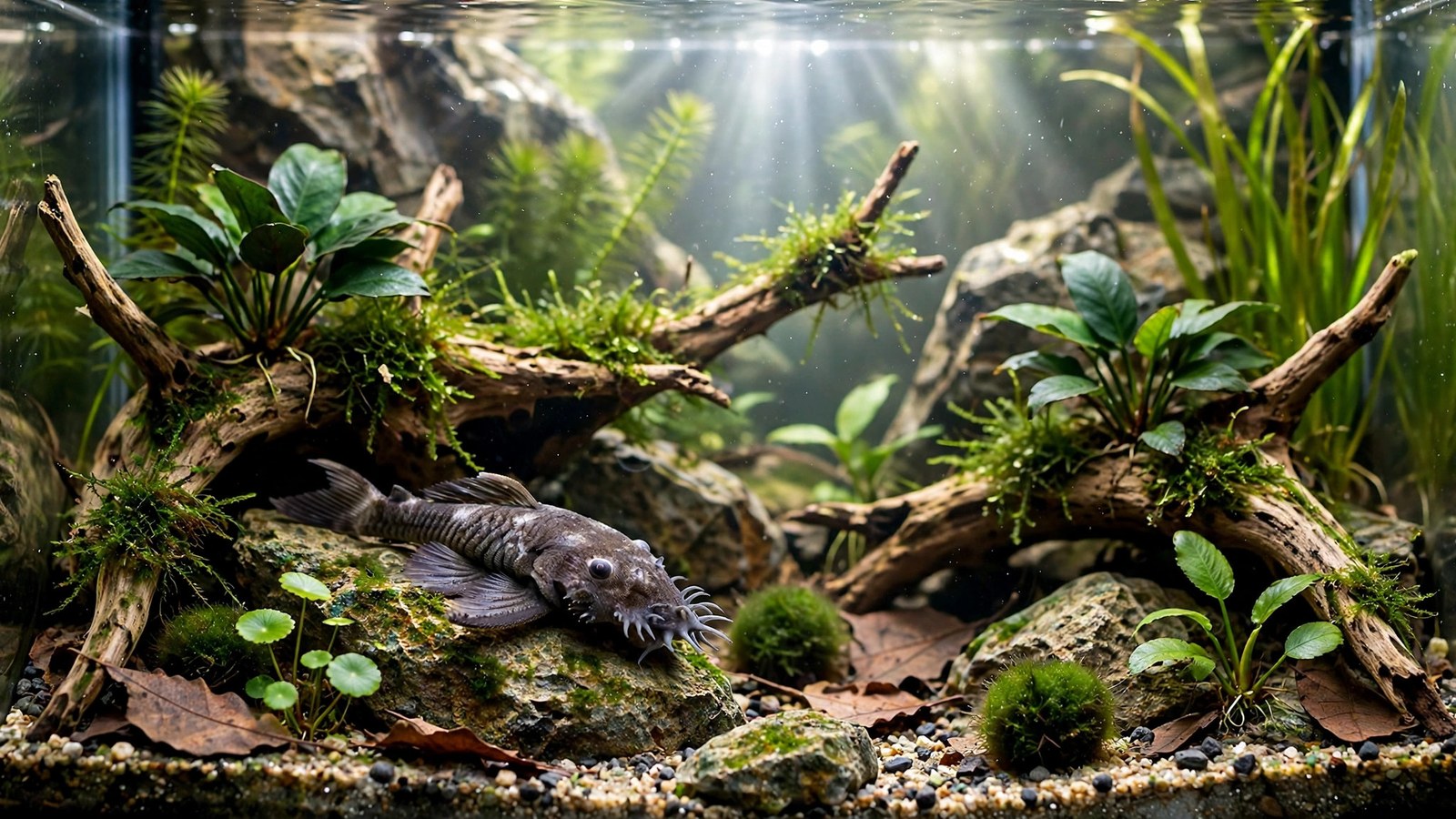
A mature male medusa pleco looks like nothing else in the hobby: a slate-black catfish with a forest of long, fleshy tentacles sprouting from its snout, earning its mythological name at a glance. Setting up a medusa pleco planted tank means forgetting the still community-tank recipe this fish never evolved for — Ancistrus ranunculus (L034) comes from the clear, fast-moving, rocky shallows of the middle Rio Xingu near Altamira, Brazil, and needs warm water, strong flow, and high oxygen. This guide covers the hardscape, parameters, and protein-leaning diet that keep L034 settled and healthy.
In short: The medusa pleco (L034) is a 4.5–5.5" (some reach 6–7") Xingu bristlenose needing a 30–40 gallon tank at 78–86°F, pH 6.4–7.4, strong current, high oxygen, one cave per pleco, and a protein-leaning omnivore diet — bloodworms, frozen prawn, gel foods, vegetables, and bogwood. Not a strict algae eater; mature males grow the longest snout bristles in the Ancistrus family.
Medusa Pleco Planted Tank Setup: Flow, Rock, and Cover
The single biggest mistake is treating L034 like a common bristlenose. Its Xingu habitat is clear, shallow, fast water tumbling over rock — not a sluggish pond. Start with hardscape first: smooth, rounded river stones in stable piles, slate ledges, and at least one snug cave per pleco. Choose plants that thrive in a fish-first planted tank — tough, flow-tolerant species anchored to rock and wood — because delicate stems won't survive the current this fish wants.
Filtration should turn the tank over 8–10 times per hour, with the outflow or a powerhead breaking the surface for gas exchange. Add an airstone as backup: warm water at 78–86°F holds less oxygen, which is exactly why flow and surface agitation matter.
Standard tropical lighting is fine — this pleco is mostly nocturnal and hides by day. Plant densely around, never inside, the rockwork: Java fern and Anubias tied to driftwood, moss on the stones, and floating plants to shade the tank give it the dim refuge it prefers. Driftwood doubles as shelter and the raspable cellulose this fish digests.
The Medusa Look: Tentacles Like No Other Bristlenose
What makes Ancistrus ranunculus famous is the crown of long, thick, fleshy tentacles ringing the snout. Both sexes carry them, but on mature males the bristles reach spectacular length — the longest and bushiest of any Ancistrus species. That is the "Medusa" namesake: a head of tentacles where Greek myth put snakes.
The rest of the fish is all pleco: broad flattened head, dark slate-brown to near-black body with subtle mottling, pale belly. Females are slightly broader with a shorter, neater bristle set. This shared-tentacle trait is also what trips up identification — don't buy on bristles alone.
Feeding: An Omnivore With a Carnivorous Streak
This is where most medusa plecos quietly suffer: they are omnivores wanting noticeably more protein than the average bristlenose. They are not reliable algae cleaners, and a diet of algae wafers and leftover vegetables will leave them undernourished. Offer a protein base first — frozen bloodworms, frozen or blanched prawn, mysis shrimp, and Repashy-style gel foods — then round it out with blanched zucchini, cucumber, spinach, and sinking algae wafers a few times a week.
Feeding table — one rotation per day, target the cave entrance after lights out:
| Food group | Examples | Frequency |
|---|---|---|
| Protein core | Frozen bloodworms, frozen prawn, mysis | Daily to every other day |
| Gel foods | Repashy-style protein blends | 2–3× per week |
| Vegetables | Blanched zucchini, spinach, cucumber | 2–3× per week |
| Wafers | Sinking algae wafers | 2× per week |
| Wood | Bogwood or driftwood, always available | Constant |
Like the common bristlenose in planted tanks, L034 rasps driftwood for digestion — keep bogwood in the tank. Feed after lights-out; a pinched belly behind the pectoral fins means protein is running short.
Medusa Pleco vs. Snowball Pleco: Don't Confuse the Two
Retailers mix these two up constantly, but they are different fish from different rivers. The medusa is an Ancistrus (a bristlenose) from the Rio Xingu, named for its tentacled snout. The snowball pleco is a Hypancistrus from the Rio Negro, named for the white polka-dot pattern across its dark body — no tentacles at all — and skews even more carnivorous in diet. If your "snowball" has a face full of fleshy bristles, it was mislabeled: you have a medusa. The zebra pleco setup guide covers another Xingu Hypancistrus (L046) for the contrast.
Tankmates and a Cave Per Fish
L034 is peaceful toward anything swimming mid-water or higher — tetras, rasboras, and calm community fish coexist without trouble. The exception is its own neighborhood: it can be territorial toward other plecos and bottom-dwellers when hiding places run short. The fix is structural — one cave per pleco, territories separated by rockwork — and a male–female pair fits a 40-gallon tank comfortably. The wood-eating clown pleco in planted tanks and the warm-water gold nugget pleco setup follow the same one-territory-per-fish thinking.
A hungry medusa can opportunistically harass very small bottom-dwellers at night, so keep it well fed and skip pairing it with tiny loaches or vulnerable fry. Shrimp are generally fine in a fed tank with plant cover.
Frequently Asked Questions
How big does a medusa pleco get?
Most medusa plecos (L034) reach 4.5–5.5 inches, though some stock grows to 6–7 inches. That is why the 30–40 gallon minimum matters: a full-grown male needs real footprint, not just water volume, plus a cave sized to its adult body.
Is the medusa pleco a good algae eater?
No — the most common misconception about L034. It grazes surfaces occasionally, but it is an omnivore that prefers protein like bloodworms, frozen prawn, and gel foods. Expecting it to control algae will starve it. Supplement with vegetables and algae wafers, and plan separate algae control.
Can I keep a medusa pleco with other plecos?
It is peaceful with mid- and upper-water fish but can be territorial toward other plecos and bottom-dwellers if hiding places are scarce. Provide one cave per pleco and separate territories with rockwork. A male–female pair works in a 40-gallon tank with several caves.
Does a medusa pleco need strong water flow?
Yes — non-negotiable. L034 comes from the clear, fast-moving rocky shallows of the middle Rio Xingu, so it needs strong current and highly oxygenated water. Use a spray bar, powerhead, or wavemaker with surface agitation and turn the tank over 8–10 times per hour. Low-flow, warm, still water stresses it quickly.
Why do only some medusa plecos have huge tentacles?
Both sexes grow snout tentacles, but only mature males develop the spectacular long bristles that give the species its name — the longest of any Ancistrus. Young fish look similar, so sexing juveniles is difficult. Short bristles into adulthood usually means a female.
Will a medusa pleco eat my aquarium plants?
Generally no, as long as it is fed properly. A well-fed medusa mostly ignores plants and rasps driftwood instead. Plant damage happens when it is hungry — an underfed pleco will chew soft leaves. Keep to the protein-heavy rotation above and anchor tough species like Anubias and Java fern to hardscape.
A medusa pleco rewards the keeper who builds around the fish: rock first, flow second, caves everywhere, and a diet that respects its carnivorous streak. Get those four right and you get one of the most characterful catfish in the hobby — a peaceful, nocturnal Xingu native wearing the most dramatic face in the Ancistrus family. Useful secondary references: the Aquarium Wiki's Ancistrus ranunculus profile and the Aquatic Arts L034 care page.