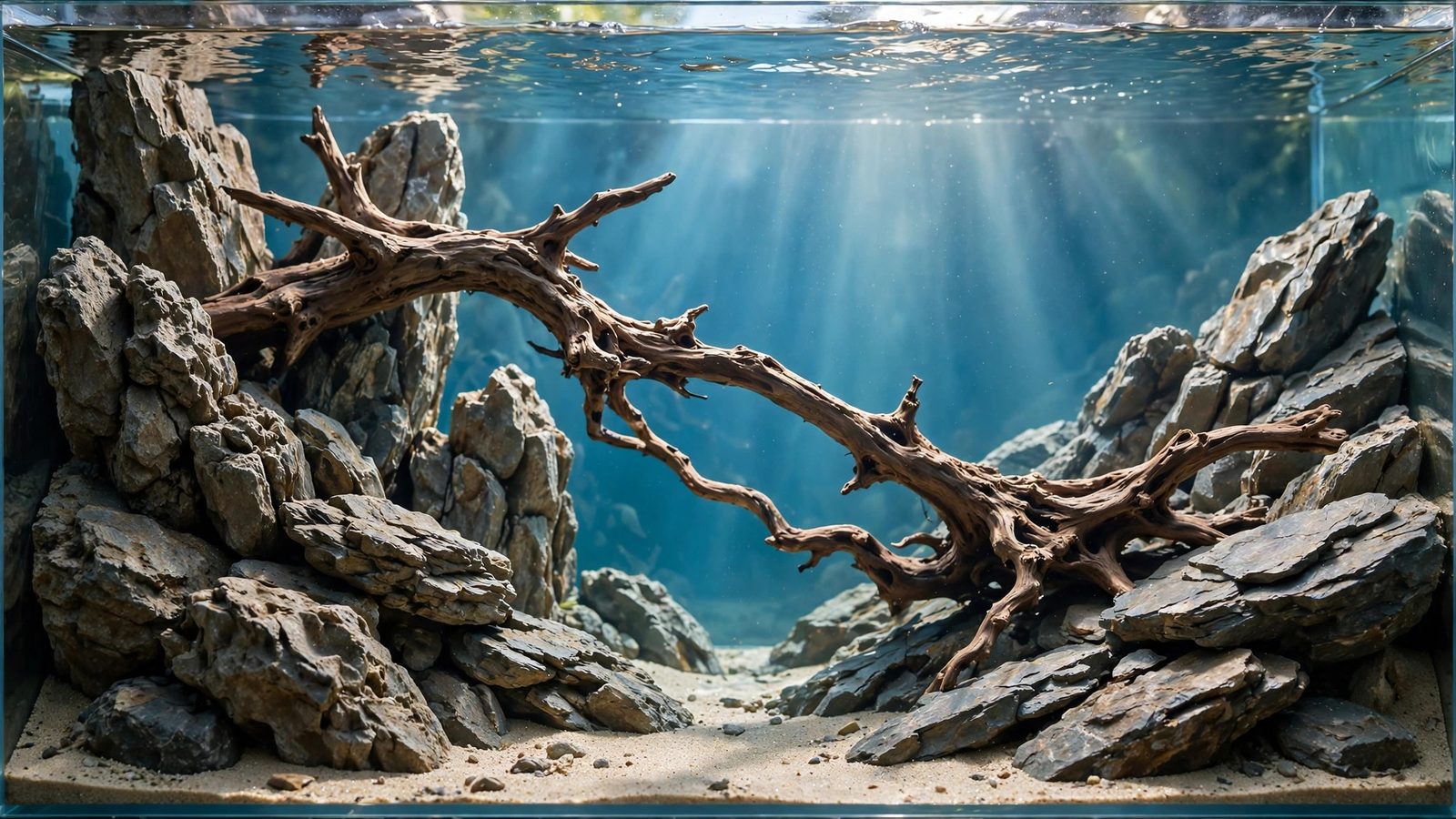
Strip the plants out of an aquascape and most people expect an empty box of rocks. What they actually get — if you do it right — is the most honest style of aquascaping there is. A hardscape aquascape puts stone and wood under the same spotlight plants usually hog, and the results can look more like a river canyon or a windswept ridge than anything in a pet store. By the end of this guide, you'll know how to choose rock and driftwood, compose them so the layout feels alive, and keep a plant-free tank thriving for years.
What a Hardscape-Only Aquascape Really Is
Let's clear up the confusion first, because the phrase gets misused. A hardscape-only aquascape is not a tank that is "still cycling" or a tank you plan to plant later. It is a finished, intentional composition built from stone, driftwood, substrate, and water, with no rooted or stem plants at all. The hardscape-first method many aquascapers use for planted tanks gets pushed to its logical extreme here: the skeleton becomes the whole body.
This style has real roots: Takashi Amano's early work leaned on stone groupings before plants were added, and strict iwagumi discipline comes from Japanese karesansui rock gardens — compositions with no living plants at all. Zen aesthetics prove the point: a few rocks on raked sand can hold attention for hours, and water adds motion, reflections, and light play a dry garden can't.
It is also the lowest-maintenance layout you'll ever own: no trimming, no melted crypts, no carpet to fill in. The composition you build on day one is the one you photograph in year three — so the design phase deserves more care, not less.
Why Go Plant-Free?
Honest reasons, no evangelism. Some aquarists keep fish that uproot or eat everything green — goldfish, cichlids, larger loaches — and fighting that battle forever is exhausting. Others travel, work long hours, or simply want a tank that doesn't demand weekly gardening. And some people just prefer the look: stark, architectural, a little moody, like a landscape photograph come to life.
There are real trade-offs. Without plants eating nitrates, your filter and water changes do all the biological heavy lifting — and with no plant competition, algae face no rivals, so nutrient control has to be tighter. Accept those conditions and a hardscape-only tank can be more stable than a planted one, simply because there's less biology to go wrong.
Choosing Your Stone
Stone is your foreground, midground, and background all at once. The single most important rule: one rock family per tank. Seiryu with dragon stone in the same layout clashes — textures fight and the viewer can't settle on a "place." Match the family to your landscape: jagged dark stone for canyons, rounded river rock for streambeds, pale sandstone for desert washes.
| Rock type | Color / texture | Water chemistry | Best for |
|---|---|---|---|
| Seiryu stone | Blue-grey, layered, sharp edges | Raises pH/KH slightly | Mountain and canyon compositions |
| Dragon stone (ohko) | Brown clay, honeycomb holes | Inert | Cliff faces, caves, cichlid layouts |
| Ryuoh stone | Dark grey, smooth, rounded | Raises pH/KH slightly | Riverbed and streambed scapes |
| Frodo / pagoda stone | Rustic grey-brown, stacked strata | Raises pH/KH slightly | Desert and mesa-style compositions |
| Lava rock | Dark, rough, porous | Inert | Rugged terrain, budget builds |
Test every stone before it goes in. Rocks that fizz in vinegar contain carbonates and will steadily raise pH and hardness — fine for African cichlids, terrible for soft-water tetras. Scrub new stone with a stiff brush under hot water; never boil rocks, since trapped air and water can make some crack or burst. For a complete walkthrough of testing, cleaning, and arranging stone, the one-rock minimalist layout guide covers selection discipline in detail.
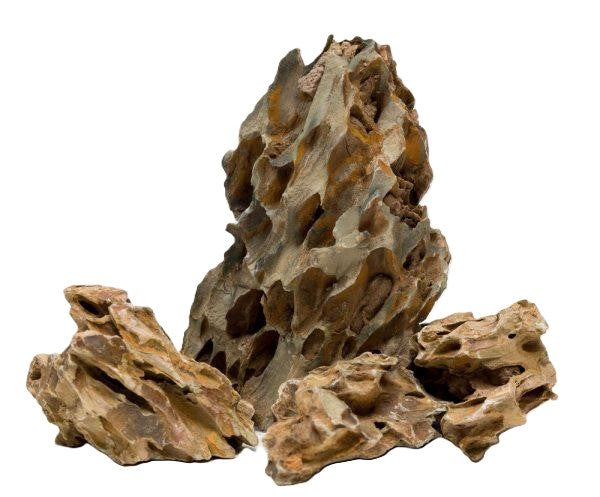 ★4.5
Unocho Natural Dragon Stone Ohko Rocks
Check Price on Amazon ★4.5Choosing Your Driftwood
Driftwood in a hardscape-only tank plays the role plants normally do: fine detail, upward reach, visual softness against the weight of stone. Same unity rule — one wood species, two to four pieces that look like they came from the same tree. Spiderwood's thin fingers pair with rounded river stone; manzanita's gnarled architecture suits dark canyon rock; a single dramatic bonsai driftwood tree centerpiece can carry a minimalist composition on its own.
Prepare wood properly or it will punish you. Soak driftwood until it sinks — spiderwood takes days, mopani can take weeks — and pre-soak out tannins if your design needs crisp water rather than a tea tint. Anchor ambitious pieces to slate bases or silicone them to stone before the substrate goes in, since no plant roots will lock them down.
Design Rules That Keep It Alive
Here is where most plant-free attempts die. Without a lush carpet to lead the eye, the composition has to work on pure geometry. These five rules carry the whole style:
1. Golden ratio placement
Place your main focal point roughly 62% across the tank's width, slightly above or below center height — not dead center. Off-center placement creates tension the eye wants to resolve; centered focal points feel static.
2. Odd-numbered groupings
Group stones in threes, fives, or sevens. Even numbers split into pairs and feel mechanical; odd numbers read as natural clusters: a dominant "father" stone, a smaller "mother" leaning toward it, one or two small attendants.
3. Negative space is a material
A wide expanse of smooth sand between rock clusters tells the viewer the clusters are mountains, not rubble — scale comes from the void around the forms. Resist the urge to fill every corner. The guide to negative space in aquascaping breaks down how much emptiness different layouts need.
4. Build real depth
Hardscape-only tanks go flat fast with no layered planting to fake dimension. Fix it with a 2:1 rear-to-front substrate slope plus smaller stones toward the back to force perspective, and let a sand pathway pull the eye into the background. Read the breakdown of techniques that create depth in aquascapes before you glue anything down.
5. Repeat shapes, vary sizes
A jagged seiryu cluster echoed by a small jagged fragment near the front glass feels designed; a jagged cluster next to a round boulder feels accidental. Gather stones from one rock family so repetition happens naturally.
Building It: Step by Step
Plan first, water last. A hardscape-only layout is the one style where you can — and should — build the entire composition dry before a drop of water touches it.
- Sketch the layout. Draw a top-down and front view. Mark the golden-ratio focal point, the substrate slope, and where the filter intake and heater will hide. This ten-minute step prevents hours of wet rearranging.
- Place the equipment. Heater, filter intake/outflow, and any CO2-less extras like a surface skimmer go in now, positioned so hardscape hides them. In a plant-free tank there's no foliage to disguise a heater — every visible wire is a design failure.
- Add the substrate. Inert sand or fine gravel (2–3 mm grain) works best. Build the slope — deep at the back, shallow at the front — and mist it with a spray bottle to pack it down. No nutrient-rich aquasoil needed; nothing is rooting.
- Set the anchor pieces. Largest stone or main driftwood first, at the golden-ratio point. Test stability by nudging firmly — if it rocks, wedge a flat shard underneath or silicone it to a slate foot.
- Build the composition outward. Add supporting stones and wood around the anchor, working from large to small. Step back to viewing distance every few pieces; close-up arranging lies.
- Photograph the dry build. Phone photos reveal composition flaws your eyes gloss over in person. Fix what the photos show, then fill slowly — pour water over a plate or plastic bag so the flow doesn't blast your slope apart.
- Fine-tune with water in. Submerged stone looks smaller and lighter; wood darkens. Expect to shift a few pieces in the first week. Live with it for seven days before calling it done.
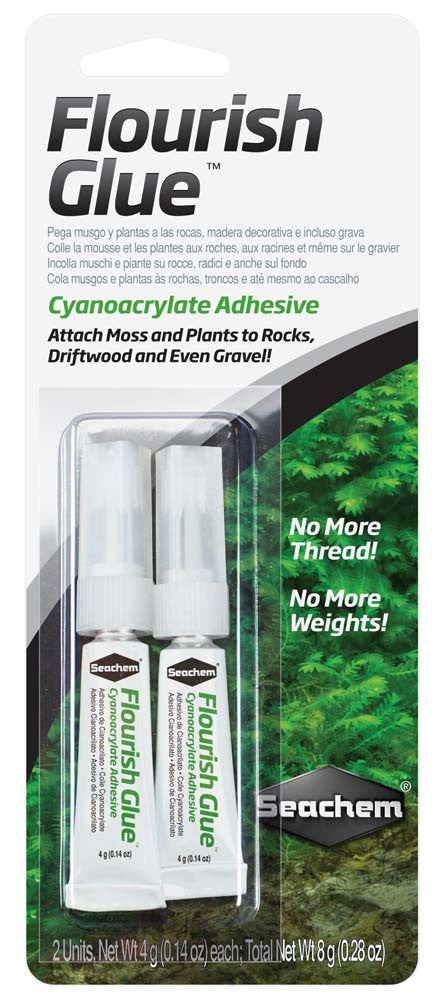 ★4.3
Seachem Flourish Glue
Check Price on Amazon ★4.3Substrate and Water for Plant-Free Tanks
Because nothing is rooting, your substrate is purely aesthetic and functional: it sets the color mood and traps debris you'll siphon out. Pale pool-filter sand makes dark rock pop; dark sand makes fish colors explode but swallows shadow detail. Keep it shallow up front (3–4 cm) — deep sand beds without plant roots can develop anaerobic pockets.
Match stone to livestock: inert dragon stone or lava rock for soft-water species, carbonate stones for hard-water cichlids. Aim for stability — a steady pH of 7.8 beats a swinging 7.0. Filtration should turn the tank volume over 8–10 times per hour since no plant mass absorbs waste; a canister filter with layered mechanical media is the workhorse setup.
Stocking: Your Livestock Is the Motion
In a hardscape-only tank, fish are the animation layer: a static layout with moving livestock feels alive; empty, it feels like a diorama. Choose schoolers that contrast with your hardscape — neon or cardinal tetras flashing over dark lava rock, a shoal of rummy-nose tetras tracing the current line.
Scale fish to the scape: small tetras (2–3 cm) preserve the sense of vastness in a canyon of tall seiryu; large fish shrink the landscape. Bottom dwellers like corydoras add a second motion layer along the substrate, while nerite snails and Amano shrimp graze the algae that would otherwise claim bare rock. The design-first stocking guide for aquascaped tanks rates species for how they interact with layouts like this one.
Maintenance Without Plants
The good news: no trimming, ever. The real news: algae management becomes your main hobby skill. Without fast growers stealing nutrients, every photon and phosphate is available to algae. The fix is a low-energy system: 6–7 hours of modest light daily, lean feeding, and disciplined water changes.
- Light: 6–7 hours on a timer, low to medium intensity. If algae appears, cut duration before intensity.
- Water changes: 30% weekly, siphoning debris off the sand. Bare substrate shows waste fast — that's a feature, not a bug, because it reminds you to clean.
- Filter: rinse mechanical media monthly in old tank water. Check flow rate quarterly; hardscape tanks clog slower than planted ones, but neglected filters still crash.
- Glass and rock: wipe glass weekly, brush algae off stone monthly with a soft toothbrush during water changes. Diatoms in new setups fade on their own within a few weeks.
- Livestock feeding: feed what fish eat in 60–90 seconds, once or twice daily. Uneaten food is the number one algae trigger in plant-free tanks.
Frequently Asked Questions
Can a tank with no plants still cycle properly?
Yes — the nitrogen cycle depends on beneficial bacteria colonizing filter media and surfaces, not on plants. Cycle a hardscape-only tank exactly like any fish tank: add an ammonia source, test daily, and wait for ammonia and nitrite to read zero while nitrates rise, typically 3–6 weeks. The large surface area of porous rock like lava stone actually gives bacteria plenty of colonization room.
Won't a plant-free tank always have algae problems?
Not if you run it as a low-energy system. Algae needs light plus nutrients; plants normally steal the nutrients, so you compensate with short light periods (6–7 hours), lean feeding, and weekly 30% water changes. Many hardscape-only tanks stay cleaner than neglected planted tanks precisely because there's no decaying plant matter feeding algae blooms.
What fish work best in a hardscape-only aquascape?
Schooling species that move as a group — tetras, rasboras, danios — because their synchronized motion becomes the tank's living element against static rock and wood. Match size to your scape: small fish in grand canyon-style layouts preserve the sense of scale. Add bottom grazers like corydoras and algae-eating nerite snails or Amano shrimp as your cleanup crew.
Do I need special substrate if there are no plants?
No — skip expensive nutrient-rich aquasoils entirely, since nothing is rooting. Inert sand or fine gravel is all you need, chosen for color and grain size rather than nutrition. Keep the front layer shallow (3–4 cm) to avoid anaerobic pockets, and slope it deeper toward the back for visual depth.
How long does a hardscape-only layout last?
Years — that is one of the style's biggest selling points. Stone and driftwood don't melt, overgrow, or need replanting. The main long-term changes are slow: driftwood may soften after several years, and mineral deposits can build up on rocks in hard water. A well-built layout looks as sharp in year three as on day one, which is why the initial composition deserves real care.
Is hardscape-only aquascaping accepted in contests?
The major contests judge planted layouts, so a plant-free tank won't compete in categories that require plants. But hardscape composition skill transfers directly — the rock and wood placement discipline behind great planted tanks is identical. Study winning layouts for their stone arrangement and negative space, then apply those lessons to your planted work too.
Bringing It All Together
A hardscape-only aquascape asks more of your eye and less of your calendar than any other style. Choose one rock family and one wood species, compose them with the golden ratio and honest negative space, stock the tank with fish that move against the stone, and run a low-energy system that starves algae instead of outgrowing it. Do that, and the tank won't look like something's missing — it'll look like the plants were never the point. And the best part: nothing you build this weekend will need replanting next month.