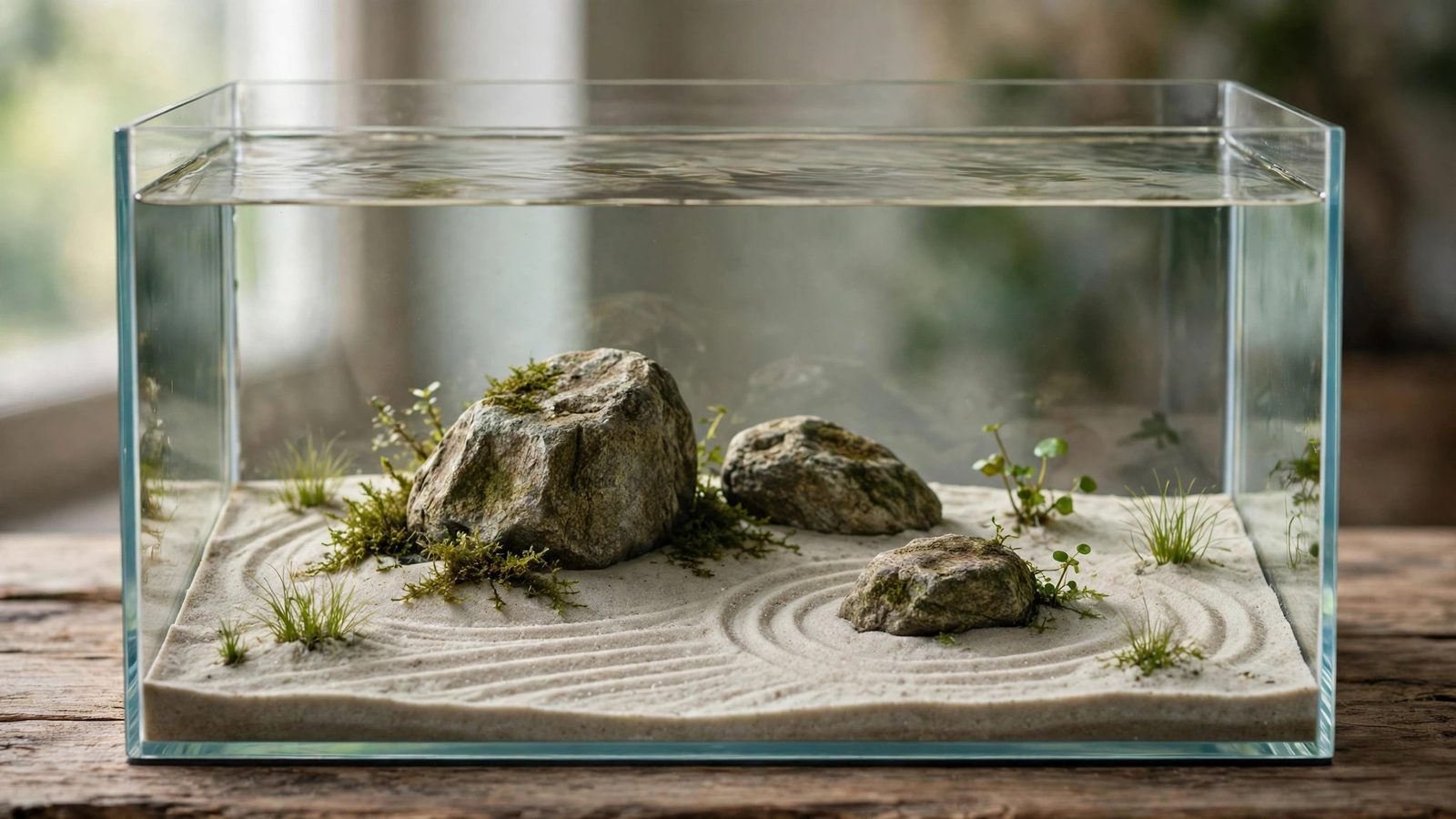
Most aquascapes shout. A zen aquascape whispers — and somehow the whisper fills the whole room. The style borrows its soul from Japanese dry gardens and the wabi-sabi aesthetic: weathered stone, raked sand standing in for water, and a planting discipline so strict that a single moss-covered rock can carry an entire 60-liter tank. This guide covers the philosophy, the plant palette, the karesansui sand techniques, and the step-by-step process to build your first one.
What makes a zen aquascape different from other minimal styles
Every aquascaping school has a minimalism, but they are not the same minimalism. Iwagumi minimalism is about stone arrangement grammar — the odd-numbered stones, the golden-ratio anchor, the carpet that frames them. If you want that grammar, our iwagumi layout guide covers it in full. Zen minimalism is different: it is a philosophy applied to a tank, where every element must justify its existence against ideas like impermanence and quietude, not against composition rules alone.
That distinction changes your decisions: in an iwagumi you ask "does this stone balance the group?" — in a zen aquascape you ask "does this stone need to be here at all?" The result reads less like a designed layout and more like a found scene: a weathered rock that could be a thousand years old, moss growing where it pleases, sand raked into waves that suggest water without showing any.
| Style school | Core idea | Plant count | Signature element | Mood |
|---|---|---|---|---|
| Zen (wabi-sabi) | Beauty in imperfection and restraint | 1–3 species | Raked sand / karesansui | Stillness, contemplation |
| Iwagumi | Stone arrangement grammar | 1 (carpet) | Odd-numbered stone group | Order, precision |
| Nature Aquarium | Recreating a landscape underwater | 5–15 species | Driftwood + layered planting | Lush, immersive |
| Wabi-kusa | Emergent ball of nature | 5+ (emergent) | Moss ball above waterline | Wild, textural |
| Dutch | Horticultural display, color streets | 10–20+ species | Terraced stem-plant rows | Abundance, craft |
The table's lesson: zen is the only school where subtraction is the technique — you pare a normal tank down until only the essential remains. The IAPLC gallery is full of top-ranked minimalist layouts worth studying frame by frame.
Wabi-sabi: the philosophy beneath the style
Wabi-sabi is the Japanese aesthetic of finding beauty in things that are imperfect, impermanent, and incomplete — born from 15th-century tea ceremony culture as a deliberate rejection of ornate perfection. Underwater, it gives you three working principles.
- Embrace imperfection (wabi). Choose the stone with the crack, the driftwood with the odd bend — the weathered piece reads as ancient. This is why zen layouts almost always use fukinsei — deliberate asymmetry — with focal elements placed off-center.
- Accept impermanence (sabi). Moss yellows at the tips. Sand patterns soften. A zen tank is not finished on planting day; it is a living arrangement you tend and re-rake.
- Leave it incomplete. Negative space is not empty space waiting to be filled — it is the subject. Our negative space aquascaping guide treats this as composition technique; in zen it is a spiritual principle. If your tank feels "done," remove one more thing.
Choose materials that age well — rough, dark, weathered rock looks better at month six than month one. Design for the mature tank, not the photograph of the fresh build.
Karesansui sand gardens, submerged
Karesansui — the dry landscape gardens of Zen temples, most famously Ryoan-ji in Kyoto — represent water with raked gravel and islands with rocks. The zen aquascape reverses the trick: real water, but sand raked into wave patterns that evoke the dry garden's stillness.
Sand patterns absolutely survive submersion, but they need the right conditions:
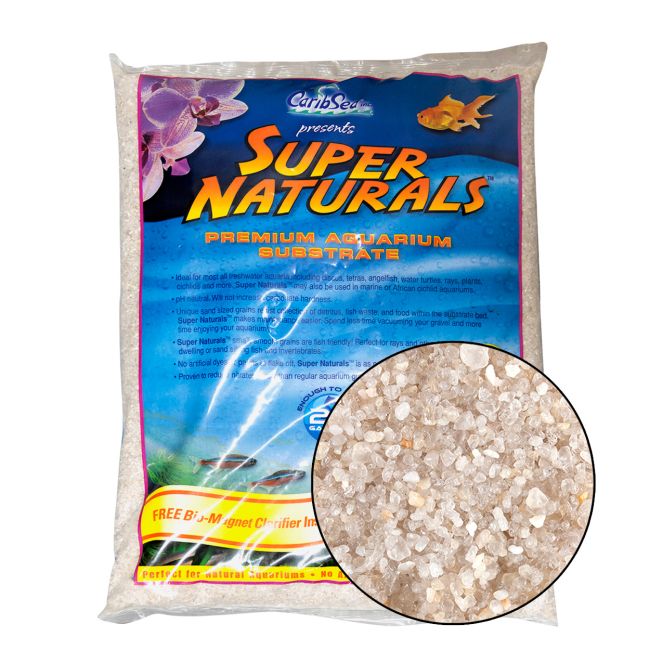
- Coarse sand, 1–2 mm grain — fine sand clouds and collapses; gravel is too heavy to rake into crisp lines. River sand or coarse aquarium sand holds ridges for days.
- Low flow. Aim filter output at the glass or use a spray bar; direct current erases a week's raking in an hour. Keep turnover modest (4–6× tank volume per hour).
- Flat, calm livestock only. No corydoras, loaches, or digging cichlids in the sand garden zone. Small mid-water schoolers (chili rasboras, ember tetras) and otocinclus leave patterns alone.
- A sand-only foreground. Keep the raked zone free of rooted plants; their runners blur the lines. Use a 2–3 cm deep sand bed, sloping gently up toward the back.
Three patterns that survive underwater, from easiest to most demanding:
- Parallel waves. Straight, evenly spaced lines running front-to-back or diagonally. Forgiving, reads beautifully from across the room, lasts 5–7 days.
- Concentric rings around the anchor stone. Circles radiating from your main rock like ripples. Slightly fiddly near the stone; re-touch every 3–4 days.
- Flowing S-curves. Continuous winding lines that suggest a stream. The most karesansui-authentic — and the first to blur, so reserve it for tanks you tend twice weekly. Our sand pathway guide covers the bordering techniques that keep these lines crisp against planted zones.
 ★4.6
CaribSea Super Naturals Moonlight Sand
Check Price on Amazon ★4.6The disciplined zen plant palette
Here is the rule that separates zen from every other style: one to three species, total. A single texture, repeated, reads as intentional in a way twelve never can.
The palette draws from slow growers that look better slightly neglected — the wabi-sabi ideal. Moss is the soul of the zen tank: it softens stone edges and suggests age. For species-level care details, the 2hraquarist plant guides are one of the most reliable references available.
| Species | Role in a zen layout | Light | CO₂ | Growth pace |
|---|---|---|---|---|
| Christmas moss / Java moss (Taxiphyllum spp.) | Draped on stone and wood; the "age" layer | Low | Not needed | Slow–medium |
| Anubias nana 'Petite' | Dark anchor points at stone bases | Low | Not needed | Very slow |
| Cryptocoryne parva | Low grass-like tufts at sand edges | Low–medium | Optional | Very slow |
| Bucephalandra 'Wavy Green' | Jewel accents on hardscape (use sparingly) | Low–medium | Optional | Very slow |
| Microsorum pterotrichoides (narrow-leaf java fern) | Vertical accent behind the anchor stone | Low | Not needed | Slow |
Notice what is missing: no red plants, no fast stems, no carpets demanding weekly mowing — if you crave crimson foliage, build a different tank with the best light for red aquarium plants. A zen tank trades color for texture: a few greens, a few textures, one mood.
Moss gardens deserve one warning: early cladophora algae looks almost identical to establishing moss — stringy, green, attached to hardscape. Learn the difference with our aquarium algae identification chart before your first tie-down, or you'll "leave the moss alone" for a month and return to a takeover.
Hardscape minimalism: fewer stones, more meaning
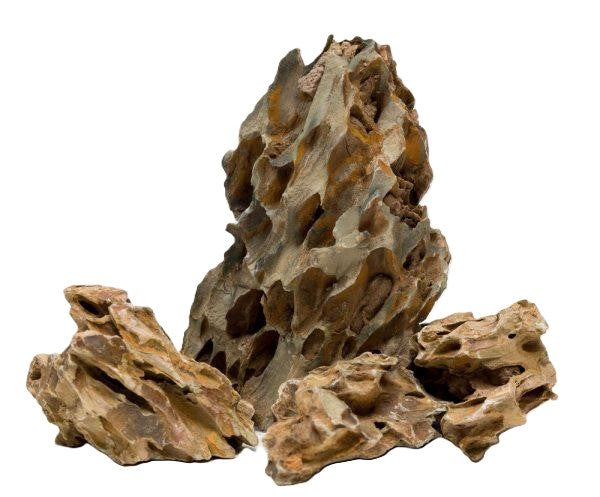
Zen hardscape follows two rules: odd numbers and one voice. Use one stone type only — mixing dragon stone with seiryu-style rock shatters the illusion of a single found place. Group in threes or fives, with one clear anchor (the "main stone") roughly twice the mass of the next largest, placed at a golden-ratio or rule-of-thirds intersection, never dead center.
Technique matters here, but note the boundary: our one-rock aquascape guide is about the mechanics of single-stone layouts — selecting characterful rock, golden-ratio placement, carpet framing. This article is about the philosophy — why the stone sits alone, what the emptiness around it means, and how the tank ages. Read both; they answer different questions.
Weathering is your friend. Study each stone's faces before placing — the interesting side faces the viewer — and tilt stones 5 to 10 degrees off vertical; slight tilts read as natural, plumb stones read as installed. Bury each stone a third of its height into the substrate (the hardscape-first method makes this easy) so it looks rooted rather than placed. Then attach moss with thread or gel superglue only on upward faces and crevices — moss in the cracks looks grown; moss on every surface looks decorated.
Driftwood has a place in zen, but choose one sculptural branch, not a tangle — a single weathered limb rising from a moss mound can be the entire hardscape of a 60-liter tank.
 ★4.5
Unocho Dragon Stone Aquarium Rocks
Check Price on Amazon ★4.5Designing your first zen aquascape: the step-by-step process
Work dry and photograph each stage from your normal viewing chair — the camera catches symmetry and clutter your eyes forgive. Budget one unhurried afternoon.
- Compose for one viewpoint. Zen layouts serve the chair you actually sit in. Shallow tanks (25–30 cm tall) suit the style best; a 60 × 30 × 30 cm (54 L) is the classic canvas.
- Slope the substrate from 2–3 cm at the front glass to 8–10 cm at the back — this single move creates most of your depth (technique: the substrate sloping guide). Cap only the foreground zone with raked sand.
- Place the anchor stone dry at roughly the 1/3 or 2/3 horizontal mark (golden ratio guide), tilted slightly, buried a third deep. Live with it an hour before adding anything else.
- Add supporting stones — then remove one. Place two to four smaller stones asymmetrically, echoing the anchor's tilt. Then take one away; the almost-resolved composition is the wabi-sabi signature.
- Attach moss and epiphytes. Christmas moss on upward stone faces, Anubias 'Petite' wedged at stone bases, Cryptocoryne parva along the sand's rear edge. Two or three species is plenty.
- Rake the sand garden — start with parallel waves — and mist lightly so ridges hold while you flood.
- Flood slowly and hide the machinery. Pour over a plate to protect the raking; tuck filter intake and heater behind hardscape (see the equipment-hiding playbook).
- Stock lightly, after cycling: 10–15 chili rasboras or ember tetras plus otocinclus. Livestock is punctuation, not prose.
Three buildable layouts to start from:
- Nano (20–30 L): "One stone, one sea." A single fist-sized weathered stone off-center, parallel-wave sand across 80% of the floor, Christmas moss on the stone's crown.
- Standard (54–60 L): "Ryoan-ji trio." Three asymmetrical stones, concentric sand rings around the anchor, Cryptocoryne parva edging the back — plus one small stone visible only from an angle.
- Large (90 L+): "Moss valley." One gnarled branch rising from a moss mound on one third, an S-curve sand stream through the rest, narrow-leaf java fern as the vertical accent. For an emergent twist, the DOOA Terra 30 and Mistflow systems extend the composition above the waterline with wabi-kusa-style plantings.
Maintenance as meditation: the weekly rhythm
A zen tank's maintenance is lighter than a Dutch tank's but more deliberate: the raked sand is the canary — skip a week and the tank tells on you.
- Re-rake the sand during each 30% weekly water change, with the level dropped — five minutes with a fork restores the pattern.
- Trim moss every 2–3 weeks on schedule, not when it looks shaggy. Scheduled trims stay dense and velvety; panic trims tear and brown. Technique: our aquascape trimming and maintenance guide.
- Defend the emptiness. Monthly, one plant will try to colonize the sand garden — a crypt runner, a moss fragment. Remove it; negative space needs weeding too.
- Wipe stone faces monthly with a soft toothbrush. Green dust on upward faces is patina; green beards on edges is neglect.
- Photoperiod 6–8 hours. Less light means slower algae on pale sand — the biggest aesthetic threat to a zen layout.
Seasonal change is part of the philosophy, not a failure of it. A zen aquascape at month twelve should look older than at month one — weathered, settled, quietly more itself. If it looks newer, you're over-maintaining.
 ★4.7
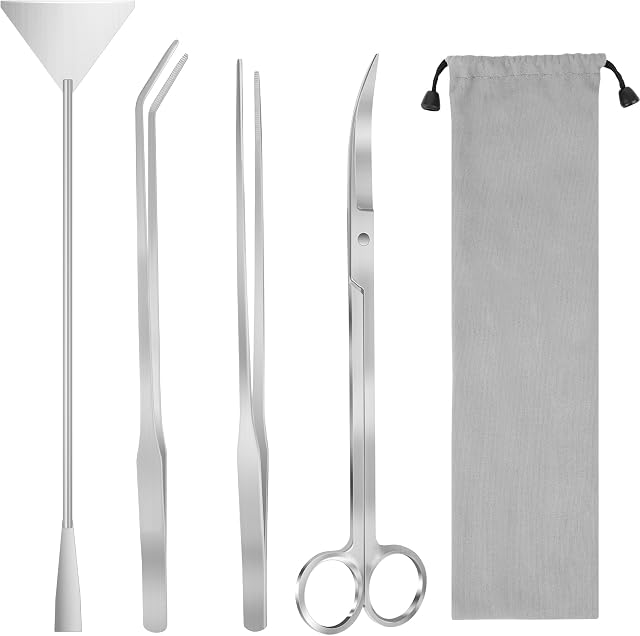
Liveek 4-in-1 Aquascaping Tool Kit
Check Price on Amazon ★4.7Frequently Asked Questions
Is a zen aquascape the same as an iwagumi?
No. Iwagumi is a stone-arrangement grammar — odd-numbered groups, carpeted foreground — a design system. Zen is a philosophy (wabi-sabi) that can use one stone or five, sand gardens or moss valleys. An iwagumi can feel zen, but most zen layouts would fail iwagumi rules, and that's fine.
How do I keep raked sand patterns from disappearing?
Coarse 1–2 mm sand, gentle flow aimed away from the bed, calm livestock only (no diggers), and a weekly re-rake during water changes. Even then, expect softening after 5–7 days — the re-raking ritual is part of the style, not a flaw in it.
Can I do a zen aquascape without CO₂?
Easily — it's one of the best low-tech styles. The classic palette (mosses, Anubias, Cryptocoryne, Bucephalandra, java fern) thrives without injected CO₂. Growth is slower, which suits the aesthetic: a zen tank should look settled and timeless, never rushed or explosive.
What fish suit a zen aquascape?
Small, calm, mid-water schoolers that ignore the sand: chili rasboras, ember tetras, celestial pearl danios, or green neon tetras in groups of 10–15, plus otocinclus for algae. Avoid corydoras, loaches, and cichlids — digging species erase karesansui patterns overnight — choose livestock carefully.
Why does my zen tank look empty instead of peaceful?
Usually three causes: hardscape too small for the tank (scale up the anchor stone), a flat or absent sand pattern (raking adds the texture that makes emptiness read as intentional), or the wrong viewing angle — compose for the one chair you actually sit in.
How is a zen aquascape different from wabi-kusa?
Wabi-kusa is a technique — a ball of emergent plants grown half above water. Zen aquascaping is a design philosophy for the whole underwater scene. They combine beautifully, but one is a planting method and the other is an aesthetic school.
The quiet tank is the hardest tank
Anyone can fill a tank. It takes courage to stop — to place three stones, rake the sand, tie the moss, and declare it finished. That restraint is what makes visitors go silent in front of a zen aquascape: nothing to decode, nothing competing for attention, just water, stone, and time made visible. Start with one stone and one rake. The philosophy does the rest.