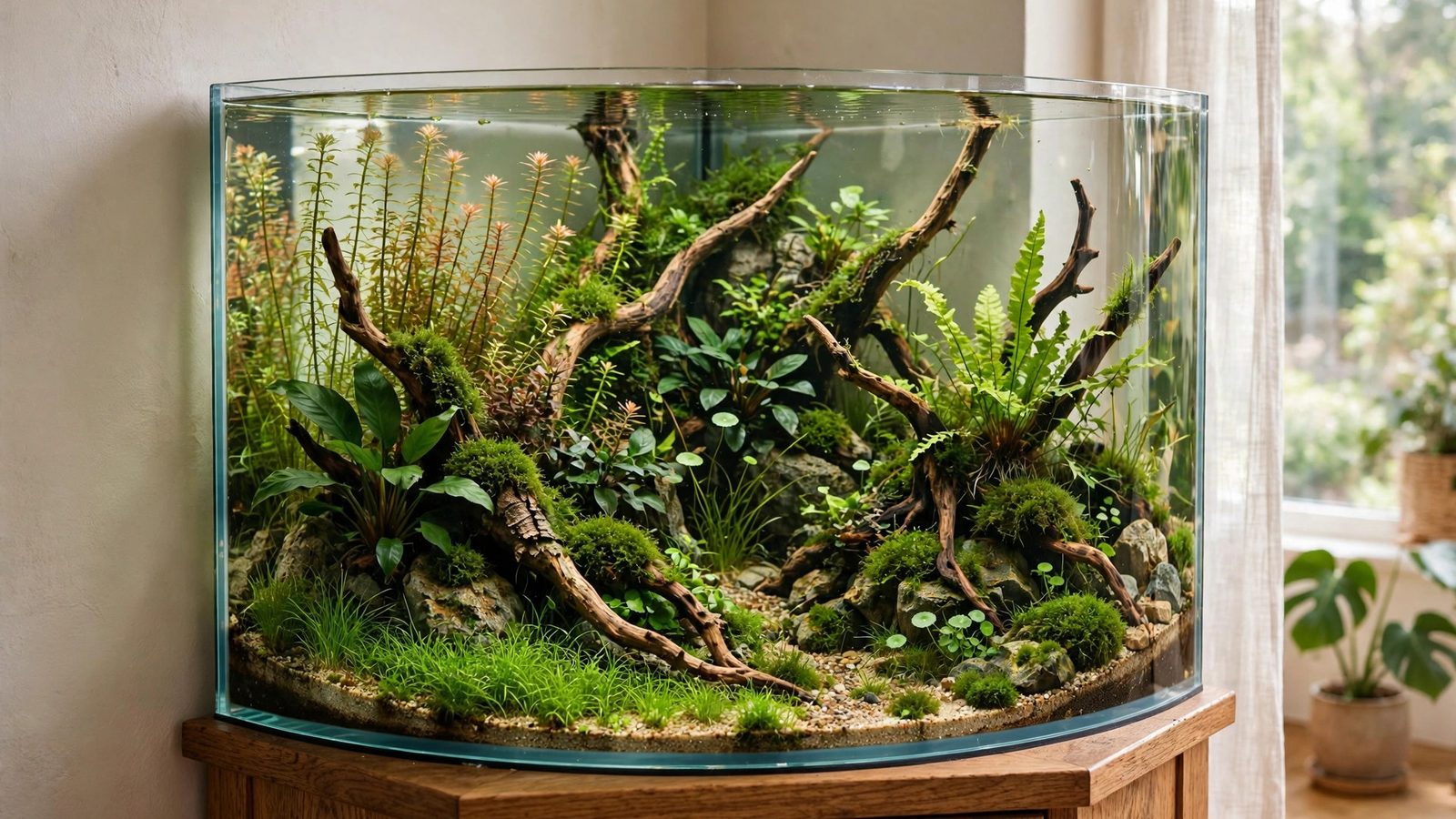
Most aquascapes are designed for a flat pane of glass and a front-row seat. Drop that same layout into a corner tank aquascape and it quietly falls apart: the curve bends straight lines at the edges, side panes you never planned on become viewing windows, and a perfectly centered rock formation sits stranded in a wedge of glass nobody actually looks through. By the end of this guide you will know how to compose for quarter-cylinder corners, bowfronts, and tall columns: hardscape on the true sightline, plants matched to the depth profile, and lighting without the dark-corner trap. New to planted tanks? Work through this lightly planted aquarium setup guide first — these principles stack straight onto it.
corner tank aquascape: three shapes, three rulebooks
Rectangle rules assume one audience in one seat; a corner tank's audience stands everywhere. Tape the tank's footprint on the floor, mark where people linger, and draw a line from each spot to the tank. Where the lines overlap is your primary sightline — everything must read along it.
| Tank shape | Depth profile | Layout strategy | Best for |
|---|---|---|---|
| Quarter-cylinder corner | Deep back corner, curved front | Triangle: tall hardscape in the deep corner, planting falling toward the curve | Room focal points; open-water swimmers |
| Bowfront | Curved front, flat-ish back | Concave valley: low center, planted mounds at both back corners | Big visual impact in living rooms |
| Hex / column | Narrow footprint, great height | Vertical: branching wood and tall rosettes, one open swimming column | Small rooms; betta, shrimp, or a single showpiece fish |
| Corner-flow / L-shape | Rectangular body with a wrapped pane | Island: strong central cluster, sparse edges | Open-plan spaces viewed from two rooms |
The quarter-cylinder is the most forgiving: its deep back corner naturally takes a tall element, and the curve softens everything in front of it. The bowfront is trickiest because the curved front acts like a lens. The hex punishes horizontal thinking; any side-to-side layout looks crushed. Plant choice matters as much as layout, so use the complete guide to freshwater aquarium plants when picking species for each depth profile.
Design for the widest sightline, not the front pane
Here is the exercise that saves more corner scapes than any plant: dry-scape your hardscape outside the tank first. Lay the footprint on the floor in painter's tape, arrange rock and wood inside it, then walk around slowly at sitting and standing height. The arrangement that looks deliberate from three positions is the keeper. Curved glass compresses apparent depth: a rock that looks safely midground from the front can block the whole composition from 90 degrees. The methods to create depth in an aquascape still apply, but run them along the diagonal sightline rather than front-to-back: layer foreground, midground, and background on a 45-degree axis from the deep corner outward. Peninsula tanks share this multi-sided problem: mirrored focal weight and no dead back side translate directly.
Hardscape belongs on the diagonal
The single costliest mistake in curved tanks is placing the hero rock or the big driftwood piece dead center, as rectangle instincts demand. In a bowfront, center means pressed into the lens: the curve magnifies anything within the first 8–10 cm of the front glass, so a center-placed stone reads twice its size and flattens everything behind it. Pull the composition back and to one side instead. A proven corner formula: one tall vertical element (branching wood or a seiryu pinnacle) anchored two-thirds toward the deep corner, a smaller stone cluster one-third out on the same diagonal, open swimming space everywhere else. Keep every piece at least 5 cm off the glass — scraping algae off wood-on-glass through a curve is miserable.
 ★4.2
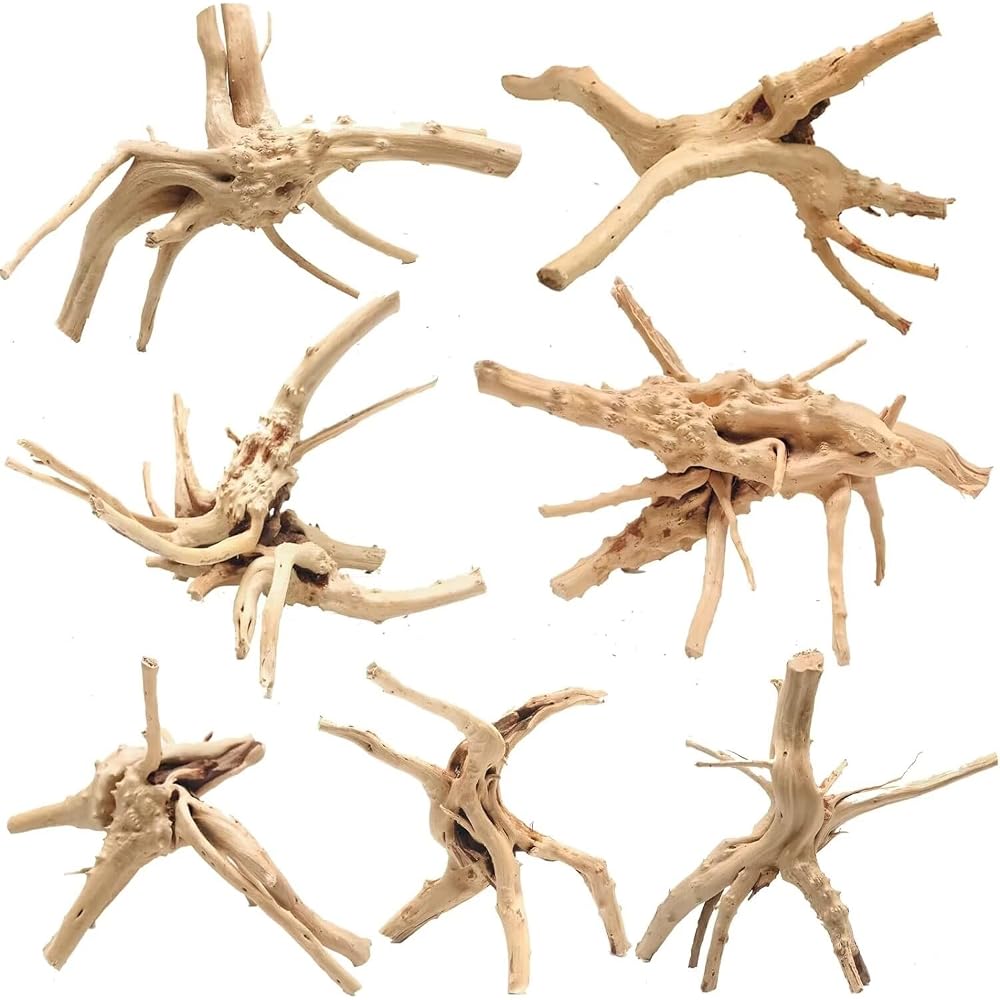
Hamiledyi Natural Spider Wood Driftwood
Check Price on Amazon ★4.2Plants matched to the depth profile
Each shape hands you a different planting geometry, and the winners are species that naturally grow into it. Hex and column tanks suit vertical growers: Vallisneria, Aponogeton and big rosette swords reach the upper third, while Anubias and Bucephalandra ride the vertical wood. Bowfronts reward the opposite: low carpets across the curve, planted crypt mounds at the back corners, and the center valley left open so the curve magnifies empty water. Quarter-cylinders take stem groups along the flat back wall and a single red accent (Alternanthera or Ludwigia) at the deep corner. The vertical aquascape design guide shows how column planting reads from below, and Tropica's inspiration gallery filters scapes by species for narrow footprints.
Lighting quirks of curved glass
Curved glass bends your light cone the same way it bends your view. A bowfront typically runs 10–20% brighter at the substrate center than at the corners, while the curved edges leak light sideways and grow algae on the glass first. The fix: raise the fixture 8–10 cm higher than over a rectangle, dim to compensate, and aim the brightest point slightly forward of center so the curve spreads it. A 6–8 hour photoperiod with a midday siesta tames edge algae while plants establish. PAR 30–50 suits low-to-medium planting; go brighter only with CO2 dialed in, since hotspots punish imbalance fast. The shallow tank aquascaping guide covers spread-first fixture choices that translate well to bowfronts.
Frequently Asked Questions
Can I aquascape a corner tank like a normal rectangle?
No — this is where most corner tanks go wrong. Rectangles are composed for one front pane, but corner tanks are viewed from two or three sides, so centered layouts look lopsided. Design around the widest sightline, anchor hardscape on the diagonal, and keep the deep corner open. The shape is an asset once you stop fighting it.
Where should the focal point go in a bowfront tank?
Off-center, about one-third in from one back corner — never against the curve. The bowfront magnifies anything near the front glass, so a centered focal point looks oversized and flattens everything behind it. Place hero wood or stone on a diagonal, balance it with a smaller cluster opposite, and leave the center open.
Does curved glass distort the view of my scape?
Slightly, mostly at the edges of bowfronts. Straight lines can bend near the curve, and anything within 8 cm of the front glass appears magnified. Use it deliberately: keep hardscape back from the curve, put fine detail where magnification helps, and avoid straight rows of stems that visibly bend at the edges.
What plants work best in a tall hex or column tank?
Tall growers: Vallisneria, Aponogeton and large Echinodorus swords, plus Anubias and Bucephalandra on vertical wood. Skip carpets — they sit in the dimmest zone — and avoid overplanting the top, which shades everything below. One open swimming column keeps the tank feeling tall, not crowded.
Do I need a background on a corner tank?
Usually no — the "background" is a pane someone looks through. Frosted film on the flat back panels hides equipment in quarter-cylinders, but leave at least one side clear if people see through it. For bowfronts and hexes, skip backgrounds and scape for see-through viewing.
Why are the edges of my bowfront darker than the center?
Curved glass bends the light cone inward, concentrating PAR at the center — often a 10–20% difference versus the corners. Raise the fixture 8–10 cm, dim slightly, and shift the bright point forward of center so the curve spreads it. Check corner readings, not just the middle, before judging your plants.
A shape worth celebrating
A corner tank never rewards rectangle thinking, but it offers something a rectangle cannot: a scape that changes as you walk around it. Compose for the sightline, plant for the depth profile, and let the curve turn a corner into the spot everyone gathers around.