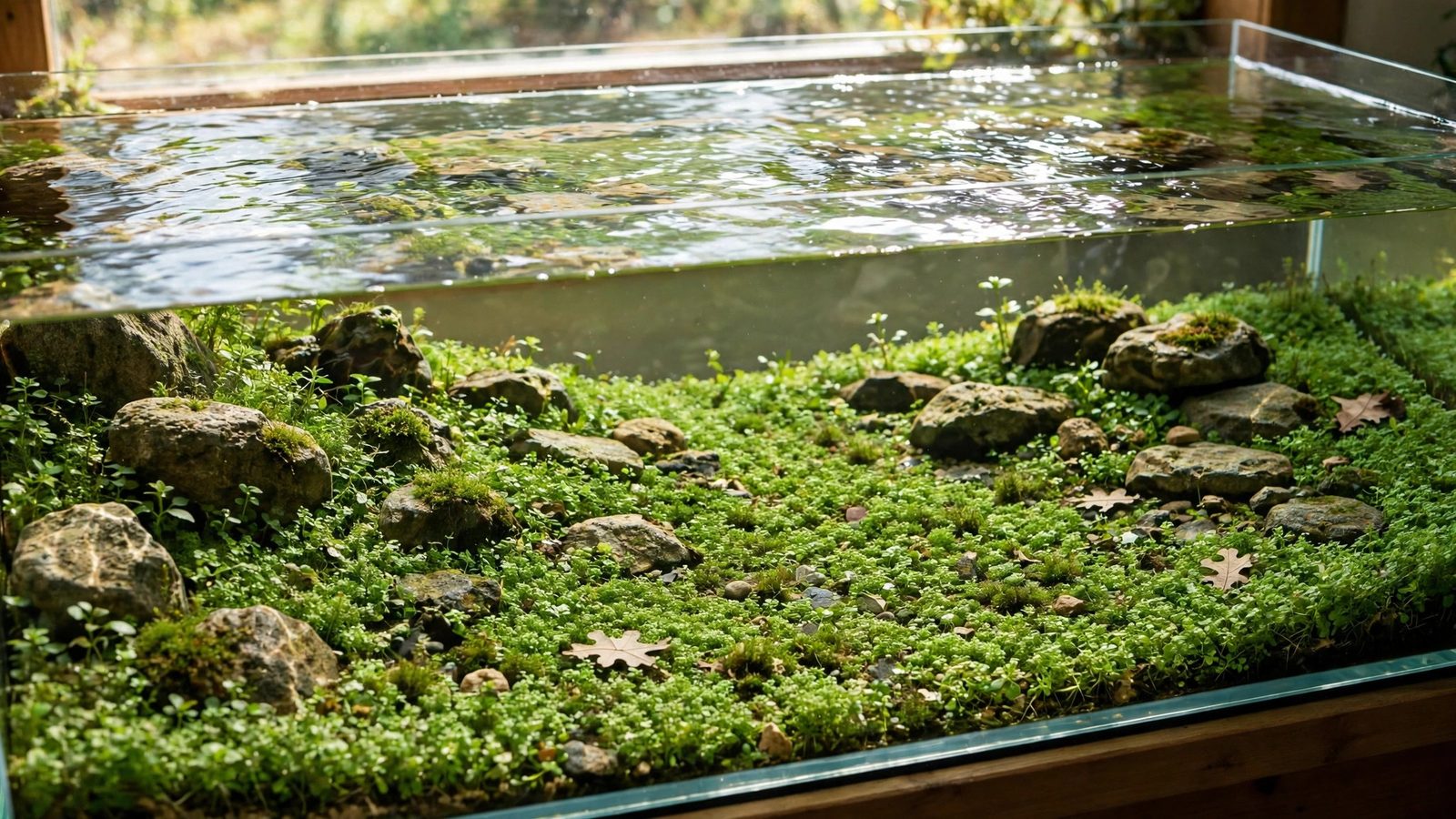
A shallow tank aquascape is a glass frame that behaves more like a living diorama than a traditional aquarium. With water depths of 18 to 25 centimeters, every stone, slope, and stem sits in plain view, so tiny decisions echo loudly. Get the basics right and a shallow tank aquascape becomes one of the most rewarding layouts you can build — a tank you view as much from above as through the front glass.
What Makes a Shallow Tank Aquascape Different
Depth is the whole story. In a standard 45-centimeter-tall tank, plants have room to stretch and equipment hides behind hardscape; in a shallow tank, the water column is roughly the height of a paperback book. There is nowhere for a clumsy filter inlet or a patch of algae to hide. The upside is access: you can reach the substrate with your bare hand, and the top-down view — unavailable in tall tanks — becomes a second stage for your composition.
Pros and cons at a glance
| Advantage | Trade-off |
|---|---|
| Excellent light penetration — even carpeting plants thrive under modest fixtures | Water evaporates fast; salinity and mineral concentration swing quicker |
| Top-down viewing adds a second composition angle | Very limited planting depth — tall stem plants are mostly unusable |
| Easy maintenance: full reach to the substrate by hand | Light spill and glare spill across the room more easily |
| Strong sense of scale with nano livestock | Fish can jump out of low glass; lids matter |
Choosing the Tank
The reference shape for this style is the ADA 60-F style: a 60-centimeter-long, 30-centimeter-deep, 18-centimeter-tall rimless shallow tank. That low profile is the aesthetic sweet spot — long enough for a real composition, low enough that the whole scape reads in one glance. Rimless, low-iron glass is almost mandatory here, since a thick black frame would visually consume a third of the tank's height and ordinary glass tints green at glancing angles.
Planning the Layout: Two Viewing Angles
Most aquascapes are composed for one perspective: the front glass. A shallow tank forces you to design for two — the front view and the view from above. A carpet of Eleocharis acicularis mini looks like a green lawn from the front but reads as texture and pattern from above; a rock that is a bold focal point head-on can look like a dull gray blob from overhead. The trick is to pick a "hero angle" and make the other one support it.
Top-down-heavy designs favor flat carpeting with small accents — a pebble path, a patch of red Alternanthera reineckii mini, a single low stone. Front-view-heavy designs lean on hardscape height: a ridge of dragon stone breaking the waterline draws the eye even from straight ahead. Sketch both angles on paper before you buy stone; five minutes of doodling saves a sack of rocks you cannot place.
The rule of thirds still governs shallow tanks, but the grid stretches: focal points placed at the left or right third of the width carry more weight than anything placed by height, which is why island-style aquascapes adapt so naturally to shallow formats.
Managing Evaporation and ATO Options
Evaporation is the shallow tank's tax on beauty. With an open top and a large surface area relative to water volume, a 60-F style tank can lose half a centimeter of water a day in a dry, heated room — and every lost centimeter is a bigger fraction of the total depth than in a tall tank. That shifts the waterline visibly in days and concentrates dissolved minerals, creeping hardness and pH upward.
Three ways to handle it:
- Manual top-off: keep a jug of remineralized or RO water beside the tank and top up every day or two — honestly what most shallow-tank keepers do.
- Gravity or float-valve ATO: a small reservoir mounted above tank level feeding a float valve. Cheap and silent, but the reservoir must look intentional on your shelf.
- Electronic ATO: optical or float sensors with a small dosing pump in a reservoir. Most hands-off and most expensive.
Always top off with pure RO or distilled water, never tap — evaporation leaves minerals behind, so topping up with mineralized water slowly hardens the tank. Skip a week of top-offs and your waterline drops several centimeters while your TDS climbs.
Lighting Without the Spill
Light that is perfect inside the tank becomes glare the moment it escapes. Shallow tanks are notorious for light spill because fixtures sit close to the waterline and the whole room can see the LEDs directly from a low seating position. The human detail here is real: I once had a beautiful shallow scape that lit my living room like an airport runway every evening — I fixed it in ten minutes with a strip of black aluminum angle clipped along the front edge of the light fixture, and the tank went from floodlight to framed picture.
Practical fixture choices:
- Adjustable-intensity LED bars with a dimmer — shallow water needs far less punch than tall tanks, so run 50–70% power.
- Pendant lights hung higher above the tank for a softer, more even spread.
- DIY or clip-on light shields — matte-black acrylic or aluminum strips on the fixture's front edge block line-of-sight glare without touching the tank's light levels.
Photoperiod stays the standard 6–8 hours, and because light penetration is total, watch for algae on the substrate's sunlit slopes first — that is where it always starts in a shallow tank.
Raising the light tames spill and evens out coverage: light riser brackets.
Jumper-Proofing: Open Top vs. Lids
Open-top shallow tanks look stunning — the waterline becomes part of the composition — but an 18-centimeter wall is not much of an obstacle for a startled fish. Shrimp climb filter tubing; bettas and killifish explore. You have three real options.
Go open-top with the right livestock
Slow, bottom-oriented species like pygmy corydoras, small tetras kept in calm groups, and most ornamental shrimp rarely jump. Keep the waterline 2–3 centimeters below the rim and avoid surface-dashing tankmates, and many keepers run open shallow tanks for years without losses.
Use a mesh or acrylic lid
A custom-cut thin mesh cover sits nearly invisible on the glass edge and stops jumpers cold — the pragmatic middle ground most people end up at.
Raise the waterline with a glass top
A cut sheet of low-iron glass maximizes water volume and looks clean, but it traps heat and reduces gas exchange. Use it only where jumping risk is genuinely high.
Whatever you choose, a lid that hides the waterline from above kills the top-down view entirely — which is why most shallow-tank scapers accept mesh over glass.
Planting Depth Limits: What Actually Works
Shallow tanks brutally expose plant choices. Anything that wants to grow 30 centimeters tall becomes a lid-poking weed within weeks. The usable palette is short by design — and that constraint is a gift, because it forces the kind of tight, deliberate planting that shallow scapes need. The nano-tank plant palette overlaps heavily with what works here.
Carpets and foregrounds
Eleocharis acicularis mini, Hemianthus callitrichoides (HC Cuba), Glossostigma elatinoides, and Marsilea hirsuta are the classic foreground carpets, all staying under 3 centimeters. HC Cuba demands CO2 and good light; Marsilea is the patient person's choice — slow, but nearly indestructible. Check light and CO2 needs for each species in Tropica's plant database before committing.
Midground accents
Staurogyne repens, Bucephalandra tied to low stones, Anubias nana petite, and Cryptocoryne parva give midground structure without breaking scale. Cryptocoryne parva is famously slow, which in a shallow tank is a feature: it stays put for months.
What to avoid
Fast stem plants like Rotala and Ludwigia outgrow a shallow tank in weeks, and tall swords and most Vallisneria are out entirely. If you love a red accent, trim Alternanthera reineckii mini as a low mound.
Epiphytes deserve a special mention: with so little substrate depth, attaching Bucephalandra and mosses directly to hardscape lets the composition breathe without planting holes.
Substrate Strategy for Thin Beds
A shallow tank rarely holds more than 2–3 centimeters of substrate in front, rising to maybe 6–8 centimeters at the back. Sloping the substrate from front to back is the single most important trick for faking depth — a slope of even 5 centimeters reads as a hillside from the front glass. Use buried stones or soil retainers along the slope line to stop it flattening over months, and keep cosmetic sand caps to about 1 centimeter over aquasoil.
If you are building up serious elevation — a back bank that climbs to the waterline — consider a lightweight base layer. Our guide to pumice base layers explains how volcanic rock cuts weight and cost while keeping deep banks aerated.
Composition Techniques for Low Profiles
Depth cues are everything when the tank is only 18 centimeters tall. The classic depth-creation toolkit applies, but shallow tanks change the emphasis:
- Forced perspective with stone size: large stones up front, progressively smaller ones toward the back. The eye reads shrinking scale as distance.
- Diagonal paths: a sand path or carpet gap running from a front corner to the opposite rear corner creates a sightline the eye follows into the tank.
- Overhead canopy gaps: because you view from above too, leave deliberate gaps in the carpet — negative space reads as distance from the top-down angle.
- Low horizon lines: keep hardscape peaks below two-thirds of the tank height. Anything taller breaks the shallow illusion and starts reading as "deep tank crammed into a small box."
Texture contrast matters more here than in tall tanks because everything sits in the same focal plane. Pairing fine Eleocharis against coarse dragon stone, or smooth pebbles against a rough lava-rock ridge, gives the eye landmarks that substitute for depth. A deliberate study of texture contrast pays off disproportionately in shallow formats.
Equipment Placement Without the Clutter
A hang-on-back filter on an 18-centimeter-tall tank is like wearing a backpack on your face. The goal is invisibility: a small canister filter tucked in the cabinet with glass lily pipes in the tank, or a rear filtration chamber in an all-in-one shallow kit. Lily pipes in a shallow tank must be the short "nano" style — standard pipes plunge too deep and churn the substrate.
The heater is the other headache. A 50-watt slim heater laid horizontally along the back glass, or hidden behind a hardscape ridge, disappears entirely; alternatively, run the tank at room temperature if your livestock tolerates it — many shallow tanks house shrimp and nano fish that thrive at 22–24°C. For more camouflage tactics, see our guide to hiding equipment in aquascapes.
Stocking: Scale Is Everything
Fish that look small in a 60-liter cube look enormous in a 24-liter shallow. Stock like a miniaturist: chili rasboras, celestial pearl danios, ember tetras, pygmy corydoras, and ornamental shrimp are the natural residents. A school of 12 chili rasboras over a dwarf hairgrass carpet makes the tank feel vast — the opposite effect of putting a single angelfish in the same box. Keep bioloads light; a shallow tank's small water volume forgives overstocking less than any other format.
Maintenance Rhythm
Shallow tanks are easy to maintain but hard to neglect — small volume means problems arrive fast and visibly. A weekly rhythm works: 30–40% water change, glass wiped inside the waterline, carpet trimmed before it mats, filter rinsed monthly. Trimming carpets is the most frequent job; Glossostigma and HC Cuba need attention every two to three weeks or they lift off the substrate in sheets. Test nitrates weekly for the first two months, then settle into a monthly check once the tank matures.
Algae control leans on the same basics as any planted tank — stable CO2, consistent photoperiod, no overfeeding — but catch it early: a shallow tank's algae problem is always visible, which is actually an advantage. You will see it the day it starts.
Frequently Asked Questions
How much water does a shallow tank lose to evaporation?
A typical 60×30×18 cm open-top shallow tank loses roughly 3–5 millimeters per day in a normal heated room, more in dry winter air. Because total depth is only 18 cm, that is about 2–3% of the water volume daily. Topping up with RO water every one to two days keeps levels and mineral concentration stable; an auto-top-off system removes the chore entirely.
Can you keep fish in a shallow tank, or is it shrimp only?
Small fish work beautifully — chili rasboras, ember tetras, celestial pearl danios, and pygmy corydoras are all excellent choices. Avoid tall-bodied or fast-dashing species, and avoid known jumpers unless you use a mesh lid. Keep schools modest and the bioload light, since the small water volume is less forgiving of overstocking.
Do shallow tanks need CO2 injection?
Not strictly, but CO2 makes the classic shallow-tank carpets — HC Cuba, Glossostigma, dwarf hairgrass — far more reliable and much faster to establish. Low-tech shallow tanks work best with undemanding carpets like Marsilea hirsuta and heavy use of epiphytes such as Bucephalandra and Anubias. If you want the magazine-cover carpet look, budget for CO2.
What lighting wattage suits a shallow aquascape?
Less than you think. With only 18–25 cm of water to penetrate, a dimmable LED bar run at 50–70% power is usually plenty for demanding carpets. Start lower than your instinct suggests and raise intensity only if plants stall. Too much light in a shallow tank is the fastest route to algae, because every photon reaches the substrate.
How do you clean a shallow tank without disturbing the scape?
Use a small-diameter siphon or even a turkey baster for detritus between carpet blades, and wipe the glass with a soft sponge rather than a magnetic cleaner that could topple hardscape. Trim carpets with curved aquascaping scissors and net out the cuttings immediately — loose trimmings rot fast in a shallow tank's warm surface layer.
Are shallow tanks harder than regular tanks for beginners?
They are more honest rather than harder. Mistakes show immediately — an algae bloom or a waterline drop is visible within a day — but the fixes are also quick and the small scale keeps every intervention cheap and easy. A beginner who follows a consistent weekly routine will find a shallow tank one of the most satisfying first builds.
Start Low, Think Wide
A shallow tank aquascape rewards the scaper who thinks in two dimensions at once — front view and top-down — and who respects the format's honest constraints: fast evaporation, shallow roots, and livestock chosen by the centimeter. Meet those constraints and the format hands you something no tall tank can: a living diorama you can read in a single glance, lit like a stage, maintained with your hands rather than your tools. Sketch both viewing angles before you buy a single stone — the aquascape planning process and a solid grasp of focal point placement will save you more than any gadget.