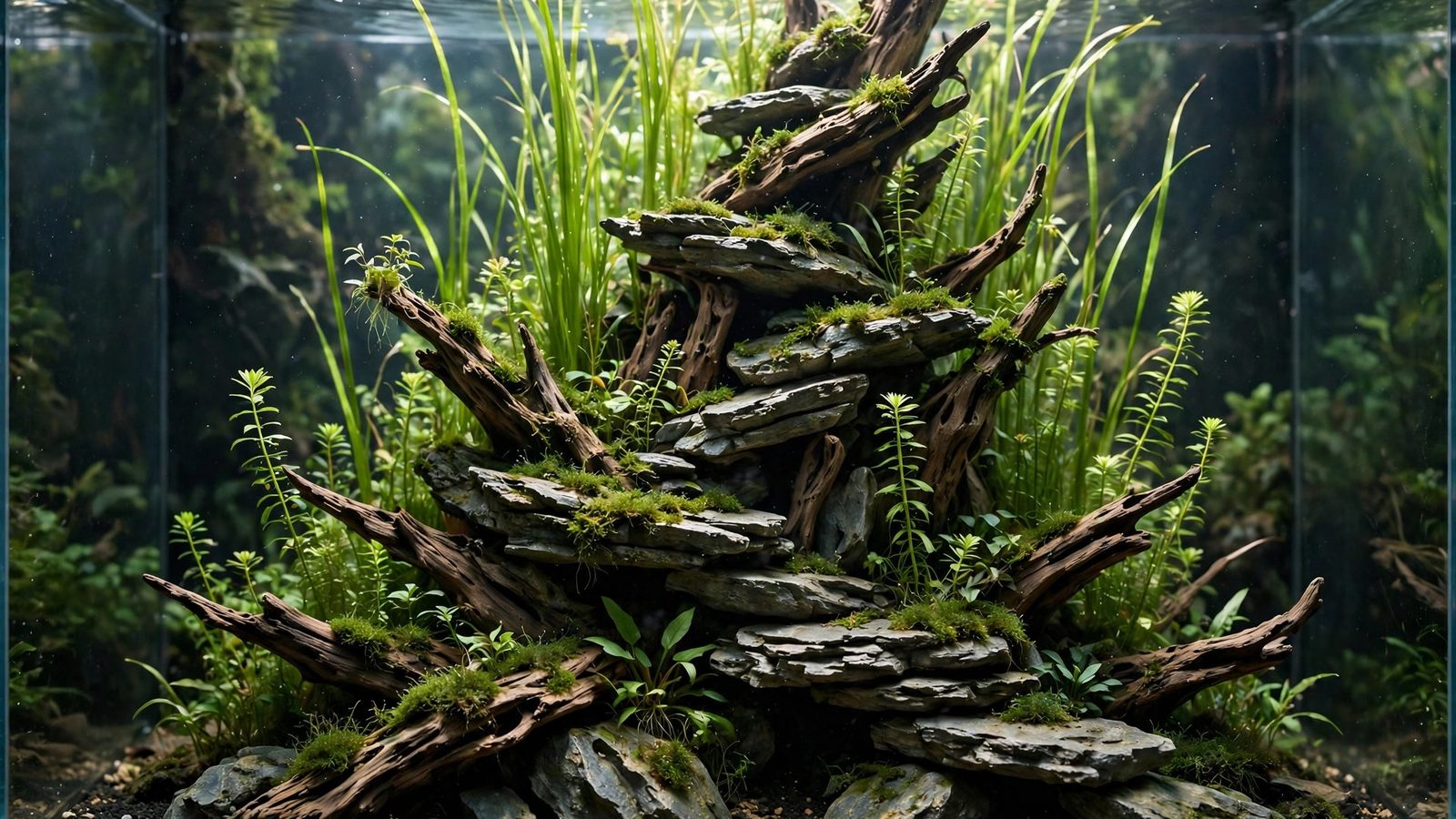
Most planted-tank layout guides are written for wide rectangles: iwagumi's open sand valleys, the Dutch's tiered terraces, the concave's inviting bowl. All of them assume width. Then you buy — or inherit — a tall, narrow aquarium, and every one of those grammars collapses. Plant a low carpet, add a few stones, and your eye falls straight through the bare middle to the filter outlet and surface scum above. That's the core challenge of vertical aquascape ideas: compositions built for the vertical axis first. A tall aquascape design doesn't imitate a riverbed viewed from the side. It imitates a cliff face, a canyon wall, a tower of roots — something your gaze climbs rather than scans.
This guide gives you a complete method for height-driven aquascaping: how to stack hardscape safely, which plants genuinely carry vertical structure, how to light a tall water column without starving the bottom, how to keep water moving from top to floor, and how to reach the upper story for trimming once everything is established. Tall tanks are under-served by design writing, but they're among the most dramatic shapes in the hobby once you stop treating them like broken rectangles.
Why Tall Tanks Break Horizontal Layout Rules
A wide 60-liter rectangle and a tall 60-liter column hold the same water but behave like different environments. In a wide tank, foreground, midground, and background are separate horizontal zones. In a column, those zones stack on top of each other, and the classic failure is the "desert middle" — a planted bottom third, an empty upper two-thirds, and equipment visible at the top. The eye reads the whole thing as unfinished.
Three physical facts drive everything that follows. First, light intensity falls off sharply with distance through water, so the floor of a tall tank can receive far less light than the surface. Second, water stratifies: without deliberate circulation, the lower layers stagnate while the surface stays agitated. Third, gravity never stops working on your hardscape — a toppled rock in a glass box can crack the glass and crush livestock. None of this is mysterious. It just means vertical layouts need their own grammar rather than rotated horizontal ones.
Vertical Aquascape Ideas: Skyline, Anchor, and Ascent
Horizontal layouts organize around vanishing points and golden-ratio focal positions. Vertical layouts organize around the skyline — the silhouette your hardscape and plants draw against the water surface and upper glass. Think of the scape the way you'd read a city skyline or a mountain ridge: interest comes from peaks and saddles, not a flat line. A uniform hedge of stems across the whole tank reads as a ceiling, not a design. Vary the heights so the eye has somewhere to travel.
One anchor, not two
Wide tanks often use two counterbalanced focal areas. Tall tanks should commit to one dominant anchor — a single dramatic piece of hardscape, slightly off-center, rising two-thirds or more of the tank height. Everything else leans on it, literally and visually. This is where focal point placement matters even more than usual: a focal point too high makes the scape feel top-heavy and unstable; too low, and it vanishes into the substrate zone. Aim for the visual center of mass just above the tank's vertical middle.
Lead the eye upward in stages
Don't build evenly spaced shelves — that reads as artificial. Plan two or three ascent points: a rock jutting from a ledge, a branch forking upward, a dense stem cluster climbing from the midground. Each one gives the viewer a handhold for the climb. Concave layouts, covered in our guide to concave layout aquascaping, draw the eye inward; vertical design draws it upward, in stages, from the foreground carpet to the crown.
Respect the top margin
Leave 3–5 centimeters of clear water under the surface, free of hardscape and fast stems. This breathing band keeps the filter intake clear, keeps surface skimmers working, and frames the composition instead of letting it crash into the waterline. Plants that reach the surface should be deliberate exceptions, never the whole back line.
Stacking Hardscape Safely at Height
Stacked stone is the backbone of vertical aquascaping, and a toppling rock is this style's one genuine danger. Follow these rules without exception.
Base and interlock
Every tall structure must sit on the tank floor or on a continuous, level bed of compacted substrate — never on a loose mound that can settle. Build and test your tower before flooding, while you can still push, wiggle, and lean on it with real force. If anything shifts, rebuild. Bury the base stone a few centimeters into the substrate and lean the whole structure slightly back against the rear glass, so gravity pins it into the corner instead of pulling it forward.
For anything taller than about 15 centimeters, stones must interlock: each upper stone resting on at least two contact points below, like dry stone walling. Where a piece won't lock naturally, bond contact points with fully cured aquarium silicone, or bed base stones on a stainless-steel grid buried in the substrate. Never stack smooth, rounded river rocks in a precarious column — rounded stones have no friction faces and they will fail, usually right after you've filled the tank. Keep towers away from the center span of large glass bottoms, where flex and concentrated load are greatest.
Wood is kinder than stone
Branched driftwood is often the smarter choice for vertical builds: it interlocks naturally and weighs far less. Pick pieces with upward-sweeping forks and plant the base deep. Moss, anubias, and bucephalandra tied to vertical wood — see how to attach aquarium plants to driftwood — turn a wooden skeleton into a living wall, one of the signature vertical aquascape ideas and much lighter than equivalent stone.
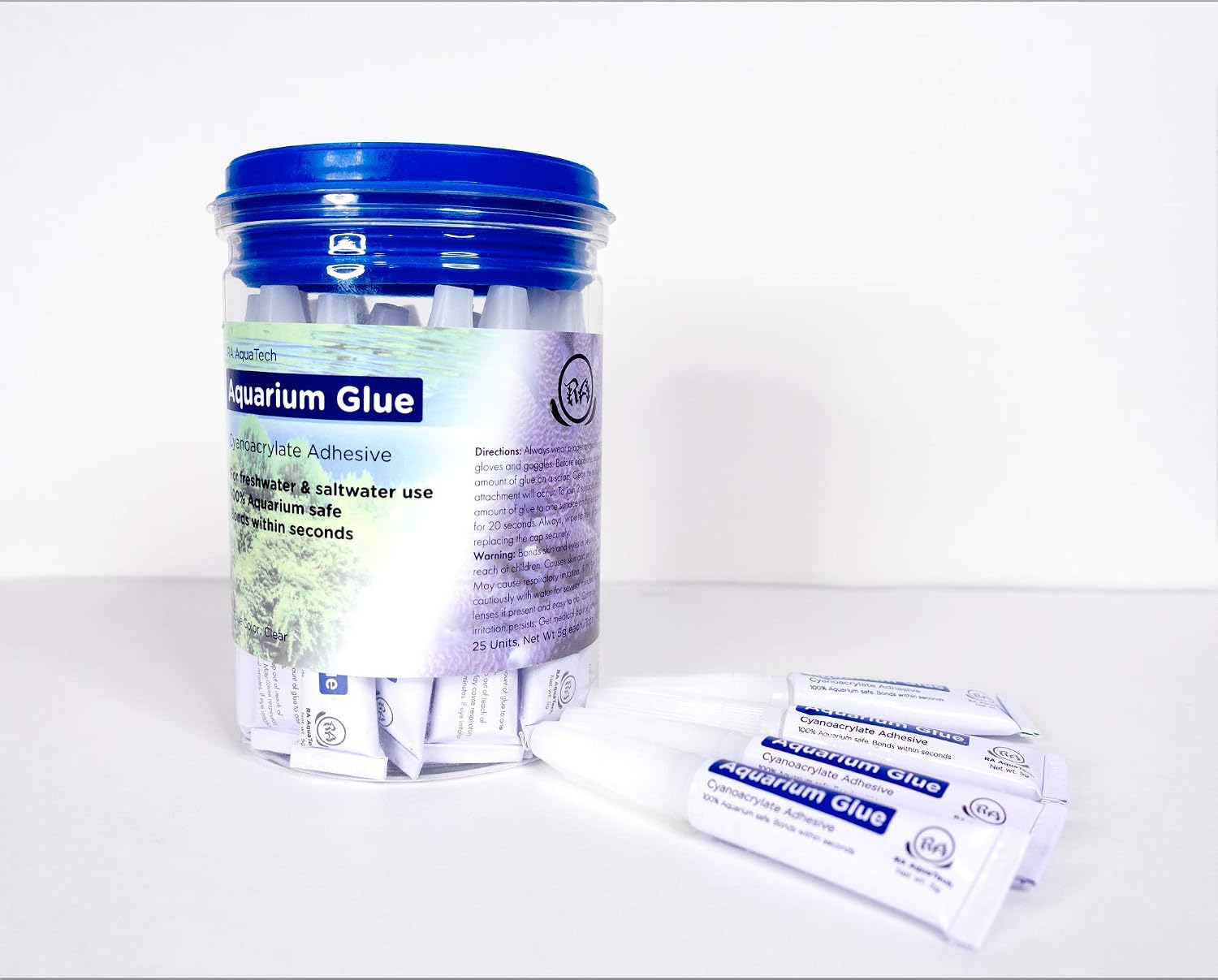
Tall stacks live or die by their bond points: aquascaping glue.
 ★4.3
RA AquaTech Aquarium Glue
Check Price on Amazon ★4.3Plants That Carry Vertical Structure
The instinct is to buy tall background plants and let them run. That fails because most fast stems grow straight past the midground and collapse into a curtain with bare lower halves — worse under the dim bottom light of a tall column. Choose plants that hold density at every height.
| Plant | Vertical role | Notes for tall tanks |
|---|---|---|
| Anubias barteri / nana | Mid-stack structure | Tied to ledges at any height; tolerates the dim lower column where stems would rot. |
| Bucephalandra species | Accent color on stone | Slow but rock-tough; blues and purples add color without adding height. |
| Java fern | Feathered mid-level mass | Fills gaps between stone and wood with airy texture; undemanding. |
| Vallisneria / sagittaria | True vertical lines | Ribbon leaves rise the full column — among the only plants that draw genuine vertical strokes. |
| Water wisteria / hygrophila | Fast fill behind stacks | Hides bare structure quickly, but needs regular topping to stay bushy in low bottom light. |
| Mosses (java, christmas, weeping) | Canyon-wall texture | Blankets every horizontal surface of a stack; the best tool for a planted-cliff look. |
| Cryptocoryne wendtii | Base grounding | Low rosettes anchor the bottom of towers and mask the structural base. |
| Dwarf sagittaria / eleocharis | Foreground contrast | A low carpet around tower bases makes the vertical elements read taller by contrast. |
A useful rule: epiphytes for the stack, rooted plants for the floor. Anything attached to hardscape feeds from the water column and performs the same at any height. Rooted stems forced into the dim lower third are the classic cause of leggy, rotting middles — use them in the bright upper third or skip them. If budget constrains your plant order, buy the stack epiphytes first; our guide to aquascaping on a budget covers how to stretch one plant order across a whole layout.
Lighting a Tall Water Column
In a 45-centimeter-deep column, the substrate can receive less than half the light the surface gets, and algae will colonize the bright upper rocks while the floor starves. The fix is layered thinking rather than raw power:
- Raise, don't overdrive: hang the light 20–30 cm above the rim. The wider spread evens out top-to-bottom falloff and kills hotspots on the tower crown.
- Measure the floor: choose photoperiod and intensity from what the bottom plants get. If the lower third is a dim zone, plant it as one (anubias, crypts, moss) instead of adding light that only feeds algae upstairs.
- Side-fill trick: a small low-intensity clip-on aimed at the lower half from the side can rescue a dark column bottom without brightening the surface.
- Start conservative: six hours of moderate light beats eight hours of strong light in a new vertical build. Extend duration only after plants grow actively and upper rocks stay algae-free.
CO₂ follows the same gradient logic. Place the diffuser low and near the filter intake so gas circulates up through the column, and confirm with a drop checker parked at mid-depth — the surface reading always looks fine while the bottom starves. Keep dosing conservative at first: gas gradients are steep in tall water, so start low and observe livestock behavior before increasing.
Flow and Filtration: Moving Water Up, Not Around
Standard filters push water horizontally. In a column you need vertical circulation: surface water driven down one side, bottom water lifted on the other. A single strong outlet at the top creates a lazy eddy in the lower third that accumulates detritus and dead spots.
- Angled outflow: aim the spray bar or lily pipe diagonally downward so the current reaches the substrate before climbing the far wall. Every plant should sway gently, including the bottom third.
- Powerhead low: in tanks over 50 cm tall, a small powerhead or internal filter placed low on the opposite wall breaks up stratification. Baffle it so livestock don't fight the current.
- Pre-filter discipline: vertical tanks shed moss and debris from upper structures; a pre-filter sponge on the intake prevents clogs — the most common cause of "mysterious" flow loss in these tanks.
- Night oxygen: tall tanks hold a lot of plant mass relative to their surface area. Watch for fish hanging at the surface in the morning and add after-dark surface agitation if you see it.
Maintenance Access and Trimming Up High
A vertical scape is only as good as your ability to service it. Before planting, rehearse the maintenance: reach every ledge with your tools through the tank's opening. Long tweezers and curved scissors are the price of admission, and top-loading narrow tanks often have small openings — keep the fiddly detail work where your hands can actually go.
Trim from the top down. Comb and thin epiphyte mats so light reaches the rock behind them; harvest moss on upper ledges before it mats into a rotting thatch. Trim vallisneria and other ribbon plants at the base — pull and replant the runner — rather than mid-leaf, since a cut leaf browns at the tip and spoils the vertical line. Re-level substrate around tower bases every few water changes: substrate creeps downhill, and an undermined tower needs rebuilding before it shifts.
Frequently Asked Questions
What tank sizes work best for a vertical aquascape?
Columns with height at least 1.5 times the width are the sweet spot — tall nano columns of 30–60 liters are typical. Very narrow tubes under 20 liters are hard to service and stratify badly, while merely deep standard tanks still follow horizontal grammar. For a first vertical build, a 30 × 30 × 60 cm column is forgiving: room to stack and room to reach in.
How do I keep stacked rocks from falling?
Three rules: bury and brace the base stone so it cannot slide, interlock upper stones with at least two contact points each, and test with real force before planting. Rounded river rocks stack poorly — use angular stone with friction faces. For stacks over 15 cm, bond contact points with fully cured aquarium silicone or pin the base on buried grid. Never build on loose, unsettled substrate.
Why do my tall plants go bare at the bottom?
Light falloff through the water column is the usual cause: the lower third of a tall tank is dramatically dimmer, so stems stretch and drop lower leaves. Fix it with plant selection — epiphytes on the stack, light-hungry stems in the bright upper third, crypts and moss on the dim floor. Adding more light usually just grows algae on the bright upper rocks.
Do I need CO₂ for a vertical aquascape?
No — the best vertical plants (anubias, bucephalandra, moss, java fern, crypts) are low-tech champions. What tall tanks genuinely need is circulation so dissolved gases move through the whole column. If you inject CO₂, place the diffuser low near the filter intake, verify with a mid-depth drop checker, and start conservative — gradients are steep in tall water, so watch livestock before increasing dosage.
How do I clean algae off a tall rock tower?
Prevention beats scrubbing: moderate upper-rock light, good circulation so detritus doesn't settle on ledges, and climbing cleaners like nerite snails and otocinclus. For spot work, a long-handled soft brush reaches most ledges during water changes. Never chip or pry at the rock itself — mechanical force on a stacked tower is exactly what risks a collapse.
Can I make a vertical aquascape in a regular rectangular tank?
Yes — build one tall anchor on one side and treat the rest of the tank as breathing room. This "tower on the prairie" style is easier than a true column because you keep the simple access and circulation of a rectangle. The same rules apply: stable interlocked base, epiphytes on the structure, one dominant anchor, and a clear breathing band at the surface.
Your Vertical Aquascape Ideas, Built Up
A vertical aquascape rewards a different patience than a wide layout. You aren't arranging a landscape you look across; you're building something you look up at — a small canyon, a root tower, a cliff that happens to be underwater. Get the structure mechanically sound, let epiphytes green it at every height, keep the column moving and the floor planted, and the shape that looked so awkward on the shelf becomes the most dramatic tank in the room. For how the horizontal grammars this style departs from read when width is the constraint, see our guide to creating depth in an aquascape.