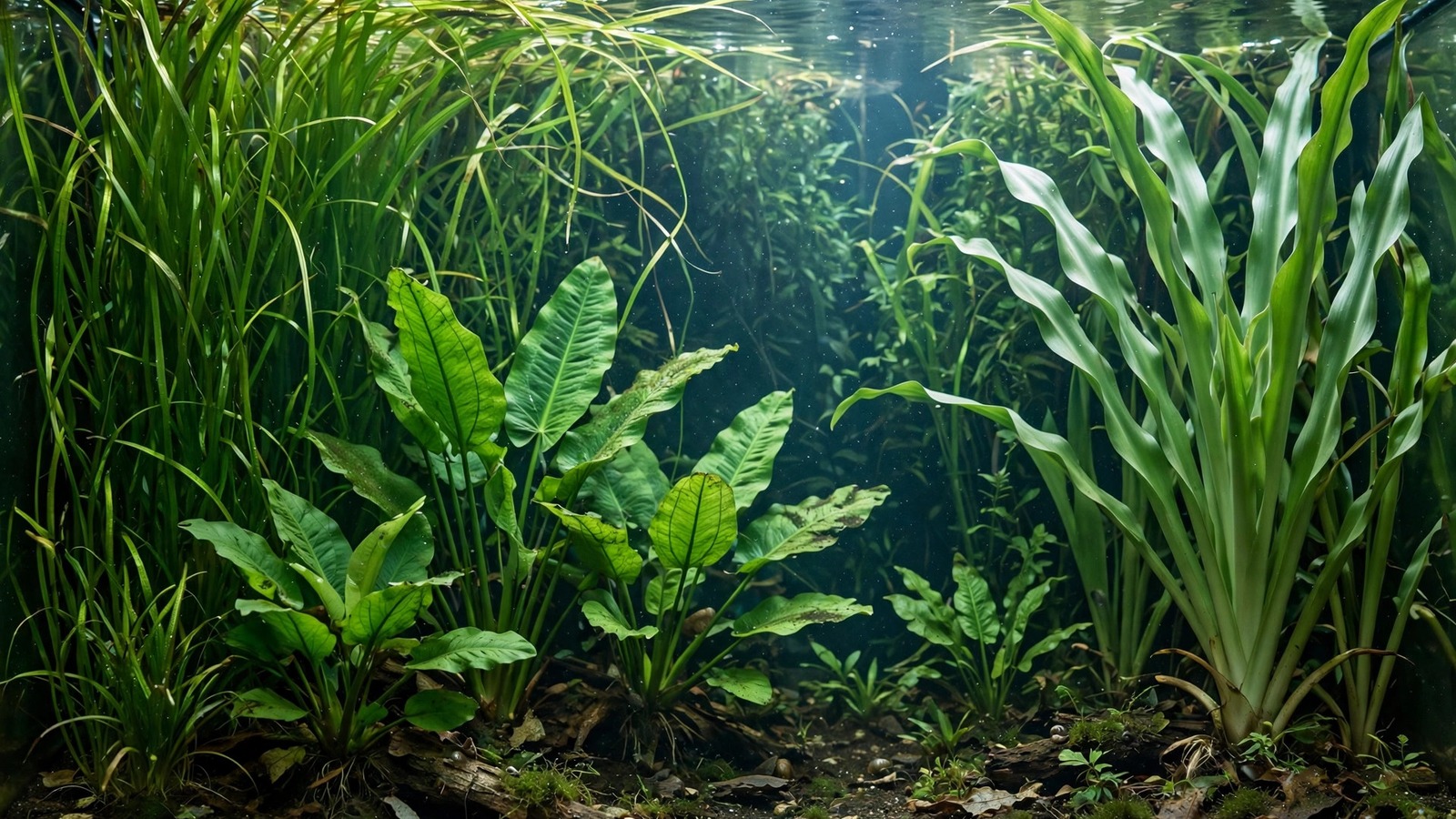
Most background-plant lists quietly assume an 18-inch tank, and that assumption collapses in anything deeper. In a 24-inch-plus aquarium, species that look statuesque in shallow water stall at mid-height, leaving a bare band of glass no hardscape can hide. Choosing tall background aquarium plants that genuinely reach from substrate to surface fixes this: the back wall fills in, depth perception improves, and shy fish get the vertical cover they crave.
This guide profiles twelve species that honestly earn the word "tall" — every one clears 50 cm in a healthy tank, and several cruise past a meter. Each profile gives you realistic height, growth rate, light and CO2 needs, and the planting techniques that separate a plant that survives in a deep tank from one that dominates it.
Choosing Tall Background Aquarium Plants for Deep Tanks
Depth changes three things. First, light fades fast with distance: medium light at 12 inches can be low light at 24, so tall species must tolerate dim roots while their tops bask near the surface. Second, many "background" plants simply aren't tall enough — a 35 cm plant will always leave a gap in a 60 cm tank. Third, CO2 and flow distribute unevenly in deep water, so species demanding high CO2 at substrate level often struggle.
The fix is to pick species whose natural maximum height exceeds your tank depth, then mix growth habits. Tall rosettes (swords, crinums) anchor back corners with permanent structure; runner-spreaders (vals, Egeria) and fast stems fill the back wall quickly but need thinning. Plant both from day one: fast growers give instant coverage while slow anchors mature.
Substrate depth matters too — mound 7–10 cm at the back (higher than the front) so heavy root feeders can build the root systems that support meter-tall leaves, and pair them with root tabs from day one. Our guide to DIY aquarium plant fertilizer covers feeding routines that keep tall plants growing without triggering algae.
12 Species That Genuinely Fill Vertical Space
1. Vallisneria americana (Jungle Val)
Height: 100–150 cm+. Growth: very fast via runners. The undisputed king of tall background plants — ribbon leaves shoot up and trail along the surface, curtaining the back wall of even a 30-inch tank within months. Light/CO2: thrives in low to medium light with no injected CO2, ideal for deep tanks where substrate light is limited.
Planting: space crowns 5–8 cm apart along the back glass, crowns level with the substrate. Thin runners ruthlessly or it crowds slower neighbors. Remove whole outer leaves at the base rather than cutting across blades, which leaves ragged brown edges. Check local regulations before buying — see our guide to invasive aquarium plants you should never release.
2. Vallisneria spiralis (Straight Val)
Height: 50–75 cm. Growth: fast. Jungle val's neater sibling, with straight, upright blades that reach the surface of a 24-inch tank without draping half the waterline in foliage. Light/CO2: low to medium light, no CO2 needed. Expect initial melting after planting; new crown growth means it has settled.
Planting: excellent for back corners of 55–75 gallon tanks, where its tidy habit frames the scape. Spreads by runners, so leave expansion room or uproot daughters monthly. Avoid glutaraldehyde-based liquid carbon products around vals — many hobbyists report melted leaves.
3. Echinodorus bleheri (Broad-Leaf Amazon Sword)
Height: 50–60 cm. Growth: moderate. The classic big-tank anchor: broad lance leaves on a rosette spanning 40 cm wide, with a presence no stem plant can match. Light/CO2: medium light ideal (tolerates less, grows slower); no CO2 needed. A heavy root feeder — root tabs are non-negotiable.
Planting: allow 25–30 cm clearance and keep the crown just above the substrate (buried crowns rot). In deep tanks, mound substrate behind it to lift the crown toward the light. Strip old outer leaves at the base to keep the rosette open and push energy into new growth.
4. Aponogeton ulvaceus (Wavy Aponogeton)
Height: 50–70 cm. Growth: moderate to fast in its growing phase. A bulb plant unfurling translucent, rippled leaves in an almost luminous green — the soft, flowing centerpiece of a deep background. Light/CO2: medium light, no CO2 required; feeds from roots and water column, so combine root tabs with liquid fertilizer.
Planting: set the bulb half-buried with the growing tip exposed in a back corner. Expect periodic dormancy — leaves drop for weeks, then the bulb resprouts. Don't discard it. Stagger two bulbs so the background never goes bare at once.
5. Aponogeton boivinianus (Boivin's Aponogeton)
Height: 60–80 cm. Growth: moderate. Bold where ulvaceus is delicate: dark green, heavily textured ("bullate") leaves with an almost prehistoric look, genuinely dramatic in tanks over 24 inches deep. Light/CO2: medium light; tolerates lower light better than it looks. No CO2 needed; iron-rich root feeding deepens its color.
Planting: allow 30 cm around the bulb for leaf spread, and plant faster companions behind it while it establishes. Like all aponogetons it may go dormant — a 6–8 week cool rest often triggers a stronger comeback than leaving a struggling bulb in place.
6. Crinum calamistratum (African Onion Plant)
Height: 100–120 cm. Growth: slow. A bulb plant with narrow, crinkled, corkscrew-twisted leaves rising like green ribbons — a living sculpture. Slow to establish, but one mature specimen can define a deep background for years. Light/CO2: low to medium light, no CO2; among the safest tall picks for deep low-tech tanks.
Planting: set the bulb with its neck above the substrate and never move it afterward — crinums sulk for months after disturbance. Feed with root tabs twice a year and otherwise leave it alone. Budget six months before it looks impressive; the decade after is the reward.
7. Crinum thaianum (Thai Onion Plant)
Height: 150 cm+. Growth: slow to moderate. The tallest crinum in the hobby, with smooth strap leaves that flow at the surface like kelp — exactly the vertical fill shorter background plants can't provide. Light/CO2: low to medium light, no CO2; tolerates dim substrate zones well.
Planting: one plant per back corner is plenty given its enormous spread. Keep the bulb neck exposed during rescapes. Surface-trailing leaves shade heavily — thin the oldest leaves at the base if midground plants start stretching. Choose its spot on day one; it hates being moved.
8. Hygrophila corymbosa (Giant Hygro / Temple Plant)
Height: 60 cm+. Growth: fast. A disciplined stem plant with broad, bright-green leaves that grows straight up and branches when trimmed — a few stems become a dense background hedge within weeks. Light/CO2: medium light, no CO2 required; CO2 and good fertilization speed it up and intensify color.
Planting: group five or more stems 3–4 cm apart; singles look sparse. When stems hit the surface, cut two-thirds down and replant the tops — stumps sprout two shoots each, doubling the hedge. For color contrast beside all this green, see our guide to red aquarium plants that thrive without CO2.
9. Limnophila aquatica (Giant Ambulia)
Height: 50 cm+. Growth: fast. Feathery, whorled bright-green foliage — the texture contrast against broad swords and ribbon vals gives the back wall real visual depth. Light/CO2: medium to high light (gets leggy when dim); CO2 helps significantly. Nutrient-hungry — don't let nitrates or iron bottom out.
Planting: trim early and often, replanting the top third to keep the stand bushy from base to tip. In deep tanks, set it slightly forward of the back glass so light reaches lower leaves. It's also a proven fast-growing stem that fights algae in new tanks by outcompeting algae for nutrients.
10. Myriophyllum mattogrossense (Mato Grosso Milfoil)
Height: 60 cm. Growth: fast. Finer and more delicate than giant ambulia, with soft pinnate leaves in a yellow-green that glows under good light and sways in gentle current — motion that stiff rosettes can't provide. Light/CO2: medium light, no CO2 required; tolerates a wide temperature range.
Planting: plant small bunches with space between them rather than one dense clump, and thin regularly — fine stems tangle. Trimmings root readily, so share them with fellow hobbyists instead of flushing them (see the responsibility note below).
11. Potamogeton gayi (Gay's Pondweed)
Height: 60 cm+. Growth: moderate. An underused gem: narrow, wavy, olive-green leaves on upright stems with a wild, meadow-like character perfect for natural-style scapes — and it needs far less trimming than most tall stems. Light/CO2: low to medium light, no CO2; keeps its form even when substrate light is modest.
Planting: space stems a few centimeters apart for the meadow effect; it spreads by separable side shoots. It's uncommon in shops, so quarantine new purchases and inspect for hitchhiker snails and algae before adding them to a display tank.
12. Egeria densa (Brazilian Waterweed / Anacharis)
Height: 60–100 cm. Growth: very fast. Bright green whorls on brittle stems that rocket upward in almost any conditions — low light, no CO2, cool or warm water. Arguably the easiest tall background plant in existence, which is exactly why it demands responsible handling. Light/CO2: thrives in low light with zero supplementation.
Planting: anchor bunches in substrate or let stems float — both work. Stems snap easily and every fragment roots, so collect all trimmings during maintenance. Never release it into waterways: it's a documented invasive in many regions, and the responsibility note below plus our guide to invasive aquarium plants you should never release cover safe disposal.
Tall Background Plants at a Glance
Shortlist by your tank's constraints — height first, then light and speed.
| Species | Max height | Growth rate | Light | CO2 needed? |
|---|---|---|---|---|
| Vallisneria americana | 100–150 cm | Very fast | Low–medium | No |
| Vallisneria spiralis | 50–75 cm | Fast | Low–medium | No |
| Echinodorus bleheri | 50–60 cm | Moderate | Medium | No |
| Aponogeton ulvaceus | 50–70 cm | Moderate–fast | Medium | No |
| Aponogeton boivinianus | 60–80 cm | Moderate | Medium | No |
| Crinum calamistratum | 100–120 cm | Slow | Low–medium | No |
| Crinum thaianum | 150 cm+ | Slow–moderate | Low–medium | No |
| Hygrophila corymbosa | 60 cm+ | Fast | Medium | No |
| Limnophila aquatica | 50 cm+ | Fast | Medium–high | Helpful |
| Myriophyllum mattogrossense | 60 cm | Fast | Medium | No |
| Potamogeton gayi | 60 cm+ | Moderate | Low–medium | No |
| Egeria densa | 60–100 cm | Very fast | Low | No |
Planting Techniques for Deep-Tank Backgrounds
Terrace the substrate. Slope from 3–4 cm at the front glass to 8–12 cm at the back. This gives root feeders the depth they need and lifts the planting zone closer to the light — a meaningful gain in a 24-inch tank. Lock the slope with flat stones or driftwood along the contour lines.
Stage fast and slow together. The quick fillers give you a finished-looking background in weeks; the slow anchors take over the composition over months. Without the fast layer, most people give up on slow plants before they peak — and without the slow layer, the tank never gains permanence.
Light for depth. Choose fixtures rated for your tank's depth (manufacturers publish PAR-at-depth charts) and start with a 7–9 hour photoperiod. If lower leaves yellow while tops look fine, that's a penetration problem, not necessarily a nutrient problem — raising the fixture slightly often fixes it better than more fertilizer.
Manage the surface canopy. Tall plants that reach the top will shade everything below — welcome for fish that like dim water (many betta tanks use floating val leaves as cover), but thin weekly if midground plants stretch. Remove whole outer leaves at the base; trim stem tops before they mat across the waterline. Tough-leaved swords and crinums also survive pleco tanks, where softer stems get rasped to skeletons.
A Responsibility Note on Vigorous Spreaders
Several of the most effective tall background plants — Egeria densa, Vallisneria species, Hygrophila — are restricted or invasive in parts of the world precisely because they establish so readily. That vigor makes them great aquarium plants and dangerous escapees. Dispose of all trimmings in household trash or compost, never down drains or into ponds, ditches, or stormwater systems, and rinse nets and buckets away from waterways.
If you're unsure which species are regulated near you, the UF/IFAS Center for Aquatic and Invasive Plants maintains identification resources and regional guidance, and Tropica's plant database includes cultivation notes for matching species to your setup. The hobby keeps its freedom to trade these plants only if hobbyists handle them responsibly.
Frequently Asked Questions
How tall should background plants be in a 24-inch-deep tank?
Choose species with a realistic maximum height of at least 50 cm (20 inches), preferably 60 cm or more. Anything shorter leaves a visible band of bare glass above it that breaks the illusion of depth. Vals, crinums, and giant hygro comfortably clear this bar, while many plants sold as "background" plants top out at 30–40 cm and disappoint in deep tanks.
Do tall background aquarium plants need CO2 in a deep tank?
Most species in this guide — vals, swords, crinums, aponogetons, Egeria — grow well without injected CO2, which is fortunate because CO2 distributes unevenly in deep water. They need adequate light and root nutrition instead. Only the fastest fine-leaved stems, like giant ambulia, improve dramatically with CO2, so start low-tech and add it only if growth stalls.
Why do my Vallisneria leaves melt or stay short after planting?
Melting right after planting is normal: vals often shed emersed-grown leaves and regrow submerged-adapted ones from the crown within two to three weeks. Stunted growth afterward usually means too little light at the substrate, a buried crown, or exposure to liquid carbon supplements. Plant crowns at substrate level, add root tabs, and leave new runners undisturbed.
Can I mix tall stem plants with rosette plants in the background?
Yes — this is the most reliable deep-tank strategy. Fast stems like Hygrophila corymbosa and Myriophyllum fill the back wall within weeks, while slow rosettes like Amazon swords and crinums build permanent structure over months. Plant both at once, then thin the stems as the rosettes mature, so the background transitions from quick cover to long-term architecture without ever looking empty.
How do I stop tall plants from shading everything in front of them?
Thin the canopy weekly: remove whole outer val and sword leaves at the base rather than cutting across blades, and trim stem tops before they mat at the surface. In very deep tanks, some surface cover is genuinely beneficial — it mimics the dappled light fish experience in nature. Aim for filtered light reaching the midground, not a sealed lid of foliage.
Start With Height, Then Build Around It
The single biggest upgrade for a deep tank is choosing background plants by honest maximum height instead of the store label. Pick two or three species here — one fast spreader for quick coverage, one bold rosette or bulb for structure — terrace your substrate, feed the roots, and give the slow growers time. Within a season, that empty band of glass becomes the most alive part of the tank: leaves rising, trailing, and swaying all the way to the surface, exactly as a deep aquarium should look.
Tissue-culture plants are the exception — they’re grown in sterile gel and adapt with minimal melting, which is part of what you’re paying for. Plants bought submersed from another hobbyist’s tank also transition with little melt, since they’re already in the right form.
Which Plants Melt Most (and Least)
Heavy melters (expect significant leaf loss)
- Cryptocorynes — infamous for “crypt melt,” sometimes dropping every leaf after any disturbance. They almost always recover from the roots within weeks.
- Stem plants grown emersed — rotala, ludwigia, and hygrophila often shed lower emersed leaves while the growing tips transition.
- Amazon swords — emersed-grown swords typically lose their broad oval aerial leaves and replace them with longer submersed ribbon leaves.
Light melters
- Anubias, java fern, bucephalandra — slow-growing rhizome plants transition gradually; occasional old-leaf melt but rarely dramatic.
- Vallisneria — usually transitions well, though it dislikes the move itself and may sulk for a week.
- Floating plants — minimal melt since their leaves were already at the air-water interface.
The Acclimation Protocol
Step 1: Quarantine or dip first
Before acclimating to your tank’s conditions, make sure you’re not acclimating pests along with the plant. Run new arrivals through our quarantine and dip protocol — it adds days upfront but prevents months of regret.
Step 2: Float to temperature-match (30 minutes)
Float the bag or container in your tank for 20–30 minutes to equalize temperature. Plants are less temperature-sensitive than fish, but a 10°F shock on top of transplant stress is an avoidable insult.
Step 3: Trim before planting
Remove any leaves that are already damaged, yellowing, or heavily algae-covered — they won’t recover and they’ll rot in your tank, feeding algae. For stem plants, trim off the bottom inch and any emersed leaves that look unlikely to adapt; the plant wastes energy maintaining leaves it’s going to shed anyway. Keep the healthy growing tips — that’s where recovery starts.
Step 4: Plant correctly the first time
Follow our planting guide — right depth, crown exposed on rosettes, rhizomes unburied on epiphytes. Every uprooting and replanting restarts the acclimation clock, so get placement right on the first attempt. Decide where each plant goes before it goes in the water.
Step 5: Run a gentle first week
For the first 7 days after planting:
- Moderate light — run your normal photoperiod but consider dropping intensity 20–30% if your light is dimmable. Blast-level light on a melting plant grows algae on the dying leaves, not recovery.
- Stable CO2 — if you inject CO2, keep it consistent. Fluctuating CO2 during acclimation is a melt accelerator. If you’re low-tech, this doesn’t apply — see growing without CO2.
- Half-strength fertilizer — new plants with damaged leaves can’t use full dosing, and the excess feeds algae. Ramp to full strength over 2–3 weeks per our fertilizer schedule.
- No disturbance — don’t move, trim, or “check on” new plants for at least two weeks. Every touch resets root establishment. This is especially critical for crypts.
Step 6: Remove melt, keep the base
As emersed leaves melt, remove the mushy material promptly — decaying leaves release ammonia and grow fungus that can spread to healthy tissue. But never discard the plant while the crown, rhizome, or roots are firm and alive. A crypt that’s lost every leaf but has firm roots is a plant that’s about to recover, not a dead plant. Give it 3–4 weeks before judging.
Telling Normal Melt From Real Problems
Normal transition melt:
- Affects oldest/emersed leaves first, newest growth last
- New submersed leaves emerge even as old ones dissolve
- Roots and crown stay firm and white/green
- Timeline: 1–4 weeks, then obvious new growth
Concerning melt (see our full melting diagnosis guide):
- New growth also melts or emerges deformed
- Rhizome or crown turns mushy and brown — this is rot, not transition
- Entire plant dissolves within days with no new growth after 4+ weeks
- Melting spreads to established plants that weren’t recently moved
Buying Tips to Minimize Melt
- Buy submersed-grown when available — hobbyist-grown cuttings transition with almost no melt.
- Choose tissue culture for sensitive species — crypts and delicate stems establish far more reliably from sterile cups.
- Avoid plants already melting in the store tank — some melt is normal, but a plant that’s mostly mush at purchase has less energy for recovery.
- Transport carefully — keep plants damp and out of direct sun/heat. A plant that dries out or cooks in a hot car melts far worse than one transported properly.
The First-Month Timeline: What to Expect Week by Week
Knowing what’s normal when removes most acclimation anxiety. Here’s the typical timeline for a healthy plant adapting to a new tank:
Week 1: The quiet week
Almost nothing visible happens. The plant is growing roots you can’t see and assessing its new environment. Some species (vallisneria, stem plants) may start shedding their lowest leaves. This is normal. Resist the urge to “help” — no moving, no extra fertilizer, no light changes. The most common beginner mistake is intervening during a week when the correct action is nothing.
Week 2: Melt peaks
This is when emersed leaves give up in earnest. Crypts may drop everything; swords shed their broad aerial leaves; stem plants lose lower foliage. It looks catastrophic and it’s usually fine. Keep removing mushy material, keep conditions stable, and watch the crown and growing tips — if those are firm and green, recovery is already underway.
Week 3: The turn
New submersed-adapted leaves emerge — smaller, thinner, often a slightly different shade of green than the emersed foliage. Stem plant tips start growing visibly; crypts push tiny curled leaves from the crown; swords unfurl narrow ribbon leaves. This is the moment most beginners exhale for the first time.
Week 4+: Established
New growth outpaces melt, and the plant is functionally yours. You can resume full-strength fertilizer, normal trimming, and stop treating it as fragile. Some slow growers (anubias, bucephalandra) take 6–8 weeks to show obvious progress — that’s their normal speed, not a problem.
Acclimating Different Plant Formats
Tissue-culture cups
Sterile, pest-free, and already adapted to high-humidity (not emersed) growth — tissue cultures melt the least of any format. Rinse the agar gel off gently (leftover gel rots and feeds fungus), split the portion into small plantlets, and plant per our planting guide. They establish slowly for the first two weeks, then accelerate. No dip needed, minimal acclimation stress — this is the premium experience you’re paying for.
Potted plants
Remove the pot and strip away the rockwool completely — leftover rockwool traps debris and rots. Tease the root mass apart gently; if it’s a dense mat, splitting it into 2–3 smaller portions actually establishes faster than planting one big clump (more growing points, better water flow around roots). Potted plants are usually emersed-grown, so expect the standard 2–4 week melt cycle.
Bare-root / bunched stems
Typically sold as weighted bunches. Remove any bands, foam, or weights, strip the lower leaves, and plant stems individually or in small groups. Bunched stems from the store are often already transitioning — check for new submersed growth at the tips, which tells you the plant is mid-adaptation and will settle quickly.
Hobbyist cuttings
Already submersed-grown and the fastest to establish — often showing new growth within days. The main acclimation factor is water-parameter difference between the two tanks. Float to temperature-match, plant promptly, and they’ll usually take off with minimal melt. This is why experienced hobbyists prefer trading cuttings over buying potted plants.
Frequently Asked Questions
Should I use a “plant starter” or transplant fertilizer?
Products marketed for transplant shock are mostly B-vitamins and mild hormones. They don’t hurt, but there’s no strong evidence they help aquarium plants specifically. Stable conditions and patience outperform any bottle. Save the money for more plants.
My new plant melted completely — bare crown, no leaves. Is it dead?
Probably not, if the crown or rhizome is firm. Crypts and swords routinely lose 100% of their leaves and regrow from the base within a month. The test is firmness: firm and pale/green means alive; mushy and brown/black means rot. Give firm-but-leafless plants a full 4 weeks before declaring them dead.
Can I speed up acclimation with extra light or CO2?
No — and trying usually backfires. A melting plant can’t use extra light; the excess just grows algae on its dying leaves. Keep light moderate and CO2 stable (not boosted) during acclimation. Growth speed comes from the plant’s own adaptation timeline, which you can’t rush, only avoid delaying.
Should new plants go straight into my main display tank?
After quarantine/dipping, yes — there’s no benefit to a separate “growing-in” tank for most plants. They acclimate to your water fastest in the tank they’ll live in. The exception is very delicate species going into a tank with boisterous fish; give those a few weeks in a calm corner or breeder box first.
The Patience Rule
The single most important acclimation skill is restraint: plant it right, set gentle conditions, remove decay, and then leave it alone for a month. The hobbyists with the best plant growth aren’t doing something clever in week one — they’re simply not interfering in weeks two through four while the plants do what they’ve evolved to do. Melt looks like failure and feels like failure, but in most cases it’s the visible part of a plant successfully becoming yours.