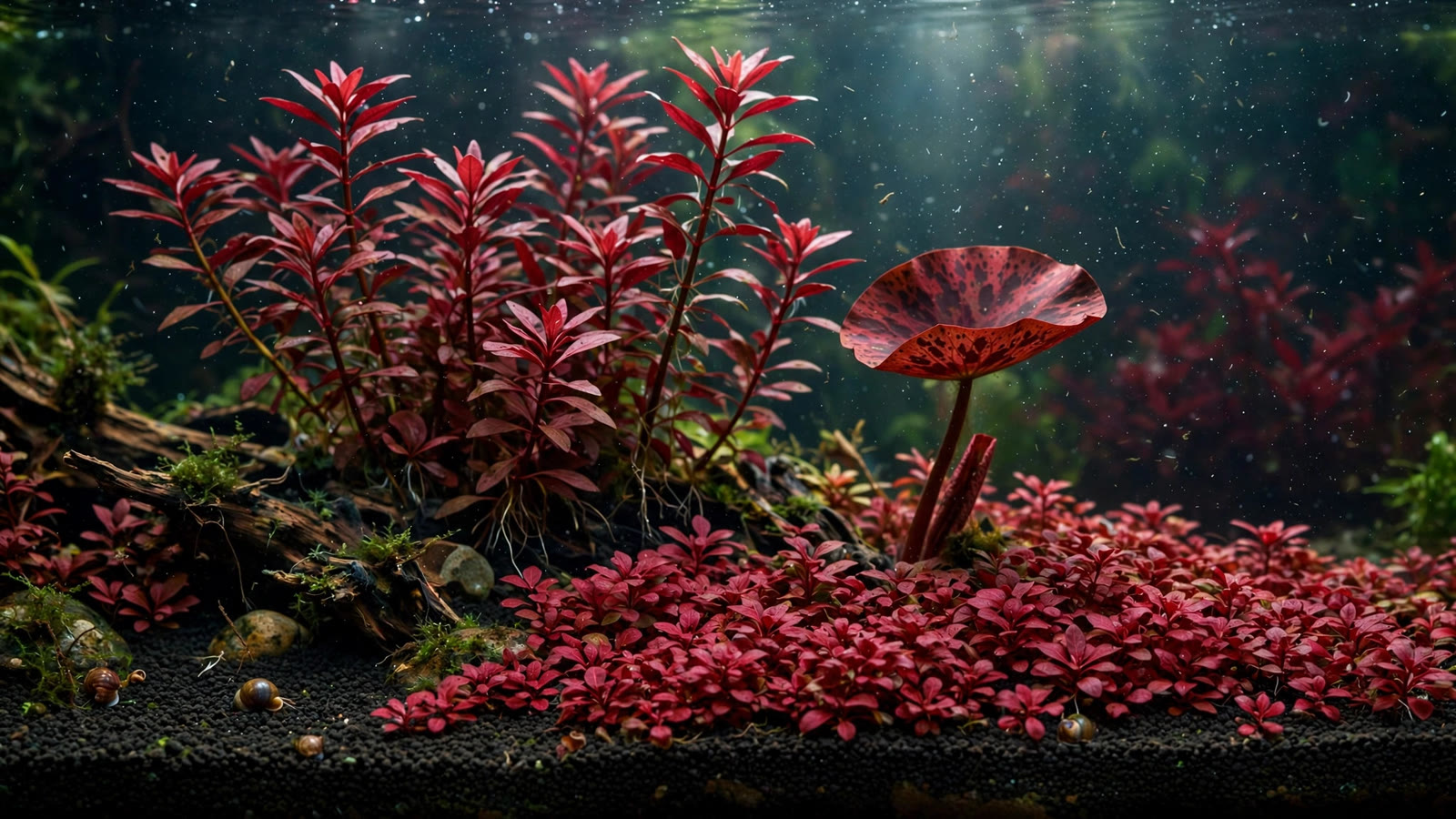
The number-one frustration I hear from low-tech hobbyists goes like this: the bag says red, the plant arrives green, and it stays green. Most red aquarium plants without CO2 lists are quietly written from high-tech setups, where pressurized carbon and monster lighting do the heavy lifting. Here is the honest version, built from no-injection tanks only: which red plants genuinely flame up, which ones merely blush, and the light-and-nitrate recipe that makes the difference.
How this ranking works: how red, how easy, how fast
Every plant below is scored on three axes, and ranked by how likely you are to see actual red in a tank with no CO2 injection, moderate light, and a basic dosing routine:
- How red — "Flame" means deep crimson or ruby through the whole leaf. "Blush" means the tops or leaf edges pick up orange-pink while the rest stays green. Both are beautiful, but you deserve to know which you're getting.
- How easy — whether it tolerates beginner mistakes: inconsistent dosing, ordinary tap water, less-than-perfect light.
- How fast — growth speed in a low-tech tank, which matters because fast growers are more forgiving and cheaper to propagate.
Here is the full comparison at a glance. If you only remember one thing from this table: strong light plus lean nitrate colors up red plants far better than any bottle of iron ever will.
| Plant | How red | Ease | Speed | Best placement |
|---|---|---|---|---|
| Ludwigia 'Super Red' | Flame | Easy | Fast | Background or midground group |
| Alternanthera reineckii 'Mini' | Flame | Moderate | Medium | Foreground to midground carpet patch |
| Rotala 'Blood Red' | Flame | Moderate | Fast | Background, side clusters |
| Ludwigia repens | Blush to red | Very easy | Fast | Background workhorse |
| Rotala rotundifolia | Blush (orange-pink tops) | Very easy | Fast | Background bush |
| Ammannia gracilis | Blush to deep pink | Moderate | Fast | Background focal point |
| Rotala 'H'ra' | Blush (orange-pink) | Easy | Fast | Background or scape edges |
| Persicaria 'Sao Paulo' | Blush to red | Easy | Fast | Midground to background |
| Nymphaea zenkeri (red tiger lotus) | Flame (submerged leaves) | Easy | Medium | Midground specimen, pruned short |
| Cryptocoryne 'Flamingo' | Blush (pink tones) | Moderate | Slow | Foreground accent |
10 Red Aquarium Plants Without CO2, Ranked
1. Ludwigia 'Super Red'
If you buy only one plant from this list, make it this one. Ludwigia 'Super Red' is the gold standard for color in no-CO2 tanks: it turns a deep, saturated crimson from base to tip, even under medium light. It is a straightforward stem plant — trim the tops, replant them, and it bushes out. Growth is fast enough to fill a background in weeks, and it tolerates a wide range of water parameters. The only real demand is decent light; under dim lighting it goes orange-red instead of true red, but it still looks great.
- Light: medium to high
- Color secret: lean nitrate (below ~10 ppm) intensifies the red
- Placement: background or a dense midground cluster for maximum impact
2. Alternanthera reineckii 'Mini'
The famous ruby carpet plant — it really does stay that red-pink without CO2. The 'Mini' variant grows compact and low, making it perfect for foreground-to-midground patches that read like red velvet against green. It is the fussier of the two "flame" plants: it appreciates a nutrient-rich substrate or root tabs and good circulation, and sulks in very dim corners. With strong light it holds its color with no gas injection at all.
- Light: medium-high to high
- Color secret: root feeding + strong light; trim often to keep it compact
- Placement: foreground patch, ideally in front of dark substrate or shadow
3. Rotala 'Blood Red'
The most aptly named plant on this list. Rotala 'Blood Red' produces the deepest red of any rotala in low-tech conditions — near-crimson upper stems when the light is strong. It is a slightly more demanding grower than its cousin rotundifolia: it wants stable conditions, good light, and lean nitrate to hold the color, and thin or stunted new growth usually means it is under-lit rather than nutrient-deficient. Planted in a thick background cluster, it becomes the scape's single loudest statement. Check how it compares with the red stem plant color guide before you pick between the rotalas.
- Light: high for best color
- Color secret: bright light + low nitrate; plant densely so stems compete upward
- Placement: background side clusters — never a single lonely stem
4. Ludwigia repens
The classic that refuses to go out of fashion. Ludwigia repens is one of the most forgiving stems in the hobby: it grows in almost anything, melts rarely, and recovers from rough trims. Its color story is a blush-to-red gradient — the tops and new growth flush orange-red under good light while older lower leaves stay olive-green. It will never be the crimson of 'Super Red', but it is the easiest genuinely colorful stem you can own, and the red tops read beautifully against a dark background. A top pick among the best stem plants for beginners for a reason.
- Light: low to medium (colors up in medium)
- Color secret: the red appears mostly in the top third — trim and replant tops to stack color
- Placement: background; plant in groups of 5–7 stems
5. Rotala rotundifolia
The gateway red. Rotala rotundifolia is nearly indestructible, grows like a weed, and turns its upper leaves a lovely orange-pink under medium light — more of a sunset blush than a flame, but enormously pretty in big bushes. It is the ideal first "red" plant for a brand-new low-tech tank because it also tells you when something is wrong: pale, leggy growth means not enough light, long before your harder plants complain. Propagating is free and endless — every trimming becomes a new plant.
- Light: low to medium (orange-pink in medium-high)
- Color secret: let it grow to the surface; the tops exposed to light color up first
- Placement: dense background bush, the classic Dutch-style street
6. Ammannia gracilis
Ammannia gracilis is the show-off of the list: broad, crinkled leaves that shift from green-gold low down to intense pink-red at the tips under strong light. Without CO2 it stays a little less saturated, but it still delivers one of the boldest color statements available to low-tech keepers. It likes stability — consistent dosing, no wild swings. Give it room; crowded stems lose their lower leaves.
- Light: medium-high to high
- Color secret: lean nitrate + consistent routine; it punishes erratic dosing
- Placement: background focal point, 3–5 stems as a single feature
7. Rotala 'H'ra'
Rotala 'H'ra' is the warm-toned alternative to its redder cousins: under good light the upper stems glow orange-pink, fading to yellow-green at the base. It is nearly as easy as rotundifolia and grows fast, which makes it a great "color rehearsal" plant — you learn what red-leaning stems want (light, lean nitrate, regular trimming) on something that forgives mistakes.
- Light: medium to high
- Color secret: strong light shifts it from pink to near-orange; nitrate below ~10 ppm
- Placement: background or along scape edges for warm contrast
8. Persicaria 'Sao Paulo'
One of the hobby's best-kept secrets for low-tech color. Persicaria 'Sao Paulo' is a fast, easy stem that develops reddish-pink tones along its stems and leaf edges with no CO2 at all — a color range most people associate with much harder plants. It grows upright and responds beautifully to topping: trim, replant, and you get a bushier, more colorful stand every round. It is also unusually tolerant of harder water for a color plant, which widens its audience.
- Light: medium to high
- Color secret: light intensity is the main lever; it colors up steadily, not dramatically
- Placement: midground to background, transition zone between green and red groups
9. Nymphaea zenkeri (red tiger lotus)
The non-stem outlier that breaks every rule — including needing to be a stem at all. Red tiger lotus grows from a bulb and produces broad, ruby-red to bronze submerged leaves with no CO2 required, as long as you keep trimming the floating leaves that steal energy from the underwater display. It is the easiest way to get a large, unmissable red feature: one healthy bulb can anchor a whole midground. Feed it with root tabs, give it a rest from floating leaves every week or two, and it will reward you for years.
- Light: medium
- Color secret: trim floating leaves aggressively to keep energy in the red submerged leaves
- Placement: midground specimen — one plant, given space
10. Cryptocoryne 'Flamingo'
The pink one. Cryptocoryne 'Flamingo' is a slow-growing foreground crypt with soft pink-to-blush leaves that hold their color in low-tech tanks. It will never be crimson, and it tests your patience — crypts are slow to establish and hate being moved. But once settled, it provides a rosy accent at the front of the scape that no stem can replicate. Plant it, then leave it alone.
- Light: low to medium
- Color secret: stability over intensity — don't chase color with brighter light, it just grows algae on slow leaves
- Placement: foreground accent among green carpet or small stones
The light-intensity truth: why strong light + lean nitrate beats iron
Walk into any planted-tank forum and someone will tell you red plants need iron. Here is what actually happens in low-tech tanks: anthocyanins — the red pigments — are the plant's sunscreen. When light is strong and growth is slightly nutrient-limited, plants produce more of them. Iron plays a supporting role in chlorophyll, but pouring iron into a tank does not paint leaves red; it mostly feeds algae when it is already in excess.
The reliable recipe, confirmed by countless low-tech keepers, is three-part:
- Give it real light. "Low light" and "red plants" are opposing goals. You need medium at minimum, high for the flaming species. If your fixture is dim, the honest move is picking the blush plants from this list rather than fighting physics.
- Keep nitrate lean. Around 5–10 ppm nitrate lets color plants redden; constantly high nitrate (20+ ppm) keeps them growing green and lush instead. This is why lean dosing tanks so often show the best reds.
- Dose everything else normally. Potassium, phosphate, and micros still matter — starving the plant entirely just melts it. Lean nitrate, not zero nutrients.
The evidence-based rule: upgrade your light before your fertilizer. A brighter fixture with plain tap water will color up Ludwigia 'Super Red' faster than a dim tank dosed with every bottle on the shelf. For authoritative plant-by-plant data, Tropica's plant database lists each species' light and nutrient demands, which is worth checking before you buy.
Placement: how to make red actually pop
Red only looks red next to the right neighbors. Five placement rules that turn a decent planting into a striking one:
- Cluster, don't sprinkle. A single red stem looks like a mistake. Groups of 5–10 stems read as intentional color blocks.
- Red against dark. Dark substrate, dark background, or a shadowed corner makes red leaves glow; pale sand washes them out.
- Pair warm with cool. Crimson (Ludwigia 'Super Red', Blood Red) against fresh green (a bright rotala green or java fern) creates the contrast the eye is drawn to. Orange-pink blushers sit beautifully next to the true flames.
- Tall red in back, low red in front. Background stems give the color mass; a foreground patch of Alternanthera reineckii 'Mini' or a Flamingo crypt echoes the color forward and ties the scape together.
- Use the tiger lotus as the exclamation point. One red tiger lotus in the midground draws the eye first; the stems then fill in the supporting color around it.
If your tank is tall and you are short on background options, our guide to background aquarium plants for tall tanks pairs well with this list — and if you want a red foreground specifically, compare the 'Mini' and 'Flamingo' approaches in the foreground carpeting plants for beginners guide.
Frequently Asked Questions
Can red aquarium plants really stay red without CO2?
Yes — several species genuinely can. Ludwigia 'Super Red', Alternanthera reineckii 'Mini', and Rotala 'Blood Red' hold deep red in no-injection tanks as long as the light is strong and nitrate is kept lean. What CO2 mostly buys you is speed and saturation at the extreme end; it is not the on/off switch for redness that many people assume. The biggest variable in low-tech tanks is light intensity, not carbon.
Do I need to dose iron to get red plants?
No. Red pigments (anthocyanins) respond to strong light and slightly lean nitrate, not iron. Plants do need normal iron as part of a complete micronutrient mix, but overdosing iron to chase redness rarely helps and often feeds algae. Fix your light first, keep nitrate in the 5–10 ppm range, and dose micros at standard levels.
Why are my red plants turning green?
Almost always one of three things: not enough light, nitrate running high, or the plant is still transitioning from emersed growth. Check light first — move a stem to the brightest spot in the tank and watch the new growth. Old green leaves rarely re-color; judge progress by new growth only.
Which red plant is easiest for a complete beginner?
Ludwigia repens. It tolerates almost everything — low light, inconsistent dosing, new-tank conditions — and still gives you orange-red tips. Rotala rotundifolia is a close second and grows even faster. Both are cheap, nearly impossible to kill, and propagate from every trimming, so mistakes cost nothing. Start with these two, then graduate to the flaming species once your routine is stable.
How many red plants should I put in one tank?
Fewer species, more stems. Two or three red species planted in dense groups looks far better than ten different reds scattered singly. A proven low-tech formula: one background color block (Ludwigia 'Super Red' or Rotala 'Blood Red'), one blush stem for warmth (Rotala rotundifolia or 'H'ra'), and one red focal point (tiger lotus or Alternanthera reineckii 'Mini'). Restraint makes red look deliberate instead of chaotic.
Will red plants work in a low-light tank?
Honestly? Only the forgiving ones, and only as a blush. Ludwigia repens and Rotala rotundifolia survive in low light but stay mostly green there. True crimson needs at least medium light, and the flaming species need high. If your fixture is dim and you love red, start with our low-light aquarium plants for beginners guide and pick the two that tolerate it — or treat this list as the reason to upgrade your light.
Start with one flame and one blush
You do not need a CO2 cylinder to have a colorful tank — you need the right plants, enough light, and lean nitrate. Pick one plant from the "flame" tier and one from the "blush" tier, plant each in a proper group, and give the new growth two to three weeks to tell you the truth. Once you see crimson under your own light with your own routine, no myth about iron or gas will ever fool you again.
Tissue-culture plants are the exception — they’re grown in sterile gel and adapt with minimal melting, which is part of what you’re paying for. Plants bought submersed from another hobbyist’s tank also transition with little melt, since they’re already in the right form.
Which Plants Melt Most (and Least)
Heavy melters (expect significant leaf loss)
- Cryptocorynes — infamous for “crypt melt,” sometimes dropping every leaf after any disturbance. They almost always recover from the roots within weeks.
- Stem plants grown emersed — rotala, ludwigia, and hygrophila often shed lower emersed leaves while the growing tips transition.
- Amazon swords — emersed-grown swords typically lose their broad oval aerial leaves and replace them with longer submersed ribbon leaves.
Light melters
- Anubias, java fern, bucephalandra — slow-growing rhizome plants transition gradually; occasional old-leaf melt but rarely dramatic.
- Vallisneria — usually transitions well, though it dislikes the move itself and may sulk for a week.
- Floating plants — minimal melt since their leaves were already at the air-water interface.
The Acclimation Protocol
Step 1: Quarantine or dip first
Before acclimating to your tank’s conditions, make sure you’re not acclimating pests along with the plant. Run new arrivals through our quarantine and dip protocol — it adds days upfront but prevents months of regret.
Step 2: Float to temperature-match (30 minutes)
Float the bag or container in your tank for 20–30 minutes to equalize temperature. Plants are less temperature-sensitive than fish, but a 10°F shock on top of transplant stress is an avoidable insult.
Step 3: Trim before planting
Remove any leaves that are already damaged, yellowing, or heavily algae-covered — they won’t recover and they’ll rot in your tank, feeding algae. For stem plants, trim off the bottom inch and any emersed leaves that look unlikely to adapt; the plant wastes energy maintaining leaves it’s going to shed anyway. Keep the healthy growing tips — that’s where recovery starts.
Step 4: Plant correctly the first time
Follow our planting guide — right depth, crown exposed on rosettes, rhizomes unburied on epiphytes. Every uprooting and replanting restarts the acclimation clock, so get placement right on the first attempt. Decide where each plant goes before it goes in the water.
Step 5: Run a gentle first week
For the first 7 days after planting:
- Moderate light — run your normal photoperiod but consider dropping intensity 20–30% if your light is dimmable. Blast-level light on a melting plant grows algae on the dying leaves, not recovery.
- Stable CO2 — if you inject CO2, keep it consistent. Fluctuating CO2 during acclimation is a melt accelerator. If you’re low-tech, this doesn’t apply — see growing without CO2.
- Half-strength fertilizer — new plants with damaged leaves can’t use full dosing, and the excess feeds algae. Ramp to full strength over 2–3 weeks per our fertilizer schedule.
- No disturbance — don’t move, trim, or “check on” new plants for at least two weeks. Every touch resets root establishment. This is especially critical for crypts.
Step 6: Remove melt, keep the base
As emersed leaves melt, remove the mushy material promptly — decaying leaves release ammonia and grow fungus that can spread to healthy tissue. But never discard the plant while the crown, rhizome, or roots are firm and alive. A crypt that’s lost every leaf but has firm roots is a plant that’s about to recover, not a dead plant. Give it 3–4 weeks before judging.
Telling Normal Melt From Real Problems
Normal transition melt:
- Affects oldest/emersed leaves first, newest growth last
- New submersed leaves emerge even as old ones dissolve
- Roots and crown stay firm and white/green
- Timeline: 1–4 weeks, then obvious new growth
Concerning melt (see our full melting diagnosis guide):
- New growth also melts or emerges deformed
- Rhizome or crown turns mushy and brown — this is rot, not transition
- Entire plant dissolves within days with no new growth after 4+ weeks
- Melting spreads to established plants that weren’t recently moved
Buying Tips to Minimize Melt
- Buy submersed-grown when available — hobbyist-grown cuttings transition with almost no melt.
- Choose tissue culture for sensitive species — crypts and delicate stems establish far more reliably from sterile cups.
- Avoid plants already melting in the store tank — some melt is normal, but a plant that’s mostly mush at purchase has less energy for recovery.
- Transport carefully — keep plants damp and out of direct sun/heat. A plant that dries out or cooks in a hot car melts far worse than one transported properly.
The First-Month Timeline: What to Expect Week by Week
Knowing what’s normal when removes most acclimation anxiety. Here’s the typical timeline for a healthy plant adapting to a new tank:
Week 1: The quiet week
Almost nothing visible happens. The plant is growing roots you can’t see and assessing its new environment. Some species (vallisneria, stem plants) may start shedding their lowest leaves. This is normal. Resist the urge to “help” — no moving, no extra fertilizer, no light changes. The most common beginner mistake is intervening during a week when the correct action is nothing.
Week 2: Melt peaks
This is when emersed leaves give up in earnest. Crypts may drop everything; swords shed their broad aerial leaves; stem plants lose lower foliage. It looks catastrophic and it’s usually fine. Keep removing mushy material, keep conditions stable, and watch the crown and growing tips — if those are firm and green, recovery is already underway.
Week 3: The turn
New submersed-adapted leaves emerge — smaller, thinner, often a slightly different shade of green than the emersed foliage. Stem plant tips start growing visibly; crypts push tiny curled leaves from the crown; swords unfurl narrow ribbon leaves. This is the moment most beginners exhale for the first time.
Week 4+: Established
New growth outpaces melt, and the plant is functionally yours. You can resume full-strength fertilizer, normal trimming, and stop treating it as fragile. Some slow growers (anubias, bucephalandra) take 6–8 weeks to show obvious progress — that’s their normal speed, not a problem.
Acclimating Different Plant Formats
Tissue-culture cups
Sterile, pest-free, and already adapted to high-humidity (not emersed) growth — tissue cultures melt the least of any format. Rinse the agar gel off gently (leftover gel rots and feeds fungus), split the portion into small plantlets, and plant per our planting guide. They establish slowly for the first two weeks, then accelerate. No dip needed, minimal acclimation stress — this is the premium experience you’re paying for.
Potted plants
Remove the pot and strip away the rockwool completely — leftover rockwool traps debris and rots. Tease the root mass apart gently; if it’s a dense mat, splitting it into 2–3 smaller portions actually establishes faster than planting one big clump (more growing points, better water flow around roots). Potted plants are usually emersed-grown, so expect the standard 2–4 week melt cycle.
Bare-root / bunched stems
Typically sold as weighted bunches. Remove any bands, foam, or weights, strip the lower leaves, and plant stems individually or in small groups. Bunched stems from the store are often already transitioning — check for new submersed growth at the tips, which tells you the plant is mid-adaptation and will settle quickly.
Hobbyist cuttings
Already submersed-grown and the fastest to establish — often showing new growth within days. The main acclimation factor is water-parameter difference between the two tanks. Float to temperature-match, plant promptly, and they’ll usually take off with minimal melt. This is why experienced hobbyists prefer trading cuttings over buying potted plants.
Frequently Asked Questions
Should I use a “plant starter” or transplant fertilizer?
Products marketed for transplant shock are mostly B-vitamins and mild hormones. They don’t hurt, but there’s no strong evidence they help aquarium plants specifically. Stable conditions and patience outperform any bottle. Save the money for more plants.
My new plant melted completely — bare crown, no leaves. Is it dead?
Probably not, if the crown or rhizome is firm. Crypts and swords routinely lose 100% of their leaves and regrow from the base within a month. The test is firmness: firm and pale/green means alive; mushy and brown/black means rot. Give firm-but-leafless plants a full 4 weeks before declaring them dead.
Can I speed up acclimation with extra light or CO2?
No — and trying usually backfires. A melting plant can’t use extra light; the excess just grows algae on its dying leaves. Keep light moderate and CO2 stable (not boosted) during acclimation. Growth speed comes from the plant’s own adaptation timeline, which you can’t rush, only avoid delaying.
Should new plants go straight into my main display tank?
After quarantine/dipping, yes — there’s no benefit to a separate “growing-in” tank for most plants. They acclimate to your water fastest in the tank they’ll live in. The exception is very delicate species going into a tank with boisterous fish; give those a few weeks in a calm corner or breeder box first.
The Patience Rule
The single most important acclimation skill is restraint: plant it right, set gentle conditions, remove decay, and then leave it alone for a month. The hobbyists with the best plant growth aren’t doing something clever in week one — they’re simply not interfering in weeks two through four while the plants do what they’ve evolved to do. Melt looks like failure and feels like failure, but in most cases it’s the visible part of a plant successfully becoming yours.