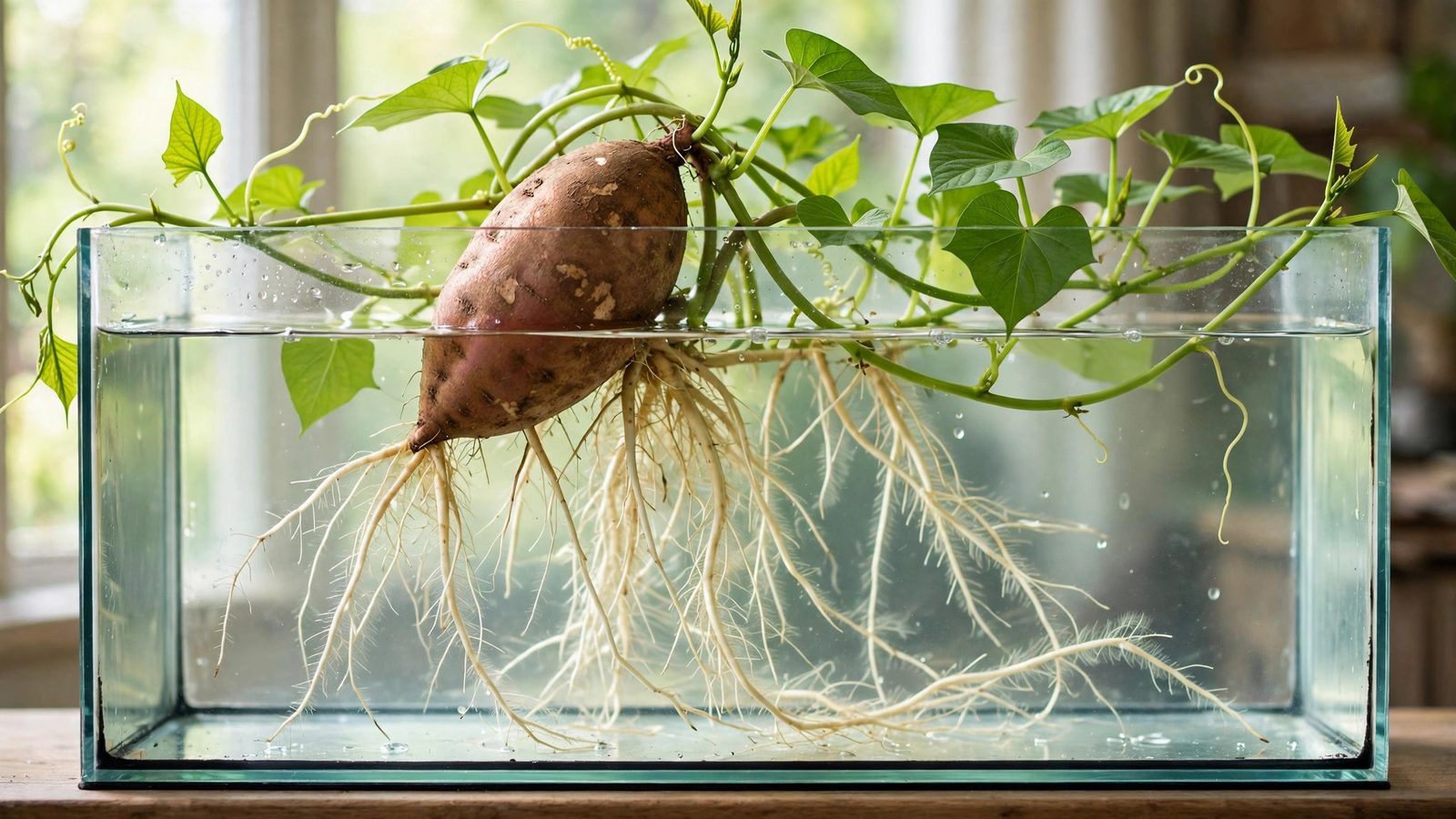
The tuber's the whole problem and the whole promise: dunk a whole sweet potato underwater and it rots into an ammonia-spiking mess within days; suspend just its bottom half at the surface and it turns into a sweet potato aquarium filter — a tangle of white roots that eats nitrates, shelters your fry, and throws trailing vines over the tank rim. Yes, you can grow sweet potato in a fish tank, and it's one of the cheapest riparium tricks in the hobby.
This is a roots-only technique. The tuber sits half in the air; only the roots enter the water. Follow that one rule and the plant does the rest — no CO2, no fertilizer, no substrate. For the broader approach, see our riparium-style guide to growing houseplants out of your aquarium.
 ★4.6
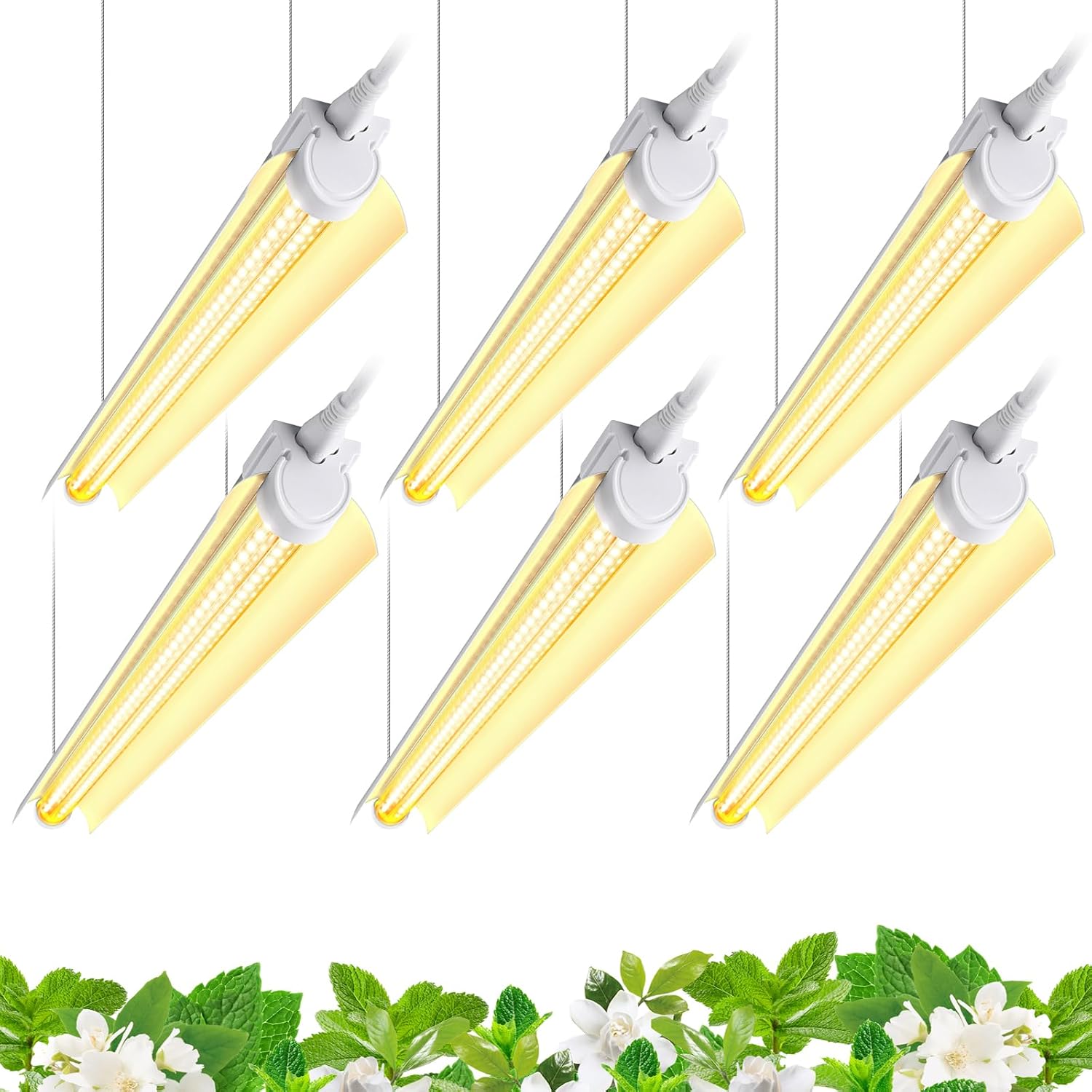
Barrina T8 LED Grow Light
Check Price on Amazon ★4.6Why a Sweet Potato Aquarium Works So Well
Sweet potato (Ipomoea batatas) is a tropical vine that evolved to root aggressively at every opportunity — NC State Extension's postharvest guide for the crop notes stored roots sprout readily above 60°F — within weeks at room warmth. Give it constant water contact at one end and free air at the other, and it throws out roots far faster than almost any true floating aquarium plant. Those roots are hungry: they pull nitrogen compounds straight from the water column — exactly what your test kit keeps nagging you about. Within a month the root mass functions like a nitrate-absorbing plant on steroids — and doubles as a micro-habitat where fry and baby shrimp hide, like the cover offered by spawning plants for egg-scatterers. Within 6–8 weeks you'll also get the payoff overhead: stems cascading over the rim into a curtain of heart-shaped leaves.
Setting Up: Skewers or Suction-Cup Holder
Both methods aim for the same geometry: tuber half above the waterline, lower half touching water.
Method 1 — bamboo skewers (5 minutes, zero cost). Push 3–4 skewers horizontally into the tuber's sides at its midpoint, then rest it across the tank rim or an open-top corner. Classic kitchen-sprouting setup, transplanted to glass. Downside: skewer holes are entry points for rot, and the tuber can wobble in high-flow tanks.
Method 2 — suction-cup holder (sturdier, cleaner). Stick a plastic soap-holder-style suction cup rack to the inside glass at water level and seat the tuber in it. No punctures, no wobble — it sits in the tank corner like a real riparium planter. Use this version with a hang-on-back filter creating surface current.
Week-by-Week: What to Expect
| Week | What happens | Your job |
|---|---|---|
| 1 | White root nubs appear around the submerged half; tiny bumps may form at the eyes. | Keep water level steady; don't disturb the tuber. |
| 2 | Roots reach 5–10 cm; first green shoots may poke from the tuber's crown. | Start watching nitrate readings — they often dip here. |
| 3–4 | Root mass thickens into a curtain; emersed vines trail over the rim with heart-shaped leaves. | Thin roots if filter flow is choked. |
| 6–8 | Full display: dense roots below, trailing foliage above; peak nitrate uptake. | Trim vines to taste; enjoy the look. |
| 3–6 months | Tuber softens and may smell slightly — its fuel tank is empty. | Remove and replace with a fresh tuber. |
Light matters more than people expect. The leaves live in air, not water, so they want decent light on the foliage. A standard aquarium light on 8–10 hours a day is plenty; a dim corner gives you leggy, pale vines.
Water Chemistry: What the Roots Actually Do
Here's the honest version. The roots absorb dissolved nitrogen — ammonia and nitrite first, nitrate next — and release oxygen around them. The principle is well documented at larger scales: a published study on floating treatment wetlands in aquaculture found plant root systems removed up to 90% of total ammonia nitrogen in a grouper-farming trial. Your tank is a very small wetland, and algae and your sweet potato are now competing for the same nutrients — classic natural algae control — giving you real algae-control support.
What it won't do: replace your filter, complete a fishless cycle on its own, or fix overstocking. Think of it as a supplement that can visibly stretch the interval between water changes in a lightly stocked tank — not a license to skip maintenance. Keep testing; let your kit, not the vines, decide when to change water.
Fish, Shrimp, and Fry: Is It Safe?
The number-one worry — "is it poisonous?" — has a reassuring track record. The roots aren't toxic to fish; long-term keepers report guppies, shrimp, and snails living among sweet potato roots with zero issues, and fry actively using the root mass as a nursery. Cherry shrimp graze biofilm off the roots. Monitor plant-eating species like goldfish around the leaves, and remove the tuber the same day it turns mushy or sour.
Maintenance is otherwise nearly zero. No fertilizer — fish waste feeds it. No CO2 — the leaves breathe room air. Trim roots and vines freely with clean scissors; the plant regrows within days. Thin the root mass if it starts restricting flow around your filter intake.
How It Compares to Other Nutrient-Hungry Plants
Sweet potato's niche is unique: true riparium growth with grocery-store availability. Oxygenating plants like hornwort live fully underwater and shade the tank; pothos cuttings do the same aerial trick but root more slowly and never deliver the vine show. Sweet potato roots fastest of the kitchen-tuber options — faster than regular potato or avocado pits — and pays out with trailing foliage as a bonus.
Frequently Asked Questions
Can the tuber touch the water, or only the roots?
The tuber's lower half sits in the water while the top half stays dry — that contact is what triggers rooting. What you must avoid is full submersion. A completely submerged tuber can't breathe, rots within days, and can spike ammonia. Half in, half out is the rule that makes the whole thing work.
Are sweet potato roots really safe for guppies and shrimp?
Yes, by extensive keeper experience. The roots aren't poisonous to fish — guppies, shrimp, and snails live among them without issues, and fry use the root tangle as shelter. The only real risk is a decaying tuber fouling the water, so remove and replace tubers as soon as they soften.
How long does one tuber last before I replace it?
Typically 3–6 months of vigorous growth. The tuber is a battery: it spends its stored energy growing roots and vines, then softens and may start to smell. Swap in a fresh grocery-store tuber 2–3 times a year. You can even pre-sprout the replacement in a jar so there's no gap in nitrate uptake.
Do I need CO2 or fertilizer for it to grow?
No. The leaves breathe CO2 from room air — an unfair advantage over fully submerged plants — and the roots feed on nitrogen compounds from fish waste. That's why it thrives with zero dosing. If growth stalls, check light on the foliage and water flow around the roots, not the fertilizer shelf.
Will the roots clog my filter or take over the tank?
They can, in a small tank left untrimmed for months — roots reach 15–30 cm and may drift toward filter intakes. Trim them monthly with clean scissors, just like hair. Keep the tuber seated in a corner away from the intake and you'll rarely have a problem.
For the cost of a side dish, a sweet potato turns your tank's rim into a riparium and gives your nitrogen cycle a living assist. Start with the skewer method this weekend — if you like the look, upgrade to a suction-cup holder and keep a sprouting backup tuber in the kitchen. Your nitrates, your fry, and your living room will all thank you.