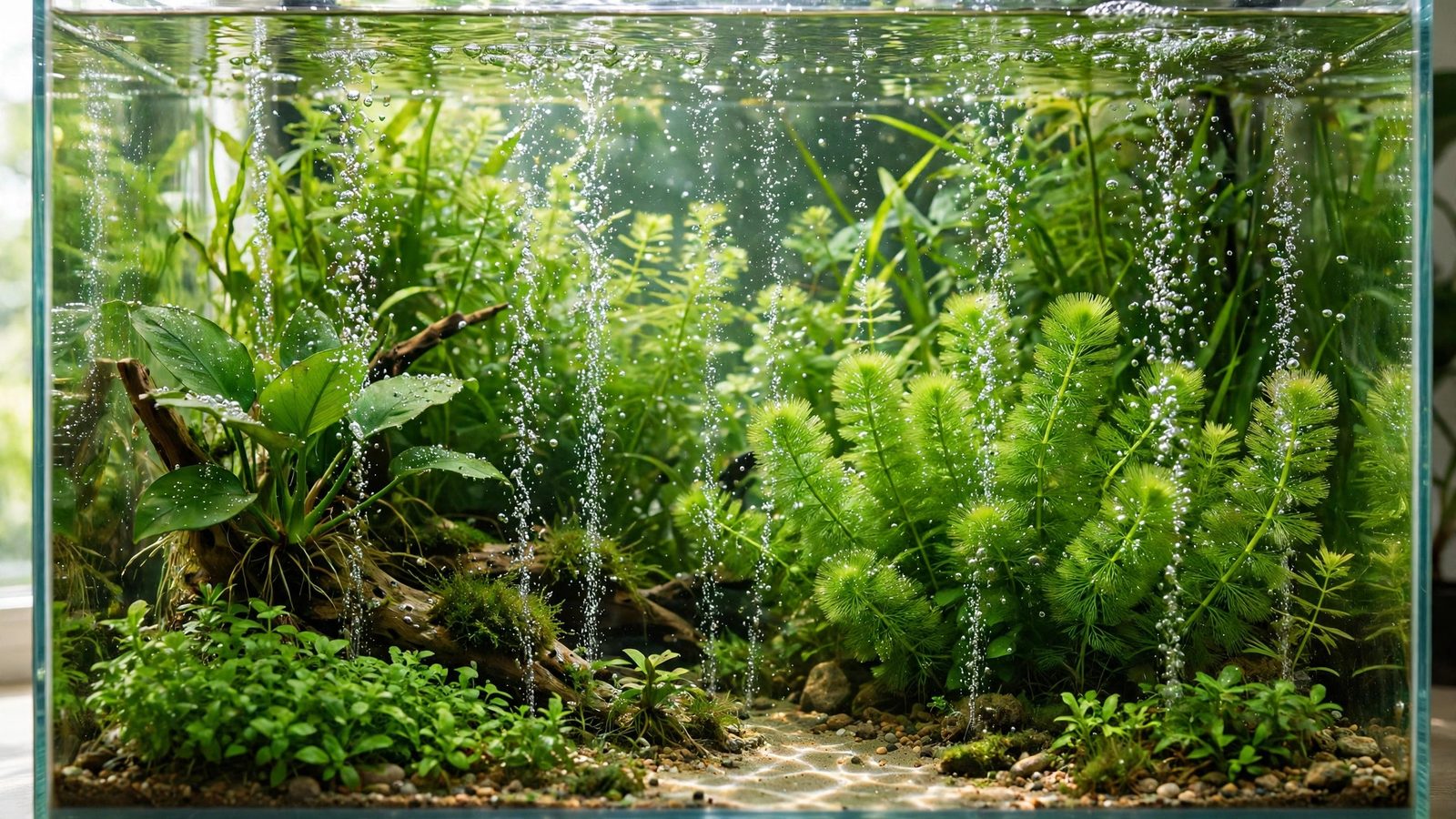
"Oxygenating plants" is one of the hobby's oldest terms — the fast-growing submerged species sold to keep pond and aquarium water oxygen-rich and clear. The science is simple: submerged plants photosynthesize underwater, releasing oxygen directly into the water during the day, while their rapid growth strips out the excess nutrients that fuel algae. These 10 plants are the best oxygenators for aquariums, with honest notes on what oxygenation actually does for your tank.
What Oxygenating Plants Actually Do
All submerged plants oxygenate — it's just photosynthesis. The "oxygenating" label traditionally goes to fast-growing species with high metabolic rates: hornwort, anacharis, vallisneria, and their kin. During lights-on hours they pump dissolved oxygen into the water; at night they consume a little (respiration), but the net daily contribution is strongly positive in a planted tank.
The realistic benefits: higher daytime dissolved oxygen (fish are more active, beneficial bacteria work faster), rapid nutrient uptake that starves algae, and excellent cover for fry and shy fish. What oxygenators don't do: replace surface agitation or filtration. Gas exchange at the surface is still your primary oxygen source — plants are the supplement, not the system. Pair them with the nutrient-sponge strategy in our nitrate-absorbing plants guide for the full water-quality picture.
Getting the Most Oxygenation
Light drives it
Oxygen production scales directly with photosynthesis, which scales with light. Oxygenators under strong light pearl visibly (oxygen bubbles streaming from leaves); under dim light they merely survive. If oxygenation is the goal, give these plants the light they need to work.
Keep them growing
A stalled plant oxygenates nothing. Fast growers need complete nutrition — nitrogen, potassium, iron, micros — to maintain the growth rates that produce oxygen. Trim regularly: fresh young growth photosynthesizes far more efficiently than old algae-coated leaves.
Don't overdo the density
A tank choked wall-to-wall with oxygenators can actually swing oxygen badly — massive daytime production followed by significant nighttime consumption in a tank with no surface agitation. Keep plant mass vigorous but not suffocating, and always maintain some surface movement for gas exchange.
A reliable pick here is API Leaf Zone.
The 10 Best Oxygenating Plants
1. Hornwort (Ceratophyllum demersum)
The definitive oxygenator — sold for centuries as the pond oxygenator, and the fastest oxygen producer in the aquarium trade. Hornwort's feathery foliage has enormous surface area, it grows inches per week, and it needs nothing from you. Float it or weigh it down; either way it works. The benchmark everything else is measured against.
2. Anacharis (Egeria densa)
The other classic oxygenator, and a temperate plant that works in cold and tropical tanks alike. Anacharis grows rapidly in almost any conditions, producing visible oxygen streams under good light. It's the standard "new tank" plant partly because its oxygenation and nutrient uptake stabilize cycling tanks so effectively.
3. Vallisneria spiralis
Vallisneria's long ribbon leaves provide huge photosynthetic area, and established stands are oxygen powerhouses — you'll see pearling along the leaf edges under strong light. As a bonus, vals can use bicarbonate as a carbon source, keeping photosynthesis (and oxygenation) high even in hard water where dissolved CO2 is scarce. See background plants for tall tanks for layout ideas.
4. Water Wisteria (Hygrophila difformis)
Fast stem growth plus large lacy leaves equals serious oxygen output. Wisteria's advantage is versatility — it oxygenates as a background stem, as a floating mass, or even emersed. Trim regularly to keep fresh growth coming; old leggy stems produce a fraction of what young bushy growth does.
5. Cabomba caroliniana
Cabomba's finely divided fan leaves have exceptional surface area for their volume — every square inch is photosynthesizing. It's a superb oxygenator in moderate light and provides the fine cover fry need. Keep it out of strong direct filter flow, which tangles its delicate foliage and reduces its efficiency.
6. Ambulia (Limnophila sessiliflora)
Like cabomba but tougher and faster — ambulia's feathery bright-green foliage grows explosively, making it one of the highest-output oxygenators for the effort involved. It tolerates a wide range of conditions and recovers from trimming within days. If cabomba sulks in your water, ambulia won't.
7. Guppy Grass (Najas guadalupensis)
Fine-leaved, fast, indestructible — guppy grass forms dense oxygenating thickets that double as the best fry shelter in the hobby. It grows floating or planted, in any water, at any temperature. Pull handfuls as needed; it replaces them within days. The ultimate low-effort oxygenator.
8. Dwarf Sagittaria
An oxygenator for the foreground — dwarf sag's grassy runner-spread meadow photosynthesizes across a huge area at the tank's bottom, where oxygen is often lowest. In bright light a dwarf sag lawn pearls beautifully. It proves oxygenation isn't just a background-plant job.
9. Rotala rotundifolia
Fast stem growth with dense leaf packing — a well-trimmed rotala bush is a compact oxygen factory. Its advantage over the classics is looks: it oxygenates while providing the pink-tipped aesthetics the pond weeds can't. Our beginner stem guide covers its easy care.
10. Pondweed (Potamogeton gayi)
The connoisseur's oxygenator — narrow translucent leaves on upright stems, graceful and unusual, with excellent growth rates in moderate light. Less common in stores than hornwort or anacharis, but worth seeking out for a refined-looking oxygenator that still works as hard as the classics.
Oxygenation and Your Filter
Plants and filtration complement each other: the filter provides circulation (delivering CO2 and nutrients to leaves, carrying oxygenated water through the tank) and mechanical/biological filtration, while plants add daytime oxygen and consume the nitrates bacteria produce. The healthiest tanks run both. Don't reduce filtration because you added plants — increase plant mass because you have filtration. They're partners, not substitutes.
Oxygenation for Ponds and Unfiltered Tanks
Oxygenating plants shine brightest where filtration is minimal — outdoor ponds and unfiltered Walstad-style tanks. In ponds, a 50/50 balance of submerged oxygenators and surface coverage keeps water clear and fish healthy with no equipment at all; the plants are the life-support system. Species like hornwort and anacharis are sold specifically as pond oxygenators for this reason, and our pond plant guide covers the crossover species. In unfiltered indoor tanks, oxygenators plus a soil substrate create a self-sustaining ecosystem — but go heavy on plant mass from the start, since there's no filter as backup. As a rule of thumb, unfiltered setups need roughly double the plant biomass of filtered ones to maintain the same water quality, and fast oxygenators should dominate that biomass.
A reliable pick here is Seachem Flourish.
Frequently Asked Questions
How many oxygenating plants do I need?
For meaningful effect, dedicate at least a third of the tank to fast-growing oxygenators — a few stems won't move the needle. Think in terms of biomass: a dense background of hornwort or anacharis plus a vallisneria stand is a working oxygenation system; three stems in the corner is decoration.
Do oxygenating plants help at night?
No — at night plants respire, consuming small amounts of oxygen. In a balanced tank this is negligible, but in an extremely over-planted tank with no surface agitation, pre-dawn oxygen can dip. The solution is simple: always maintain gentle surface movement for gas exchange, and don't let plant mass completely choke the tank.
Can I see oxygenation happening?
Yes — it's called pearling. Under strong light, fast-growing oxygenators release visible streams of tiny oxygen bubbles from their leaves. Heavy pearling means photosynthesis is running at full tilt. It's beautiful, it's a health indicator, and it's the most satisfying thing to watch in a planted tank.
Do oxygenators work in low light?
They survive, but they don't oxygenate much — photosynthesis (and thus oxygen production) scales with light. In low-light tanks, oxygenators function mainly as nutrient sponges and cover rather than oxygen sources. For real oxygenation, give them moderate to strong light.
Will oxygenating plants raise my pH?
Temporarily, during the day — photosynthesis consumes dissolved CO2, which raises pH slightly; at night respiration reverses it. In heavily planted tanks you may measure a 0.2–0.5 pH swing between morning and evening. This is normal and harmless; fish evolved with diurnal pH rhythms. Large swings indicate too much plant mass relative to buffering.
Are oxygenating plants good for goldfish tanks?
Excellent — goldfish are oxygen-hungry and produce heavy waste, and oxygenators address both. Choose tough species goldfish won't demolish: anacharis and hornwort (they'll nibble but the plants outgrow it), vallisneria, and guppy grass. See our goldfish tank plant guide for the full tough-plant list.
Do I need an air stone if I have oxygenating plants?
Not necessarily during the day, but it's wise insurance at night. Plants produce oxygen only while lit; in a heavily planted tank with no surface agitation, pre-dawn oxygen can dip. A small air stone on a nighttime timer gives you the best of both worlds — plant-powered days and guaranteed oxygenated nights. In lightly planted tanks with good filter agitation, you don't need one at all.
Breathe Easy
Oxygenating plants are the workhorses of the planted tank — unglamorous, fast-growing, and quietly doing the water-quality heavy lifting while showier plants take the credit. Plant them heavily, light them well, trim them regularly, and your tank's water will be clearer, your fish more active, and your algae problems smaller. The pond keepers who coined the term centuries ago knew what they were doing.