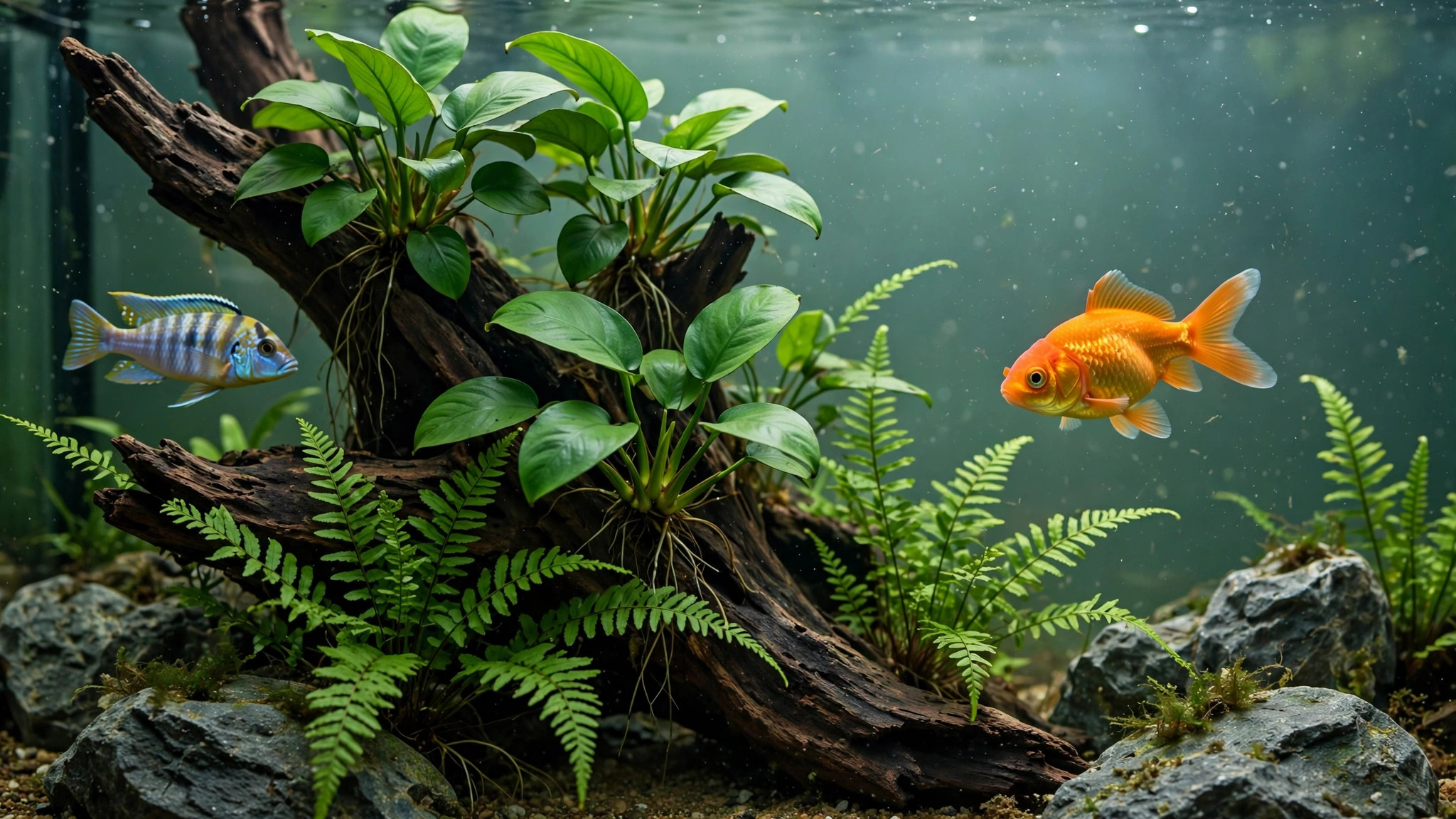
You plant a small fortune in delicate stems on Saturday. By Sunday, your goldfish have turned it into confetti and your cichlids have rearranged the rest like interior designers with a grudge. Every keeper of plant-eating fish pays this tuition once. The lesson is simple: with grazers, you choose plants for survival first and beauty second. The good news is that survival-first plants can still look great — and they are some of the easiest plants in the hobby.
Direct answer: The easiest aquarium plants that fish will not eat are anubias, java fern, bucephalandra, African water fern, cryptocoryne wendtii, vallisneria, Amazon sword, crinum, hornwort, and java moss. Fish avoid them because their leaves are tough and leathery, many taste unpleasant, and several grow attached to wood or rock where digging fish cannot uproot them. All ten thrive in low to moderate light without CO2, which makes them beginner-friendly as well as fish-resistant.
Why Fish Leave Some Plants Alone (and Shred Others)
Fish do not eat plants out of malice. Goldfish, cichlids, silver dollars, and plecos graze for fiber, for boredom, or simply because a soft new leaf looks like food. Whether your plants survive comes down to three traits.
1. Leaf toughness. This is the single biggest factor. Anubias leaves feel almost like plastic; java fern leaves are thick and rugged. Most grazing fish take one experimental bite and move on. Soft, feathery stems like cabomba or limnophila tear like tissue paper, so fish keep eating them.
2. Taste. Java fern is one of the few plants that fish consistently refuse, and hobbyists widely report that its leaves taste bitter or unpleasant to fish. Anubias carries the same reputation: goldfish that demolish everything else in the tank will swim past an anubias untouched.
3. Growth habit. Epiphytes — plants that grow attached to wood or rock rather than rooted in substrate — defeat digging fish. A cichlid that bulldozes your substrate cannot uproot an anubias glued to driftwood. Fast growers like hornwort play a different game: they regenerate faster than fish can eat them.
The 10 Easiest Aquarium Plants Fish Won't Eat
Every plant below is easy (low to moderate light, no CO2 needed) and genuinely resistant to grazing. They are ordered roughly from most to least fish-proof.
1. Anubias (Anubias barteri varieties)
The undisputed champion of grazer tanks. Thick, leathery, slow-growing leaves that goldfish and cichlids find unpalatable, on a rhizome you attach to wood or rock instead of planting — so it cannot be dug up either. Anubias nana stays compact for the foreground and midground; the larger barteri works as a midground feature. Our full anubias care guide covers the rhizome rule: never bury it, or it rots.
2. Java fern (Microsorum pteropus)
Nearly as tough as anubias, with the same epiphyte advantage — attach it to hardscape and digging fish become irrelevant. Its leaves are widely reported to taste bad to fish, which is why java fern survives in tanks where almost nothing else does. It tolerates low light and neglect, and reproduces by growing baby plantlets on old leaves. See our java fern care guide for the details.
3. Bucephalandra
Think of buce as anubias's smaller, prettier cousin: a slow-growing rhizome plant with tough little leaves that you glue or tie to rock and wood. Fish ignore it for the same reasons they ignore anubias. The honest catch is price — buce costs noticeably more than anubias — so start with a small portion on a prominent rock. Our bucephalandra care guide walks through mounting and the slow recovery from new-tank melt.
4. African water fern (Bolbitis heudelotii)
A larger, lacy epiphyte with tough, leathery fronds that goldfish and cichlids leave alone. Like anubias and java fern, it anchors to wood or stone, which removes the uprooting problem entirely. It prefers gentle flow and lower light, and it sulks after replanting — give it a month to settle. Details in our African water fern care guide.
5. Cryptocoryne wendtii
Crypts earn their spot through tough, waxy leaves and a deep root system that resists uprooting once established. Wendtii is the most forgiving variety: it tolerates low light, adapts to most water, and comes in green, bronze, and red-brown forms. Expect some initial melt after planting — this is normal crypt behavior, not fish damage — and do not move it once it settles. Our cryptocoryne wendtii care guide covers the melt-and-recover cycle.
6. Vallisneria
Long, tough, strap-like leaves that most grazers ignore, spreading by runners into a background wall. Vals root deeply, which helps against diggers once the runner network is established. Two cautions: plant the crown at the substrate surface (burying it causes melt), and keep liquid carbon supplements like glutaraldehyde away from vallisneria — it is famously sensitive and can melt overnight. More in our vallisneria care guide.
7. Amazon sword (Echinodorus species)
Broad, firm leaves hold up well against moderate grazers, and the big root system anchors the plant against casual digging. Swords are not invincible — a large, determined cichlid will eventually chew one — but for community tanks with mild plant-nibblers they are a reliable background plant. They are heavy root feeders, so push root tabs into the substrate around the crown. See our Amazon sword care guide.
8. Crinum (Crinum thaianum and relatives)
The sleeper pick. Crinum grows long, tough, strap-like leaves from a bulb, and its foliage is so coarse that most fish lose interest immediately. It is slow to establish — the bulb sulks for weeks — but once growing it is nearly indestructible and can live for decades in the same spot. Plant the bulb with its neck above the substrate and feed the roots with tabs. Our crinum care guide covers the never-move-it rule.
9. Hornwort (Ceratophyllum demersum)
Hornwort survives by outgrowing the damage. Its stiff, needle-like foliage is unappealing to most fish, and it grows so fast that even nibbling cannot keep up. Float it or let it drift — as a floating plant it is completely safe from diggers and doubles as fry cover. The tradeoff: it sheds needles when conditions change, so expect some cleanup after planting.
10. Java moss (Taxiphyllum barbieri)
Moss survives the same way hornwort does: sheer growth speed. Tie it to driftwood or rocks and it forms dense mats that fish use as cover rather than food — they are usually more interested in living in it than eating it. It tolerates almost any light and water. Our java moss care guide covers attaching and trimming.
| Plant | Why fish avoid it | Light | How to plant |
|---|---|---|---|
| Anubias | Leathery, unpalatable leaves | Low–moderate | Attach to wood/rock |
| Java fern | Tough, bitter-tasting leaves | Low–moderate | Attach to wood/rock |
| Bucephalandra | Tough rhizome leaves | Low–moderate | Glue/tie to rock |
| African water fern | Leathery fronds | Low | Attach to wood |
| Cryptocoryne wendtii | Waxy leaves, deep roots | Low–moderate | Rooted, don't move |
| Vallisneria | Tough strap leaves | Moderate | Rooted, crown exposed |
| Amazon sword | Firm broad leaves | Moderate | Rooted + root tabs |
| Crinum | Coarse strap leaves | Moderate | Bulb, neck exposed |
| Hornwort | Stiff needles, fast growth | Any | Float or drift |
| Java moss | Outgrows grazing | Any | Tie to hardscape |
Plants Fish Will Eat: Save Your Money
Knowing what to avoid is as valuable as knowing what survives. Soft-leafed stems — cabomba, limnophila, rotala, and most fine-leafed stem plants — get shredded in grazer tanks within days. Duckweed and water sprite are eaten outright by goldfish (some keepers grow them deliberately as living fish food). Tender new shoots of almost any plant get sampled, which is why slow growers with tough mature leaves outperform fast, soft growers in these tanks.
The Feeding Trick That Protects Your Plants
Many fish eat plants partly out of nutritional need or boredom. Herbivorous and omnivorous fish that get regular vegetable matter in their diet show far less interest in your aquascape. Supplement flakes or pellets with blanched zucchini, spinach, or peas a few times a week — and keep a vegetable-based staple like Hikari Tropical Algae Wafers ★4.8 in the rotation for bottom grazers.
Affiliate note: the product links in this article are Amazon affiliate links. As an Amazon Associate I earn from qualifying purchases, which helps keep these guides free — it costs you nothing extra.
On the plant side, the slow growers on this list feed from the water column, so a lean liquid fertilizer keeps them healthy without fueling algae. Dose a comprehensive liquid like Seachem Flourish ★4.7 lightly and consistently rather than dumping in heavy doses — slow leaves plus rich water is how algae takes hold.
Quick Guide by Fish Type
Goldfish are the classic plant destroyers: they eat soft plants and uproot the rest while foraging. Anubias and java fern attached to hardscape are the most reliable survivors, with hornwort as a floating backup. Our full goldfish tank plant guide ranks nine species.
Cichlids do more digging than eating, which makes the epiphyte strategy — anubias, java fern, bolbitis glued to rock — especially effective. Attach plants securely and plant densely so no single plant becomes the territory punching bag. See plants that survive African cichlids and our cichlid tank plant picks.
Silver dollars are the hardest case: schooling herbivores that can strip a tank overnight. Stick to the toughest tier (anubias, java fern, crinum), plant densely, and keep them well-fed on vegetables — even then, expect some battle damage.
Plecos rasp rather than bite, and a hungry pleco will sand the leaves off anubias. The fix is dietary: provide driftwood to rasp and sinking vegetable foods so the pleco leaves your plants alone. Our pleco tank plant guide covers the seven best survivors.
Frequently Asked Questions
Will goldfish eat anubias?
Usually not. Anubias leaves are thick, leathery, and unpalatable, so goldfish that destroy everything else typically swim past it. Choose larger, established plants rather than tiny portions, attach them to hardscape so foraging goldfish can't dislodge them, and keep the goldfish well-fed. A starving goldfish may still test-nibble the leaf edges.
Do cichlids eat java fern?
Most cichlids leave java fern alone because the leaves are tough and taste unpleasant to fish. The bigger risk with cichlids is uprooting, not eating — so attach java fern to rock or driftwood rather than planting it in the substrate. Young shoot tips are softer than mature leaves and may get sampled, but the plant recovers.
Can silver dollars live with any aquarium plants?
Silver dollars are the toughest test in the hobby — a hungry school can strip soft plants overnight. Your best odds are the toughest tier: anubias, java fern, and crinum, planted densely and kept well-fed on vegetable matter. Expect some cosmetic damage; these fish are why "fish-proof" is always a relative term.
Why do my fish uproot plants instead of eating them?
Digging is foraging and territory behavior, especially in cichlids and goldfish — the plant is collateral damage, not food. The fix is to remove the substrate from the equation: use epiphytes attached to hardscape, keep rooted plants in heavy pots, and feed sinking foods so fish forage the food instead of the planting bed.
Are there plants that plecos won't rasp?
Plecos rasp surfaces for biofilm and wood fiber, so even tough leaves can get sanded if the pleco is hungry. Anubias and java fern hold up best because their leaves are thick — but the real solution is dietary: give plecos driftwood to rasp and sinking vegetable-based foods, and they will largely leave your plants alone.