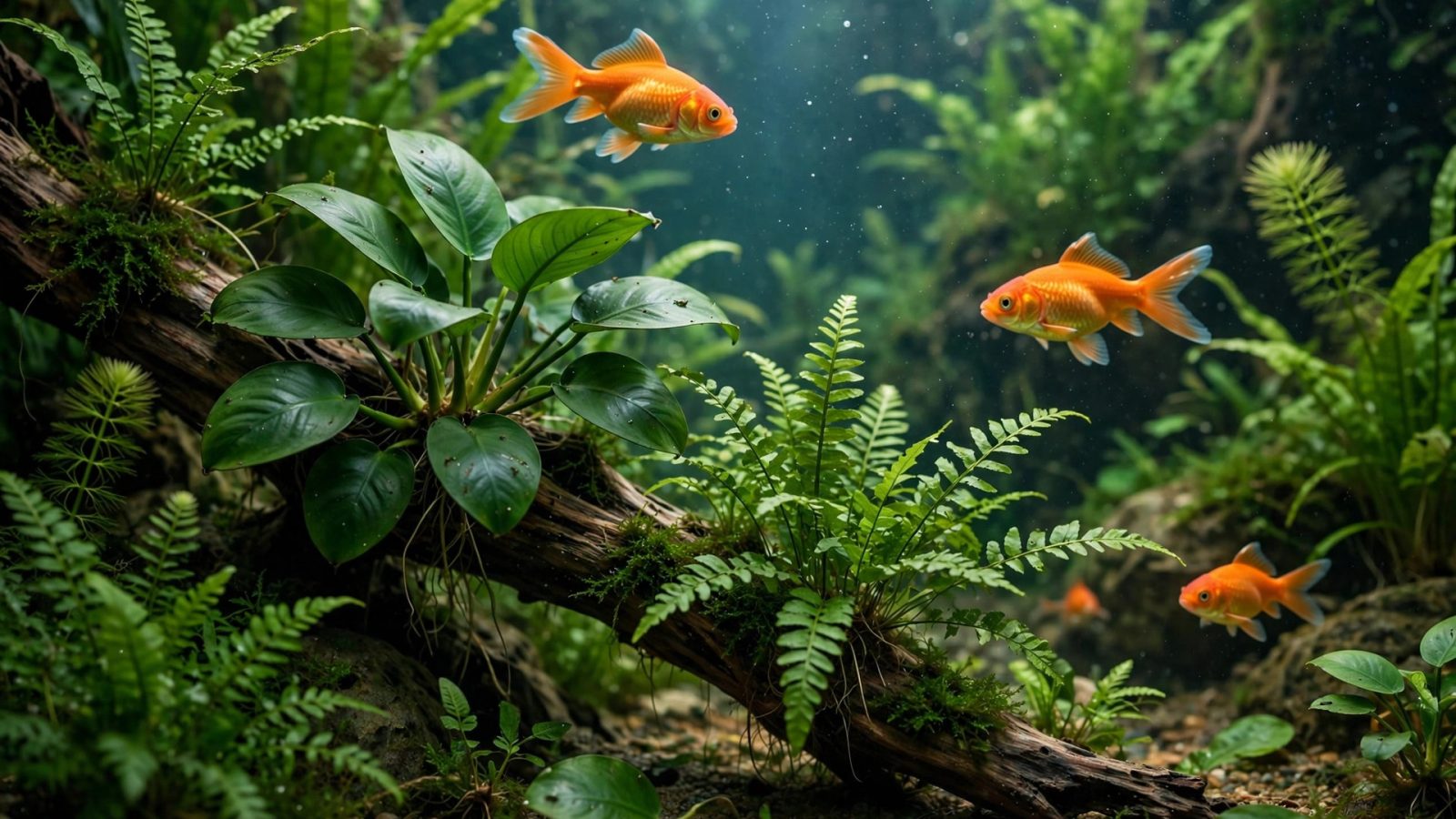
Goldfish and planted tanks have a reputation for being incompatible — and honestly, it’s earned. A determined fancy goldfish can strip a tank of soft plants in days, uprooting stems, nibbling leaves to skeletons, and generally treating your aquascape as a salad bar. But “goldfish-proof” planting is absolutely possible. The best aquarium plants for goldfish tanks share specific defenses — tough, bitter-tasting leaves, strong anchoring, or growth habits that outpace grazing — and this list of nine covers the species that genuinely survive goldfish, not just the ones that survive the week.
The key insight: you’re not looking for plants goldfish can’t eat — you’re looking for plants they won’t bother eating. Goldfish are opportunistic grazers, not obligate herbivores. Given tough, unpalatable foliage and enough proper food, most goldfish leave these nine alone indefinitely.
Why Goldfish Destroy Plants (and What Stops Them)
Goldfish attack plants for three reasons: hunger (underfed fish graze constantly), boredom (a bare tank invites investigation), and instinct (they’re natural foragers that sift substrate and mouth everything). You can’t eliminate the instinct, but you can address hunger with a proper varied diet — quality pellets, blanched vegetables, occasional frozen foods — fed in amounts they finish in two minutes, twice daily. Well-fed goldfish in an enriched tank are dramatically less destructive.
Plant choice handles the rest. The survivors share these traits:
- Tough, leathery leaves: anubias and Java fern leaves are physically difficult to bite through.
- Bitter or unpalatable chemistry: many aquarium plants taste bad to fish; goldfish learn quickly.
- Strong anchoring: epiphytes tied to heavy wood or rock can’t be uprooted by sifting.
- Size: a mature Amazon sword is simply too much plant for a goldfish to dismantle.
The 9 Best Aquarium Plants for Goldfish Tanks
1. Anubias barteri (all varieties)
The #1 goldfish-proof plant, by a wide margin. Anubias leaves are thick, leathery, and bitter — goldfish mouth them once and move on. Every variety works: standard barteri for bold midground mass, nana for compact accents, coffeefolia for texture. Tie them to heavy driftwood or large rocks (goldfish will knock loose decorations around, so anchor hardscape solidly). They thrive in the cooler water goldfish prefer and need only low light. If you plant nothing else, plant anubias — and if leaves yellow, check our anubias yellowing guide.
2. Java Fern (Microsorum pterotoides)
Java fern is anubias’s equal in goldfish resistance: tough, bitter leaves that goldfish ignore, an epiphyte habit that defeats uprooting, and tolerance for cool water and low light. Attach it to wood or rock with the rhizome exposed — the same technique in our substrate-free plant guide. The ‘Windelov’ variety’s lacy tips add visual interest goldfish can’t damage. A tank with anubias and Java fern on solid hardscape is essentially goldfish-indestructible.
3. Bolbitis heudelotii (African Water Fern)
Bolbitis brings the same epiphyte toughness with a wilder look — dark, translucent, textured fronds that goldfish find as unappealing as Java fern. It prefers stable conditions and gentle flow, both typical of goldfish tanks (goldfish dislike strong current). Attach to vertical wood for a dramatic effect. Slightly less common in shops than the first two, but worth seeking out for variety.
4. Crinum calamistratum
Crinum is the goldfish tank’s secret weapon. Its extraordinarily long, tough, crinkled leaves are completely uninteresting to goldfish — too leathery to bite, too strange to bother with. A single bulb produces a striking vertical accent that survives even large, boisterous commons and comets. Plant the bulb with its neck exposed in the substrate, add root tabs, and leave it alone. It’s slow to establish but permanent once settled — exactly the “plant once, enjoy forever” species a goldfish tank needs.
5. Amazon Sword (Echinodorus amazonicus)
Young sword leaves are vulnerable, but a mature Amazon sword is a goldfish-proof fortress: broad, tough leaves on a massive root system that no goldfish can uproot. The strategy is buy big — plant an established, full-size specimen, not a tissue-culture cup. Give it rich substrate or heavy root-tab feeding; a well-fed sword outgrows any incidental nibbling. Place it in a back corner anchored by rocks, since large goldfish rearrange unsecured decor.
6. Vallisneria (Jungle Val / Italian Val)
Vallisneria’s long, ribbon-like leaves are generally left alone — goldfish may mouth the tips but the plant grows faster than they damage it. Jungle val’s height suits the large tanks goldfish need, forming a hardy background curtain. It spreads by runners, so even grazed sections regenerate. Plant in the substrate with root tabs; the dense root mat resists the sifting behavior that uproots stem plants. Our tall-tank background guide covers vallisneria care in depth.
7. Hornwort (Ceratophyllum demersum)
Hornwort survives goldfish through sheer vigor — it grows faster than they can eat it, and its needle-like foliage isn’t a preferred food. Float it or anchor bunches; floating is safer since goldfish can’t uproot what isn’t planted. It’s also a nutrient sponge that helps manage the heavy waste load goldfish produce. The tradeoff is messiness (shed needles), but in a goldfish tank with strong filtration, it’s a net win. Also thrives in unheated tanks — see our cold-water plant list.
8. Tiger Lotus (Nymphaea zenkeri)
The red tiger lotus’s tough, spotted leaves are generally ignored by goldfish, and its bulb-anchored growth resists uprooting. It brings the only warm red color reliably available in a goldfish tank — a genuine focal point. Let a few pads reach the surface; goldfish often rest in the shade beneath them. Feed the bulb with root tabs. One caution: very large, very bored goldfish occasionally rasp at the pads — but the plant produces leaves faster than they damage them.
9. Java Moss (attached high)
Java moss is the exception that proves the rule — goldfish will eat moss on the substrate. But moss attached high on wood or rock, out of the main grazing zone, usually survives: goldfish are bottom-oriented foragers and rarely pick at elevated moss persistently. Use it to soften hardscape edges and add age to the aquascape. Attach firmly with thread or glue; loose moss becomes a goldfish toy. Think of it as decoration insurance rather than a guarantee — the eight above are the true workhorses.
Setting Up a Planted Goldfish Tank
Tank size first: goldfish need volume — 30+ gallons for fancies, 75+ for commons — and plants need space away from constant fish traffic. Crowded goldfish destroy plants from stress-boredom as much as hunger. Anchor everything: use heavy driftwood, large rocks, and plant epiphytes on hardscape rather than in substrate where sifting uproots them. For rooted plants, surround the base with a ring of stones for the first month until roots establish.
The Establishment Window: Plant First, Fish Second
The single highest-leverage trick for a planted goldfish tank is timing: plant the tank and let it grow in for 4–6 weeks before the goldfish arrive. Rooted plants like swords and vallisneria develop the deep, gripping root systems that resist sifting only given undisturbed weeks; epiphytes on hardscape need time for their roots to truly lock onto wood and rock. A plant added the same day as a curious goldfish gets investigated, mouthed, and uprooted before it ever anchors.
During the establishment window, run the tank like a normal planted setup: moderate light 7–8 hours daily, weekly liquid fertilizer, and root tabs under the heavy feeders. You’ll likely see a mild algae phase as the tank cycles — normal, and far easier to handle without fish in the way. By the time the goldfish move in, the plants are rooted, the epiphytes are gripping, and the tank reads as an established environment rather than a novelty to dismantle. Goldfish introduced to a mature planted tank graze far less destructively than goldfish “helping” you plant it.
Tank size first: goldfish need volume — 30+ gallons for fancies, 75+ for commons — and plants need space away from constant fish traffic. Crowded goldfish destroy plants from stress-boredom as much as hunger. Anchor everything: use heavy driftwood, large rocks, and plant epiphytes on hardscape rather than in substrate where sifting uproots them. For rooted plants, surround the base with a ring of stones for the first month until roots establish.
Feed the fish properly. This is the variable most aquarists underestimate. Goldfish fed only flake food graze plants for missing fiber and nutrients. A diet of quality sinking pellets, regular blanched vegetables (zucchini, peas, spinach), and occasional frozen foods keeps them satisfied — and a satisfied goldfish largely ignores even edible plants. Feed the plants too: goldfish waste is rich in nitrogen but poor in potassium and micronutrients; dose a comprehensive liquid fertilizer and use root tabs for heavy root feeders.
Plants to Avoid With Goldfish
Honesty requires the other list: don’t bother with dwarf hairgrass, Monte Carlo, HC Cuba, or any fine carpeting plant (uprooted within days); soft stem plants like rotala and ludwigia (eaten to stems); duckweed (devoured — though some keepers grow it as a supplemental food in a separate container); and delicate mosses on the substrate. These aren’t bad plants — they’re just incompatible with goldfish behavior. Save them for a tropical community tank.
Frequently Asked Questions
Will goldfish eat anubias?
Overwhelmingly, no. Anubias is the most goldfish-proof plant in the hobby — tough, bitter leaves that goldfish sample once and abandon. It’s the safe default for any goldfish tank.
Can I keep a carpet with goldfish?
Realistically, no. Goldfish sift substrate constantly, uprooting carpeting plants faster than they establish. The epiphyte-on-hardscape approach gives you a planted look without fighting goldfish nature.
Do I need CO2 in a goldfish tank?
No — and it’s usually impractical anyway, since goldfish tanks run cool with high surface agitation (for oxygen), which off-gasses CO2. All nine plants here thrive low-tech; the no-CO2 method is the right regime.
My goldfish ate the “goldfish-proof” plant. Now what?
First, check feeding — hungry goldfish eat anything. Second, check the individual: occasionally a particular fish develops a taste for a specific plant. Replace with a different species from this list; individual preferences vary, but no goldfish eats all nine.
Aquascaping a Goldfish Tank: Design That Survives
Forget delicate Dutch layouts — goldfish aquascaping is hardscape-first design. Start with heavy, stable hardscape: large driftwood pieces that won’t shift when a six-inch fancy bumps them, and rocks big enough to stay put. Arrange these as the permanent skeleton, then attach your epiphytes (anubias, Java fern, Bolbitis) directly to the hardscape. The result is a planted tank with nothing in the substrate for goldfish to uproot — the single most important design decision.
For the background, plant your vallisneria, Amazon swords, and crinum in the substrate behind a low rock barrier. The rocks serve two purposes: they protect young root systems during the establishment month, and they create a visual transition between the hardscape zone and the planted background. Once roots are established (4–6 weeks), the barrier becomes decorative rather than functional.
Leave open swimming space. Goldfish are active, clumsy swimmers that need unobstructed room — a full third of the tank floor should be open. This isn’t wasted space; it’s what keeps your fish healthy and your plants undamaged. The planted zones frame the swimming space rather than filling it. Think “garden with a lawn,” not “jungle.”
Water Parameters: The Goldfish-Plants Overlap
Here’s the good news: goldfish and hardy plants want nearly the same water. Goldfish thrive in cool water (65–72°F / 18–22°C), neutral to slightly alkaline pH (7.0–8.0), and moderate hardness — conditions where anubias, Java fern, vallisneria, and hornwort all grow happily. No heater needed, no pH buffering, no soft-water chemistry. It’s one of the lowest-maintenance planted setups possible.
The challenge is waste. Goldfish are famously messy — high ammonia output, constant particulate. This demands oversized filtration (aim for 8–10x turnover per hour) and weekly 30–50% water changes. Paradoxically, the waste is also fertilizer: goldfish tanks rarely need nitrogen supplementation. What they need is what waste doesn’t provide — potassium, iron, and trace elements — so dose a comprehensive liquid fertilizer that emphasizes micros, and use root tabs for the heavy root feeders. Test nitrates monthly; if they’re consistently above 40ppm despite water changes, you’re overstocked or under-filtered, and no plant selection fixes that.
Oxygen deserves a mention: goldfish need well-oxygenated water, which means surface agitation from filters or air stones. This drives off CO2 — one more reason the low-tech, no-CO2 plant list is the right approach. The plants on this list evolved for exactly these conditions; they’ll pearl and grow without any carbon supplementation beyond what the fish provide.