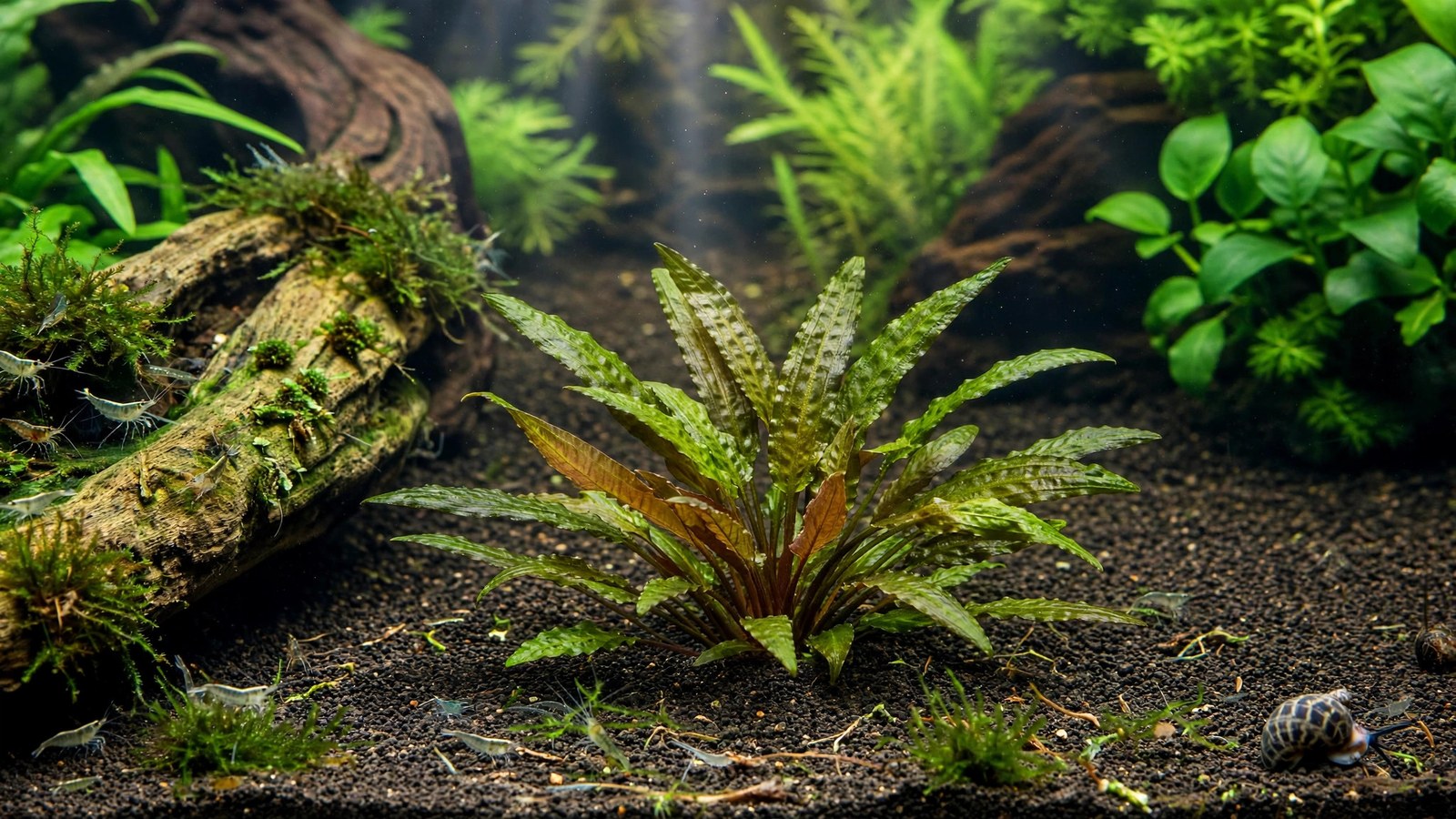
Every crypt keeper knows the ritual: you plant it, it melts to nothing, you panic — and then it comes back stronger than ever. Cryptocoryne wendtii care is the art of patience: this Sri Lankan rosette plant is nearly indestructible once established, tolerates low light and no CO2, and comes in green, bronze, and red-brown varieties. It just demands that you leave it alone.
This guide covers the famous "crypt melt" and how to survive it, wendtii's varieties, planting technique, light and nutrient needs, propagation through runners, and long-term care for a plant that can live for years.
Quick Care Reference
| Parameter | Requirement |
|---|---|
| Light | Low to medium (20–50 PAR) |
| CO2 | Not required |
| Growth rate | Slow |
| Placement | Midground |
| Difficulty | Easy (once established) |
| Temperature | 68–82°F (20–28°C) |
| pH | 5.5–8.0 |
| Height | 4–8 inches (10–20 cm) |
Understanding Crypt Melt (Read This First)
Cryptocoryne wendtii is infamous for "crypt melt" — the sudden dissolution of all its leaves after planting, moving, or even a large water change. Here's what's actually happening: crypts grow different leaf structures for different conditions, and when conditions change abruptly, the plant abandons its old leaves and grows new ones suited to the new environment. The leaves melt; the roots and rhizome survive.
The rules for surviving crypt melt are simple but absolute:
- Never throw away a melted crypt. If the roots and crown are firm, the plant is alive. It will regrow — usually within 2–4 weeks, sometimes longer.
- Don't move it. Every relocation can trigger another melt. Choose the planting spot carefully and commit.
- Remove mush promptly. Dissolving leaves rot and foul the water; pull them gently so decay doesn't spread.
- Wait. New leaves emerge from the crown — small at first, then full-sized. This is the plant working, not failing.
Once established (2–3 months), wendtii becomes one of the toughest plants in the hobby — the melt phase is the price of admission, paid once. Our general Cryptocoryne care guide covers the genus-wide principles if you grow multiple species.
Wendtii Varieties
Several cultivated forms exist, differing mainly in color:
- Green — the classic; bright to deep green ruffled leaves. Fastest-growing and most forgiving.
- Bronze / Brown — warm bronze-brown foliage; the most popular for contrast against green plants.
- Red / 'Mi Oya' — deeper red-brown tones; slightly slower and a touch fussier.
- 'Tropica' — compact form with deeply ruffled leaves; excellent for smaller tanks.
Care is identical across varieties. Bronze wendtii against green Staurogyne repens or Anubias nana petite is one of the most reliable color contrasts in low-tech aquascaping — no CO2, no high light, just warm bronze against green.
Planting Cryptocoryne Wendtii
Wendtii is usually sold potted, with roots wrapped in rockwool. Remove the pot and rockwool completely — leftover rockwool rots and traps debris. Split the plant into individual crowns (each with its own roots); a single pot often contains 3–5 plantlets. Plant each crown with roots spread, buried about an inch deep, crown (where leaves meet roots) just at or slightly above the substrate surface.
Substrate matters enormously for crypts: they are heavy root feeders. Nutrient-rich aquasoil is ideal; in inert substrates, place root tabs directly under each planting. Wendtii planted in rich substrate grows dramatically better — larger leaves, faster spreading, deeper color. This is the single biggest factor in crypt success after "don't move it."
Place it in the midground, where its 4–8 inch rosettes fill the transition between foreground carpets and background stems. Give each crown 2–3 inches of space — established crypts spread into substantial clumps.
Light, CO2, and Water
Wendtii prefers low to medium light (20–50 PAR) — it's one of the best plants for dimmer tanks and shaded spots under hardscape or taller plants. Too much light can actually encourage algae on its slow-growing leaves without benefiting the plant. Eight hours daily is plenty; in low-tech tanks it thrives on less.
CO2 is unnecessary. Wendtii grows perfectly well without it — it's a staple of low-tech and Walstad-style tanks. CO2 speeds growth modestly but changes nothing fundamental about its care.
It's adaptable on water chemistry (pH 5.5–8.0, soft to hard) but sensitive to change: sudden shifts in pH, temperature, or hardness trigger melt. Keep parameters stable and it handles almost any baseline. This sensitivity to change — not to absolute values — is the key insight for crypt keeping.
Fertilizer: Feed the Roots
Crypts feed primarily through their roots — this cannot be overstated. Root tabs are the most important fertilizer for wendtii: place them under the plant every 2–3 months in inert substrates, less often in aquasoil. A comprehensive liquid fertilizer helps too, but root nutrition is what drives the big, lush leaves.
Iron supports the bronze and red varieties' coloration; dose it as part of a complete micro mix. Because wendtii grows slowly, deficiencies appear slowly — yellowing older leaves (nitrogen), pale new growth (iron), pinholes (potassium). Judge over weeks, and remember that a melting crypt isn't nutrient-deficient, it's transitioning — don't "fix" melt with fertilizer.
Section explicitly about root feeding; tabs are the direct fit: Seachem Flourish Tabs pushed into the substrate.
Propagation: Runners
Established wendtii spreads via underground runners, sending up daughter plants around the mother crown. This is wonderfully hands-off: a single planting becomes a clump, then a drift, over 6–12 months. To propagate deliberately, wait until daughters have several leaves and their own roots, then separate gently and replant — or just let the clump expand naturally for a lush, wild look.
Division of large clumps is possible but traumatic — expect melt afterward. Divide only when necessary, and do it knowing the plant will sulk for a month. Patience, again, is the crypt keeper's virtue.
Long-Term Care
Wendtii is a long-lived plant — specimens thriving for 5+ years are common. Long-term care is minimal: root tabs a few times a year, remove old outer leaves as they age, and above all, don't move it. Large, undisturbed crypts develop impressive root systems and produce their largest, most beautiful leaves in years two and three.
Old leaves naturally yellow and die — remove them at the base to keep the crown clean. If a long-established crypt suddenly melts, something changed: check for CO2 interruptions, major water parameter shifts, or substrate exhaustion. Stability is the entire care program.
Troubleshooting Common Problems
Total melt after planting or moving
Normal crypt behavior. Don't discard; keep the crown planted, remove mush, maintain stable conditions, and wait 2–4 weeks for regrowth. This is the plant's adaptation mechanism, not death. See the melt protocol at the top of this guide.
Leaves developing holes
Potassium deficiency — the classic crypt issue, showing as pinholes in older leaves that enlarge over time. Increase potassium via fertilizer or root tabs. Note: plecos and some snails also rasp crypt leaves; distinguish pest damage (ragged edges) from deficiency (clean pinholes).
Yellowing leaves
Older leaves yellowing: nitrogen deficiency or natural aging — remove spent leaves and check root nutrition. New leaves pale: iron deficiency. Whole plant pale and stalled: substrate exhausted; add root tabs directly under the crown.
Stunted, tiny new leaves
Usually root-zone problems: compacted substrate, exhausted nutrients, or the crown planted too deep (crowns buried under substrate rot slowly). Gently check that the crown sits at the surface, add root tabs, and avoid disturbing further.
Algae on leaves
Slow growth plus light equals algae, especially green spot algae on older leaves. Reduce photoperiod if excessive, ensure the plant isn't under blast-level light it doesn't need, and use nerite snails — they're excellent on crypt leaves. Remove badly affected old leaves; the plant replaces them.
Design Roles
Wendtii is the midground anchor of low-tech aquascaping. Its ruffled rosettes fill space between foreground and background with minimal care, and the bronze variety provides warm color without any high-tech demands. Plant it in drifts of 3–5 crowns for natural-looking clumps, or as single specimens among Anubias-covered wood for a classic nature-style composition.
It also excels in low-light tanks where nothing else with color survives — a bronze wendtii under a basic LED is one of the few ways to get warm tones without upgrading your light. For shrimp tanks, its broad leaves offer grazing surface and its dense clumps shelter shrimplets.
Frequently Asked Questions
Why did my Cryptocoryne wendtii melt completely?
Crypt melt is a normal adaptation response to changed conditions — the plant discards old leaves and grows new ones suited to your tank. Keep the crown planted (firm roots mean it's alive), remove mushy leaves, keep conditions stable, and wait 2–4 weeks for regrowth. Never throw away a melted crypt with firm roots.
How long does crypt melt last?
Typically 2–4 weeks from melt to visible new growth, sometimes 6–8 weeks for full recovery. Larger, healthier root systems recover faster. During recovery, maintain stable parameters, don't move the plant, and resist fertilizing aggressively — the plant can't use much while leafless.
Does Cryptocoryne wendtii need CO2?
No. It's a classic low-tech plant that grows well without CO2 injection. CO2 speeds growth slightly but isn't required for health, size, or color. Wendtii is ideal for low-tech, low-light setups where CO2-dependent plants would fail. Its undemanding nature is why it anchors so many low-tech aquascapes.
How do I plant Cryptocoryne wendtii?
Remove pot and rockwool, split into individual crowns, and plant each with roots spread about an inch deep — crown at or just above the substrate surface. Use rich substrate or root tabs (crypts are heavy root feeders), space crowns 2–3 inches apart, and then don't move them. Choose the spot carefully the first time.
Why are the leaves getting holes?
Pinholes in older leaves are potassium deficiency — increase potassium through fertilizer or root tabs. Distinguish this from pest damage: deficiency makes clean round holes, while plecos or snails leave ragged chewed edges. Crypts show potassium hunger clearly, making them useful indicator plants.
Can I move an established crypt?
You can, but expect melt — moving triggers the adaptation response in most cases. If you must move it, do it once, do it gently (keep as much root mass as possible), replant immediately, and accept 3–6 weeks of recovery. The golden rule stands: plant crypts where you want them to live permanently.
Bringing It All Together
Cryptocoryne wendtii asks for exactly three things: rich root nutrition, stable conditions, and to be left alone. Provide those, survive the initial melt without panicking, and you get a long-lived, bronze-or-green rosette that anchors the midground for years with almost no maintenance. It's the plant that teaches aquarists the hobby's hardest lesson — that sometimes the best care is no interference at all.