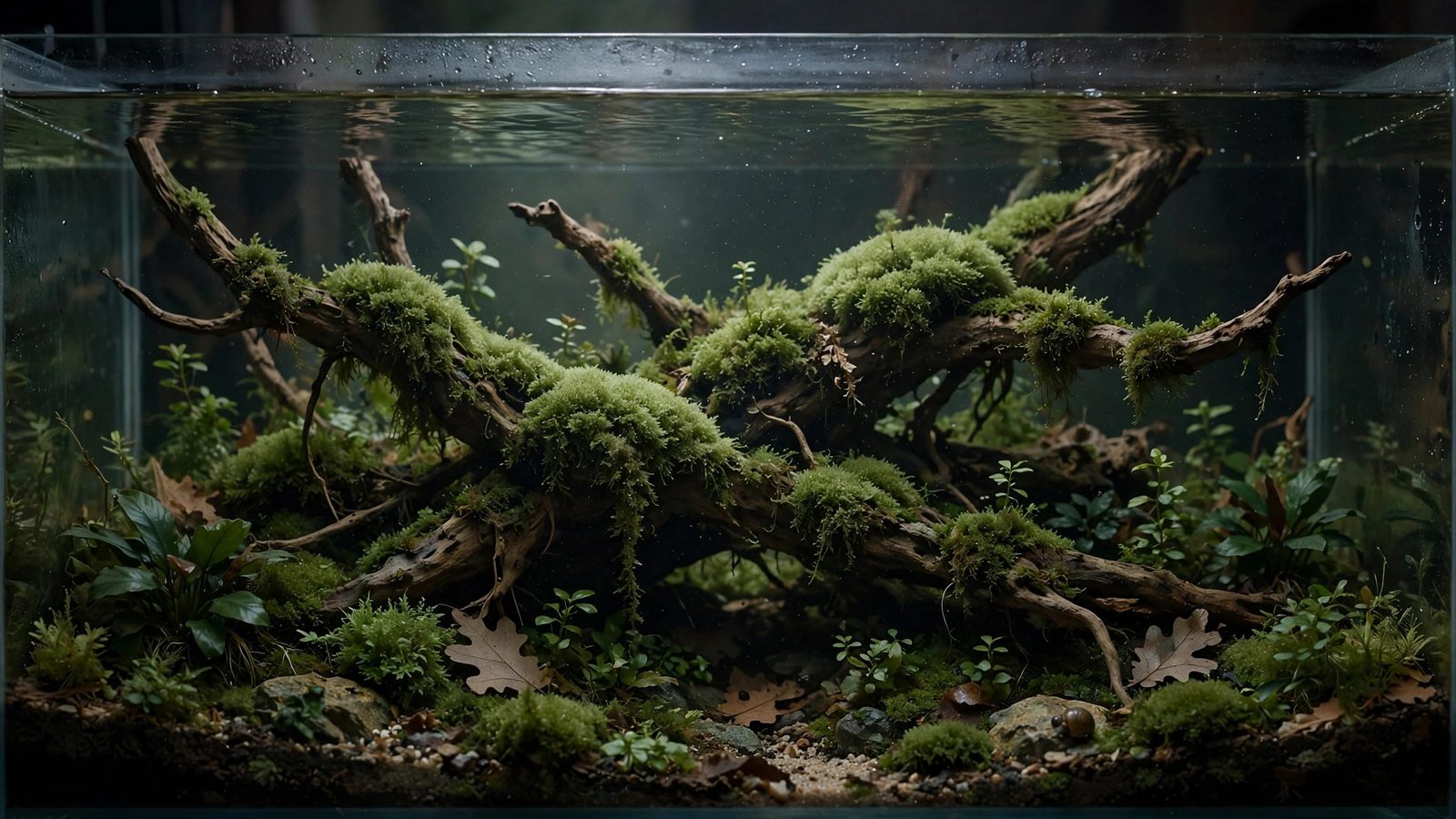
Most aquarium plants sulk in dim tanks — but mosses are the exception. These hardy epiphytes evolved under forest canopies, so yes, you can grow moss in a low-light tank, and java moss will happily take over your driftwood while your stem plants starve. The trick is picking the right species: a few mosses genuinely thrive in dim light, while others merely survive — slowly, brownly, eventually not at all. This guide tells you which to buy (best aquarium mosses compared), how to set them up without CO2, and which ones to skip.
How to grow moss in a low-light tank without CO2
Pick a shade-tolerant species, glue it to hardscape with cyanoacrylate gel, run your light 7–8 hours a day, and skip the CO2. Mosses feed from the water column, so they don't care that your substrate is inert gravel and your light is the stock kit LED. What matters is stability: press moss firmly onto driftwood or lava rock, dab glue at the edges (never across the growing tips), and don't touch it for two weeks while it anchors.
Flow is the unsung variable. Without strong light to outpace algae, moss needs gentle, constant movement across its surface — enough to keep debris from settling, not so much it flattens the fronds. A sponge filter or baffled HOB does the job. On whether injected CO2 changes anything — for mosses, it's a confident no.
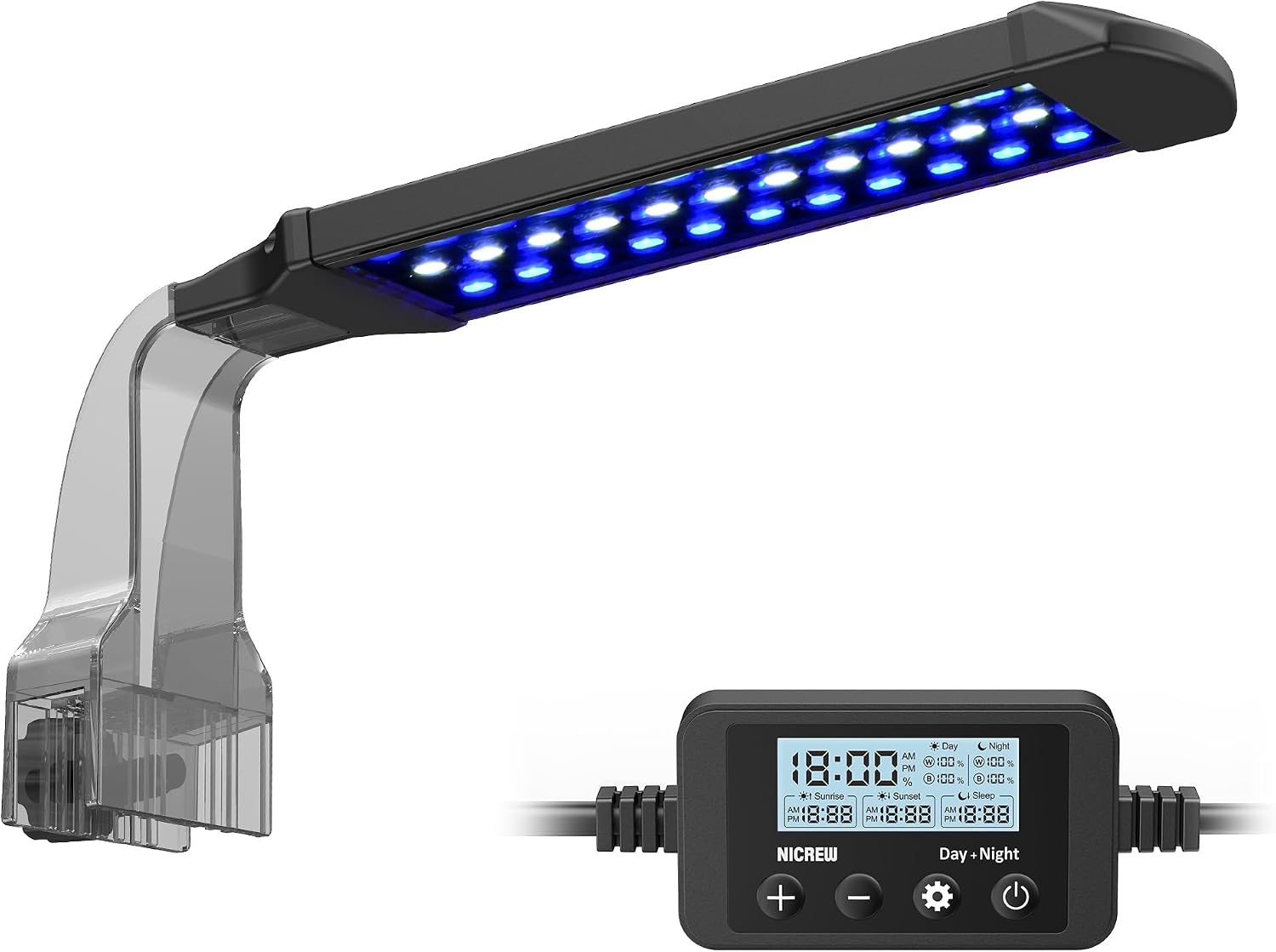 ★4.6
NICREW ClassicLED Plus planted aquarium light
Check Price on Amazon ★4.6The Best Low-Light Moss Species, Ranked
For mosses, "low light" means roughly 20–50 µmol of PAR at the substrate — what a standard entry-level LED delivers. Tolerances below are cross-checked against Tropica's plant database.
| Species | Growth habit | Dim-light performance | Growth rate in dim light |
|---|---|---|---|
| Java moss (Taxiphyllum barbieri) | Branching mat | Truly thrives | 3–5 cm/month |
| Christmas moss (Vesicularia montagnei) | Fern-like branches | Does well | 2–3 cm/month |
| Weeping moss (Vesicularia ferriei) | Drooping, teardrop fronds | Does well | 2–3 cm/month |
| Peacock moss (Taxiphyllum sp. 'Peacock') | Fan-shaped fronds | Survives well | 1.5–2 cm/month |
| Flame moss (Taxiphyllum 'Flame') | Upright spirals | Survives | 1–2 cm/month |
Java moss sits alone at the top: it actively grows in low light, hosting the biofilm prized in aquarium plants for shrimp tanks. Christmas and weeping mosses are prettier but slower, and need clean flow to stay algae-free. Peacock moss stays jewel-green but grows at a glacial pace — an accent, not a carpet. Flame moss survives dim tanks but loses its upright "flame" habit, so buy it only if you can push light toward 40 µmol. For nano setups, java and peacock moss are the natural picks for aquarium plants for 5-gallon tanks.
Mosses to Avoid in Truly Dim Tanks
Two popular mosses demand more light than they're sold with. Fissidens fontanus (phoenix moss) needs at least 50 µmol PAR plus CO2 to look its best; under dim stock lighting it stalls, then the tips brown over 4–6 weeks. Riccardia chamedryfolia (mini pellia) wants medium light and CO2 to stay compact — in dim tanks it stretches into stringy, algae-magnet threads.
Apply the same skepticism to portions shipped brown and "dormant": healthy moss arrives bright green with no sour smell, and a mostly-brown ball won't resurrect in low light.
Setup: Placement, Flow, and Trimming
Attach portions to driftwood or rock in the mid-ground where flow reaches them — not in shadowed corners behind hardscape, where even java moss gives up. Keep moss off the substrate — rhizoids grip hard surfaces, and portions half-buried in sand rot. In goldfish setups, tie moss high on wood, out of nibbling range — see aquarium plants for goldfish tanks and aquarium plants for soft water for more hardy pairings.
Every 4–6 weeks, shear the top third of the mat and siphon clippings out immediately — loose fragments seed everywhere, including your filter intake. Trimming resets the mat before lower layers brown from self-shading, which is why low-light moss looks great in month two and tired in month five.
Buying Moss: What to Look For
Tissue-culture cups are the premium option: guaranteed pest-free — no hydra, planaria, or algae spores — and already in submerged form, so there's no emersed-to-submerged melting. Loose portions from hobbyists are cheaper and larger — squeeze and smell them; sour or swampy means decay is underway.
Quarantine whatever you buy with an alum dip (1 tablespoon per gallon, 3 hours, then rinse well) to knock back pests. And skip "moss topiary" — java moss wrapped around foam forms that falls apart within months and clogs your filter.
Troubleshooting: Why Your Low-Light Moss Isn't Happy
Browning tips mean light is slightly too weak — add an hour to the photoperiod. Browning at the base means the mat is too thick and self-shading; trim hard instead of adding light. Before buying equipment, check does java moss need CO2 — extra CO2 rarely solves moss problems.
Algae on the moss usually means too long a photoperiod, not too much intensity. Cut back to 6–7 hours, improve flow, and spot-treat with 1–2 ml of 3% hydrogen peroxide per gallon (filters off, 20 minutes) — a method from 2hr Aquarist's low-tech guides. Also check floating plants aren't shading the moss out — floaters multiply fast.
Melting after planting is normal for farm-grown moss adjusting to submerged form; leave it alone 2–3 weeks and new growth appears from the base. Intervene only if it turns fully brown and mushy — that's rot, not adaptation.
Frequently Asked Questions
Can java moss grow with no light at all?
No. "Low light" isn't "no light" — java moss needs at least 15–20 µmol of PAR, roughly what a basic clip-on LED provides. In total darkness it survives a week or two, then browns and dies. A cheap timer running that light 6–8 hours daily is enough to hold it green.
How long does java moss take to grow in low light?
Expect 3–5 cm of new growth per month, with visible spread over hardscape in 4–6 weeks. A golf-ball portion covers a fist-sized piece of driftwood in 2–3 months — slower than high-tech, but algae-free. Snipping the tips monthly encourages denser branching instead of leggy strands.
Do mosses need fertilizer in a low-light tank?
Usually not — fish waste plus a weekly water change supplies enough for dim-tank growth. If growth stalls and leaves pale, a half-dose of all-in-one liquid fertilizer weekly is plenty — full dosing just feeds algae. Mosses feed through their leaves, so substrate root tabs do nothing for them.
Can I grow moss without attaching it to anything?
Java moss survives as a free-floating ball, but it won't thrive — it tumbles, self-shades, and browns in the center. Always anchor moss to wood, rock, or mesh; even a rubber band holding it to a stone for three weeks lets rhizoids grip permanently.
Why is my moss turning brown in a low-light tank?
Diagnose by where browning starts: tips mean light is too weak; the base means the mat is too thick (trim hard); the whole portion fading means emersed-grown moss is adapting — leave it alone for 2–3 weeks. Browning from the center outward after a trim usually means light can't reach the interior — thin the mat.
Dim Tank, Lush Green: Your Next Step
Low light isn't a handicap for mosses — it's their home turf. Start with java moss on your main driftwood, add Christmas or weeping moss as accents once the first mat establishes, and keep light-hungry species off your shopping list. Trim on schedule and keep debris out, and your dim tank will look intentionally lush. See our best aquarium mosses compared guide for the full species breakdown before you buy.