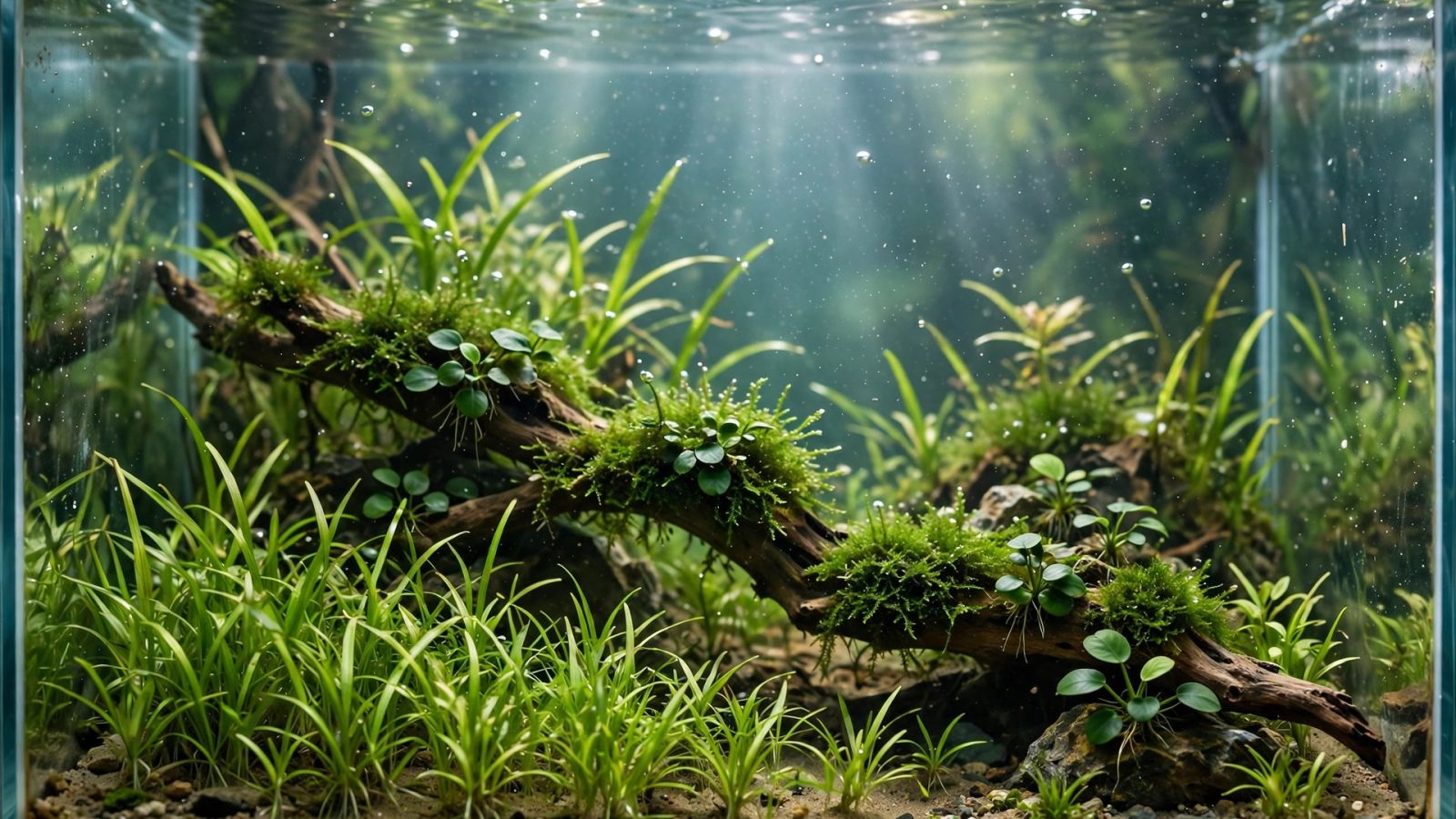
Five gallons is the most popular small tank size — and the easiest to plant badly. Standard plant lists recommend species that outgrow a nano tank in weeks, turning a promising aquascape into an overgrown jungle. The best aquarium plants for 5-gallon tanks are chosen for the opposite trait: they stay small, grow at a manageable pace, and look proportional in a tank where every inch matters. These ten species are proven at nano scale.
The nano challenge is threefold: scale (a plant that’s “compact” in a 20-gallon is a monster in 5), stability (small water volumes swing fast — temperature, parameters, nutrients), and maintenance access (your hand barely fits). The plants below address all three: small mature size, tolerance for the parameter wobbles nanos experience, and growth habits that don’t demand weekly surgery.
Nano Scaping Principles
- Fewer species, bigger impact: 3–5 plant species maximum in a 5-gallon. A nano with twelve species looks chaotic; one with four well-chosen species looks designed.
- Small leaves read bigger: fine-textured, small-leafed plants make the tank look larger — the same forced-perspective trick bonsai uses. Bold, large leaves shrink the perceived space.
- Negative space is mandatory: leave 30–40% of a nano tank open. An overfilled 5-gallon looks cluttered, not lush; restraint is the difference.
- Hardscape carries weight: one good stone or wood piece with epiphytes does more in a nano than any planting scheme. Invest in hardscape.
The 10 Best Plants for 5-Gallon Tanks
1. Anubias nana ‘Petite’
The definitive nano plant. ‘Petite’ keeps the classic anubias toughness in leaves under an inch long — proportional where standard anubias overwhelms. Glue small portions to nano-scale rock or wood; over months they form dense dark-green cushions. It needs nothing: low light, no CO2, liquid fertilizer occasionally. In a 5-gallon, three ‘Petite’ clusters on hardscape can carry the entire midground. If leaves yellow, our anubias guide applies at any scale.
2. Bucephalandra (small varieties)
Buce is the premium nano epiphyte: tiny, slow-growing, available in colors and textures (iridescent greens, deep purples, ruffled edges) that make a 5-gallon look like a jeweler’s display. Varieties like ‘Wavy Green’, ‘Kedagang’, and ‘Brownie Phantom’ stay compact indefinitely. Attach to small stones — a fist-sized rock with three buce varieties is a complete nano focal point. The slow growth means months between maintenance; the high cost per portion is offset by needing so little.
3. Cryptocoryne parva
The smallest crypt is the nano foreground/midground solution: narrow green leaves in a tidy rosette, 2–3 inches tall, spreading slowly into a lawn-like stand. It’s nearly indestructible once established and never outgrows the tank — the anti-jungle plant. The tradeoff is patience: parva takes months to fill in, so plant densely from the start (one pot per 2–3 square inches). Standard crypt rules — root tabs, don’t move it — in miniature.
4. Monte Carlo (Micranthemum tweediei)
Monte Carlo carpets beautifully at nano scale — its small round leaves are proportionally perfect for 5 gallons, and a little goes a long way (one tissue-culture cup carpets a 5-gallon foreground). It grows without CO2, just slowly; the dry-start method in our carpeting guide is ideal for nanos since you’re planting before flooding anyway. Trim with small curved scissors; nano carpets need less frequent cutting because growth is contained.
5. Java Moss / Christmas Moss
Moss is the nano multitasker: attach to wood for an aged look, wedge into rock crevices, or form a moss wall on mesh for a living backdrop. In a 5-gallon, a moss-covered branch is often the entire aquascape’s backbone. Christmas moss’s structured fronds suit deliberate nano designs; Java moss’s wild tangles suit natural styles. Both shelter shrimplets — and most 5-gallon tanks keep shrimp (see our shrimp plant guide). Trim every few weeks to prevent the interior dying off.
6. Staurogyne repens
S. repens is the nano stem plant that behaves: compact, bright green, staying 2–4 inches with occasional trimming. Planted in a group of 5–7 stems, it forms a structured midground mound that contrasts with moss softness and anubias boldness. It tolerates the moderate light typical of nano kits and propagates from trimmings — one purchase becomes a permanent supply. In a 5-gallon, it’s often the tallest plant, which is exactly right.
7. Dwarf Hairgrass (Eleocharis parvula)
For the grassy meadow look at nano scale, dwarf hairgrass is unmatched — fine blades 2–3 inches tall that stay proportional. Plant in dense plugs (divide one pot into 15+ portions for a 5-gallon); nano carpets establish faster because the area is small. It tolerates the stock lighting of most 5-gallon kits, though moderate light keeps it compact. The “mowed lawn” trim every month maintains the manicured look.
8. Rotala rotundifolia (nano-trimmed)
Rotala works in a 5-gallon if you commit to trimming — kept at 4–6 inches through regular topping, it’s a colorful background accent that never overwhelms. The pink-red tips under good light provide the warm color nanos need as a focal point. Plant 5–7 stems in the back corner; trim tops every 2–3 weeks and replant them to thicken. It’s the highest-maintenance plant on this list, but also the most rewarding — a well-kept nano rotala stand looks professionally aquascaped.
9. Red Root Floaters
Every nano needs a floater, and red root floaters are the nano-perfect choice: small enough not to dominate, beautiful enough to be a feature, with red roots that add color at the surface. Corral them to one corner (a small airline-tubing ring) covering 20–30% of the surface. They absorb the excess nutrients that accumulate fast in small volumes — genuinely functional, not just decorative. Thin weekly; in a 5-gallon, a handful removed is significant export. More floaters in our floating plant guide.
10. Pearl Weed (Hemianthus micranthemoides)
Pearl weed is the nano filler — fast-growing, tiny-leafed, endlessly useful. Trimmed short it’s a foreground carpet; left slightly taller it’s a midground bush; trimmings become new plants anywhere. In a 5-gallon its vigor is an asset (fast fill-in) rather than a burden (small area = quick trims). It’s the most forgiving plant here: wrong light, missed ferts, beginner mistakes — pearl weed shrugs them off. Every nano should have a portion.
Nano Maintenance: Small Tank, Specific Rhythm
Water changes: 20–30% weekly, non-negotiable. Small volumes accumulate waste fast and evaporate noticeably — top off evaporation with treated water between changes (never let the waterline drop more than half an inch; concentration spikes follow). Trimming: little-and-often beats occasional overhauls. Five minutes weekly with small scissors keeps a nano composed; an hour monthly means tearing out half the tank.
Fertilizing: dose lean. A 5-gallon needs roughly a quarter of the fertilizer a 20-gallon does, and excess accumulates fast. Start at half the bottle’s recommended dose for your volume, watch new growth for two weeks, adjust. Root tabs: use halves or quarters — a full tab overwhelms a nano root zone. Algae: nanos are algae-prone (high light-to-volume ratio, fast parameter swings). The defenses are: 6–7 hour photoperiod, weekly water changes, a nerite snail or cherry shrimp crew, and floaters absorbing excess. Caught early, nano algae is a 10-minute fix; ignored, it’s a teardown.
Stocking a Planted 5-Gallon
Plants and livestock balance differently at nano scale. The classic planted 5-gallon is a shrimp tank: 10–20 cherry shrimp, the plants above, no fish. Shrimp have negligible bioload, graze biofilm continuously, and breed — the tank becomes a self-sustaining ecosystem. If you want fish: a single betta (with the floaters and moss for enrichment), or 6 chili rasboras / ember tetras as the maximum. Never both a betta and small fish in 5 gallons — and never goldfish, obviously.
The planted nano’s secret: understock deliberately. An understocked nano with thriving plants is a jewel; a fully-stocked nano is a maintenance treadmill. Let the plants be the display and the livestock the accent, not the reverse.
Frequently Asked Questions
Can I use the stock light that came with my 5-gallon kit?
Usually yes for the plants on this list — most kit lights deliver low-moderate light sufficient for anubias, buce, moss, crypt parva, and Java fern. Monte Carlo, hairgrass, and rotala want a bit more; if they stretch or stay green, consider a small clip-on planted-tank light as an upgrade.
Do I need CO2 in a 5-gallon?
No. All ten plants grow well without it — consistent with the low-tech method. Nano CO2 kits exist but add instability risk to small volumes; master low-tech first.
How many plants fit in a 5-gallon?
More than you’d think, if they’re the right ones: 3–5 species, planted in defined groups with open space between. A typical layout: moss on wood (background), S. repens group (midground), Monte Carlo or crypt parva (foreground), red root floaters (surface), one buce-accented stone (focal). That’s a complete, professional-looking nano.
Why is my nano always getting algae?
The usual trio: too much light (cut to 6 hours), too much fertilizer (halve the dose), too few plants (add floaters and fast growers). Fix all three simultaneously — nanos respond fast because the volume is small. Our fast-growing plant guide covers the algae-competition strategy.
Nano Equipment: What Actually Matters
Filtration: a small sponge filter is the nano gold standard — gentle flow (plants and shrimp prefer it), no intake to trap shrimplets, biological filtration proportional to the tank, and under $15. Hang-on-back filters work but need the intake sponged and the outflow baffled; in a 5-gallon their flow is often too strong unmodified. Whatever you choose, the filter should turn the tank volume 4–6x per hour — less than the 8–10x of larger tanks, because nano plants and shrimp dislike current.
Heating: a 25-watt adjustable heater with a thermostat — never a preset “mini” heater, which cook nanos during warm spells. Place it horizontally near the filter for even distribution. In a temperature-stable room, some keepers run unheated with the temperate plants from our cold-water list; but most nano livestock (betta, shrimp) wants 72–78°F, so a heater is standard.
Lighting: the kit light suffices for 6 of the 10 plants here. If upgrading, a small clip-on full-spectrum LED (15–20 watts) with a timer transforms a nano — the intensity jump takes Monte Carlo, hairgrass, and rotala from surviving to thriving. Set 7 hours daily; nanos need less photoperiod than large tanks because the light-to-volume ratio is inherently higher.
Three 5-Gallon Layouts to Copy
1. The Mossy Ravine. A central branch of spider wood, Java moss and Christmas moss attached along its length, anubias ‘Petite’ tucked in the forks, crypt parva foreground, red root floaters corralled at the surface. Shrimp colony. The wood is the scape; plants soften it. Maintenance: trim moss monthly, thin floaters weekly.
2. The Iwagumi Nano. Three small seiryu stones (one large, two supporting) in classic odd-number arrangement, dwarf hairgrass carpet throughout, a single buce-accented pebble as the focal detail. No fish — cherry shrimp only, or completely livestock-free as a pure aquascape. The stone layout carries the design; the hairgrass unifies it. Maintenance: mow the hairgrass monthly, 30% water changes weekly.
3. The Jungle Cube. Pearl weed background (trimmed as a bush), S. repens midground, Monte Carlo foreground patches, frogbit surface, one betta. Lush, forgiving, fast to establish — the beginner’s nano that looks impressive within two months. The pearl weed’s vigor covers early mistakes; the betta provides movement and personality. Maintenance: weekly 5-minute trim, biweekly water change.
All three follow the nano rules: 3–5 species, defined groups, 30%+ open space, hardscape as architecture. Copy one exactly for your first nano, then improvise once you understand why it works.