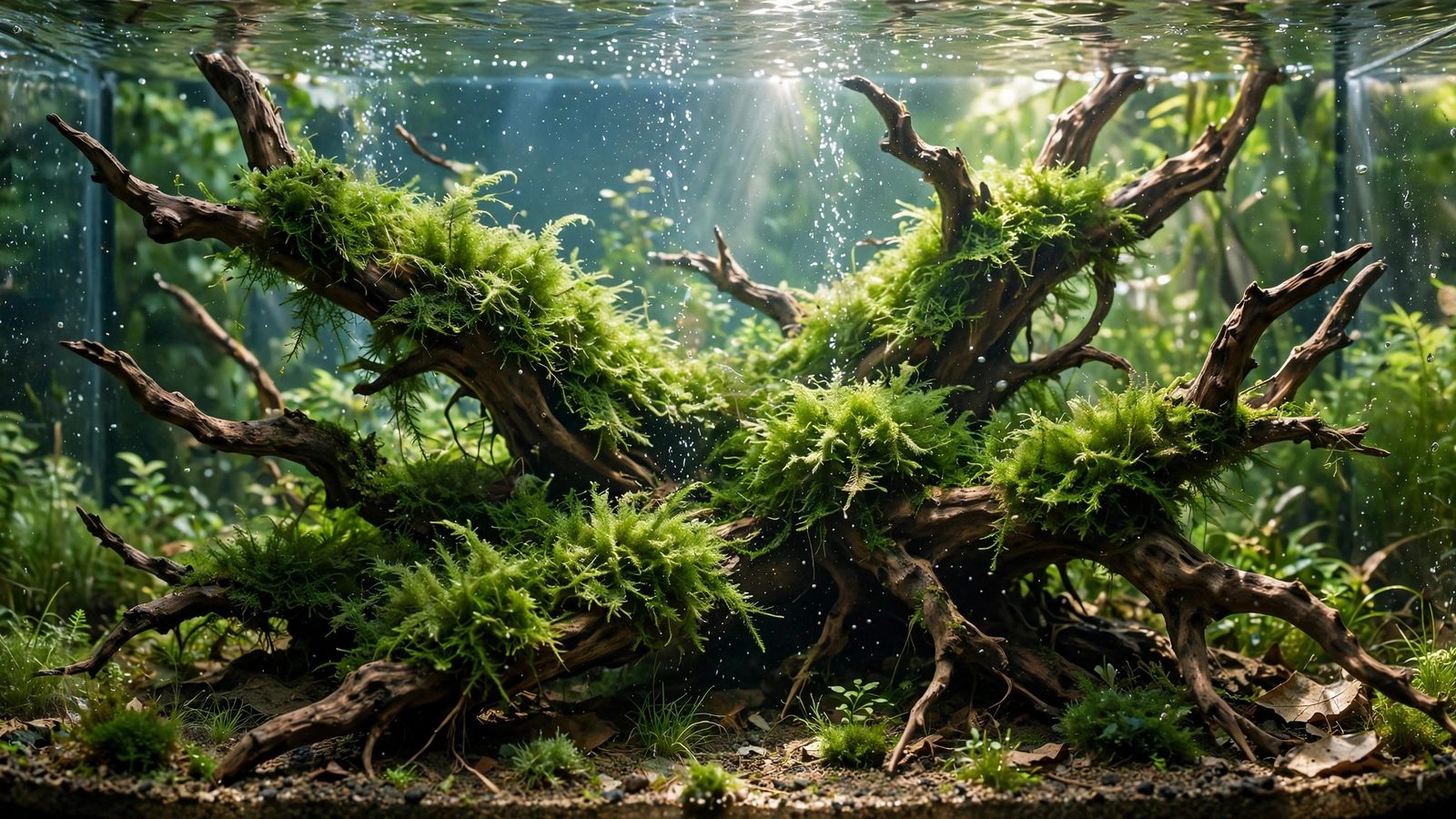
Among low-tech aquarium plants java moss is the undisputed champion — yet search any forum and you'll find the CO2 question asked a hundred ways, with a hundred conflicting answers. Here's the straight version: java moss doesn't need CO2 to live, grow, or look good. A plain clump will thrive in a bowl of tap water on a windowsill. But add CO2 and it grows two to three times faster, denser, and a brighter green — which means the upgrade is worth it for some tanks and pointless for others.
Aquarium Plants Java Moss and CO2: The Short Answer
Java moss (Taxiphyllum barbieri) evolved in shaded Southeast Asian streams, where dissolved CO2 sits at a fraction of what a pressurized cylinder delivers. Its slow metabolism simply can't use that much carbon, so ordinary surface gas exchange — the air meeting your tank water — supplies everything it needs. It will grow, spread, and stay green in a low-tech tank with zero injection.
That's why Tropica and most nurseries list its CO2 demand as low or optional. Injection doesn't unlock some hidden potential in the species; it just accelerates the same slow, steady growth. If you're still deciding which moss to grow, our moss comparison guide walks through the low-tech-friendly options side by side.
So the honest baseline: no CO2, no problem. The interesting question is what you actually gain if you add it — and what it costs you in algae risk and tank stability.
Growth With vs Without CO2: The Real Numbers
Give java moss six months in a low-tech tank and you'll get a modest, shaggy clump — maybe 6–15 cm of total new growth, enough to soften a piece of driftwood but not to carpet a moss wall. Run the same moss at 25–30 ppm injected CO2 with medium light, and it doubles or triples that pace, with visibly tighter branching and a brighter, almost lime-green color.
The difference isn't just speed. Injected tanks also pearl — those streams of oxygen bubbles on the moss after a water change — while low-tech moss rarely does. Here's how the two approaches compare:
| Trait | Without CO2 | With CO2 (25–30 ppm) |
|---|---|---|
| Monthly growth | 1–3 cm | 3–8 cm |
| Color | Deep green | Brighter, vivid green |
| Branching | Sparse, slightly stringy | Dense, bushy |
| Pearling | Rare | Common after water changes |
| Trimming needed | Every 6–10 weeks | Every 3–4 weeks |
Note the trade-off in that last row: faster growth means faster maintenance. For a detailed look at how java moss stacks up against its closest rival, see Java moss vs Christmas moss.
CO2 and Algae: The Hidden Trade-Off
Here's the catch nobody mentions in the product listings: java moss without CO2 is slow, and slow growers are sitting ducks for algae. Hair algae and black beard algae love to colonize moss fronds, and once they're woven in, you can't scrub them out — you have to trim away the infested sections.
Adding CO2 doesn't directly cause algae; imbalance does. But it does change the equation: with CO2 available, you can run slightly higher light and leaner nutrients, and the moss grows fast enough to outcompete algae. In a no-CO2 tank, your defense is restraint: cap the photoperiod at 6–8 hours, keep nitrates around 5–15 ppm, and don't blast the tank with light hoping the moss will speed up — it won't, but the algae will.
Attachment: Does CO2 Help Moss Stick?
Java moss anchors itself with tiny rhizoids that grip wood and rock in about 2–4 weeks. CO2 makes a small difference here — faster tissue growth means marginally faster attachment, maybe shaving a few days off — but your technique matters far more than your carbon source. Tie the moss down with cotton thread, fishing line, or a dab of cyanoacrylate gel, and keep it snug against the surface.
The same thread-and-trim technique used for propagating java moss covers attachment: tie it down snug against the surface and let it colonize on its own schedule.
When CO2 Is Actually Worth It for a Moss Tank
Most java moss keepers never need injection. But CO2 earns its keep in a few specific setups:
| Tank setup | CO2 verdict |
|---|---|
| Low-tech betta or shrimp tank | Skip — stability matters more than speed |
| Moss wall or moss tree | Optional DIY CO2; fills in 2–4 weeks faster |
| Aquascaped show tank | Worth it — density and color pay off |
| Fry or breeding tank | Skip — keep water calm and simple |
| Goldfish tank | Skip — goldfish shred moss long before CO2 matters; see our guide to plants that survive goldfish tanks |
Two edge cases worth knowing. In hard-water tanks, CO2 plus already-high pH rarely pushes levels into the danger zone, but stable parameters still beat chasing numbers — see our guide to aquarium plants for hard water. And in shrimp tanks, injected CO2 can swing pH enough to stress sensitive species like crystal reds, so keep injection gentle and consistent if you try it.
2Hr Aquarist's guide to pushing CO2 limits safely explains how to target 25–30 ppm without endangering livestock — worth reading before you touch a regulator.
Frequently Asked Questions
Can java moss survive with no CO2 at all?
Yes — easily. Java moss is one of the least demanding aquarium plants sold, and Tropica lists its CO2 demand as low or optional. In a low-tech tank with modest light it grows 1–3 cm per month indefinitely. It won't pearl or grow fast, but it will stay healthy and green for years.
How much faster does java moss grow with CO2?
Expect roughly two to three times the pace: 3–8 cm per month at 25–30 ppm injected CO2 versus 1–3 cm without. Growth also comes in denser and brighter. But it never becomes a "fast" plant — CO2 accelerates moss, it doesn't transform it into a stem plant.
Does CO2 make java moss attach to wood faster?
Slightly — faster tissue growth means rhizoids grip a few days sooner — but the effect is minor. Attachment takes 2–4 weeks either way. Your tying method matters far more: thread or gel the moss snugly against the surface and leave it undisturbed.
Will java moss melt if I add CO2 to an established tank?
No. Java moss tolerates the transition well and doesn't melt like crypts or some stems do. Raise CO2 gradually over a week or two, keep light moderate during the adjustment, and watch livestock for gasping — the moss itself will simply start growing faster.
Can I use liquid carbon instead of CO2 for java moss?
You can, but expect modest results. Liquid carbon (glutaraldehyde-based products) gives a small boost to algae suppression and a slight growth lift — nowhere near injected gas. Mosses also tolerate it less well than stems at high doses, so start at half strength.
The Bottom Line
Java moss is the rare aquarium plant where CO2 is a genuine option rather than a requirement. Run it low-tech and it rewards you with years of undemanding green; inject it and it rewards you with speed, density, and color — at the cost of trimming and balance. Match the choice to the tank, not the hype, and you'll never go wrong.