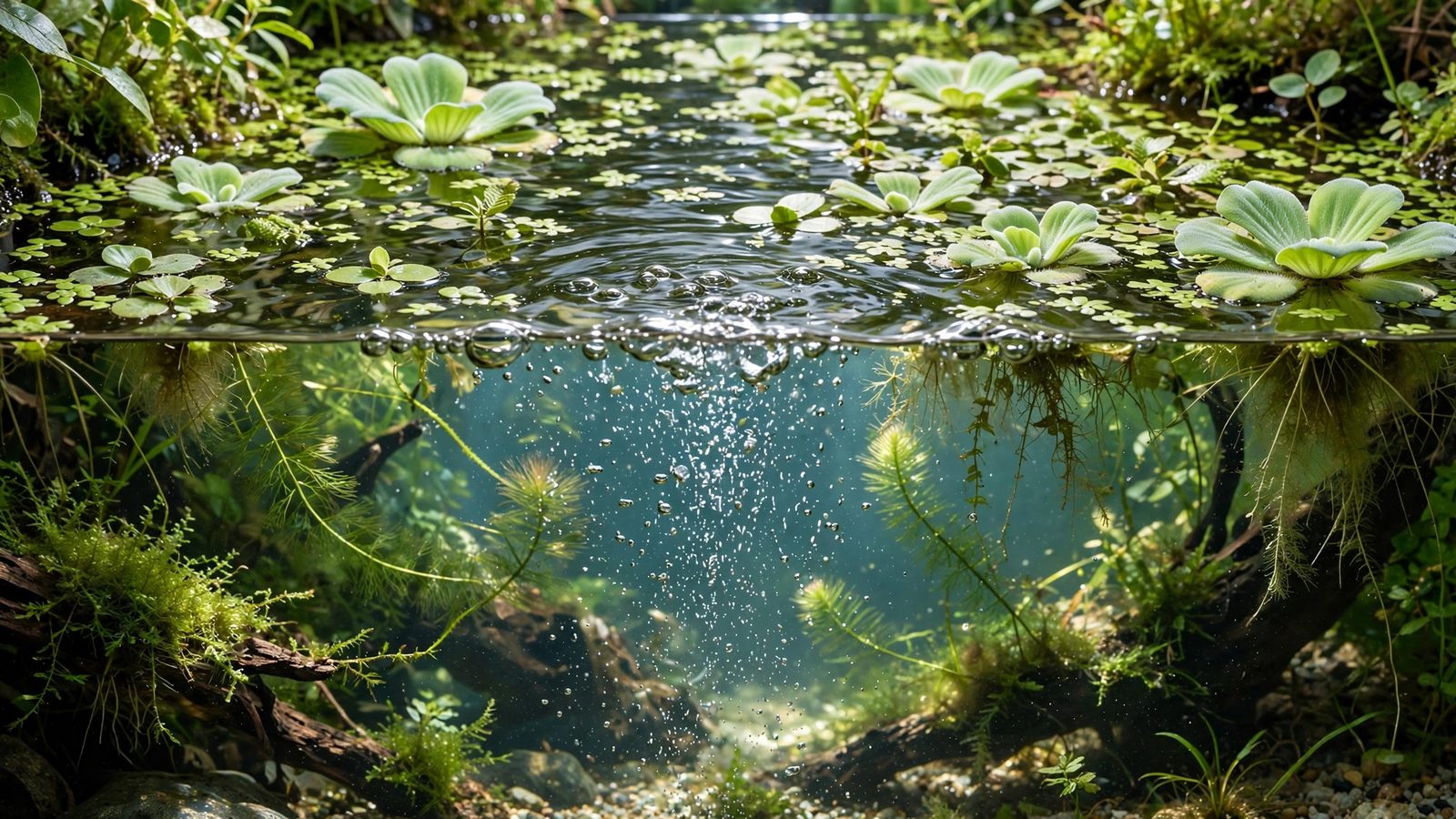
Here's the paradox that starts every argument about floating plants: duckweed can carpet a pond in a week with no CO2 system, no fertilizer, and barely a glance from you — while the prized stem plants below it stall without injected gas. The difference isn't luck; it's where the plant breathes. Floating plants pull carbon straight from the air, and that single fact settles the floating plants co2 debate before it starts. By the end of this guide, you'll know exactly when floaters can skip CO2 entirely, what they genuinely need to explode with growth, and the one situation where extra CO2 actually earns its keep.
The floating plants co2 question, answered
Short answer: no, floating plants do not need supplemental CO2. If you haven't chosen your floaters yet, read our beginner's guide to floating aquarium plants first, then come back — because the reasoning below applies to every species on that list.
A submerged plant is fighting for carbon in water that holds roughly 2–3 ppm of dissolved CO2 — scarce and slow-moving. A floating plant's leaves sit in open air at roughly 420 ppm CO2, with gas exchanging almost instantly across the leaf surface. Diffusion of CO2 through air is on the order of 10,000 times faster than through water. That's not a small advantage; it's like comparing breathing to drinking through a straw. This is precisely why experienced aquarists toss floaters into a brand-new tank on day one: while everything else is still adjusting, the floaters are already photosynthesizing at full speed and soaking up ammonia before algae gets a foothold.
Why floaters play by different rules
Floating plants evolved for the surface. Their stomata — the pores that admit CO2 — sit on the top of the leaf, exposed to the atmosphere, while their roots dangle in the water column harvesting dissolved nutrients. Submerged leaves, by contrast, absorb CO2 from the water itself, which is why a CO2 cylinder transforms a high-tech scape but barely registers for floaters.
Think of it as two different supply chains. Your rotala or monte carlo depends on dissolved gas that must be injected, diffused, and kept stable — a fragile chain. Your frogbit or red root floaters are plugged directly into the atmosphere: an effectively infinite CO2 source that never fluctuates and never needs a refill. In the nutrient race against algae, floaters run on rocket fuel while everything else runs on batteries.
What floating plants actually need (it's not CO2)
If carbon is already handled, what limits a floating plant? Three things, in this order of importance:
| Need | Target | What goes wrong without it |
|---|---|---|
| Light | 20–40 PAR at the surface, 6–8 hours | Leaves shrink, stems stretch, plants melt from the edges inward |
| Nutrients | All-in-one liquid fertilizer, dosed weekly | Yellowing (nitrogen), pinholes in leaves (potassium), stalled growth |
| Calm surface | Gentle flow, minimal splashing | Waterlogged leaves, rot — especially salvinia and red root floaters |
| Open air space | Not sealed under a tight lid | Condensation drips burn leaves; some species stall in stagnant humid air |
Notice nutrients sit above CO2 in importance. A floater starving in lean water won't be saved by carbon — it will yellow, then dissolve. Our sister article on whether floating plants need fertilizer breaks down the dosing math, but the rule of thumb is simple: floaters show deficiencies days before submerged plants do, because they grow so fast they burn through their reserves.
When extra CO2 actually helps
Honest answer: it helps a little, in one specific scenario. In a high-light, high-tech tank already running CO2 for the submerged plants, floaters will multiply even faster — you'll thin them twice a week instead of once. The added carbon nudges an already-explosive growth rate upward. But it never unlocks growth the way it does for a carpet of dwarf hairgrass, because carbon was never the bottleneck for floaters.
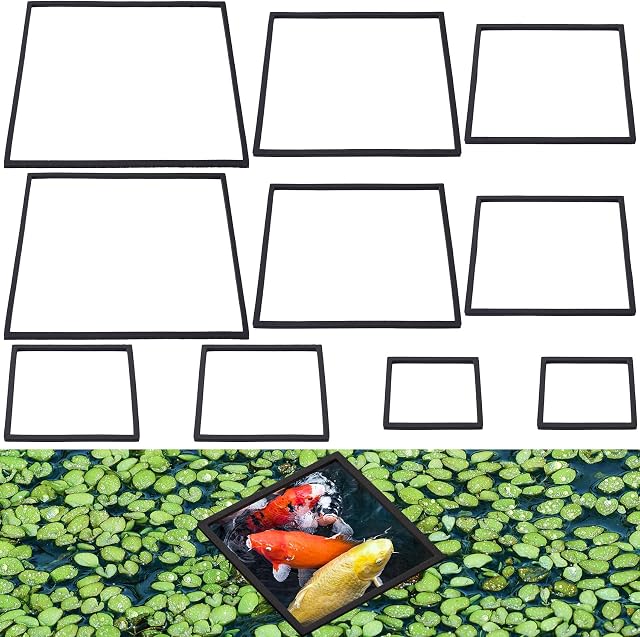
So here's the spending logic: if your floaters are the stars of the tank, put your money into a better light and a good all-in-one fertilizer, not a CO2 rig. If you're already injecting CO2 for the aquascape below, the floaters will happily ride along — just don't buy the cylinder for them. And one practical note for CO2 users: strong surface agitation is the one thing that genuinely bothers floaters, so corral them with airline tubing rings to keep them in calm corners.
There's a side benefit worth knowing: because floaters grow so aggressively on atmospheric CO2, they're excellent algae competitors — see how floating plants help control algae for the full strategy.
Buying healthy floating plant portions
Floaters multiply so fast that a modest starter portion is all you need. Look for firm, green rosettes with intact roots and no slimy film, algae, or hitchhiking pests. Amazon frogbit, salvinia, and red root floaters are the classic beginner trio: frogbit for bulletproof reliability, salvinia for texture, red root floaters for color under strong light.
Quarantine every new portion before it touches your display tank. A 60–90 second dip in a 1:20 hydrogen peroxide solution (1 part 3% peroxide to 20 parts water), followed by a clean-water rinse, kills most algae spores and hitchhikers without harming the plant. Start with enough to cover roughly 10% of the surface; in a healthy tank, you'll be removing handfuls within a month. Fair warning: duckweed is nearly impossible to remove once established — read our duckweed care guide before inviting it in. If you keep bettas, floaters double as perfect cover — our best aquarium plants for betta tanks list explains why.
 ★3.9
PAGOW Floating Plant Corral Rings
Check Price on Amazon ★3.9Frequently Asked Questions
Do floating plants need CO2 in a low-tech tank?
No. Low-tech is where floaters shine brightest — they draw CO2 directly from the air, so they grow fast even without injection, bright high-tech lighting, or enriched substrates. They're the easiest plants in a no-CO2 setup, full stop.
Can CO2 injection harm floating plants?
CO2 itself won't hurt them. The real issue in injected tanks is mechanical: strong flow and surface agitation from diffusers can waterlog leaves and push floaters under. Corral them with a floating airline-tubing ring in a calm corner and they'll thrive alongside your CO2 setup.
Why are my floating plants melting if they don't need CO2?
Usually it's nutrients or water sitting on the leaves, not carbon. Dose an all-in-one liquid fertilizer, reduce surface splashing, and keep condensation from dripping on leaves in lidded tanks. Transition melt is also normal — new portions often shed old leaves before exploding with new growth.
Can floating plants replace a CO2 system for my submerged plants?
No. Floaters consume CO2 from the air, not the water, so they add nothing to dissolved CO2 levels — and they compete with submerged plants for light and nutrients. They complement a planted tank; they don't carbon-supplement it.
Do floating plants grow faster with CO2 injection?
Marginally, in high-light tanks. Since carbon was never their limiting factor, the boost is small compared with the transformation CO2 brings to submerged plants. If you want faster floaters, increase light and fertilizer first — you'll see a bigger response for less money.
The bottom line
Floating plants solved the carbon problem millions of years before aquarists invented CO2 cylinders: they simply breathe air. Skip the regulator, buy the better light, keep fertilizer in the water column, and thin the mat weekly — that's the entire formula. Your floaters will reward you with the fastest, easiest growth in the tank, and your submerged plants will thank you for the algae competition. For authoritative background on how CO2 actually works in planted aquariums, Tropica's CO2 guide is the clearest reference we've found.