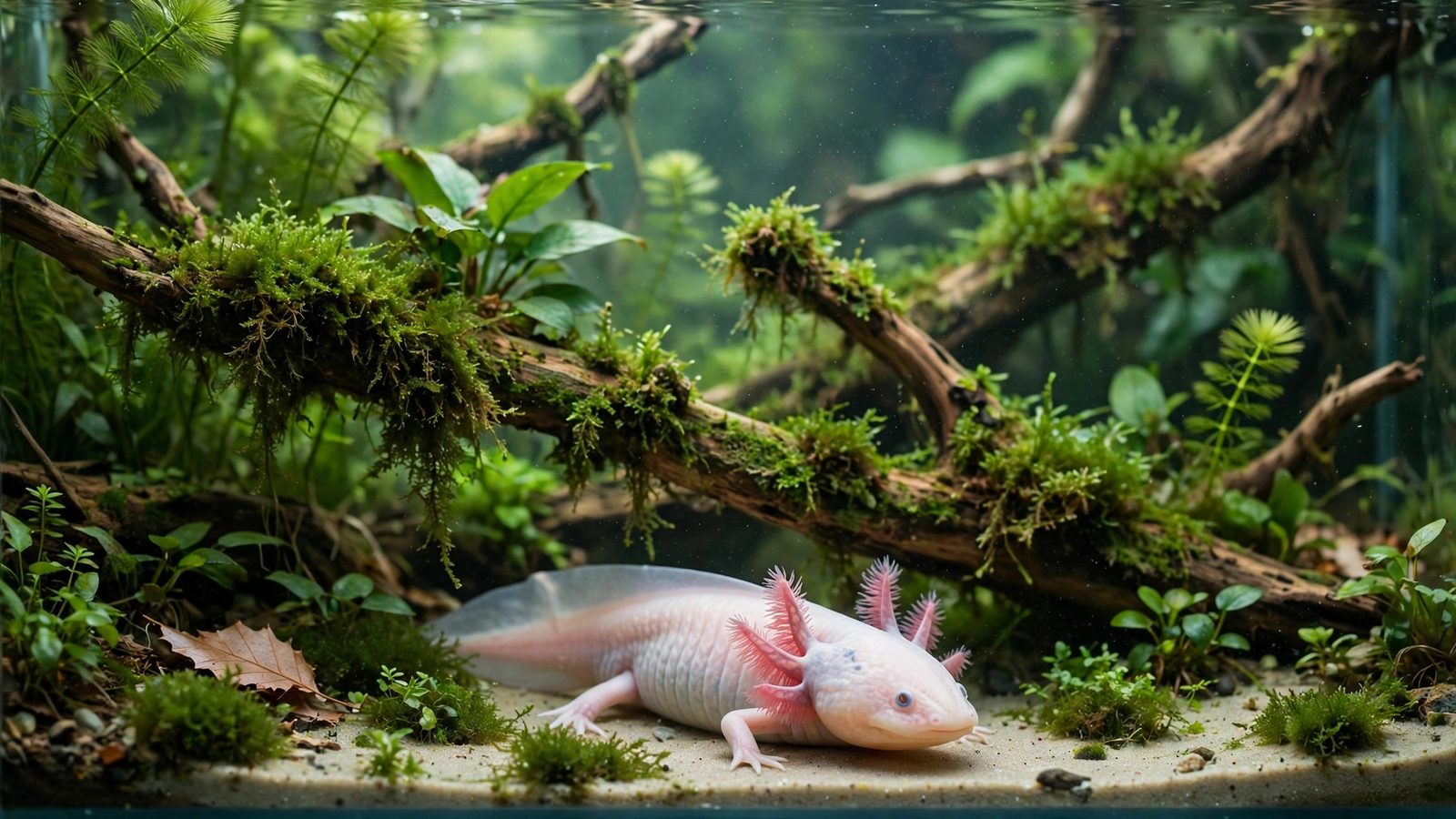
Axolotls break most aquarium-plant rules: they need cold water (60–68°F), dim lighting, gentle flow, and a bare or sand-only bottom — conditions that rule out half the plants in the hobby. But axolotl tanks desperately need plants: they absorb nitrates, provide hiding spots that reduce stress, and give females somewhere to attach eggs. These 8 plants thrive in the cold, dim, low-flow world axolotls require.
Understanding Axolotl Tank Conditions
Axolotls are cold-water amphibians with specific needs that shape every plant choice. Temperature 60–68°F (16–20°C) — tropical plants melt; temperate and cold-tolerant species thrive. Dim lighting — axolotls have no eyelids and are stressed by bright light, so tanks run low light with hides and shade. Gentle flow — strong currents stress axolotls, so filtration is gentle and plants can't depend on high flow for nutrient delivery. Sand or bare bottom — gravel is an impaction risk if swallowed, so plants must work in sand, attached to hardscape, or floating.
The good news: many of the hobby's toughest plants are cold-tolerant shade-lovers. Axolotl tanks grow beautiful planted setups — just different plants than a tropical show tank. Our cold-water plant guide covers the broader temperate palette.
The 8 Best Axolotl-Tank Plants
1. Anubias barteri var. nana — the perfect axolotl plant
Anubias might have been designed for axolotl tanks: thrives in cold water, loves low light, attaches to hardscape (no substrate needed), and has tough leaves axolotls rest on without damage. Axolotls frequently perch on broad anubias leaves — it's enrichment and decoration in one. Glue to driftwood or rocks; it asks for nothing and gives everything.
2. Java Fern — the cold-water workhorse
Java fern tolerates temperatures down to the 60s happily, grows in dim light, and attaches to wood and rock. Its broad leaves provide cover and egg-laying surfaces — female axolotls preferentially attach eggs to broad-leafed plants. The 'Windelov' variety's split tips add texture. Like anubias, never bury the rhizome; see our epiphyte guide for attachment.
3. Java Moss — the egg-laying essential
If you breed axolotls (or might), java moss is close to mandatory — females lay eggs preferentially in fine-leaved plants, and moss catches and protects them. Even without breeding, moss provides hiding spots for juveniles and infusoria grazing. It grows slowly in cold water but steadily; tie it to hardscape in shaded spots. Compare moss options in our aquarium moss comparison — several work in cold water.
Bonus: Floating Plants for Shade
While not a single species, a colony of beginner floating plants like frogbit or dwarf water lettuce is worth adding to any axolotl tank: they diffuse the bright light axolotls hate, absorb nitrates aggressively, and need zero planting. Thin weekly so they don't cover the entire surface — axolotls still need open water to surface for air. For species hardy enough for unheated setups, cross-reference our cold-water plant picks, and check growth requirements against Tropica's plant database when shopping.
4. Anacharis (Egeria densa) — the cold-water nutrient sponge
Anacharis is a temperate plant that genuinely prefers cooler water — it grows better at 65°F than at 78°F. It absorbs nitrates aggressively (valuable in messy axolotl tanks), provides cover, and can be floated or planted in sand. The fastest-growing cold-water plant available, and cheap enough to replace whenever.
5. Hornwort — the floating filter
Another temperate native that loves cold water. Hornwort floats at the surface, diffusing light (axolotls appreciate the shade), absorbing nitrates, and providing cover — all with zero planting and zero substrate needs. It grows well in the gentle flow of axolotl tanks. Net out shed needles; otherwise ignore it.
6. Marimo Moss Balls — the axolotl toy
Axolotls nudge moss balls around, rest against them, and generally interact with them — they're enrichment as much as decoration. Moss balls tolerate cold water perfectly, need only occasional rolling and rinsing, and add a soft organic element to the hardscape. Get large ones; axolotls will rearrange small ones into corners.
7. Cryptocoryne wendtii — the cold-tolerant rosette
One of the few rosette plants that handles cold water well. Crypt wendtii grows slowly in the 60s but steadily, forming low colonies in sand (with root tabs) that give the tank a planted foreground without gravel. It tolerates the dim lighting axolotls need. Expect the usual crypt melt on introduction; it recovers.
8. Water Sprite (Ceratopteris thalictroides) — the versatile floater
Water sprite grows floating or planted, tolerates cooler temperatures, and provides the fine-leaved cover axolotls and their eggs love. As a floater it shades the tank (reducing axolotl light stress) and absorbs nitrates rapidly. Thin it regularly — it multiplies fast even in cold water.
A reliable pick here is Seachem Flourish Glue.
Setting Up a Planted Axolotl Tank
Substrate strategy
Fine sand (or bare bottom) is the axolotl-safe choice. Plants in sand need root tabs (crypts) or should be epiphytes/floaters that don't care about substrate. Slope sand deeper at the back for planted pockets. Never use gravel with axolotls — impaction risk is real and often fatal.
Lighting for plants without stressing axolotls
Run a dimmable LED at low intensity for 6–8 hours, and provide hides (caves, PVC pipes, dense plant thickets) where the axolotl can escape light entirely. Floating plants (hornwort, water sprite, duckweed) create natural shade — the single best light-management tool. The plants on this list all grow in low light, so there's no conflict.
Hardscape as plant infrastructure
Since substrate planting is limited, hardscape carries the aquascape: driftwood and smooth rocks (no sharp edges — axolotl skin tears easily) with anubias, java fern, and moss attached. Build caves and overhangs that serve as both hides and plant mounts. Every structure should do double duty.
A reliable pick here is Seachem Flourish.
What to Avoid
Skip tropical plants that need warmth (most stem plants, red species, HC Cuba), anything needing strong light or CO2, and sharp or rough hardscape. Avoid fertilizers with copper (toxic to amphibians) — in practice, axolotl tanks need minimal fertilization anyway since bioload provides nutrients. If you dose, use shrimp-safe, copper-free products at half strength.
Seasonal Care for Cold-Water Planted Tanks
Cold-water planted tanks follow the seasons even indoors. In summer, room temperatures creep up — watch that the tank stays under 68°F, increase surface agitation for oxygen (cold water holds more oxygen, but warm spikes deplete it fast), and expect a growth spurt from your plants as temperatures rise into the mid-60s. In winter, growth slows to a crawl; reduce fertilizer dosing accordingly, since plants can't use nutrients they aren't metabolizing, and excess just feeds algae. Anacharis and hornwort may shed more in the coldest months — normal seasonal behavior, not a crisis. The annual rhythm is gentle, but acknowledging it keeps the tank stable: feed the growth in summer, rest the system in winter, and your axolotl-plant ecosystem will hum along for years with minimal intervention.
Frequently Asked Questions
Can axolotls live with any plant, or are some toxic?
All eight plants on this list are safe. The main toxicity concern isn't plants but chemicals — copper-based algaecides, many medications, and some fertilizers are dangerous to axolotls. Stick to plain, untreated aquarium plants from reputable sources and avoid wild-collected plants that may carry pesticides.
Will my axolotl uproot or eat the plants?
Axolotls don't eat plants, but they bulldoze — a large axolotl charging across the tank uproots light plantings. That's why epiphytes glued to heavy hardscape and floaters dominate this list: nothing to uproot. If you plant in sand, use deep pockets and heavy root tabs, and accept occasional rearrangement.
Do I need a chiller for a planted axolotl tank?
If your room exceeds 70°F in summer, yes — axolotls stress above 68°F and plants won't save them. A chiller is the reliable solution; fans and frozen water bottles are stopgaps. The plants on this list handle the full 60–68°F range, so temperature management is about the axolotl, with plants as willing passengers.
Can I keep shrimp or snails with axolotls and plants?
Snails (mystery, nerite) work as cleanup crews; shrimp become expensive axolotl snacks — ghost shrimp as occasional live food is fine, but don't expect a colony to survive. The plants provide enough grazing surface and cover that a snail crew keeps algae in check without shrimp.
How do plants help with axolotl egg-laying?
Female axolotls attach eggs individually to surfaces, strongly preferring fine-leaved plants and broad leaves. Dense java moss and java fern give her ideal laying sites and protect eggs from being eaten (including by the parents — remove adults after laying). A breeding tank should be packed with moss and fern.
My cold-water plants are growing very slowly — is something wrong?
No — cold water means slow metabolism for plants too. Growth at 64°F runs at roughly half tropical speed. That's normal and fine; it also means less trimming and fewer nutrient demands. Judge health by color and new growth (even slow), not by speed. If growth stalls entirely and leaves pale, add gentle liquid fertilizer at half dose.
Can I use a hang-on-back filter with plants in an axolotl tank?
Yes, with modifications — baffle the outflow with a sponge to keep current gentle, since strong flow stresses axolotls and uproots delicate plantings. A baffled HOB works fine alongside floaters and attached epiphytes; just keep the intake sponge-covered so curious axolotls and plant fragments don't get sucked in. Canister filters with spray bars aimed at the glass are the gentler alternative.
Cold, Dim, and Beautiful
Axolotl tanks won't win high-tech aquascaping contests, but a well-planted cold-water setup — anubias-covered driftwood, java fern thickets, floating hornwort diffusing the light, moss softening every edge — is genuinely beautiful in its own right. More importantly, it's a healthier, less stressful home for one of the hobby's most charismatic animals. Plant for the axolotl's needs, and the aesthetics follow.