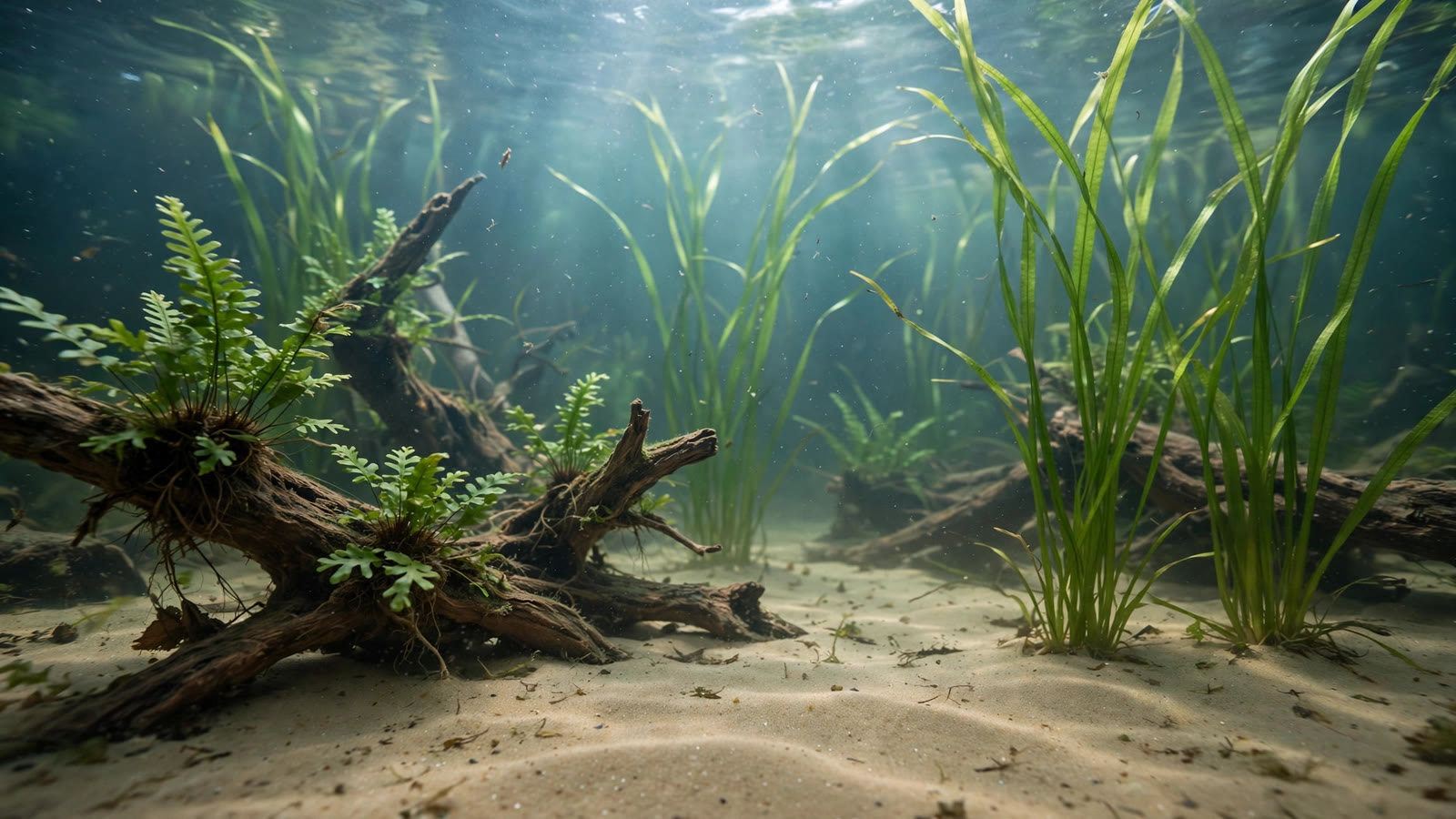
Brackish water aquarium plants sound like a contradiction — plants die in salt, right? Yet walk any tidal estuary and you'll find green life rooted in water saltier than your freshwater tank will ever be. A small group of aquarium plants has quietly adapted to exactly those conditions, and understanding which species tolerate salt — and at what specific gravity — opens up a planted-tank style most aquarists never attempt. This guide covers what brackish water really is, the freshwater species that can handle low salinity, how to acclimate them safely, the plants to avoid, and how to feed plants when your water carries salt.
What "Brackish Water" Actually Means
Brackish water is simply water with salinity between freshwater and seawater: saltier than a river, fresher than the ocean. Aquarium salt is never table salt or "tonic salt" — brackish setups use marine salt mix, the same product reef keepers buy, because it contains the full spectrum of minerals (calcium, magnesium, potassium, trace elements) that plants and fish need. Mix it in a separate bucket with water matched to tank temperature, stir until fully dissolved, and measure before the water touches your aquarium.
Hobbyists measure brackish strength two ways. The most common is specific gravity (SG), read with a hydrometer or refractometer: pure freshwater reads 1.000 and full seawater reads about 1.025, both at roughly 25°C (77°F) — the calibration temperature most hydrometers assume. The other is parts per thousand (ppt), where seawater sits near 35 ppt. For planted brackish tanks, the useful working range is narrow: about SG 1.002 to 1.008 (roughly 3 to 10 ppt). A low-salinity community tank for mollies and gobies typically sits around SG 1.003–1.005, which is also where the widest plant selection survives. That plant-friendly zone sits at the very bottom of the broader aquarium range described in Chewy's guide to creating a brackish habitat aquarium, which spans SG 1.002–1.022 — most of it far saltier than any planted tank. Push past SG 1.010 and the list of living plants shrinks to a handful of true brackish specialists.
One measurement warning matters more than any species list: SG readings drift with temperature, so reference numbers assume 25°C/77°F. A refractometer calibrated with distilled water is the reliable tool; a floating hydrometer works if you let the water settle in a jar first and read at the water level, not the meniscus.
Why Salt Defeats Most Freshwater Plants
Salt kills freshwater plants through osmosis, not poison. Plant cells maintain a higher internal concentration of dissolved substances than the water around them, so freshwater normally flows inward across cell membranes and keeps tissues turgid. Add salt to the tank and the gradient reverses: water is pulled out of the leaves, cells collapse, and the plant wilts from the inside. Fast-growing soft-leaved stems, with their thin cuticles and rapid water turnover, are usually the first casualties.
Salt-tolerant species survive through adaptations like tougher, waxier leaf surfaces that slow water loss, and internal osmotic rebalancing — the same trick coastal wetland plants use. A few aquarium plants, most notably Cryptocoryne ciliata, genuinely live in brackish estuaries in the wild. The rest of the plants in this guide are freshwater species with unusually wide tolerances — they don't love salt, but they can endure the low end of the brackish range if you give them time to adjust.
Brackish Water Aquarium Plants: Freshwater Species That Tolerate Low Salt
Start with these four familiar species. All are hardy, widely available, and documented in WetWebMedia's long-running brackish aquarium plant FAQs as comfortable around SG 1.003–1.005 — the range most planted brackish community tanks actually run.
Java Fern (Microsorum pterotoides)
Java fern is arguably the most forgiving brackish-tolerant plant in the trade, comfortable up to about SG 1.005 when acclimated carefully. Its thick, leathery leaves lose water slowly, and it needs no planting — tie it to wood or rock and the rhizome absorbs nutrients straight from the water, which suits the moderate-light, moderate-nutrient reality of most brackish setups. Give java fern moderate light and gentle flow, attaching the rhizome to hardscape rather than burying it.
Anubias (Anubias barteri varieties)
Like java fern, Anubias species grow from a rhizome that must stay above the substrate, and their broad, waxy leaves shrug off low salinity up to around SG 1.005. Anubias nana and Anubias barteri are the forms most often kept in brackish tanks; both grow slowly enough that a single plant can anchor a hardscape for years. Their brackish-specific weakness is algae: slow leaves plus the phosphate marine salt mix adds equals algae magnets, so keep light moderate and clean older leaves at water changes. Keep rhizomes above the substrate — buried rhizomes rot.
Vallisneria (Vallisneria spiralis, V. americana)
Vallisneria is one of the few background plants with genuine brackish credentials: some wild populations grow in coastal estuaries, and hobbyists report success up to about SG 1.005 after slow acclimation. Its long ribbon leaves create the flowing backdrop a brackish tank otherwise lacks. Plant individual crowns in a nutrient substrate, expect a few weeks of sulking during the transition, and then watch runners spread. Give new crowns two or more inches of nutrient substrate so runners spread freely.
Cryptocorynes (Cryptocoryne wendtii and relatives)
Common cryptocorynes such as C. wendtii cope acceptably with very low salinity — up to about SG 1.003 in practice. Expect "crypt melt" after any change: leaves may dissolve, then return grown for the new conditions, so don't yank the plant. For the true brackish species, look for Cryptocoryne ciliata, which grows in mangrove-fringed estuaries in the wild and handles roughly SG 1.010 — double what its freshwater cousins manage. Expect a cryptocoryne melt cycle after the salinity transition, then steady recovery.
Brackish-Tolerant Plants at a Glance
The ranges below are conservative typical hobby ranges, not absolute limits — slow acclimation buys tolerance at the top end. When in doubt, start low and raise salinity gradually.
| Plant | Safe upper salinity | Notes |
|---|---|---|
| Java fern | SG 1.005 (~6 ppt) | Rhizome plant; tie to hardscape |
| Anubias (barteri, nana) | SG 1.005 (~6 ppt) | Waxy leaves; watch for algae |
| Vallisneria | SG 1.005 (~6 ppt) | Wild estuary populations exist |
| Cryptocoryne wendtii | SG 1.003 (~4 ppt) | Expect melt, then recovery |
| Cryptocoryne ciliata | SG 1.010 (~13 ppt) | True brackish species |
| Bacopa monnieri | SG 1.008 (~10 ppt) | Needs good light and substrate |
| Samolus valerandi | SG 1.008 (~10 ppt) | Light- and substrate-hungry |
| Crinum calamistratum | SG 1.005 (~6 ppt) | Bulb plant; very slow |
| Java moss / moss balls | SG 1.005 (~6 ppt) | Reliable at low salinity |
Beyond these, mangroves (Rhizophora and Avicennia species) deserve a mention: they're the one higher plant genuinely built for salt, but they grow emergent — leaves in the air, roots in the water — so they suit open-top brackish tanks, not submerged aquascapes. Check local regulations before acquiring any species, and never release aquarium plants into the wild.
Plants to Avoid in Brackish Tanks
Most soft-leaved stem plants are the first to fail, so skip them rather than watch them dissolve: Rotala, Ludwigia, and Cabomba melt rapidly once salinity climbs past trace levels. Carpeting plants fail the same way — dwarf baby tears (Hemianthus callitrichoides) and Monte Carlo (Micranthemum tweediei) have paper-thin leaves and almost no salt tolerance — and delicate mosses beyond java moss (fissidens, flame moss) usually brown off above SG 1.003.
A few plants are surprising survivors at trace salinity — Amazon swords, Hygrophila, and Egeria densa cope acceptably at or below SG 1.003 if the water is hard and alkaline and everything else (light, nutrients) is right. Treat these as borderline: fine for a tank kept barely-brackish, doomed if you later raise salt for the fish. And before importing anything unusual, check the rules in your area — some jurisdictions restrict salt-tolerant species because they colonize coastal waterways. Our guide to invasive aquarium plants you should never release explains why that rule matters.
How to Acclimate Plants to Brackish Water
Plants don't need drip acclimation like fish, but they do need a gradual ramp — dropping a freshwater plant straight into SG 1.005 is how you buy a melting mess. Establish the plants first, let them root and grow, and only then raise the salinity.
- Plant at SG 1.002 or below. Set up the aquascape essentially as a freshwater tank with a whisper of marine salt. Give the plants one to two weeks to settle, root, and show new growth.
- Raise SG by no more than 0.002 per week. Mix your water-change water slightly saltier than the tank, and let each water change step the tank up gently. This is the same conservative pace recommended for acclimating filter bacteria.
- Watch the newest leaves, not the old ones. Older leaves may brown or drop during the transition — that's normal. What matters is whether new growth emerges looking healthy. No new growth after two to three weeks means that species has hit its limit.
- Stop at your target, then hold steady. For a planted community with mollies and gobies, SG 1.003–1.005 is the sweet spot. Only push toward SG 1.008–1.010 if you've stocked the true brackish species (C. ciliata, Bacopa monnieri) that can handle it.
- Buy clean stock. Tissue-culture plants arrive pest- and algae-free, which matters when your salty tank already leans toward algae — see our comparison of tissue culture vs potted aquarium plants.
Patience beats precision here. A plant raised two weeks per salinity step and given time to grow salt-adapted leaves will outperform the same plant dumped straight into its "tolerant" range.
Fertilizing a Brackish Planted Tank
Marine salt mix floods the water with calcium, magnesium, and buffering capacity, so you can skip the hardness and alkalinity supplements a freshwater tank might need — the salt does that job. But it adds almost none of the nutrients plants consume fastest: potassium and iron remain the first deficiencies to appear, exactly as in freshwater.
Dose lean and watch. Start at roughly half the label dose of a comprehensive liquid fertilizer, because you have fewer hungry fast-growers pulling nutrients and high salinity already stresses plants — excess fertilizer plus stress equals algae. Root tabs under heavy feeders like Vallisneria and swords work normally. Two warnings carry over from freshwater practice: many fertilizers contain trace copper, and copper toxicity bites harder at the higher pH typical of brackish water, so dose conservatively — check copper labeling on the bottle and start at half the recommended dose. Our guide to plants that absorb nitrates covers the nitrogen-uptake mechanics that still apply in brackish water.
Brackish Tankmates That Suit Planted Tanks
This isn't livestock care — but plant choice depends on who shares the water, so here's the context. Mollies are the classic brackish community fish: peaceful, salt-flexible, and generally plant-safe, though large sailfins may nibble soft new shoots. Bumblebee gobies are tiny and fine at SG 1.002–1.005 where most plants thrive — but they're fussy feeders. Knight gobies and figure-8 puffers both prefer the SG 1.005 neighborhood that matches java fern and Anubias perfectly; figure-8s are the poster fish for planted brackish tanks, though they'll hunt your snails too.
What to skip in a planted brackish setup: green spotted puffers and scats eventually want marine-level salinity (SG 1.010+) that kills most plants, and they grow large enough to shred aquascapes. If you want a true planted display rather than a fish tank that happens to contain plants, stock for the plants' salinity ceiling — SG 1.003–1.005 — not the fish's. The classic planted-brackish community of mollies, bumblebee gobies, and one figure-8 puffer exists precisely because all three thrive at plant-friendly salinity.
Frequently Asked Questions
Can aquarium plants grow in brackish water?
Yes — a limited selection does. Hardy rhizome plants like java fern and Anubias, Vallisneria, and Cryptocoryne ciliata (a genuine brackish species) all grow at low salinity when acclimated slowly. Most delicate stem plants and carpeting species cannot. The realistic expectation is a low-salinity planted tank around SG 1.003–1.005 with a curated plant list, not a lush Dutch-style aquascape.
What salinity is safe for brackish water aquarium plants?
SG 1.002–1.003 suits most hard-water-tolerant freshwater plants, including Amazon swords and Hygrophila. SG 1.005 is the practical ceiling for the reliable brackish-tolerant list: java fern, Anubias, Vallisneria, Bacopa monnieri, and Cryptocoryne ciliata. Past SG 1.008–1.010, only true brackish specialists and emergent mangroves survive, and the plant palette becomes very thin.
How do I convert a planted freshwater tank to brackish?
Establish the plants first and raise the salinity no faster than about 0.002 SG per week, mixing slightly saltier water-change water each time. Use marine salt mix, never aquarium salt, and measure with a refractometer at 25°C. Expect some older leaves to melt during the ramp; judge progress by whether new growth emerges healthy, and hold at SG 1.003–1.005 for a mixed planted community.
Why are my plants melting after adding salt?
Sudden salinity shocks collapse plant cells faster than they can adjust, and most melt is caused by raising salt too quickly rather than by the final salinity itself. Soft-leaved stems and carpeting plants may be past saving, but hardy species like java fern, Anubias, and crypts often melt back and regrow salt-adapted leaves. Hold the salinity steady, trim dead tissue, and give regrowth two to three weeks before declaring a plant dead.
Do brackish planted tanks need CO2 and fertilizer?
They benefit, but dose lighter than a freshwater tank. Marine salt mix supplies calcium, magnesium, and buffering, so start liquid fertilizer at about half the label dose and focus on potassium and iron — the first deficiencies to show. CO2 helps light-hungry species like Bacopa monnieri at SG 1.005+, but many successful brackish planted tanks run low-tech with moderate light and patient stocking.
Can I keep mangroves in a brackish aquarium?
Yes, but only in open-top tanks with room above the waterline — mangroves grow emergent, with leaves in the air and roots in the water. Red mangrove (Rhizophora) is the common aquarium choice and tolerates full brackish-to-marine salinity easily. It won't fill the submerged aquascape the way submerged plants do, so treat mangroves as a feature plant above the tank, and always verify legality in your region before acquiring them.
Start Low, Go Slow, and Respect the Salt
A planted brackish tank is one of the hobby's most rewarding niches precisely because it asks for restraint: SG 1.003–1.005, a shortlist of proven plants, salinity raised a hair per week, fertilizer at half strength. Get those right and you get something few aquarists own — a green, living estuary with figure-8 puffers hunting through java fern. If you're pairing these plants with a specific layout, browse our tall background aquarium plants for deep tanks for placement ideas, or add a red aquarium plant for beginners to break up the green once the tank is stable. Check local regulations before acquiring new species, never release aquarium plants into the wild, and enjoy the slow-growing end of the hobby.
Tissue-culture plants are the exception — they’re grown in sterile gel and adapt with minimal melting, which is part of what you’re paying for. Plants bought submersed from another hobbyist’s tank also transition with little melt, since they’re already in the right form.
Which Plants Melt Most (and Least)
Heavy melters (expect significant leaf loss)
- Cryptocorynes — infamous for “crypt melt,” sometimes dropping every leaf after any disturbance. They almost always recover from the roots within weeks.
- Stem plants grown emersed — rotala, ludwigia, and hygrophila often shed lower emersed leaves while the growing tips transition.
- Amazon swords — emersed-grown swords typically lose their broad oval aerial leaves and replace them with longer submersed ribbon leaves.
Light melters
- Anubias, java fern, bucephalandra — slow-growing rhizome plants transition gradually; occasional old-leaf melt but rarely dramatic.
- Vallisneria — usually transitions well, though it dislikes the move itself and may sulk for a week.
- Floating plants — minimal melt since their leaves were already at the air-water interface.
The Acclimation Protocol
Step 1: Quarantine or dip first
Before acclimating to your tank’s conditions, make sure you’re not acclimating pests along with the plant. Run new arrivals through our quarantine and dip protocol — it adds days upfront but prevents months of regret.
Step 2: Float to temperature-match (30 minutes)
Float the bag or container in your tank for 20–30 minutes to equalize temperature. Plants are less temperature-sensitive than fish, but a 10°F shock on top of transplant stress is an avoidable insult.
Step 3: Trim before planting
Remove any leaves that are already damaged, yellowing, or heavily algae-covered — they won’t recover and they’ll rot in your tank, feeding algae. For stem plants, trim off the bottom inch and any emersed leaves that look unlikely to adapt; the plant wastes energy maintaining leaves it’s going to shed anyway. Keep the healthy growing tips — that’s where recovery starts.
Step 4: Plant correctly the first time
Follow our planting guide — right depth, crown exposed on rosettes, rhizomes unburied on epiphytes. Every uprooting and replanting restarts the acclimation clock, so get placement right on the first attempt. Decide where each plant goes before it goes in the water.
Step 5: Run a gentle first week
For the first 7 days after planting:
- Moderate light — run your normal photoperiod but consider dropping intensity 20–30% if your light is dimmable. Blast-level light on a melting plant grows algae on the dying leaves, not recovery.
- Stable CO2 — if you inject CO2, keep it consistent. Fluctuating CO2 during acclimation is a melt accelerator. If you’re low-tech, this doesn’t apply — see growing without CO2.
- Half-strength fertilizer — new plants with damaged leaves can’t use full dosing, and the excess feeds algae. Ramp to full strength over 2–3 weeks per our fertilizer schedule.
- No disturbance — don’t move, trim, or “check on” new plants for at least two weeks. Every touch resets root establishment. This is especially critical for crypts.
Step 6: Remove melt, keep the base
As emersed leaves melt, remove the mushy material promptly — decaying leaves release ammonia and grow fungus that can spread to healthy tissue. But never discard the plant while the crown, rhizome, or roots are firm and alive. A crypt that’s lost every leaf but has firm roots is a plant that’s about to recover, not a dead plant. Give it 3–4 weeks before judging.
Telling Normal Melt From Real Problems
Normal transition melt:
- Affects oldest/emersed leaves first, newest growth last
- New submersed leaves emerge even as old ones dissolve
- Roots and crown stay firm and white/green
- Timeline: 1–4 weeks, then obvious new growth
Concerning melt (see our full melting diagnosis guide):
- New growth also melts or emerges deformed
- Rhizome or crown turns mushy and brown — this is rot, not transition
- Entire plant dissolves within days with no new growth after 4+ weeks
- Melting spreads to established plants that weren’t recently moved
Buying Tips to Minimize Melt
- Buy submersed-grown when available — hobbyist-grown cuttings transition with almost no melt.
- Choose tissue culture for sensitive species — crypts and delicate stems establish far more reliably from sterile cups.
- Avoid plants already melting in the store tank — some melt is normal, but a plant that’s mostly mush at purchase has less energy for recovery.
- Transport carefully — keep plants damp and out of direct sun/heat. A plant that dries out or cooks in a hot car melts far worse than one transported properly.
The First-Month Timeline: What to Expect Week by Week
Knowing what’s normal when removes most acclimation anxiety. Here’s the typical timeline for a healthy plant adapting to a new tank:
Week 1: The quiet week
Almost nothing visible happens. The plant is growing roots you can’t see and assessing its new environment. Some species (vallisneria, stem plants) may start shedding their lowest leaves. This is normal. Resist the urge to “help” — no moving, no extra fertilizer, no light changes. The most common beginner mistake is intervening during a week when the correct action is nothing.
Week 2: Melt peaks
This is when emersed leaves give up in earnest. Crypts may drop everything; swords shed their broad aerial leaves; stem plants lose lower foliage. It looks catastrophic and it’s usually fine. Keep removing mushy material, keep conditions stable, and watch the crown and growing tips — if those are firm and green, recovery is already underway.
Week 3: The turn
New submersed-adapted leaves emerge — smaller, thinner, often a slightly different shade of green than the emersed foliage. Stem plant tips start growing visibly; crypts push tiny curled leaves from the crown; swords unfurl narrow ribbon leaves. This is the moment most beginners exhale for the first time.
Week 4+: Established
New growth outpaces melt, and the plant is functionally yours. You can resume full-strength fertilizer, normal trimming, and stop treating it as fragile. Some slow growers (anubias, bucephalandra) take 6–8 weeks to show obvious progress — that’s their normal speed, not a problem.
Acclimating Different Plant Formats
Tissue-culture cups
Sterile, pest-free, and already adapted to high-humidity (not emersed) growth — tissue cultures melt the least of any format. Rinse the agar gel off gently (leftover gel rots and feeds fungus), split the portion into small plantlets, and plant per our planting guide. They establish slowly for the first two weeks, then accelerate. No dip needed, minimal acclimation stress — this is the premium experience you’re paying for.
Potted plants
Remove the pot and strip away the rockwool completely — leftover rockwool traps debris and rots. Tease the root mass apart gently; if it’s a dense mat, splitting it into 2–3 smaller portions actually establishes faster than planting one big clump (more growing points, better water flow around roots). Potted plants are usually emersed-grown, so expect the standard 2–4 week melt cycle.
Bare-root / bunched stems
Typically sold as weighted bunches. Remove any bands, foam, or weights, strip the lower leaves, and plant stems individually or in small groups. Bunched stems from the store are often already transitioning — check for new submersed growth at the tips, which tells you the plant is mid-adaptation and will settle quickly.
Hobbyist cuttings
Already submersed-grown and the fastest to establish — often showing new growth within days. The main acclimation factor is water-parameter difference between the two tanks. Float to temperature-match, plant promptly, and they’ll usually take off with minimal melt. This is why experienced hobbyists prefer trading cuttings over buying potted plants.
Frequently Asked Questions
Should I use a “plant starter” or transplant fertilizer?
Products marketed for transplant shock are mostly B-vitamins and mild hormones. They don’t hurt, but there’s no strong evidence they help aquarium plants specifically. Stable conditions and patience outperform any bottle. Save the money for more plants.
My new plant melted completely — bare crown, no leaves. Is it dead?
Probably not, if the crown or rhizome is firm. Crypts and swords routinely lose 100% of their leaves and regrow from the base within a month. The test is firmness: firm and pale/green means alive; mushy and brown/black means rot. Give firm-but-leafless plants a full 4 weeks before declaring them dead.
Can I speed up acclimation with extra light or CO2?
No — and trying usually backfires. A melting plant can’t use extra light; the excess just grows algae on its dying leaves. Keep light moderate and CO2 stable (not boosted) during acclimation. Growth speed comes from the plant’s own adaptation timeline, which you can’t rush, only avoid delaying.
Should new plants go straight into my main display tank?
After quarantine/dipping, yes — there’s no benefit to a separate “growing-in” tank for most plants. They acclimate to your water fastest in the tank they’ll live in. The exception is very delicate species going into a tank with boisterous fish; give those a few weeks in a calm corner or breeder box first.
The Patience Rule
The single most important acclimation skill is restraint: plant it right, set gentle conditions, remove decay, and then leave it alone for a month. The hobbyists with the best plant growth aren’t doing something clever in week one — they’re simply not interfering in weeks two through four while the plants do what they’ve evolved to do. Melt looks like failure and feels like failure, but in most cases it’s the visible part of a plant successfully becoming yours.