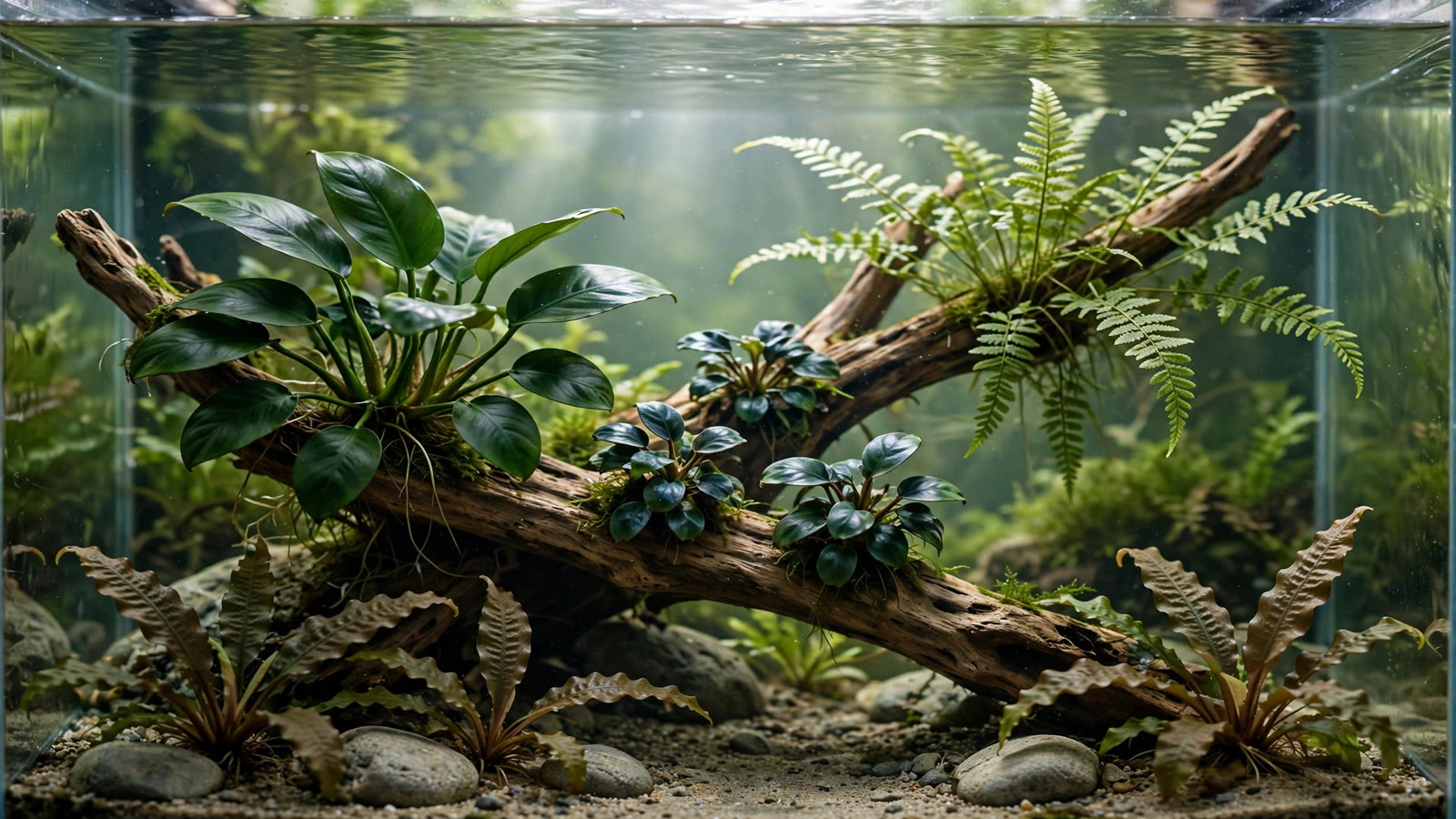
If you would rather enjoy your aquarium than maintain it, slow growing aquarium plants are the smartest selection filter you can apply. A plant can be easy to keep alive and still demand scissors every ten days. The plants below are chosen by a different standard: how rarely they need you.
Why Growth Rate Is the Real Low-Maintenance Metric
Most roundups sort by difficulty — "will it die?" — but growth rate answers the question that shapes your hobby: "how often does this plant need me?" A fast stem can be nearly indestructible and still own your Sundays.
Slow growers bring three compounding advantages. First, fewer trimmings — many need attention only every few months, and several need none at all. Second, nutrient stability — gradual uptake avoids the feast-and-famine swings fast stems trigger in low-tech tanks. Third, scaping permanence — January's layout still looks like itself in December.
The honest trade-off: slow growers take longer to fill in, so buy more coverage up front than you think you need, and run modest light with a small cleanup crew while the tank matures — algae moves faster than slow plants can outcompete. If your priority is quick reds and rapid fills instead, a fast-growing stem like Rotala H'ra is the honest opposite recommendation.
How to Choose Slow Growing Aquarium Plants
Not all "slow" plants are slow for the same reason, and the reason dictates placement:
- Rhizome epiphytes (Anubias, Java fern, Bucephalandra, Bolbitis) build dense, long-lived tissue on wood and rock. Tie them down — never bury the rhizome.
- Slow rosette plants (Cryptocoryne, Crinum) invest in deep roots and heavy leaves. Plant once, in the right spot, and leave them alone.
- Bulb plants (red tiger lotus, Aponogeton, Crinum) store energy underground and produce a few deliberate leaves rather than a constant stream.
- Creeping carpets and mosses (Staurogyne repens, Java moss) spread horizontally at a glacial pace — exactly what you want in a foreground that stays a foreground.
Match the plant's reason for slowness to a permanent position: rhizomes on hardscape, bulbs deep in substrate, creepers where they can colonize freely. Rates below assume no injected CO2.
The 12 Best Slow Growing Aquarium Plants
1. Anubias Varieties
Anubias is the reference point for the entire category: thick, algae-resistant leaves on a creeping rhizome that adds a leaf every few weeks. 'Nana' suits nano tanks, 'Nana Petite' fits small branches, and larger barteri forms make bulletproof midground anchors. Low to moderate light, no CO2 — and keep light modest, since algae colonizes the long-lived leaves faster than they can be replaced.
- Growth rate: extremely slow — a new leaf every 2–4 weeks.
- Placement: tied or glued to wood and rock.
- Why it stays slow: dense, long-lived leaf tissue built for durability, not turnover.
2. Java Fern
The other classic epiphyte, and arguably the most forgiving plant in the hobby. Java fern multiplies itself via plantlets that sprout on older leaf tips, its leathery leaves are ignored by most herbivorous fish, and it tolerates a wide range of water conditions. More rhizome species with the same temperament are covered in our guide to the best epiphyte aquarium plants. Low light is ideal; no CO2 needed.
- Growth rate: very slow — new leaves unfurl over several weeks.
- Placement: midground to background on hardscape; needs no substrate at all.
- Why it stays slow: thick rhizome tissue and long-lived fronds — energy goes to defense and longevity, not expansion.
3. Bucephalandra
The upgrade pick when Anubias feels too ordinary. Native to Borneo stream banks, Bucephalandra grows as a compact rhizome carpet on rock and wood, with leaves that shimmer in blues, purples, and deep reds under aquarium lighting. The slowest grower on this list, and superb for nano scapes where detail matters. Low to moderate light, gentle flow; CO2 optional.
- Growth rate: glacial — expect a leaf per month, roughly.
- Placement: foreground to midground on rock and wood.
- Why it stays slow: an epiphyte evolved on shaded stream rocks, with no metabolic incentive to rush.
4. Cryptocoryne Wendtii and Parva
Crypts are the backbone of slow, stable tanks. C. wendtii (green, brown, and red-brown forms) slowly forms dense midground clusters; C. parva is one of the smallest, slowest foreground crypts, taking months to carpet. Both are notorious for "crypt melt" when first planted — but melt is not death. Leave the roots alone and new leaves return within weeks.
- Growth rate: slow — wendtii adds a leaf or two weekly once established; parva can take half a year to fill a patch.
- Placement: midground clusters or foreground, in substrate with root tabs.
- Why they stay slow: heavy root investment and thick leaf tissue — built for stability, which is why they hate being moved.
5. Java Moss and Christmas Moss
Mosses are slow to establish, then quietly creep wherever surface allows. Java moss is the hardy workhorse; Christmas moss forms tidier, triangular fronds that look deliberate in a scape. Both are outstanding aquarium plants for shrimp tanks, providing grazing biofilm and cover for shrimplets. Tolerant of very low light; no CO2 required.
- Growth rate: slow to moderate once established.
- Placement: tied to wood, rock, mesh, or draped over filter intakes.
- Why it stays slow: no true roots or vascular system — all growth comes from the surface layer.
6. Marimo Moss Balls
Not a true moss but a slow-rolling ball of algae — and perhaps the lowest-workload "plant" in the hobby. Growth is measured in millimeters per year. Roll the balls during water changes so all sides get light, rinse occasionally, and that is the entire care program. Suits shrimp and betta tanks, and prefers cooler water (below about 25°C / 77°F).
- Growth rate: negligible — roughly 5 mm per year.
- Placement: foreground, resting on the substrate.
- Why it stays slow: a dense spherical algae colony with no stems, roots, or leaves — growth is limited by surface area.
7. Bolbitis
Often called the African water fern, Bolbitis looks like a more refined, translucent Java fern and behaves the same way: tie the rhizome to wood, keep light modest, and wait. It rewards patience with some of the most elegant foliage in freshwater aquascaping, and it is tough enough for tanks with plant-nibbling cichlids. Appreciates water flow across its fronds.
- Growth rate: very slow — new fronds take weeks to unfurl.
- Placement: background on tall wood or rock.
- Why it stays slow: another rhizome epiphyte investing in long-lived, leathery fronds rather than rapid turnover.
8. Red Tiger Lotus
The drama option. From a modest bulb, Nymphaea zenkeri sends up striking red, arrow-shaped leaves — one deliberate leaf at a time. Left alone it will reach for the surface with floating lily pads; pinch those off and it stays a compact, intensely colored midground rosette. If you want red without the trimming treadmill of red stems, see our red aquarium plants that need no CO2. Moderate light brings out the red; never bury the bulb completely.
- Growth rate: slow to moderate — a new leaf every week or two.
- Placement: midground, bulb half-buried in nutrient-rich substrate.
- Why it stays slow: the bulb is an energy reservoir — the plant meters out growth deliberately instead of racing.
9. Crinum
The oddball of the list: a true bulb plant with long, crinkled, onion-like leaves that can reach half a meter. It grows almost imperceptibly week to week — then one day you realize the leaves have doubled. Perfect for the background of larger tanks where you want vertical presence without weekly hedge duty. It dislikes being moved: plant deep, give root tabs, and let it settle for months.
- Growth rate: very slow — leaves extend over months; new leaves are rare events.
- Placement: background, bulb deep in nutrient-rich substrate.
- Why it stays slow: a large bulb with a conservative program — it adds leaf length, not leaf count.
10. Aponogeton
Aponogetons feel almost like houseplants — broad, wavy leaves on long stems from a central bulb. Many species go dormant periodically, dying back for a few months before resprouting: the slowest possible growth strategy is simply stopping. A. crispus is the most reliable non-dormant option for a continuously green tank. Low to moderate light; no CO2 required.
- Growth rate: slow — a few new leaves monthly during active growth; dormancy pauses everything.
- Placement: background or midground, bulb set into the substrate.
- Why it stays slow: bulb-stored energy plus a built-in rest cycle — growth happens in deliberate pulses.
11. Hygrophila Pinnatifida
The surprise of the list: a Hygrophila that is not a weed. On wood and rock, H. pinnatifida grows as a creeping rhizome with deeply lobed, fern-like leaves that turn reddish under stronger light — spreading sideways in a controlled crawl rather than shooting upward. (Planted in substrate it behaves more like a conventional stem, so keep it on hardscape if slow is the goal.) Moderate light for red tones; CO2 optional.
- Growth rate: slow — a few centimeters of rhizome creep per month on hardscape.
- Placement: midground on wood or rock; attaches with roots along the rhizome.
- Why it stays slow: on hardscape it adopts an epiphyte habit — the same rhizome strategy that keeps Anubias slow.
12. Staurogyne Repens
The classic slow foreground. Staurogyne repens forms a low, bushy carpet of bright green, slightly crinkled leaves — at a pace you can keep up with. A spaced planting fills in over two to three months, and trimming is a quarterly event, not a weekly one. Tolerates gravel with root tabs. Moderate light helps density; CO2 optional but speeds spread.
- Growth rate: slow — carpets in 2–4 months from a spaced planting.
- Placement: foreground carpet, planted in the substrate.
- Why it stays slow: short internodes and compact structure — it grows dense instead of tall.
Slow-Grower Comparison Table
Trimming frequency is estimated for low-tech conditions (low to moderate light, no injected CO2).
| Plant | Growth speed | Placement | Trimming frequency |
|---|---|---|---|
| Anubias varieties | Extremely slow | Epiphyte — wood/rock | Rarely — old leaves only |
| Java fern | Very slow | Epiphyte — wood/rock | Rarely — old leaves only |
| Bucephalandra | Glacial | Epiphyte — wood/rock | Almost never |
| Cryptocoryne wendtii / parva | Slow | Midground / foreground | Minimal — divide clumps |
| Java / Christmas moss | Slow–moderate | Epiphyte — any surface | Occasional thinning |
| Marimo moss ball | Negligible | Foreground — free resting | Never (rinse only) |
| Bolbitis | Very slow | Epiphyte — background wood | Rarely — old fronds |
| Red tiger lotus | Slow–moderate | Midground — bulb | Occasional — pinch surface leaves |
| Crinum | Very slow | Background — bulb | Minimal — damaged leaves |
| Aponogeton | Slow | Background — bulb | Minimal — dormant leaves |
| Hygrophila pinnatifida | Slow | Epiphyte — midground | Occasional — trim runners |
| Staurogyne repens | Slow | Foreground carpet | Occasional — quarterly tidy |
Building a Low-Maintenance Layout
A tank built from the plants above can go months between serious interventions. A proven formula: epiphytes on a central hardscape arrangement; a crypt cluster and red tiger lotus as midground color; Crinum or Aponogeton rising behind; Staurogyne repens carpeting the front.
Two care notes make the difference. First, less light than you think — excess light grows algae on long-lived leaves far faster than the leaves can be replaced. If you came from our low-light plants for beginners guide, that advice applies double here. Second, feed the roots — crypts, lotus, Crinum, Aponogeton, and Staurogyne all appreciate root tabs, since slow water-column uptake keeps the water lean, and lean water means stable water. For ongoing balance, see our natural algae control plants guide.
Slow Growers vs. Easy Plants
This distinction is worth making explicit. Our easiest no-CO2 plants list and this one overlap but are not the same thing. "Easy" means hard to kill. "Slow" means low workload. Hornwort is easy — nearly unkillable — but it fills a tank in weeks and demands constant cutting. Bucephalandra, conversely, is slow to the point of being fussy to establish, yet once settled asks nothing for months. Use the easy list when your fear is killing plants; use this list when your fear is becoming the plant's full-time employee.
Frequently Asked Questions
Will slow-growing plants keep algae away?
Not by themselves. Fast plants fight algae by outcompeting it for nutrients, and slow growers do not absorb nutrients fast enough to starve algae out. Control algae structurally: modest lighting, a clean hardscape, regular small water changes, and algae-eating livestock like shrimp and otocinclus.
Do slow-growing aquarium plants need CO2?
Almost all of the plants on this list grow well without injected CO2 — part of what makes them low-maintenance. CO2 will speed them up, somewhat defeating the purpose. It is only worth considering for Hygrophila pinnatifida and Staurogyne repens, for faster carpeting or stronger red tones. For the epiphytes and bulb plants here, CO2 is an unnecessary expense.
How do I make slow plants fill in faster at the start?
Buy more than you think you need and plant densely from day one — the honest shortcut. Dense planting also suppresses algae during the vulnerable early months. Use root tabs under substrate feeders, keep parameters stable so crypts and bulbs do not melt, and resist moving things. Two months of patience buys years of near-zero maintenance.
Can I keep slow growers with fast-growing stems?
Yes. Fast stems at the back absorb excess nutrients and shade the tank early on, protecting slow growers while they establish. The trade-off is inheriting the fast stems' trimming schedule. A common strategy: use fast stems for the first few months, then remove them once the slow growers have filled in.
Why are my Anubias or Java fern leaves turning yellow?
With slow growers, yellowing usually signals a nutrient shortage rather than disease, because old leaves have been around long enough to show deficiencies. First check the rhizome is not buried — buried rhizomes rot and mimic deficiency. Then add a comprehensive liquid fertilizer at half dose, and remove fully yellowed leaves, which slow growers will not recover.
Which slow-growing plant is best for a nano tank?
Bucephalandra and Anubias 'Nana Petite' stay compact for years, attach to small wood or rock, and look intentional rather than cramped. Marimo moss balls add a sculptural accent, and a small patch of Staurogyne repens carpets a nano foreground without the weekly mowing faster carpets demand. Keep lighting modest — algae beats slow plants to it in small tanks.
A Tank That Matures Instead of Mutating
Choosing slow growing aquarium plants is a quiet rebellion against the maintenance treadmill: you decide, up front, that your tank will be looked at more than worked on. Start with epiphytes on hardscape, anchor the substrate with crypts and a bulb or two, carpet the front with Staurogyne — and then give it time. In six months the tank will look settled in a way fast-planted tanks rarely achieve, and your scissors will have spent most of that time in a drawer. For full species parameters, the Tropica plant database is an excellent next stop.
Tissue-culture plants are the exception — they’re grown in sterile gel and adapt with minimal melting, which is part of what you’re paying for. Plants bought submersed from another hobbyist’s tank also transition with little melt, since they’re already in the right form.
Which Plants Melt Most (and Least)
Heavy melters (expect significant leaf loss)
- Cryptocorynes — infamous for “crypt melt,” sometimes dropping every leaf after any disturbance. They almost always recover from the roots within weeks.
- Stem plants grown emersed — rotala, ludwigia, and hygrophila often shed lower emersed leaves while the growing tips transition.
- Amazon swords — emersed-grown swords typically lose their broad oval aerial leaves and replace them with longer submersed ribbon leaves.
Light melters
- Anubias, java fern, bucephalandra — slow-growing rhizome plants transition gradually; occasional old-leaf melt but rarely dramatic.
- Vallisneria — usually transitions well, though it dislikes the move itself and may sulk for a week.
- Floating plants — minimal melt since their leaves were already at the air-water interface.
The Acclimation Protocol
Step 1: Quarantine or dip first
Before acclimating to your tank’s conditions, make sure you’re not acclimating pests along with the plant. Run new arrivals through our quarantine and dip protocol — it adds days upfront but prevents months of regret.
Step 2: Float to temperature-match (30 minutes)
Float the bag or container in your tank for 20–30 minutes to equalize temperature. Plants are less temperature-sensitive than fish, but a 10°F shock on top of transplant stress is an avoidable insult.
Step 3: Trim before planting
Remove any leaves that are already damaged, yellowing, or heavily algae-covered — they won’t recover and they’ll rot in your tank, feeding algae. For stem plants, trim off the bottom inch and any emersed leaves that look unlikely to adapt; the plant wastes energy maintaining leaves it’s going to shed anyway. Keep the healthy growing tips — that’s where recovery starts.
Step 4: Plant correctly the first time
Follow our planting guide — right depth, crown exposed on rosettes, rhizomes unburied on epiphytes. Every uprooting and replanting restarts the acclimation clock, so get placement right on the first attempt. Decide where each plant goes before it goes in the water.
Step 5: Run a gentle first week
For the first 7 days after planting:
- Moderate light — run your normal photoperiod but consider dropping intensity 20–30% if your light is dimmable. Blast-level light on a melting plant grows algae on the dying leaves, not recovery.
- Stable CO2 — if you inject CO2, keep it consistent. Fluctuating CO2 during acclimation is a melt accelerator. If you’re low-tech, this doesn’t apply — see growing without CO2.
- Half-strength fertilizer — new plants with damaged leaves can’t use full dosing, and the excess feeds algae. Ramp to full strength over 2–3 weeks per our fertilizer schedule.
- No disturbance — don’t move, trim, or “check on” new plants for at least two weeks. Every touch resets root establishment. This is especially critical for crypts.
Step 6: Remove melt, keep the base
As emersed leaves melt, remove the mushy material promptly — decaying leaves release ammonia and grow fungus that can spread to healthy tissue. But never discard the plant while the crown, rhizome, or roots are firm and alive. A crypt that’s lost every leaf but has firm roots is a plant that’s about to recover, not a dead plant. Give it 3–4 weeks before judging.
Telling Normal Melt From Real Problems
Normal transition melt:
- Affects oldest/emersed leaves first, newest growth last
- New submersed leaves emerge even as old ones dissolve
- Roots and crown stay firm and white/green
- Timeline: 1–4 weeks, then obvious new growth
Concerning melt (see our full melting diagnosis guide):
- New growth also melts or emerges deformed
- Rhizome or crown turns mushy and brown — this is rot, not transition
- Entire plant dissolves within days with no new growth after 4+ weeks
- Melting spreads to established plants that weren’t recently moved
Buying Tips to Minimize Melt
- Buy submersed-grown when available — hobbyist-grown cuttings transition with almost no melt.
- Choose tissue culture for sensitive species — crypts and delicate stems establish far more reliably from sterile cups.
- Avoid plants already melting in the store tank — some melt is normal, but a plant that’s mostly mush at purchase has less energy for recovery.
- Transport carefully — keep plants damp and out of direct sun/heat. A plant that dries out or cooks in a hot car melts far worse than one transported properly.
The First-Month Timeline: What to Expect Week by Week
Knowing what’s normal when removes most acclimation anxiety. Here’s the typical timeline for a healthy plant adapting to a new tank:
Week 1: The quiet week
Almost nothing visible happens. The plant is growing roots you can’t see and assessing its new environment. Some species (vallisneria, stem plants) may start shedding their lowest leaves. This is normal. Resist the urge to “help” — no moving, no extra fertilizer, no light changes. The most common beginner mistake is intervening during a week when the correct action is nothing.
Week 2: Melt peaks
This is when emersed leaves give up in earnest. Crypts may drop everything; swords shed their broad aerial leaves; stem plants lose lower foliage. It looks catastrophic and it’s usually fine. Keep removing mushy material, keep conditions stable, and watch the crown and growing tips — if those are firm and green, recovery is already underway.
Week 3: The turn
New submersed-adapted leaves emerge — smaller, thinner, often a slightly different shade of green than the emersed foliage. Stem plant tips start growing visibly; crypts push tiny curled leaves from the crown; swords unfurl narrow ribbon leaves. This is the moment most beginners exhale for the first time.
Week 4+: Established
New growth outpaces melt, and the plant is functionally yours. You can resume full-strength fertilizer, normal trimming, and stop treating it as fragile. Some slow growers (anubias, bucephalandra) take 6–8 weeks to show obvious progress — that’s their normal speed, not a problem.
Acclimating Different Plant Formats
Tissue-culture cups
Sterile, pest-free, and already adapted to high-humidity (not emersed) growth — tissue cultures melt the least of any format. Rinse the agar gel off gently (leftover gel rots and feeds fungus), split the portion into small plantlets, and plant per our planting guide. They establish slowly for the first two weeks, then accelerate. No dip needed, minimal acclimation stress — this is the premium experience you’re paying for.
Potted plants
Remove the pot and strip away the rockwool completely — leftover rockwool traps debris and rots. Tease the root mass apart gently; if it’s a dense mat, splitting it into 2–3 smaller portions actually establishes faster than planting one big clump (more growing points, better water flow around roots). Potted plants are usually emersed-grown, so expect the standard 2–4 week melt cycle.
Bare-root / bunched stems
Typically sold as weighted bunches. Remove any bands, foam, or weights, strip the lower leaves, and plant stems individually or in small groups. Bunched stems from the store are often already transitioning — check for new submersed growth at the tips, which tells you the plant is mid-adaptation and will settle quickly.
Hobbyist cuttings
Already submersed-grown and the fastest to establish — often showing new growth within days. The main acclimation factor is water-parameter difference between the two tanks. Float to temperature-match, plant promptly, and they’ll usually take off with minimal melt. This is why experienced hobbyists prefer trading cuttings over buying potted plants.
Frequently Asked Questions
Should I use a “plant starter” or transplant fertilizer?
Products marketed for transplant shock are mostly B-vitamins and mild hormones. They don’t hurt, but there’s no strong evidence they help aquarium plants specifically. Stable conditions and patience outperform any bottle. Save the money for more plants.
My new plant melted completely — bare crown, no leaves. Is it dead?
Probably not, if the crown or rhizome is firm. Crypts and swords routinely lose 100% of their leaves and regrow from the base within a month. The test is firmness: firm and pale/green means alive; mushy and brown/black means rot. Give firm-but-leafless plants a full 4 weeks before declaring them dead.
Can I speed up acclimation with extra light or CO2?
No — and trying usually backfires. A melting plant can’t use extra light; the excess just grows algae on its dying leaves. Keep light moderate and CO2 stable (not boosted) during acclimation. Growth speed comes from the plant’s own adaptation timeline, which you can’t rush, only avoid delaying.
Should new plants go straight into my main display tank?
After quarantine/dipping, yes — there’s no benefit to a separate “growing-in” tank for most plants. They acclimate to your water fastest in the tank they’ll live in. The exception is very delicate species going into a tank with boisterous fish; give those a few weeks in a calm corner or breeder box first.
The Patience Rule
The single most important acclimation skill is restraint: plant it right, set gentle conditions, remove decay, and then leave it alone for a month. The hobbyists with the best plant growth aren’t doing something clever in week one — they’re simply not interfering in weeks two through four while the plants do what they’ve evolved to do. Melt looks like failure and feels like failure, but in most cases it’s the visible part of a plant successfully becoming yours.