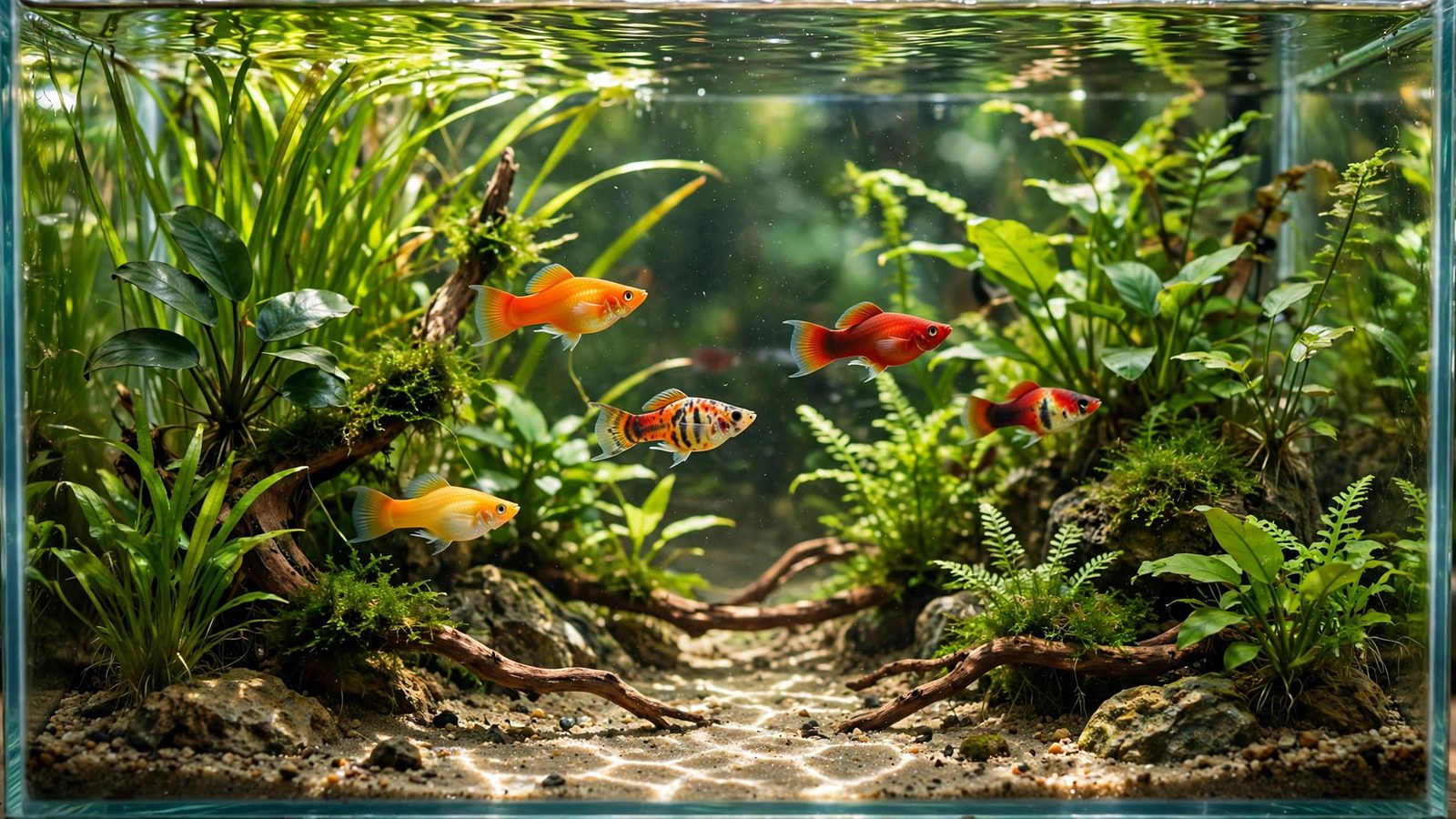
Platies have a quiet superpower most beginner fish lack: they tell you exactly what kind of water they want — hard, alkaline, and slightly warm — then reward you with bright color and non-stop fry. The problem is that most "easy aquarium plant" lists were written for soft, acidic Amazon-style water, the opposite of what your platies came from. The best aquarium plants for platy tanks are the ones that genuinely prefer hard water, hold up to constant nibbling, and give newborn fry dense cover on day one. This guide ranks 9 plants that thrive in platy parameters, plus which ones to skip and how to arrange them.
What Platies Need From Their Plants
Before the list, it helps to know what your platies actually ask of their greenery. Platies (Xiphophorus maculatus and the swordtail crosses) are Central American livebearers from hard-water springs: they do best at 21–26°C (70–78°F), pH 7.0–8.2, and GH of 10–28 dGH. If your tap water is naturally hard and alkaline, platies are doing you a favor — choose plants that share their preferences instead of fighting your water chemistry.
Behavior matters as much as chemistry. Platies are active, curious swimmers that graze constantly: they pick soft algae off leaves (free cleanup) but also rasp tender new growth. They can't shred plants like goldfish, but delicate thin leaves come out ragged within weeks. And because females drop 20–50 fully formed fry every month, fine-textured cover near the surface and among the roots is what lets any fry survive past day three. Our molly tank plant guide covers the same livebearer logic for their harder-water cousins.
The 9 Best Plants for Platy Tanks at a Glance
| Plant | Light | Placement | Its job in a platy tank |
|---|---|---|---|
| Java fern | Low | Midground, on hardscape | Tough grazing-proof anchor |
| Anubias barteri | Low | Midground, on hardscape | Leathery leaves break up sightlines |
| Vallisneria spiralis | Medium | Background | Tall hard-water-loving curtain |
| Hornwort | Low | Floating | #1 fry hideout, nitrate sponge |
| Amazon sword | Medium | Background centerpiece | Big rosette nursery for fry |
| Water wisteria | Medium | Midground–background | Fast grower that outruns nibbling |
| Cryptocoryne wendtii | Low | Midground | Compact rosette, alkaline-tolerant |
| Java moss | Low | Anywhere, tied down | Fry survival carpet |
| Frogbit | Low | Floating | Shade and security at the surface |
1. Java Fern (Microsorum pterotoides)
Java fern is the safest plant you can buy for a platy tank. It tolerates pH up to 8.0, shrugs at 20+ dGH hardness, and its leathery fronds are completely platy-graze-proof — your fish will pick algae off the leaves for hours without damaging the plant. Tie the rhizome to driftwood or rock with cotton thread (never bury it — it rots within 2–3 weeks) and it does the rest.
Why it suits platies: broad leaves give adults cover while fry shelter in the root tangle underneath. Biofilm on the leaves gives newborns something to pick at in their first days, and it competes with algae for nutrients in the waste-rich water of a breeding livebearer tank. Daughter plantlets on older leaves give you free divisions within 6 months.
2. Anubias barteri
Anubias is Java fern's tougher cousin: an epiphyte that anchors to wood or stone, grows one new leaf every 3–6 weeks, and is nearly indestructible in platy parameters — pH up to 8.5, rock-hard water, low light, the whole platy range. Platies ignore its waxy leaves while grazing biofilm off them.
Why it suits platies: in a busy community tank, broad Anubias leaves break up sightlines so dominant males can't constantly harass females — less stress, more successful drops. Placement: midground to background on hardscape; barteri and coffeefolia are the hardiest for alkaline water. Note the contrast with the best plants for betta tanks guide — platies need tough leaves over tender ones.
3. Vallisneria spiralis
If Java fern is the safest pick, Vallisneria is the happiest — it genuinely prefers hard, alkaline water and grows like a weed in it. A single runner sends up 30–50 ribbon leaves reaching 60 cm, turning the back of your platy tank into a swaying green curtain these active swimmers love weaving through.
Why it suits platies: tall blades give nervous livebearers vertical security, and dense runners create fry-hiding pockets at the substrate line — exactly where dropped fry sink for safety. It pulls nitrates hard, which helps with platy-heavy stocking. Planting tip: plant the crown just above the gravel and trim leaves at the base, since cut Vallisneria tips brown mid-leaf.
4. Hornwort (Ceratophyllum demersum)
Hornwort is a floating or bunched stem with needle-fine foliage — arguably the single best fry cover in the hobby. It thrives at pH 6.0–8.5, tolerates hard water, needs zero substrate, and grows inches per week, soaking up nitrates faster than algae can use them. Float a thick bunch and platy fry dive into it the moment they are born.
Why it suits platies: dense hornwort saves noticeably more fry per drop than a bare tank, and doubles as a water-quality engine for a breeding-heavy setup. Placement: floating or lightly weighted at the back; pair it with the other floaters in our floating plants for beginners guide for a layered surface.
5. Amazon Sword (Echinodorus amazonicus)
Despite the name, the Amazon sword is remarkably adaptable: it handles pH up to 8.0, hard water, and the full platy temperature range. Its big rosette of broad leaves makes it the natural background centerpiece of most platy setups.
Why it suits platies: the deep rosette forms a protected nursery zone near the bottom, and the broad leaves host the algae-grazing sessions your platies will spend hours on. Planting tip: push one root tab per plant into the substrate every 6–8 weeks — swords are heavy root feeders and yellow within a month without them, as noted in our plants for goldfish tanks guide.
6. Water Wisteria (Hygrophila difformis)
Water wisteria is the workhorse stem plant of this list: it tolerates pH 6.0–8.0, hard water, and low-to-medium light, and grows fast enough — up to 5 cm per week — to recover from platy nibbling overnight. Its lace-like leaves are excellent fine cover for fry, and it is cheap enough to plant a whole background for the price of one tissue-culture cup.
Why it suits platies: a true beginner plant that needs no CO2; snip the top 10 cm, replant it, and the mother stem branches into two — free plants forever. Placement: midground to background in groups of 5–8 stems spaced 3 cm apart; pinch tops regularly to keep it bushy.
7. Cryptocoryne wendtii
Crypt wendtii is the midground anchor this list needs. It adapts to nearly any water, including pH 7.5–8.0 platy tanks, staying a compact 15–25 cm rosette with ruffled bronze-to-green leaves that add real color contrast. It suffers "crypt melt" if conditions change suddenly, so plant it once in its final spot and leave it alone.
Why it suits platies: the dense, low rosette gives fry a hiding zone at the bottom while adults swim overhead, and its tough leaves survive grazing. Feed it one root tab every 2–3 months. Cross-check species parameters against Tropica's plant database, the most reliable species reference in the hobby.
8. Java Moss (Taxiphyllum barbieri)
Java moss earns its place as the fry-survival champion. Tie a golf-ball-sized clump to driftwood or rock with thread, and within two months it becomes a dense mat that newborn platy fry vanish into. It tolerates the full platy parameter range — pH 5.0–8.0, 21–26°C, hard water — and grows in light so low almost nothing else survives it.
Why it suits platies: the fine, branching structure is too dense for adults to pick fry out of, and it hosts infusoria and biofilm — first foods for day-old fry. See our best aquarium mosses compared guide for fancier alternatives — but Java moss remains the hardiest for hard-water tanks.
9. Amazon Frogbit (Limnobium laevigatum)
Frogbit is the well-behaved floater this list's surface needs. Its round, lily-pad-like leaves form a floating canopy that shades the tank, calms nervous platies, and gives fry a ceiling of dangling roots to hide in. Unlike duckweed, it is easy to scoop out in handfuls when it spreads too far — which it will, in nutrient-rich livebearer water.
Why it suits platies: platies come from waters with dappled overhead cover, and a frogbit canopy makes them visibly bolder — better color, more natural behavior. Placement: floating; corral with airline tubing if your filter pushes it around. Keep ~30–40% of the surface open so light reaches the plants below.
 ★3.9
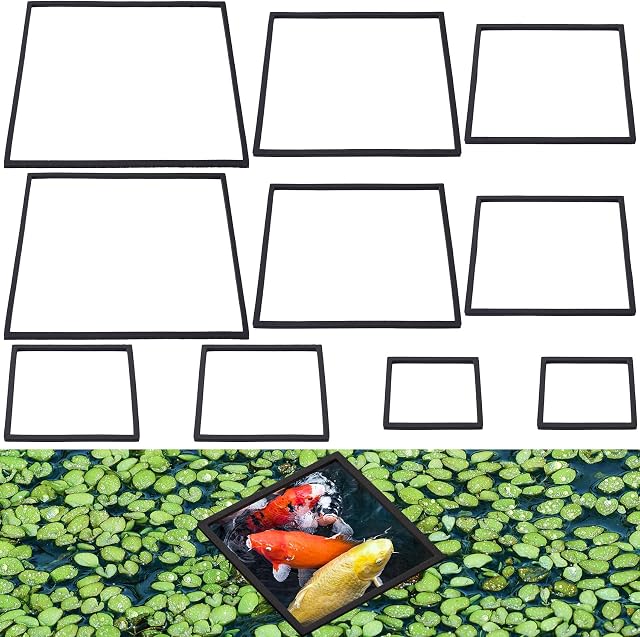
PAGOW Floating Plant Corral Rings
Check Price on Amazon ★3.9Plants to Skip With Platies
Not every "easy" plant belongs in hard, alkaline water. Skip Rotala and most red stems — they need soft, acidic water and rich iron dosing, and they stunt or yellow in platy parameters. Skip Tonina and other ultra-soft-water species for the same reason. Skip duckweed unless you genuinely love it — nearly impossible to remove once established, and frogbit gives the same benefits with control. And skip delicate fine-leaf stems like Myriophyllum in grazing-heavy tanks; platies will rasp them bare. Our danio tank plant guide shows how the same hard-water logic applies to another active schooling fish.
Arranging Plants in a Platy Tank
Platies are horizontal swimmers — they use the full tank length but rarely the corners — so arrange with swimming lanes in mind. Keep the background dense (Vallisneria curtain + wisteria), the midground anchored (crypts, Anubias, Java fern on wood), and the foreground open for grazing. Float hornwort in one back corner and frogbit across the rest, leaving open surface at the front for feeding. This gives fry three cover zones — surface roots, midwater leaves, substrate rosettes — which is why a well-planted platy tank sustains a self-replacing colony. Killifish keepers use the same three-zone thinking; see our plants for killifish tanks.
A 20-gallon platy tank wants roughly 40–60% plant coverage: enough to absorb the waste of a breeding colony (one female's monthly drop can double your headcount overnight) without blocking swimming lanes. Plant heavily from day one — these picks establish fast in hard, alkaline water, and a planted-from-the-start tank cycles more smoothly than a bare one waiting to be "filled in later."
Frequently Asked Questions
Do platies need live plants, or are they fine without them?
Platies survive without plants, but they do measurably better with them: lower stress, bolder color, cleaner water, and fry that actually survive. In a bare tank, nearly every fry gets eaten within hours; with dense cover like hornwort or Java moss, a meaningful percentage reaches adulthood. If you want one upgrade that changes everything about a platy tank, it is plants.
Will platies eat or destroy my aquarium plants?
Platies are nibblers, not destroyers. They constantly graze biofilm and soft algae off leaves — which is helpful — and may rasp tender new growth, but they cannot shred plants the way goldfish or cichlids do. Tough-leaved plants like Java fern, Anubias, and crypts come through unscathed; only very delicate thin-leaf stems show damage.
What is the best plant for platy fry survival?
Hornwort floated thickly at the surface is the top pick: fry instinctively dive into its fine needles the moment they are born, and it grows fast enough to keep up with a breeding colony's needs. Java moss tied to hardscape is the close second, especially for fry that sink to the bottom. Use both and you cover every escape route.
Can I keep aquarium plants with platies in hard tap water?
Yes — hard, alkaline tap water is actually an advantage. Every plant on this list tolerates or prefers pH 7.0–8.2 and 10–28 dGH, and Vallisneria, Java fern, and Anubias grow faster in hard water than in soft. The plants to avoid are the soft-water specialists (Rotala, Tonina) that need acidic conditions you would have to fight your tap to create.
Do platy tank plants need CO2 or fertilizer?
None of the 9 picks require CO2 — they are all selected for thriving without it. A comprehensive liquid fertilizer dosed weekly (at half strength to start) helps in hard water, where some micronutrients precipitate out, and root tabs every couple of months feed the swords and crypts. More light without CO2 grows algae, not plants, so keep lighting moderate.
How many plants do I need for a 10-gallon platy tank?
For a 10-gallon with 4–6 platies, aim for one background bunch (wisteria or Vallisneria), two midground plants (a crypt and a Java fern or Anubias on wood), a golf-ball of Java moss, and a handful of floating hornwort or frogbit. That is roughly 40–50% coverage — enough to stabilize water quality and shelter the fry a single female will produce every month.
Start With the Tough Three, Then Build Out
You don't need all nine plants on day one. Start with the tough three — Java fern, Anubias, and Vallisneria — because they love hard water, ignore platy grazing, and anchor the tank while everything else establishes. Add hornwort and Java moss before your first fry drop, then fill in with wisteria, crypts, swords, and frogbit as the tank matures. For the fish-first logic behind these picks, our aquarium plants for fish tanks guide explains how to match any plant to any fish. The real secret: match the plants to the water you already have.