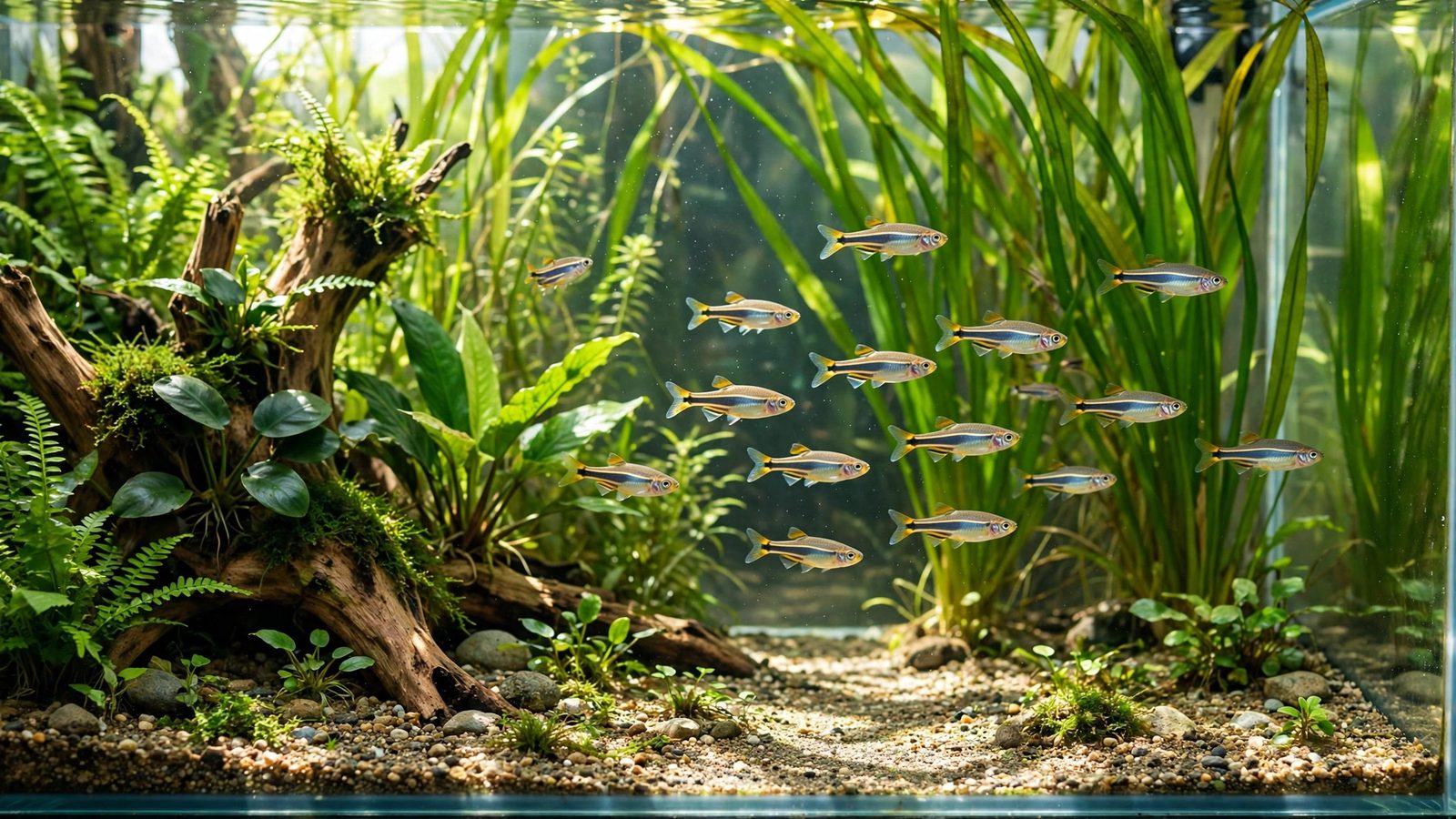
Watch a school of zebra danios for five minutes and you will spot the real cost of bad planting: torn stems, uprooted rosettes, and a bare tank where your fish ricochet off the glass. Danios are the drag racers of the hobby — fast, hardy schoolers that thrive in current and cooler water — and the best plants for danios are the ones that survive their daily demolition derby while giving cover, clean water, and egg-scattering sites. By the end of this guide you will know exactly which seven species to buy and where to put each one.
Why danios are a special planting case
Most "plants for beginners" lists assume peaceful, slow fish. Danios break that assumption three ways. First, they are speed. A school of ten zebra danios can cross a 20-gallon tank in under a second, and they do it constantly — darting, chasing, and spawning in bursts that flatten delicate stems. Second, they are strong. Giant danios push past 4 inches; even zebras dig at substrate when excited. Anything loosely planted gets excavated.
Third, they like it cool and current. Zebra, leopard, and pearl danios are happiest between 65 and 77°F, and many keepers skip the heater entirely. Heat-loving tropical species sulk and melt in danio water. If you run your tank unheated, lean on cold-water aquarium plants that need no heater for the full cool-tolerant roster.
The good news: danios are not plant eaters. Unlike goldfish, they nip leaves out of curiosity, not hunger, so plants fail here on sturdiness and temperature — not because fish devour them. Pick species with tough rhizomes, leathery leaves, and deep or no substrate roots, and your planting holds. None of the seven below need CO2 — they all sit comfortably among the easiest aquarium plants that need no CO2 — which suits the low-fuss spirit of a danio tank.
The 7 best plants for danio tanks
Each pick below survived three tests: it tolerates 65–77°F, it stands up to current and crashing fish, and it serves a job — cover, filtration, spawning medium, or structure.
1. Anubias barteri var. nana — the indestructible anchor
If you buy one plant for a danio tank, make it this one. Anubias nana grows from a thick horizontal rhizome that you tie or glue to driftwood and rock — it never goes in the substrate, so danios cannot uproot it. The dark green, leathery leaves shrug off bumps, and the plant thrives from 64 to 82°F, covering the whole danio range.
Use it as your midground anchor. A golf-ball-sized rhizome tied to mopani wood with cotton thread or gel superglue is permanent within a month; the thread dissolves by itself. Never bury the rhizome; buried rhizomes rot. Under moderate light (30–50 PAR) leaves stay compact; shade them under floaters if your light runs hot to avoid green spot algae.
2. Java fern (Microsorum pterotoides) — the current-proof epiphyte
Java fern shares Anubias's greatest danio-tank superpower: it is an epiphyte. Tie the rhizome to hardscape, and there is nothing for boisterous fish to dig up. Its long, rippled fronds sway in current rather than resisting it. It tolerates down to about 60°F and prefers the 68–75°F zebra danio sweet spot.
Plant it in groups of three or more on the same driftwood branch for a lush cluster. Old leaves grow plantlets you can pinch off and tie elsewhere — free plants for life. Like Anubias, it belongs in the best epiphyte aquarium plants that never need planting, so treat the whole group as your "glue it and forget it" backbone.
3. Vallisneria (jungle val, Vallisneria americana) — the background wall
A danio tank needs a backdrop, and jungle val is the toughest curtain you can grow. Its long ribbon leaves root deeply, and a properly planted row sends out runners that lock the whole bed together — effectively danio-proof once established. It loves current and the 68–78°F band, tolerating roughly 60 to 84°F.
Plant individual crowns 2–3 inches apart along the back glass, with the crown (the white-green junction where leaves meet roots) just above the substrate. Give it root tabs — val is a heavy root feeder — and runners fill the back wall in 8–12 weeks. Trim by cutting the longest leaves at the base — shearing the top leaves brown tips. See the best background plants for tall aquariums for alternatives, but val is the speed champion for this job.
4. Hornwort (Ceratophyllum demersum) — the living filter and egg net
Hornwort is the hardest-working plant in this list. Left floating, its dense, needle-like foliage is a nitrate sponge that visibly starves out algae — exactly what a heavily fed school of danios needs. Dropped eggs stick to the foliage, which matters because danios spawn at dawn and immediately hunt their own eggs. A floating hornwort raft is the difference between zero fry and a surprise batch of babies.
Hornwort has no true roots, so danios cannot uproot it — it just rides the current. It tolerates 60–80°F and grows in dim to bright light. It sheds needles when stressed, so buy more than you think you need and give it two weeks to stabilize. It is one of the great oxygenating aquarium plants, which pairs perfectly with danios' love of high-oxygen, high-flow water.
5. Water sprite (Ceratopteris thalictroides) — the fast nitrate sponge
When a danio tank is new and the nitrogen cycle is still maturing, water sprite is your insurance policy. It grows astonishingly fast — doubling its mass in two to three weeks — and every ounce of growth is ammonia and nitrate pulled straight out of your water. Float it or plant it; danios love the dappled shade a floating canopy creates. It thrives from about 68 to 82°F.
Floating is the danio-smart move: zero planting, zero uprooting risk, and dangling roots double as fry cover. Planted specimens develop lacy fronds for the midground but shed more in current. Thin aggressively — remove a third of the mass every two weeks — or it blocks light to everything below. For more options, browse the best floating aquarium plants for beginners.
6. Java moss (Taxiphyllum barbieri) — the fry nursery
This is the plant that turns a danio display tank into a breeding tank by accident. Java moss forms a dense, tangled mat that danio eggs fall into and fry hide inside — the filaments are too fine for adults to hunt through effectively. Without it, a school eats essentially 100% of its spawn. Tie it to rocks or driftwood in the lower third of the tank, out of the main swim lane.
It tolerates 60–80°F and near-total neglect. Trim a golf-ball chunk every two months; untrimmed mats brown in the middle. Pair this with our best spawning plants for egg-scatterers guide for the full fry-survival playbook.
7. Cryptocoryne wendtii — the midground anchor
Every danio layout needs one dependable rooted midground plant, and Cryptocoryne wendtii is the safest pick. Its broad, wavy leaves form a dense rosette that danios cannot shove aside once the root system establishes (give it 4–6 weeks). It handles 68–82°F, tolerates moderate light, and resists the melting that plagues fussier crypts. Bronze and green varieties give color contrast against the moss and fern.
Plant it with root tabs under inert gravel, and then do not touch it: crypts melt their leaves when disturbed, and the fastest way to lose a wendtii is to keep replanting it. One crypt, left alone for two months, becomes a permanent fixture. Place it off-center in the midground — never in the center swim lane.
Quick comparison: all 7 plants at a glance
| Plant | Type | Placement | Growth speed | Cool-tolerant? | Danio-proof trait |
|---|---|---|---|---|---|
| Anubias nana | Epiphyte | Midground hardscape | Slow | Yes (64°F+) | Nothing to uproot; leathery leaves |
| Java fern | Epiphyte | Midground–background wood | Slow | Yes (60°F+) | Tied to hardscape; sways in flow |
| Jungle vallisneria | Rooted runner | Background wall | Fast | Yes (60°F+) | Runner-locked bed; loves current |
| Hornwort | Floating/stem | Surface raft | Very fast | Yes (60°F+) | No roots at all |
| Water sprite | Floating/planted | Surface or midground | Very fast | Yes (68°F+) | Floats above the chaos |
| Java moss | Epiphyte mat | Lower third, off lane | Medium | Yes (60°F+) | Tied down; too dense to dig |
| Crypt wendtii | Rooted rosette | Midground, off-center | Slow–medium | Yes (68°F+) | Deep root crown |
Layout: aquascaping for speedsters
The golden rule of a danio tank is the runway. Danios claim the top and middle of the water column and need a straight, unobstructed swim path — a school with no runway paces the glass and nips fins. Reserve a clear central lane at least 50–60% of the tank's length, and push every plant to the back third and the two side thirds. Think of a U-shaped planting: vallisneria wall across the back, Java fern and Anubias on driftwood at each back corner, crypts and moss along the lower sides, floaters up top.
Stack planting vertically — tall vallisneria behind, midground crypts and fern in front — so the front half stays open from substrate to surface. Aim your filter output along the back wall; danios surf the current at the back and rest in the calmer front lane — the behavior that makes them fun to watch.
Hardscape does double duty. A few smooth river rocks and one good driftwood branch anchor your epiphytes, break sight lines so subordinate danios can escape the pecking order, and create shaded nooks where dawn spawning happens. Keep the foreground substrate thin (1–1.5 inches of gravel or coarse sand) for easy vacuuming, since danios are enthusiastic feeders and food reaches the bottom fast.
Planting day and the first month
Set up the tank, hardscape, and substrate, fill it, and start the filter — but hold the fish. Plant everything on day one: vallisneria and crypt crowns in the substrate with root tabs, Anubias and Java fern rhizomes tied to wood, moss on rocks, hornwort and water sprite floated on the surface. Dose liquid fertilizer at half strength weekly from the start so the plants can consume the ammonia cycling produces. All seven sit among the fast-growing aquarium plants for new tanks that make cycling safer, so the more mass you start with, the smoother the first month.
Expect two normal ugly phases. In week one, hornwort and water sprite may shed leaves as they adjust — net out the debris. Around week three, crypt wendtii may melt a few leaves; leave the roots alone and new growth appears within two weeks. By week four, with ammonia and nitrite at zero and nitrates under 20 ppm, add danios in two groups a week apart. From there: 25–30% weekly water changes, half-dose liquid fertilizer weekly, root tabs every 2–3 months, and a monthly moss trim.
Frequently Asked Questions
Do danios need live plants, or are they fine in a bare tank?
Danios survive in bare tanks but never behave naturally in them. Without cover, schools pace the glass and colors wash out. Plants give subordinates escape routes, break up the pecking order, and absorb the nitrates a hungry school produces. Bare works for quarantine; planted is the right long-term home.
Will danios eat or destroy my plants?
Danios are not plant eaters — damage comes from speed and digging, not grazing. They slam into delicate stems and excavate substrate when excited. The fix is structural: epiphytes tied to hardscape, deep-rooted background plants like vallisneria, and rootless floaters. If plants keep ending up floating, the species choice or planting depth is wrong, not the fish.
Can I keep plants in an unheated danio tank?
Yes — this is one of the easiest tank types to plant. Zebra and leopard danios thrive at 65–72°F, and all seven plants here tolerate that comfortably. Problems only start with heat-loving tropical species demanding 78°F+, which stall and melt in cool water. In a room that stays above 60°F year-round, fish and plants both run heater-free.
How do I get danio fry to survive in a planted tank?
Danios spawn at dawn, scattering adhesive eggs they immediately try to eat. Your tools are plant density and timing: keep a dense Java moss mat and floating hornwort raft permanently, feed adults well, and do a cool water change in the evening to trigger a dawn spawn. Expect only a few fry per spawn in a community setup — for real numbers, move a conditioned pair to a mesh-bottom spawning tank.
Do I need CO2 for a danio planted tank?
No. Every plant here grows well without injected CO2, which suits the low-maintenance spirit of danio tanks. CO2 would speed up the vallisneria and water sprite, but it demands tighter fertilization and lighting discipline — and extra growth just means more trimming in a tank whose whole point is open swimming space. Your danios will not notice the difference.
Bringing it all together
A danio tank planted right is one of the most alive setups in the hobby: a school carving laps through the open center, ducking behind vallisneria, weaving through Java fern, with fry appearing in the moss like small surprises. Start with the seven plants above, keep the runway open, plant before the fish arrive, and let the fast growers do your filtration. Within a week you will see bolder colors, tighter schooling, and the dawn spawning runs only happy fish perform. For verified care data on more species, the Tropica plant database covers hundreds of aquarium plants, including every epiphyte and floater recommended here.