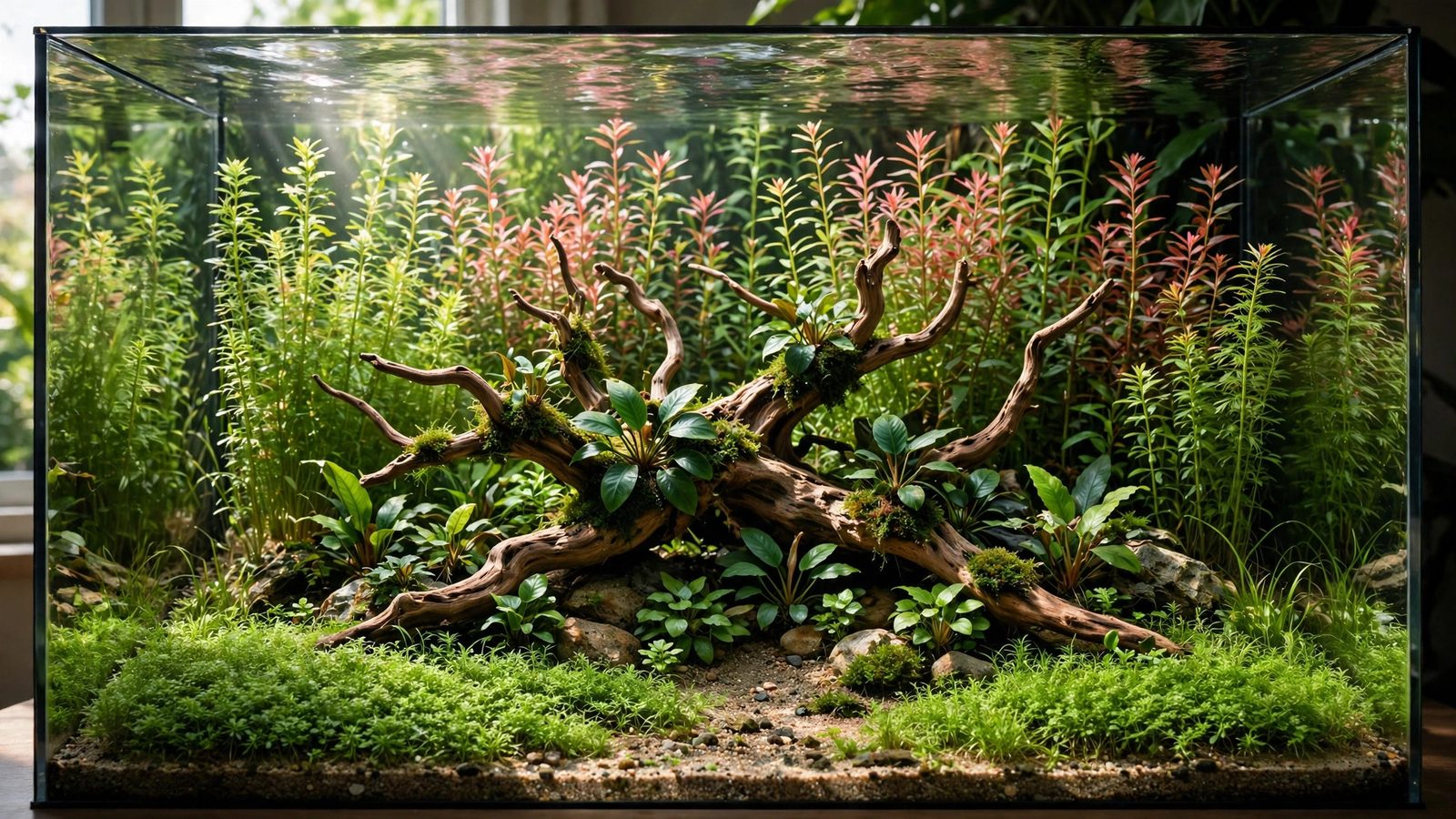
Getting aquarium plant placement right is the single biggest difference between a tank that looks deliberately designed and one that looks like a plant shop exploded inside the glass. Two aquariums can hold the exact same species, yet one glows with depth while the other reads as a green blur. The difference is rarely equipment — it is where each plant was put. This guide walks you through the zone system aquascapers have used for decades: foreground, midground, and background planting, how each zone behaves with light, CO2, and water flow, and the practical rules that keep your layout looking intentional as it grows.
Why Placement Decides the Whole Look
Aquarium plants grow upward toward the light, and most species do it at very different rates. Put a fast stem plant at the front glass and it will tower over everything behind it within a month, hiding the layout you paid for. Placement is essentially a forecast: you are planting for what the plant will look like in eight to twelve weeks, not what it looks like in the store cup.
Placement also solves three invisible problems at once. Depth perception comes from overlapping layers — short plants in front, tall plants behind — which fools the eye into seeing more distance than the glass holds. Light access improves because every zone gets unshaded leaf surface when tall species stay behind short ones. And maintenance gets simpler: plants kept where they want to grow need less trimming and replanting.
Aquarium Plant Placement: The Three Zones at a Glance
Think of your tank's footprint as three bands running from front glass to back glass. The proportions below suit a standard rectangular tank; adjust for cubes or extra-long tanks.
| Zone | Where it sits | Typical mature height | Job in the layout |
|---|---|---|---|
| Foreground | Front third, up against the glass | 1–6 cm | Open swimming space; frames the view without blocking it |
| Midground | Middle third | 6–20 cm | Focal points and structure; connects front to back |
| Background | Rear third, along the back glass | 20 cm to full tank height | Hides equipment; gives the scape its skyline |
The rule of thumb connecting them: a plant's mature height should never exceed the vertical space of its own zone. A plant that tops out at 15 cm belongs in the midground, not the foreground. A plant that wants to touch the water surface belongs at the back.
Foreground: The Lawn at Your Feet
The foreground is the carpet zone — low, spreading plants that colonize the substrate and keep the front glass clean-looking. Dwarf hairgrass, Monte Carlo, Hemianthus callitrichoides "Cuba," Cryptocoryne parva, and small Echinodorus varieties typically stay under 6 cm and spread sideways through runners — exactly what you want closest to the viewer.
The foreground is also the zone most affected by shading. Because everything grows behind or above it, the front gets the least leftover light. That is why low-light plants and slow carpeters are the safe foreground pick for tanks without CO2 injection — they tolerate living in the midground's shadow. Keep the foreground planting open: leave sandy paths or bare patches between carpet islands so the eye has somewhere to rest.
Midground: The Supporting Cast
The midground carries the visual weight of the scape. This is where your hero plants live — Anubias, Bucephalandra, crypts, ferns, shorter stem bunches — and where hardscape gets dressed. If the foreground is the lawn and the background is the skyline, the midground is the architecture: when someone glances at your tank, their eyes land here first.
Midground plants earn their place in two ways. First, they bridge the height gap: a 15 cm Cryptocoryne wendtii clump or a cluster of Staurogyne repens hides the awkward void between a 3 cm carpet and a 40 cm stem jungle. Second, they hold focal points — the single dramatic Anubias on a wood branch, the red accent that draws the eye. Consider comparing Anubias varieties to match leaf size to your midground, and lean on slow-growing plants for stable midground structure — midground features look best when they hold their shape for months rather than needing weekly haircuts.
Background: The Living Backdrop
The background is the tall-stem zone — Rotala, Ludwigia, Limnophila, Hygrophila, vallisneria, and large swords. These plants do three jobs: they hide the filter intake, heater, and rear glass; they give the tank a sense of height; and they drink up excess nutrients fast enough to starve algae.
Plant background stems in dense groups of one species, not as lonely singles. A single stem of anything looks accidental; a cluster of fifteen stems of Rotala rotundifolia looks like a plan. If your tank is deep, choose background species by height: tall background plants for deep tanks covers species that genuinely fill 60 cm of water column. Stargrass (Heteranthera zosterifolia) is a handy bridge species at the midground-to-background boundary.
How Zones Interact with Light, CO2, and Water Flow
Zones map onto how resources actually move through your tank. Ignore these interactions and even perfectly zoned plants will struggle.
Light Reaches Zones Differently
Your light fixture sits above the water, so intensity falls off with depth and distance from the source. The foreground directly under the light is brightest; the rear corners are often the darkest spots because they sit farthest from a centered light bar. This is why carpet plants fail most often at the front corners — the place where beginners push them to "fill the edge."
Floating plants change this picture dramatically. A full lid of duckweed or a raft of floating plants can cut light to the foreground by half or more. Corral floaters to one side with airline tubing so light reaches the carpet below, or accept that your foreground must be shade-tolerant species. Decide this before planting, not after the carpet melts.
Flow Carries Food to Each Zone
Water flow distributes CO2 and fertilizers, and dead spots kill plants quietly. Dense background thickets are the usual culprits: a wall of stems baffles the filter output, and the plants trapped behind it starve while algae moves in. Leave a finger-width gap between the back glass and the stems so water circulates behind them, and angle your filter outlet so the current sweeps across the background and carries CO2 down to the foreground.
CO2 stratifies by zone. Injected CO2 dissolves from the diffuser and drifts with the current; the background near the diffuser gets the richest dose, the foreground farthest from it gets the leanest. If your carpet yellows at the front while the background thrives, suspect CO2 distribution, not light. Place the diffuser centrally under the filter outflow so CO2-rich water circulates through every zone. Watch the plants, not the bubble counter — pearling (tiny oxygen bubbles on leaves) in the foreground confirms CO2 is actually arriving there.
Seven Placement Mistakes Beginners Keep Making
- Tall stems in the foreground. A bunch of Ludwigia at the front glass looks fine for a week, then blocks the entire midground. Keep anything with "will grow to 30+ cm" at the back, full stop.
- Carpets planted under the shade of hardscape. Monte Carlo tucked under a driftwood overhang never carpets — it stretches upward, pale and leggy. Plant carpet species in open light, and put the shade-tolerant mosses under the wood instead.
- Single stems scattered like confetti. One stem of five different species reads as clutter. Group by species in each zone.
- Ignoring mature width, not just height. Amazon swords and large Vallisneria spread wide as well as tall. A sword planted center-midground will eat both neighbors within months. Check expected spread on a reliable reference like the Tropica plant database before committing a plant to a crowded zone.
- Planting everything at the same depth of substrate. Foreground plants need only a couple of centimeters; large background swords and heavy root feeders want deep substrate. Slope your substrate — deeper at the back — so each zone gets the root space it needs while reinforcing visual depth.
- Mixing fast and slow growers in the same zone patch. A slow Anubias sharing a pocket with a rampant Hygrophila loses every time. Zone species by vigor as well as height.
- No plan for the filter and heater. Reserve the rear corners for intakes and heaters first, then plant the background around them — tall stems are excellent camouflage.
Planting Density: How Much Is Enough?
Underplanting is the most common reason new tanks struggle with algae. Every bare patch of substrate is an invitation: nutrients with no plant to absorb them feed algae instead. Plant heavily from day one — aim for 70–80% of the substrate planted, with the background fully stocked and the midground carrying its intended plant mass.
Density rules differ by zone:
- Foreground: carpet plugs every 3–5 cm. Closer spacing closes the carpet in weeks instead of months; each plug spreads to meet its neighbors.
- Midground: plant rosettes and rhizome plants with their mature width in mind, but don't leave wide gaps between features. Midground gaps read as holes; fill them with a runner plant like Staurogyne repens that you can thin later.
- Background: stems every 2–3 cm in rows, staggered like brickwork. Dense from the start — background stems outcompete algae only when they form a real thicket.
Heavy planting also means heavy initial nutrient demand, which is normal and healthy. A densely planted tank cycles faster, shows less algae, and gives you trimming material for propagation sooner. Buying fewer plants to save money usually costs more later in algae battles and replacement orders.
Sketch the Plan Before You Touch the Substrate
Professional aquascapers never plant directly from bags into the tank. They draw the layout first — a simple top-down sketch of the footprint divided into the three zones, with each species penciled into its spot along with its expected mature height. This five-minute exercise catches almost every placement mistake: the tall stem penciled into the foreground, the carpet drawn under the wood shadow, the empty midground. Keep a photo of the sketch; six weeks later it shows which plant drifted off-plan.
Zone each species by its mature height, not store size — this is the step everyone skips, and it is why so many first layouts look great in week one and chaotic in week eight.
- Every plant's mature height fits inside its zone's height band.
- The midground has at least one focal feature, not just filler.
- No carpet species sits in hardscape shadow.
- Background stems are grouped by species in clusters of 5+.
- Equipment corners are reserved before planting, not squeezed in after.
- Fast growers and slow growers don't share the same pocket.
Adjusting as Plants Grow
No layout stays as planted. Stems reach the surface, carpets creep into the midground, and midground rosettes double in size. Placement is a living arrangement, not a one-time decision — expect a quarterly reshuffle.
Trim stems, don't just top them. When background stems hit the surface, cut the top half and replant the cuttings in front of the old stems. The original bottoms regrow bushier, and the cuttings extend the thicket forward. Dense backgrounds are built from two or three generations of this "top and replant" cycle — not from the original planting.
Reclaim the foreground. Midground plants creep forward through runners and carpets wander. Every month or two, push wandering plants back behind their intended line and trim carpet edges along your sandy paths. The boundary between foreground and midground is the line you will redraw most often.
Move plants that landed in the wrong zone. After a month, some plants will clearly be misplaced — the "midground" crypt that wants to be 30 cm tall, the stem you thought was slow that isn't. Moving a plant in the first month is easy; its roots haven't anchored. Moving it in month six means tearing up the substrate. Re-home mistakes early, and update your sketch so you remember what went where.
Shallow tanks compress the zones — in a 20–25 cm nano tank the background band shrinks to almost nothing. Choose species for the actual vertical space you have; plants for betta tanks (typically shallow 5–10 gallon setups) are selected for exactly this compressed space.
Frequently Asked Questions
Can I mix plants from different zones in one area?
Yes, as long as the height rule holds: nothing in the mix may shade out its neighbors long-term. What fails is mixing plants of similar heights with very different growth speeds — the fast one always wins. Group species intentionally and check mature heights before combining.
How do I know which zone a new plant belongs in?
Look up the plant's mature height and growth habit, then match it to the zone height band: under 6 cm is foreground, 6–20 cm is midground, above 20 cm is background. Rhizome plants like Anubias and ferns are flexible — they work midground or low-background depending on variety size. When in doubt, plant one zone further back than you think; a plant too far forward ruins the layout, while one slightly too far back just needs trimming.
Should the background always be the tallest plants?
Almost always, yes — the background defines the skyline. The classic exception is deliberate asymmetry: one tall feature placed off-center in the midground as the focal point, with the background kept lower behind it. This works only because the exception is intentional and solitary.
Do I need different substrate depths in each zone?
Sloping the substrate deeper toward the back is standard practice, and it serves both looks and function: deep back substrate gives large root feeders room, while the shallow foreground keeps carpets easy to plant. Aim for roughly 3–4 cm at the front glass rising to 7–10 cm at the back. Use a ruler during setup — eyeballing slopes almost always ends up flatter than intended.
My foreground carpet keeps melting but everything else thrives. Is it placement?
Often, yes. Foreground melt usually means the carpet is shaded (by floaters or overhanging midground), starved of CO2 at the farthest point from the diffuser, or planted in substrate too shallow to root. Check those three in order: reduce floater coverage over the carpet, confirm CO2 reaches the front, and make sure plugs have at least 3 cm of substrate. Carpet species are unforgiving of bad placement but recover quickly once conditions are right.
Bringing It All Together
Aquarium plant placement is not decoration — it is the operating plan of your tank. The zone system gives every plant a job and a territory: carpets hold the front, midground plants carry the focal points, and background stems provide the skyline and the nutrient engine. Sketch before you plant, plant densely from day one, respect mature heights over store sizes, and keep trimming the boundaries as things grow. Do that, and the same plants that look like clutter in a bag will become a designed underwater landscape in your tank.