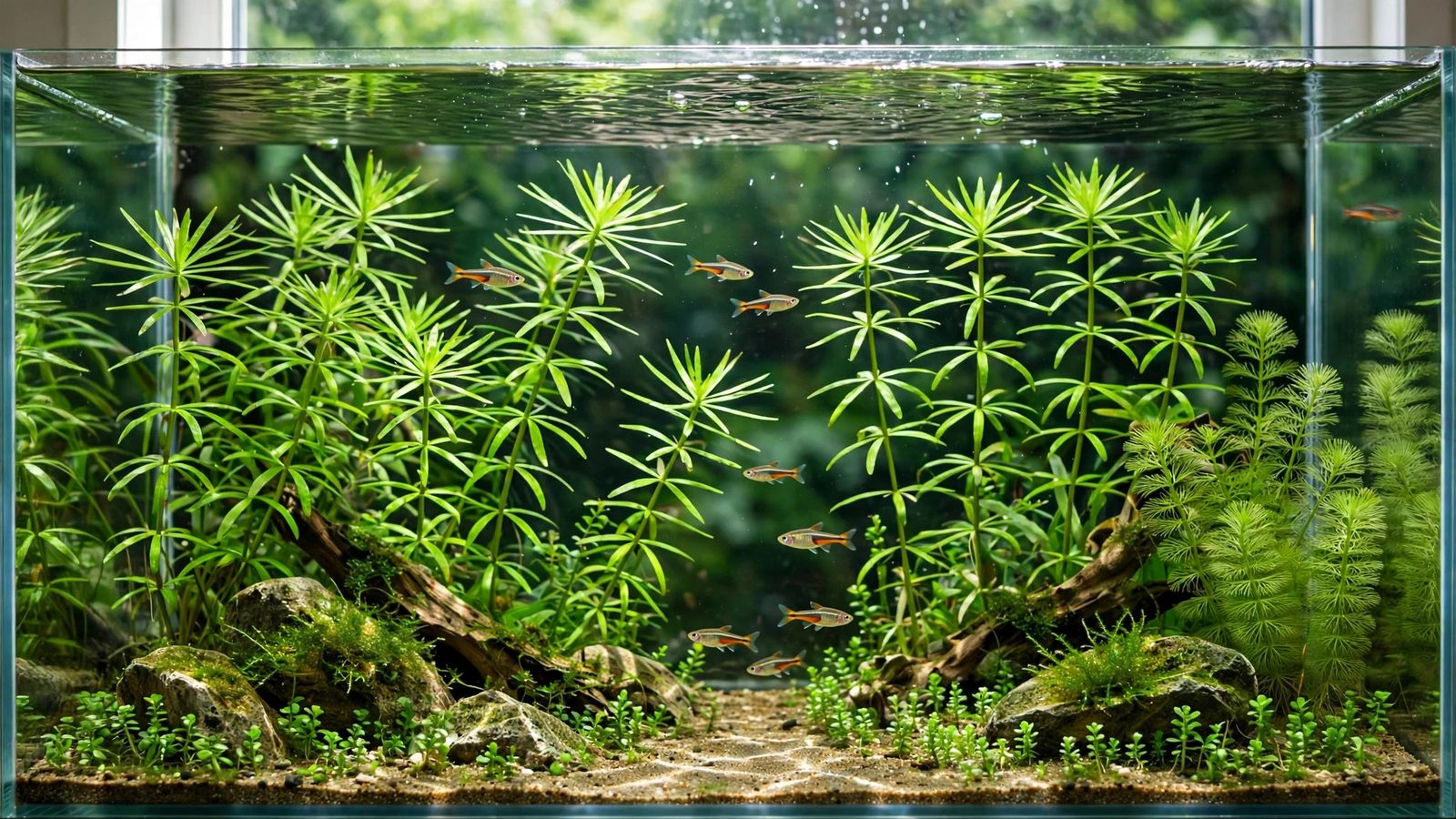
If you want an aquarium plant that rewards effort with explosive growth and a curtain of bright green foliage, stargrass aquarium plant care is worth learning well. Heteranthera zosterifolia — sold as stargrass or "star grass" — is a fast-growing South American stem plant that forms dense, feathery bushes of narrow leaves in the midground or background. It is not beginner-proof, but it is not a prima donna either: give it good light, stable carbon, and steady nutrients, and stargrass can add an inch or more a week, double in density when trimmed, and even send delicate blue flowers to the surface. This guide covers light, CO2, and nutrient needs, planting technique, trimming and propagation, tank placement, and the two problems nearly every keeper meets — melting and leggy growth.
Stargrass at a Glance
Heteranthera zosterifolia is native to slow streams and seasonal floodplains across Brazil, Bolivia, Paraguay, and Argentina. In the wild it grows both submerged and emergent, which explains two useful aquarium traits: it adapts quickly to submerged life, and its leaves are built for a lot of light. Its bright, lime-green narrow leaves grow in opposite pairs along upright stems, turning almost golden under strong light — a striking contrast against darker plants.
| Factor | Stargrass needs |
|---|---|
| Lighting | Medium to high; high light for compact, bushy growth |
| CO2 | Injected CO2 strongly recommended; survives without but grows leggy |
| Substrate | Nutrient-rich aqua soil or sand/gravel with root tabs |
| Water column | Balanced liquid fertilization; high nitrate/potassium appetite |
| Temperature | 68–82°F (20–28°C); best around 72–77°F |
| pH / hardness | Adaptable: pH 6.0–7.5, soft to moderately hard water |
| Placement | Midground bush or background curtain |
| Growth rate | Fast — up to 1–2 inches (3–5 cm) per week in good conditions |
| Difficulty | Medium; low tech possible but leggy and fragile |
Light: The Single Biggest Factor
Everything about stargrass — color, density, speed, and resistance to algae — traces back to light. This is a high-light-demanding stem plant. Under medium lighting it survives, but stems stretch and lower leaves drop, leaving bare stalks topped by a sad tuft. Under strong light it stays compact, branches freely, and develops the dense bushy form that makes it worth growing.
How much light does stargrass need?
On a standard 20–40 gallon tank, a modern full-spectrum LED running 7–9 hours daily at medium-high intensity is the baseline. If you already grow other demanding plants — red stem plants or high-tech carpeting species — your lighting is almost certainly enough for stargrass too.
Stargrass tells you about your light through its shape: short internodes and leaves held tight to the stem mean light is adequate; stems reaching upward with wide gaps between leaf pairs mean it wants more. Raise intensity gradually over a week or two — jumping straight to maximum can trigger algae on the plant's large leaf surfaces before it adjusts.
Photoperiod and consistency
Keep the photoperiod steady at 7–9 hours on a timer. Erratic day lengths are a quiet cause of melting, because the plant's carbon demands shift faster than its enzymes can adapt. Change intensity or duration in small steps and watch for a week.
CO2 and Carbon: Why Stargrass Loves It
Stargrass grows noticeably faster and thicker with pressurized CO2 injection — at a lime-green drop checker (roughly 25–35 ppm), growth is vigorous, leaves stay large, and the plant shrugs off algae. Without injected CO2 it can still grow with good light, consistent fertilization, and liquid carbon — but expect slower growth, thinner stems, and a real risk of leggy shoots.
Running low-tech? Position stargrass directly under the brightest zone, dose a comprehensive liquid fertilizer consistently, and consider one of the easiest aquarium plants that grow without CO2 for the rest of the scape. Many keepers see melting within two weeks in low-tech setups, then recovery once dosing and lighting are dialed in — the plant is adaptable, but it demands consistency.
Nutrients: Feeding a Hungry Grower
Fast growth means fast consumption. Stargrass is a heavy feeder from both the water column and the substrate, and nutrient gaps show up fast — often within days — as pale new growth or pinholes in older leaves.
Substrate and root feeding
Plant stargrass in a nutrient-rich aqua soil for the easiest results. In inert substrates, add root tabs near the planting zone every 2–3 months. If you are planting in gravel, see our guide to aquarium plants that grow in gravel for substrate techniques that apply here too.
Water-column dosing
Dose a complete liquid fertilizer containing macros and traces. Stargrass has a particular appetite for nitrate and potassium: lean nitrates stall growth and yellow old leaves from the tips inward; potassium deficiency shows as pinholes with yellow edges. A standard all-in-one schedule suits it well, and keeping nitrate at 10–20 ppm rather than zero is better for this plant. It is a useful member of the plants that absorb nitrates crowd, helping keep nitrogenous waste in check in stocked tanks.
Iron and color
Stargrass is naturally bright green, so you are not chasing color with iron. Still, iron deficiency shows as pale new growth with green veins. A balanced micronutrient dose covers it; extra iron is rarely needed.
Stargrass eats heavily from the water column: a comprehensive liquid like Seachem Flourish.
Planting Technique
Stargrass is usually sold as bunches of cut stems or in pots. Handle the stems gently — they are somewhat brittle and snap if bent sharply.
- Prepare the stems. Unwrap the bunch, remove rubber bands or lead weights, and separate the stems. Trim off any mushy or damaged lower leaves.
- Cut to length. Trim stems to roughly 4–6 inches with sharp scissors. If stems arrived emersed-grown (common from nurseries), expect the broad rounder leaves to melt and be replaced.
- Plant individually. Using aquascaping tweezers, push each stem 1–2 inches into the substrate, spacing stems about 1–1.5 inches apart. Planting the whole bunch as one clump is the most common beginner mistake: the inner stems get no light, rot, and the whole bunch lifts out of the substrate.
- Plant deeper than feels right. Fresh stargrass stems are buoyant. Bury the bottom inch firmly so roots anchor before the stem works loose; replant promptly if any float in the first few days.
For the first 1–2 weeks, leave the plant alone except for removing melted emersed leaves. Repeated disturbance resets rooting and invites melting.
Stargrass Aquarium Plant Care: Trimming and Maintenance
This is where stargrass becomes genuinely fun. It responds to trimming with explosive branching — cut one stem and two or three side shoots sprout below the cut within days. Left untrimmed it grows tall and spindly; trimmed regularly it becomes a dense, hedge-like bush.
How to trim stargrass
- Top it regularly. When stems reach your desired height, cut the top 2–4 inches off just above a leaf node. The remaining stem branches; the cut tops can be replanted to thicken the group.
- Trim before it surfaces. Do not let stargrass grow out of the water repeatedly — emersed growth changes leaf form and stresses the submerged portions.
- Thin the base. In dense groups the lowest leaves yellow from shading. Every few months, pull out the oldest bare stems and replant fresh tops — a "reset" that keeps the bush looking young.
- Use sharp scissors. Ragged cuts crush stems and invite rot. Curved aquascaping scissors give clean cuts and reach into the bush easily.
Expect to trim a thriving stargrass bush every 1–2 weeks. It is one of the fast-growing aquarium plants that double as natural nutrient export: every handful of trimmings you remove carries nitrate and phosphate out of the tank. In a new aquarium, a hungry stem plant like stargrass is one of the best stem plants for fighting algae in new tanks, outcompeting algae for nutrients during the unstable cycling weeks.
Propagation
Stargrass propagates exclusively — and almost effortlessly — from stem cuttings. No special technique is required:
- Cut a healthy stem to at least 3–4 inches, with several leaf nodes.
- Strip the lowest 1 inch of leaves to expose bare stem.
- Plant the bare section into the substrate.
- Roots develop from the buried nodes within 7–10 days; new top growth follows.
Healthy stargrass also throws out side shoots spontaneously, especially after a top trim. Snap these off once they are a couple of inches long and plant them directly. One bunch can become a full background curtain in two months of regular trimming and replanting.
Tank Placement and Aquascaping
Stargrass is most at home as a midground bush or background curtain. Its fine, feathery texture makes an excellent contrast plant: place a dense stargrass group behind or beside broad-leafed plants like anubias, swords, or crypts, and the texture difference makes both look better. Against hardscape, a stargrass bush softens the edges of rocks and driftwood.
Because it grows tall quickly, reserve it for tanks where you can commit to the trimming schedule — a 10-gallon tank needs weekly attention, a 40-gallon background about two weeks. It layers well with other tall background aquarium plants, and its bright green tone sits nicely beside red aquarium plants used as focal points.
One delightful bonus: mature, healthy stargrass occasionally sends up slender flower spikes with small star-shaped blue flowers — the namesake "stars." Emerged spikes are more common in open-top tanks or when the plant is allowed to reach the surface briefly. They are harmless and a sign the plant is thriving.
Common Problems and Fixes
Melting after planting
The number one stargrass complaint. Newly planted stargrass — especially emersed-grown nursery stock — often melts: leaves turn translucent, then disintegrate. This is a transition response, not death; emersed leaves cannot survive underwater and are being replaced. Fix: remove melted leaves promptly, keep light and CO2 stable, and give the plant 2–3 weeks. If the stems turn to mush, that is actual rot — remove them entirely. Tissue-culture plants melt far less; read our comparison of tissue culture vs potted plants before buying.
Leggy, stretched growth
Long bare internodes with small leaves at the top mean the plant is reaching for more light or more carbon — almost always insufficient light, sometimes low CO2, occasionally both. Fix: increase light intensity gradually, verify CO2 levels with a drop checker, and top the leggy stems — the new side shoots will grow in compact form under the improved conditions.
Lower leaves dropping
In dense groups, the base gets shaded and lower leaves yellow and drop, leaving bare stalks. Fix: thin the planting, trim tops regularly to keep height moderate, and consider raising light intensity slightly.
Algae on leaves
Stargrass's broad leaf surfaces collect thread and staghorn algae when stressed — usually from unstable CO2 or nutrient imbalance. Fix: stabilize CO2 first, verify dosing is complete and consistent, remove affected leaves, and let renewed growth outrun the algae. A hungry, fast-growing plant is itself one of the best tools for natural algae control.
Brittle, snapping stems
Stems that snap at a touch usually indicate weak growth from insufficient light, or GH too low for sturdy cell walls. Fix: check GH (aim for at least 3–4 dGH), ensure lighting is adequate, and handle the plant with tweezers rather than fingers.
Stargrass vs. Similar Stem Plants
Stargrass is sometimes confused with other fine-leafed stems. Limnophila sessiliflora is feathery too, but its leaves are more finely divided and it tolerates lower light far better — the easier choice for low-tech tanks. Rotala species have rounder leaves and often redden under high light, while stargrass stays green. What sets stargrass apart is the combination of very fast growth, easy propagation, and a bright lime-green color few other stems offer — compare temperaments in our best stem plants for beginners roundup.
Frequently Asked Questions
Can stargrass grow without CO2 injection?
Yes, but with honest caveats. Stargrass survives in low-tech tanks with good light and consistent liquid fertilization, but growth is much slower, stems stay thin, and the plant is prone to leggy growth and melting. Liquid carbon supplements help somewhat. If you want the dense, fast-growing bush it is famous for, pressurized CO2 is the single highest-impact upgrade.
Why is my stargrass melting even though my other plants are fine?
Stargrass reacts faster and more dramatically to transitions than most stems. Common triggers: nursery stock switching from emersed to submerged growth, a sudden change in light or CO2, or being moved between tanks. Remove melted foliage, keep parameters stable, and wait two to three weeks — new submerged growth usually emerges from the nodes. If stems themselves liquefy, discard them; healthy stems are firm and green inside when cut.
How often should I trim stargrass?
In a high-tech tank, expect to top it every one to two weeks once established — it can grow an inch or more per week. Letting it reach the surface repeatedly produces weak, transitional growth and shades everything below. Regular topping is not just maintenance; it is how you build density, since each cut stimulates two to three side shoots. Replant the healthy tops to thicken the group or start new ones.
Does stargrass need aqua soil, or will it grow in sand?
It grows in both, but aqua soil gives noticeably better results because stargrass feeds heavily through its roots. In sand or gravel, place root tabs near the stems and keep up water-column dosing — the plant will still thrive, just at a slightly slower pace. Whichever substrate you use, plant stems individually rather than as a clump so light and flow reach every stem.
Is stargrass good for beginners?
It is a medium-difficulty plant rather than a true beginner plant. A beginner with a decent LED, a timer, and a consistent fertilizer routine can absolutely succeed with it — and will learn a lot about trimming and plant nutrition in the process. But if your tank is low light with no fertilization plan, start with something more forgiving and add stargrass after you upgrade. The frustration almost always comes from under-lighting, not from the plant being delicate.
Will fish or shrimp eat stargrass?
Most community fish and all common shrimp leave stargrass alone — its leaves are too tough to appeal, and shrimp benefit from grazing biofilm off them. Herbivorous fish like goldfish, silver dollars, or large cichlids may nibble it. In a shrimp tank it is an excellent choice: dense bushes give shrimplets hiding places and grazing surfaces.
The Bottom Line
Stargrass pays you back in proportion to what you put in. Meet its three demands — strong, consistent light; stable carbon; steady nutrition — and Heteranthera zosterifolia becomes one of the most rewarding stems in the hobby: fast, forgiving of trimming mistakes, endlessly propagatable, and capable of flowering. Tropica's plant database entry for Heteranthera zosterifolia confirms its high-light, high-CO2 preferences and South American origins. Plant it individually, trim it boldly, feed it well, and one bunch can become the lush green engine of your aquascape. For broader planting strategy, the University of Florida's IFAS extension publication on aquatic plant culture for aquariums is a solid, science-backed reference.