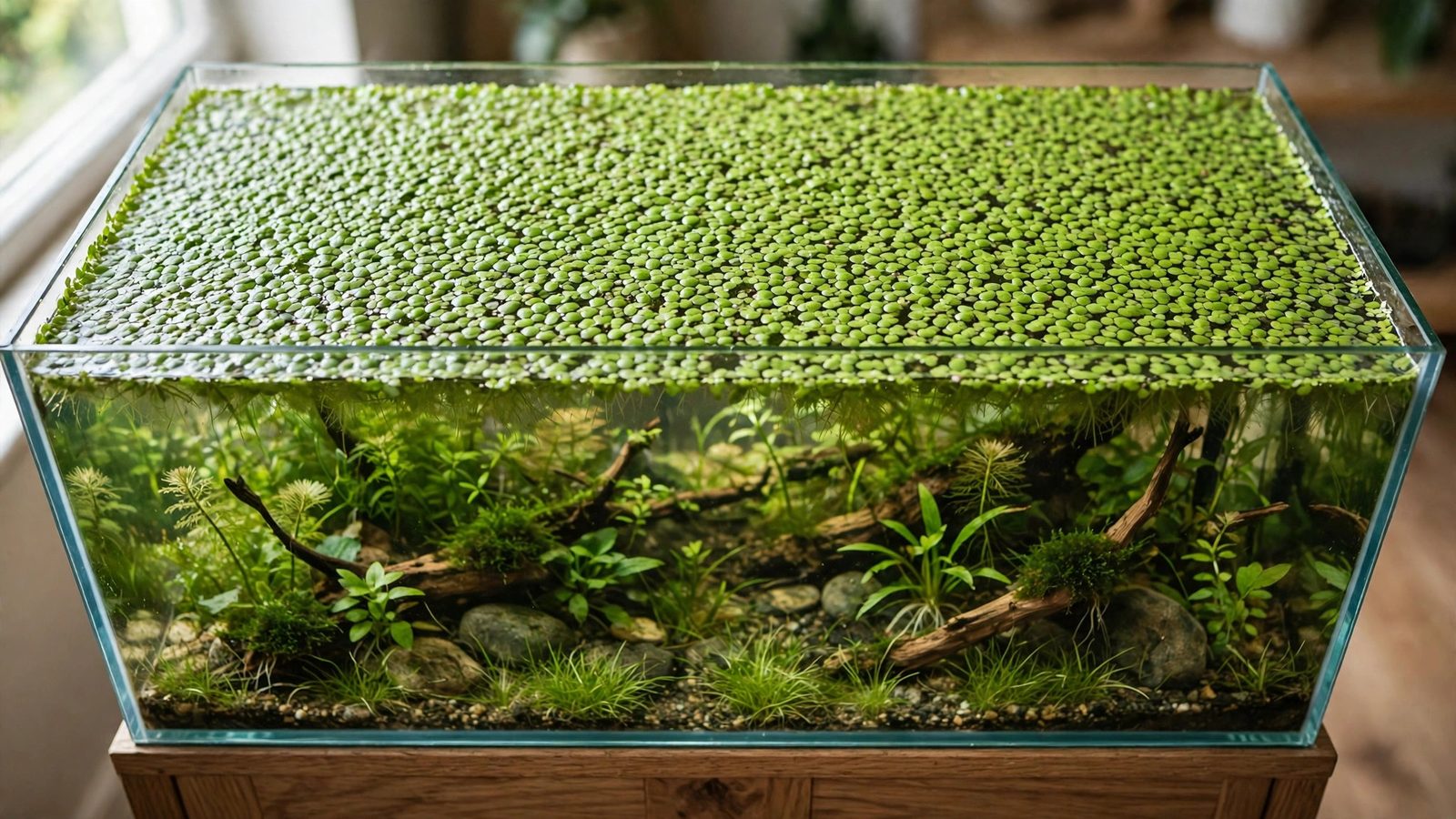
Ask most aquarists about duckweed and they will roll their eyes — the tiny floating plant has a reputation as a tank invader that arrives uninvited on a new plant and refuses to leave. But there is another side to this story: deliberately grown, common duckweed (Lemna minor) is one of the cheapest, toughest, most useful plants in the entire hobby. This duckweed aquarium care guide treats it as what it can be — a deliberate tool rather than a pest — covering how to grow it on purpose, keep it healthy and contained, and put its appetite for nutrients to work for your tank.
What Duckweed Actually Is
Duckweed is not one plant but a family of tiny floating plants, most commonly Lemna minor (common duckweed), Lemna gibba, and the larger Spirodela polyrhiza (giant duckweed). Each plant, called a frond, is a round-to-oval green leaf just 2–5 millimetres across with a single fine root dangling beneath it. Because duckweed floats, it never needs planting in substrate — it sits at the waterline, root tips pointing down into the water column. Mississippi State University Extension's profile of duckweed species confirms the basics of how these plants cluster into floating mats in still, nutrient-rich water, which is exactly the environment your aquarium provides.
Why Grow Duckweed on Purpose?
Before diving into technique, it helps to be clear about what you are buying with that humble green carpet. Grown deliberately, duckweed earns its place in several kinds of setups.
Natural filtration that works while you sleep
Duckweed feeds directly from the water column, pulling in ammonia, nitrate, and phosphate faster than almost any other hobby plant because it has unlimited access to atmospheric CO2. A healthy mat is, in practical terms, a second biological filter — one that also exports nutrients physically when you scoop handfuls out. It pairs naturally with other aquarium plants that absorb nitrates, and in low-tech tanks a duckweed carpet can be the single biggest factor keeping nitrate readings flat between water changes.
Shade, shelter, and calmer fish
Fish that evolved under canopy-covered water — bettas, gouramis, many tetras — visibly relax under floating cover. Duckweed diffuses harsh overhead light, gives shy species a ceiling to retreat under, and provides fry with a living micro-habitat full of infusoria to graze on. It is no accident that guides to the best aquarium plants for betta tanks almost always include floating plants; duckweed delivers that same cover benefit at a fraction of the cost.
Algae insurance for new tanks
A freshly set-up tank has abundant nutrients, strong light, and a bacterial colony that is still maturing — a perfect recipe for an algae bloom. Duckweed, like other fast-growing aquarium plants for new tanks, outcompetes algae for dissolved nutrients, and because it shades the substrate it also reduces the light intensity reaching the surfaces algae colonise. Running a duckweed mat through the first two months is one of the simplest ways to make a new tank self-balancing, and it works on the same principle as other plants used for natural algae control: starve the algae of both nutrients and light and the tank stays clear on its own.
Live food and a side harvest
Goldfish, mollies, koi, and many pond fish eat duckweed enthusiastically, and shrimp graze on the biofilm that colonises the roots. If you keep plant-eating livestock anywhere in your fish room, growing a surplus of duckweed in one tank gives you a free, continuous live food source — just scoop, rinse, and serve.
Duckweed Aquarium Care: Setting Up Your Tank
The good news is that duckweed asks for almost nothing. The bad news is that getting the few things it does ask for wrong is the one reason deliberate duckweed cultures fail.
Light requirements
Duckweed is famously undemanding about light — it grows under stock kit lighting where most plants would stall, and it is a staple of every no-CO2 beginner plant list for a reason. Moderate lighting is the sweet spot: too little and growth crawls; too much and fronds can bleach pale or cook under heat from very close, intense LEDs. If the mat spreads and stays rich green, your light is fine. Unlike submerged plants, duckweed can never be shaded out — it is always the top layer — so it rarely needs the high-intensity lighting other plants demand.
Water movement: the make-or-break factor
Duckweed hates turbulence. It evolved for still ponds and ditch edges, and in strong surface current fronds get pushed underwater, torn apart, or wedged against the filter intake and crushed. The single most important setup decision is to calm the surface: aim filter outputs at the glass, add a spray bar, install a surface-skimming ring or floating corral (a loop of airline tubing works), or use a pre-filter sponge that also slows the outflow. A gentle ripple is fine; white water is not.
Nutrients and feeding
Duckweed drinks from the water, so nutrient delivery is via the water column — root tabs and enriched substrate are irrelevant to it. In a stocked tank, fish waste usually provides everything it needs, and duckweed will happily consume the excess that would otherwise fuel algae. In a fishless grow-out or very lightly stocked tank, a half-dose of a comprehensive liquid fertiliser once or twice a week keeps it multiplying. Yellowing, shrunken fronds in an otherwise healthy tank are the classic sign the water is too lean for a hungry mat.
Temperature and pH
Common duckweed tolerates an exceptionally wide range: roughly 15–28°C (59–82°F) and pH 6.0–8.0. It is not picky about hard or soft water and needs no heater in most indoor settings — which is why it appears on lists of floating aquarium plants for beginners. Growth is fastest in the low-to-mid 20s Celsius; below about 15°C it slows down, and near freezing most species go dormant rather than dying outright.
A reliable pick here is API Leaf Zone.
How to Start Your Duckweed Culture
- Source clean stock. Buy from a reputable plant seller or take it from a known-clean tank. Wild-collected duckweed can carry duckweed's smaller cousin Wolffia (watermeal — nearly impossible to remove), snails, or pathogens. A 10-second dip in a mild bleach solution followed by a thorough rinse is cheap insurance against hitchhikers.
- Rinse and inspect. Float the fronds in a bowl of dechlorinated water for an hour. Healthy stock is uniform green; discard any that are brown, translucent, or broken — they decompose and foul the water.
- Place, don't plant. Scatter a tablespoon of fronds over a calm corner of the tank. There is no rooting, no tweezers, no substrate work — duckweed propagation in aquariums is simply a matter of giving healthy fronds water, light, and stillness.
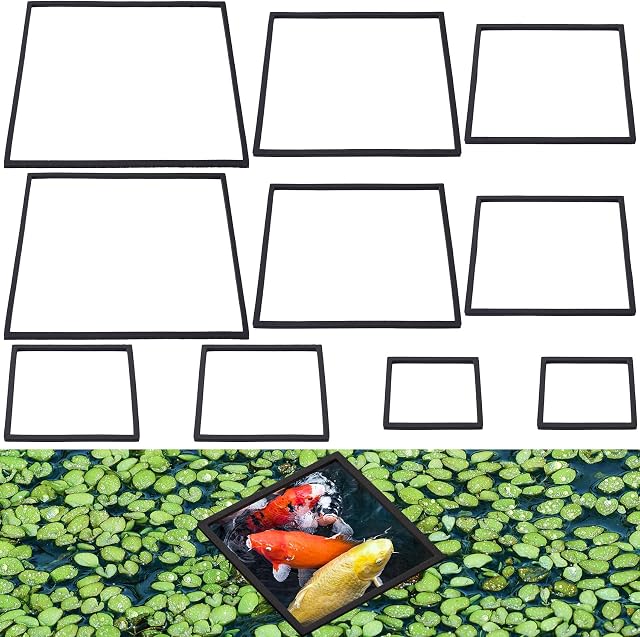
- Corral it. Place a floating ring of airline tubing, a feeding ring, or a loop of fishing line around the starter patch. This keeps the initial culture from drifting into the filter intake or being scattered into every corner before it has bulked up.
- Wait. Under decent conditions you will see the patch double within days. New fronds bud off the parent frond's side; do not be surprised to see a thin layer become a thick carpet in two to three weeks.
Managing Growth: Keeping the Carpet in Check
Duckweed's legendary growth rate is the point of growing it — and also the one management task it demands. Left alone, a mat will seal the surface completely, blocking gas exchange and light for submerged plants below. The fix is routine and takes seconds: skim handfuls off with a net or cup during your normal maintenance. Aim to keep roughly 30–70% of the surface covered; this leaves open lanes for oxygen exchange and light penetration while keeping the nutrient-sponge effect strong. Harvested duckweed can be dried for fish food, tossed in the compost, or — with a second tank — started as its own culture. The flip side of effortless growth is that neglect turns convenience into a smothered surface, so build the weekly skim into your routine the way you build in glass cleaning.
A responsibility note: duckweed is classified as invasive in many regions, so treat harvested fronds like any other aggressive plant — never dump tank water, harvested plants, or filter waste into waterways, drains, or storm gutters. Dispose of excess in the household trash or compost instead, and check your local restrictions before sharing or trading cultures across state or national lines.
A reliable pick here is floating plant corral rings.
 ★3.9
PAGOW Floating Plant Corral Rings
Check Price on Amazon ★3.9Duckweed vs. Other Floating Plants
Duckweed is not the only candidate for the water surface, and knowing how it compares helps you choose deliberately rather than by default.
| Plant | Size | Growth rate | Removability | Best for |
|---|---|---|---|---|
| Duckweed (Lemna minor) | 2–5 mm fronds | Very fast — doubles in days | Difficult once spread | Maximum nutrient export, live food |
| Giant duckweed (Spirodela) | 5–10 mm fronds | Fast | Moderate | Easier to corral than common duckweed |
| Frogbit (Limnobium laevigatum) | 2–5 cm leaves | Moderate | Easy | Aquarists who want control |
| Salvinia | 1–3 cm fronds | Moderate–fast | Easy–moderate | Textured surface, shade without takeover |
| Water lettuce (Pistia) | 5–15 cm rosettes | Moderate | Easy | Large tanks, ponds |
The honest trade-off: larger floaters give you easier control, but none of them match duckweed's sheer nutrient appetite or doubling speed. If maximum biological filtration is your goal, duckweed wins; if you want surface cover you can thin selectively, frogbit or salvinia are friendlier choices.
Tankmates That Work Well with Duckweed
Any community that appreciates dimmer light and cover will appreciate a duckweed mat. Shrimp colonies are a classic pairing — the roots grow biofilm that shrimp graze constantly, and duckweed shows up in most guides to aquarium plants for shrimp tanks for exactly this reason. Small rasboras, tetras, and livebearers use it as a nursery for fry. Betta and gourami males will build bubble nests directly under a stable mat, anchoring them against fronds instead of against glass.
The one livestock conflict worth naming: plant-eating herbivores. Goldfish, silver dollars, and many cichlids will graze duckweed down to nothing, which is fine if that is the plan (a duckweed grow-out tank feeding a goldfish tank is an excellent setup) but frustrating if you expected the carpet to persist. Snails, on the other hand, ignore living fronds entirely.
Common Problems (and Easy Fixes)
- Duckweed melting or going translucent. Usually nutrient collapse — the mat outgrew the available nitrogen or phosphate. Add a half dose of comprehensive liquid fertiliser and thin the mat so the remaining fronds get more light.
- Pale, stunted fronds. Iron or micronutrient deficiency, especially in reverse-osmosis water. A dedicated micro fertiliser, dosed lightly, greens it up within a week.
- Fronds sinking or disintegrating. Too much surface turbulence. Calm the outflow, add a floating corral, and remove the dead material before it rots.
- It won't spread. Check the three levers: light (minimum moderate), stillness (no blasting outflow), and nutrients (stocked tanks rarely have this problem; fishless ones do). One of the three is almost always the culprit.
- It spread everywhere and won't stop. Congratulations — your care is perfect. Skim weekly, and corral future cultures from day one.
Frequently Asked Questions
How fast does duckweed grow in an aquarium?
Under good conditions — moderate light, still surface, and a stocked tank's nutrient load — a duckweed patch can double in as little as two to four days. From a tablespoon of starter fronds you can expect a solid mat across a 10-gallon tank within two to three weeks. Growth stalls below about 15°C and in very lean or heavily agitated water.
Does duckweed need CO2 or fertiliser?
No CO2 is needed, ever: floating leaves draw carbon dioxide directly from the air, which is why duckweed thrives in low-tech setups. Fertiliser is only needed in fishless or very lightly stocked tanks; in a normally stocked aquarium, fish waste provides ample nitrogen and phosphate. Yellowing fronds are the signal to start dosing a liquid fertiliser.
Will duckweed kill my other plants?
Not if you manage surface coverage. A full, unskimmed mat blocks light from submerged plants and reduces gas exchange at the surface, which can starve lower plants of light. Keeping 30–70% of the surface covered, with open lanes, lets you keep the nutrient-sponge benefits while your rooted and stem plants still receive plenty of light.
Is duckweed bad for fish?
Duckweed itself is harmless to fish and even beneficial: it absorbs waste compounds, provides cover that reduces stress in shy species, and serves as live food for herbivorous fish. The only risk is a totally sealed surface in an overstocked, poorly aerated tank, which can restrict oxygen exchange — the same rule applies to any floating plant and is solved by routine skimming.
Can duckweed survive a power outage or cold snap?
Better than nearly any other aquarium plant. Duckweed tolerates temperature drops into the mid-teens Celsius with only slowed growth, and it needs no filtration, heating, or aeration to survive for days. In genuinely cold conditions most species simply go dormant at the surface rather than dying off, then resume growing when warmth returns.
How do I remove duckweed if I change my mind?
Skim aggressively with a fine net, rinse filter media (fronds hide there), and repeat weekly for a month — new sprouts keep appearing from trapped fronds. For a tank you want permanently duckweed-free, we have a dedicated removal guide covering quarantine and deep-clean methods. Prevention, though, is easier: corral every culture from day one so it never colonises the whole tank.
Putting It All Together
Duckweed rewards a small shift in mindset. Stop treating it as an accident and start treating it as infrastructure: a self-replicating biological filter, a shade system for shy fish, a nursery for fry, and a free food source — all from a plant that costs almost nothing and asks for nothing but calm water and light. Corral it, skim it, and let it work. Whether you are running a nano tank on a desk or a rack of breeding setups, a managed duckweed mat is one of the simplest upgrades in the hobby, and it may be the closest thing to a plant that takes care of itself — and your water — at the same time. For a balanced first setup, pair it with a few of the best aquarium plants for 5-gallon tanks, and watch how quickly a little green carpet stabilises the whole system.