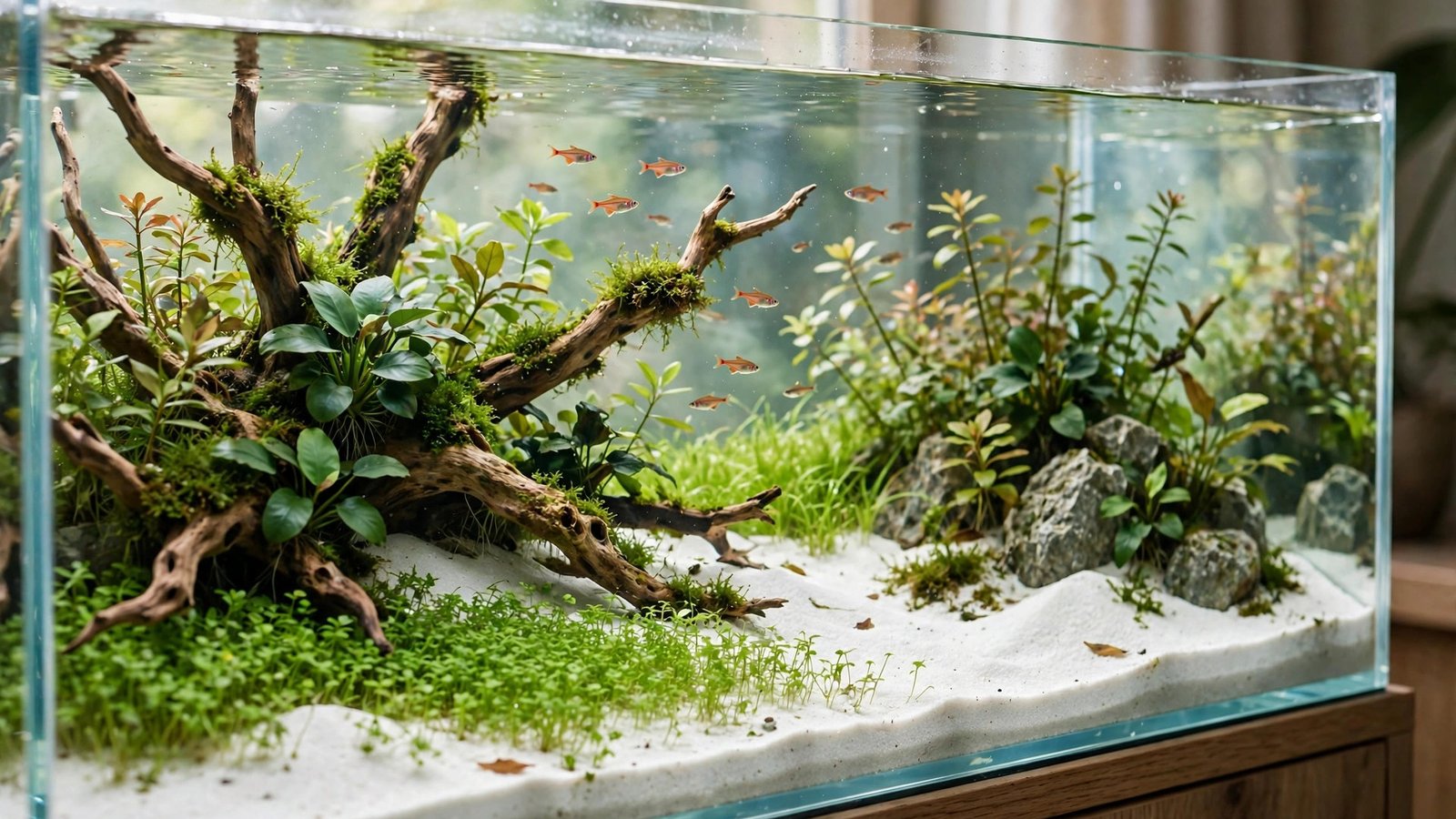
Every aquascaping contest winner knows the trick: a luminous white foreground that makes the plants behind it look twice as green. A white sand aquascape is the fastest way to make an ordinary layout look gallery-ready, but it has a reputation for turning brown, mixing into the background, and looking dingy within three months. That reputation comes from three avoidable mistakes — wrong grain size, sloppy separation from darker soils, and a maintenance routine built for gravel, not sand. Get those three right and your white foreground stays bright for years. This guide walks you through the design choices, the build technique, and the weekly routine that keeps it that way.
Why a White Sand Foreground Works So Well
White sand does three visual jobs at once. First, it acts like a reflector: light that dark substrate would swallow bounces off the foreground, which is why white sand aquascape builds photograph brighter than dark layouts under the same light. Second, it creates a high-contrast stage — green plants, red stems, and dark wood read dramatically against white, and shy fish like tetras color up more over a pale floor. Third, it gives the layout breathing room: a clean white path reads as open water and makes even a 20-gallon tank feel spacious.
There's a practical side too. Uneaten food, waste, and algae are visible the moment they land, which turns the foreground into an early-warning system for your maintenance habits — tanks with white foregrounds tend to get maintained on schedule, because neglect is obvious. Plan your hardscape layout before you buy a single bag, because moving white sand after the tank is filled is miserable work.
Choosing the Right White Sand: Grain Size Is Everything
Not all white sand behaves the same. The single most important number is grain size, in millimeters, because it controls compaction, root penetration, and how fast staining washes out of the top layer.
| Sand type | Grain size | Brightness | Best for |
|---|---|---|---|
| Fine play sand (washed) | 0.15–0.35 mm | ★★★★★ | Budget builds; compacts badly if not stirred |
| Pool filter sand | 0.4–0.8 mm | ★★★★ | The sweet spot for planted tanks — flows well under a siphon |
| Aquarium-grade silica sand | 0.2–0.5 mm | ★★★★★ | Premium choice; uniform grains, stays bright longest |
| Coarse river sand (white) | 1–2 mm | ★★★ | High-flow tanks; traps less detritus between grains |
| Coral sand / crushed aragonite | 0.5–1 mm | ★★★★ | Avoid for planted tanks — raises pH and hardness |
For most white sand aquascape builds, pool filter sand at 0.4–0.8 mm is the workhorse: inert, cheap (about $12–15 for a 50-lb bag at a pool supply store), and heavy enough to stay put under a siphon. Aquarium-grade white silica sand at 0.2–0.5 mm looks more luminous for a show tank but compacts more readily, so it demands a snail crew. See our pool filter sand guide for planted tanks and the best sand for planted aquariums roundup. Tropica's own substrate guide confirms the same rule of thumb: grain size drives compaction behavior more than brand.
The Rinse Test
Whatever you buy, rinse a cupful first: swirl in a bucket and pour off the cloudy water 8–10 times until it runs nearly clear. Then soak the rinsed sand in tap water 48 hours and test pH — if it reads more than 0.2 above your tap, the sand contains carbonate and will fight you on pH forever. Pool filter sand and true silica sand pass; decorative craft sand often fails. One bad bag can undo every other careful choice in the build.
The bright white sand pick discussed in the grain-size section: CaribSea Super Naturals Moonlight Sand.
Sand Over Soil vs. Pure Sand: Pick Your Build
The great divide in white-sand builds is whether the sand is the only substrate or just the top layer. Both work — for different goals.
| Pure sand build | Sand over aquasoil | |
|---|---|---|
| Sand depth | 1–1.5 in (2.5–4 cm) | 0.5–1 in (1.5–2.5 cm) cap over 1.5–2 in of soil |
| Plant growth | Slow; root tabs needed every 2–3 months | Vigorous from day one |
| Maintenance | Lowest — nothing to mix | Higher — must defend the border |
| Best for | Rock/wood layouts, moss, epiphytes, easy carpets | Dense stem-plant aquascapes with white negative space |
| Longevity of whiteness | Excellent — uniform color throughout | Good, but soil creep shows as dark specks |
The sand-over-soil build is the classic contest look: nutrient-rich dark soil under the planting zones, clean white sand in the foreground and negative space. The pure-sand build is the low-drama option — nothing can mix, and root tabs pushed under the sand every 8–12 weeks keep plants fed. Choose layered for heavy stem growth with a white foreground; choose pure sand for a rock garden or epiphyte-on-wood layout. Our sand cap over aquasoil guide covers the capping technique in depth.
Keeping White Sand and Dark Soil Separate (the Build That Never Mixes)
This is the step where most white-sand builds are won or lost. Soil migrates: every water change, every plant uprooted, every curious bottom-dweller nudges dark granules into the white zone, and once a foreground is 10% speckled with black aquasoil, no siphon fixes it.
- Build a buried border. Set a physical divider along the sand/soil line before adding water — a row of flat stones pushed 1 inch into the base, or a 2-inch strip of cut plastic buried vertically. It should stand about 0.5 inch taller than the soil surface.
- Slope soil away from the sand. Grade the aquasoil so it rises toward the back with the boundary at the low point; stray soil granules roll back into the planting zone, not into the sand.
- Keep the cap thin. Over soil, limit the sand cap to 0.5–0.75 inch (1.5–2 cm). Thicker caps slide downhill and bury the barrier's top edge.
- Plant before you fill. Press stems and carpets into the soil zones first, mist heavily, then lay the sand last. Every stem planted after the fill is a mixing event.
Use our substrate calculator guide to work out how many pounds of each material your tank footprint needs before you order — running short mid-build is how half-finished borders happen.
Three White-Sand Layout Styles That Always Work
1. The beach path
A winding ribbon of white sand, 2–4 inches wide, curving from the front glass to a vanishing point between rocks or wood. Plant both sides densely, leave the path bare, and vary the width — paths that swell and pinch look like shorelines; uniform paths look like roads.
2. Negative space
The Iwagumi-adjacent approach: 40–60% of the foreground is bare white sand, with two or three stones plus a carpet or a single plant group. Every element is exposed, so this demands the brightest sand you can afford. See the rock-only aquascape guide for stone selection principles that carry this style.
3. The bright valley
A white-sand valley floor framed by dark-soil planting on both sides, sloping up like amphitheater seating. The friendliest style for beginners: generous planting zones, a contained sand area, and it works from 10 to 100 gallons. Slope the floor toward the front glass so detritus collects where your siphon will find it.
Plants and Rock Pairings That Pop Against White
White sand is a stage, so choose performers with contrast. Fine-leafed green carpets — Eleocharis parvula, Micranthemum 'Monte Carlo' — read like emerald felt on white. Red stems (Rotala, Ludwigia 'Super Red') look twice as vivid against a pale floor. For midground structure, dark ferns (Microsorum, Bolbitis) tied to wood give the eye somewhere to rest.
Dragon stone's warm browns and Seiryu stone's blue-greys both pair beautifully with white sand; grey lava rock gives a cooler, more modern Iwagumi feel. Wood is nearly mandatory — spider wood or manzanita branches add dark verticals that stop the composition looking flat. Caution: Seiryu stone can raise pH, so test it like you tested your sand if your livestock needs soft water.
Species That Keep Your Sand White (and Species That Don't)
Some animals are unpaid maintenance staff; others are demolition crews. Choose accordingly.
- Malaysian trumpet snails (MTS): the number-one white-sand ally. They burrow through the top inch by day and emerge at night, aerating the sand so detritus never settles in and anaerobic pockets never form. Stock 1 per 2–3 gallons; they'll self-regulate.
- Small corydoras (C. pygmaeus, C. habrosus): constant gentle sifting that keeps the surface layer loose and bright — barbel-safe on fine sand. See the best substrate choices for corydoras.
- Nerite snails: the best algae-eaters for sand-adjacent glass and stone; they won't breed in freshwater.
- Otocinclus: polish diatoms off the sand surface during the early weeks when brown film is worst.
Species to keep out of white-sand builds: big diggers — most cichlids, large loaches, goldfish, burrowing eels, and large pictus cats — will excavate under your barriers and crater a foreground in days. If you must keep them, use the pure-sand build with no soil boundary, and expect landscaping.
If you keep cichlids or other diggers, CaribSea's substrate FAQ is worth a read before choosing between their fine white sands and coarser options.
The Weekly Routine That Keeps Sand White for Years
White sand stays white through prevention, not rescue. The routine for a 20–40 gallon planted build:
- Weekly (30–40% water change): hover-siphon the sand surface in slow passes, front glass line first — that's where detritus accumulates. Fifteen minutes is plenty.
- Lighting: 7–8 hours per day on a timer. Excessive light is the biggest cause of sand-staining algae in mature tanks; dropping from 10 to 8 hours fixes more brown sand than any chemical.
- Feeding: only what fish finish in 90 seconds, once or twice daily. Overfeeding causes permanent yellow staining — uneaten food decays into the top layer where no siphon reaches.
- Flow: keep a gentle current across the sand so detritus stays suspended for the filter. Dead spots behind rocks are where grey patches start.
Fixing brown and green staining
Weeks 2–8, expect a brown diatom film — nearly universal in new tanks, clearing as silicates exhaust, usually by week 8. Help it with otocinclus and shorter light hours, not chemicals. Green spot algae means too much light or phosphate; black beard algae on the sand edge means low CO2 or poor flow. For stubborn patches, spot-treat with 3% hydrogen peroxide (2–3 ml per 10 gallons, filter off 15 minutes, then a 30% water change). Persistent deep yellow-brown tint is almost always overfeeding — cut portions for two weeks and watch it fade.
Weekly hover-siphoning keeps the surface bright; the Python makes large tanks effortless: a no-spill water changer like the Python.
How Much Sand Do You Actually Need?
One inch of sand weighs roughly 1.3–1.5 lbs per gallon of tank size: a 20-gallon long needs about 25–30 lbs, a 40-gallon breeder 50–60 lbs. Buy 20% more than the math says — white sand shows every imperfection, and extra is cheaper than a second shipping order. Store the spare bag dry and sealed; damp sand grows mildew.
Frequently Asked Questions
How long does white sand stay white in an aquarium?
Indefinitely, if the build and routine are right. The sand itself doesn't yellow — staining comes from diatoms (weeks 2–8, temporary), algae from excess light or feeding (fixable), and soil mixing from bad borders (preventable). With proper barriers, a snail crew, and weekly hover-siphoning, white sand stays bright for 3–5 years; many contest tanks run the same sand for the tank's whole life.
Is white sand safe for bottom-dwelling fish?
Yes — fine, smooth sand at 0.2–0.8 mm is the safest substrate for corydoras, loaches, and stingrays, far gentler than gravel. Barbels stay intact and natural sifting keeps the sand aerated. Avoid sharp blasting sands and crushed coral; stick to rounded silica or pool filter sand, and keep the layer at 1–1.5 inches so waste can't pack deep.
Can I put white sand over regular gravel?
Technically yes, but it fails fast. Gravel grains work upward through sand within weeks — the "Brazil nut effect" — leaving gravel poking through white sand. Converting a gravel tank? Remove the gravel entirely first, or cap with at least 2 inches of sand and accept that some gravel will surface. Sand over aquasoil works because soil granules are smaller and lighter than the sand above them.
Why is my new white sand turning brown?
Almost certainly diatoms, the classic new-tank brown film, appearing in weeks 2–8 while silicates from fresh sand and glass get consumed. It's harmless and temporary. Reduce light to 6–7 hours, add 3–4 otocinclus per 20 gallons, and siphon the film lightly each water change. It should fade by week 8–10; if it persists past month three, test for silicates in your tap water or chronic overfeeding.
Do I need to replace white sand periodically?
No scheduled replacement is needed. Unlike aquasoil, which exhausts its nutrients in 1–2 years, inert sand lasts indefinitely — just replenish root tabs under planted areas every 2–3 months. The only reason to replace sand is chronic deep staining from years of overfeeding; even then, rinsing the top inch usually restores it. Replace rather than rinse if the bed smells of rotten eggs deep down, which signals long-term anaerobic decay.
Start With the Brightest Possible Canvas
A white sand aquascape rewards planning and punishes improvisation — every shortcut shows up on the white canvas. But no other single choice makes a tank look this bright, this spacious, and this intentional. Choose your grain size, build your borders before the water goes in, stock the snail crew, and give it the fifteen weekly minutes it asks for. The sand will stay white, the plants will look electric against it, and you'll understand why contest photographers keep coming back to the same luminous foreground.