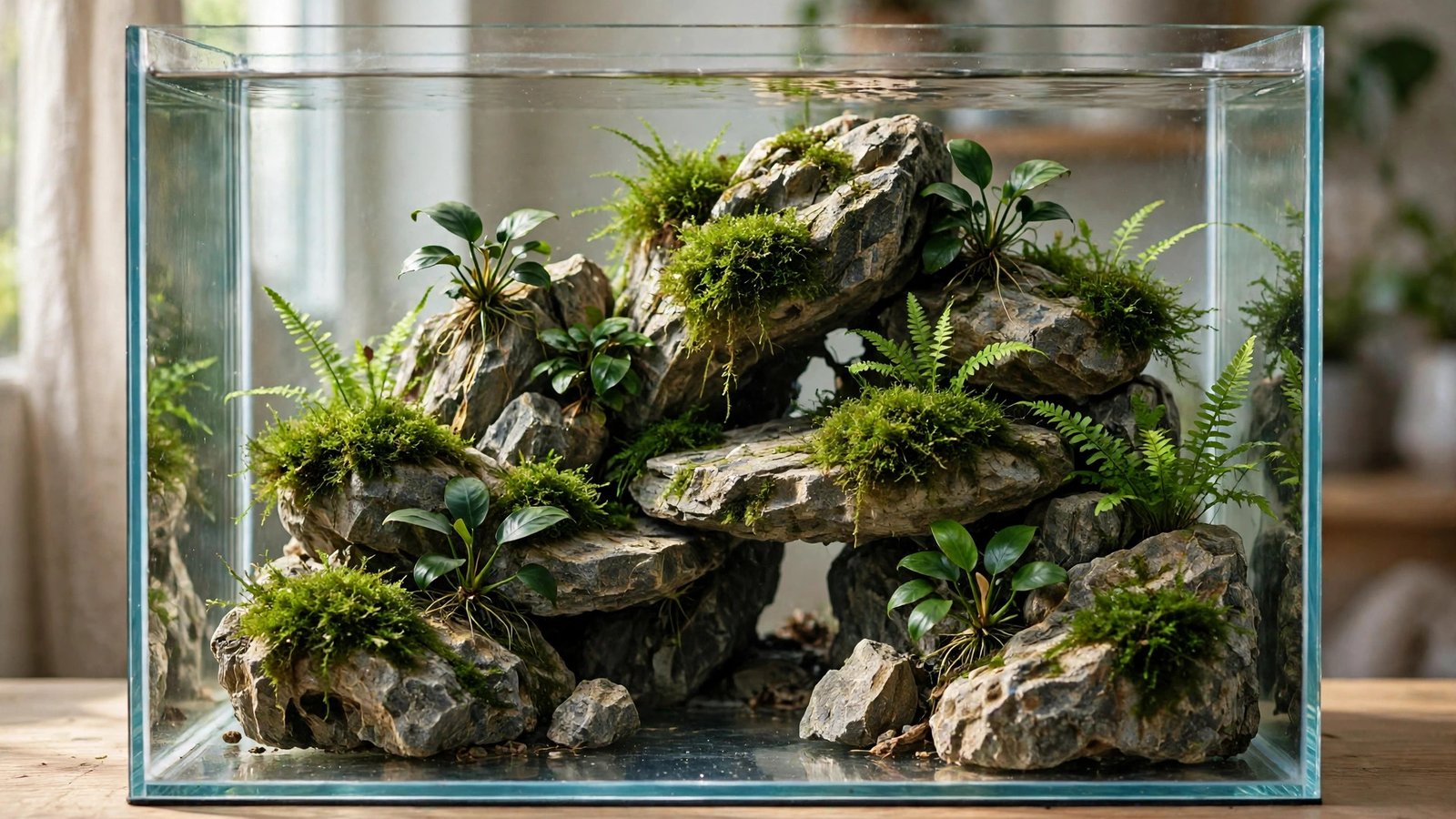
A rock only aquascape flips the standard planted-tank formula on its head: instead of nutrient-rich aquasoil feeding rooted plants, the hardscape itself becomes the garden. In this style of aquascape without substrate planting, epiphyte plants like anubias, bucephalandra, and java fern are glued or tied directly onto stone, mosses soften every edge, and floating plants fill the canopy. Yes, you can skip aquasoil entirely — provided you understand what you're giving up and build around it. This guide covers rock selection, soil-free planting, epiphyte nutrition, and algae control in low-tech setups.
Who a Rock-Only Build Is For (and Who Should Skip It)
The rock-only approach shines for beginners on a budget, for minimalist scapers drawn to Iwagumi-style aesthetics, and for anyone who has fought aquasoil's quirks — ammonia spikes during cycling, the yearly rescaping-and-replacing cost, and the way active soils buffer pH whether you want it or not. A rock-only tank starts cycling cleaner, costs less up front, and stays visually stable for years because there's nothing to exhaust.
It's a poor fit, though, if your dream tank is a lush carpeted aquascape or a dense stem-plant jungle. Heavy root feeders — cryptocorynes, sword plants, vallisneria, and most carpeting species — simply will not thrive glued to a rock. If you picture a Monte Carlo meadow, you need a soil-based system instead. Go in with clear eyes: a rock-only aquascape trades planting diversity for simplicity, longevity, and cost.
Rock-Only vs Aquasoil Builds: An Honest Comparison
| Factor | Rock-Only Aquascape | Aquasoil Build |
|---|---|---|
| Upfront substrate cost | Low — inert sand or gravel only | High — branded aquasoil is the priciest part of many builds |
| Plant palette | Epiphytes, mosses, floaters; no heavy root feeders | Everything, including carpets and heavy root feeders |
| Nutrient source | Liquid fertilizer + root tabs in rock crevices | Aquasoil reservoir + water-column dosing |
| Startup cycling | Faster — no ammonia leach from soil | Slower — ammonia leach needs several weeks of water changes |
| Rescape flexibility | Excellent — move rocks freely without disturbing soil layers | Risky — disturbing aquasoil releases ammonia and clouds water |
| Longevity | Years — rock never exhausts | 12–18 months before nutrients deplete and rescaping is needed |
| Algae risk (low-tech) | Lower — fewer nutrients sitting in the system | Higher — rich soil + any imbalance fuels algae quickly |
| Aesthetic ceiling | Exceptional for hardscape-forward styles | Exceptional for planted jungles and carpets |
Choosing the Right Rocks
Rock is not just decoration here — it's your entire planting medium. Pore structure, color, and chemistry all matter more than they would in a soil-based tank where plants have other options.
Best rock types for epiphyte planting
Seiryu stone is the classic choice: its blue-grey layered texture and countless crevices give rhizomes perfect gripping points, and the deep fissures are ideal for wedging moss. Our seiryu stone guide covers sourcing and scaping techniques in detail. Dragon stone (ohko) is the other staple — its pitted, holey surface practically invites anubias rhizomes and bucephalandra to anchor themselves, and it's light enough to build dramatic overhangs. See the dragon stone guide for composition ideas.
Frodo stone (similar to dragon stone) and lava rock are excellent budget alternatives. Lava rock is especially underrated for rock-only builds: it's cheap, wildly porous, and epiphyte roots grip it like velcro. Its rough black texture suits darker, moody scapes. For a full rundown of options beyond these staples, browse the best rocks for aquascaping roundup.
Watch the pH: not all rocks are inert
This is the one chemistry question you can't skip. Seiryu stone and several limestone-type rocks leach carbonates that raise pH and hardness — in a soil tank the aquasoil buffers against this, but a rock-only build has no such buffer. Test suspicious stones with the vinegar or acid-drop test, and read do aquarium rocks raise pH for exactly which rocks shift your water. If you keep soft-water fish, stick to inert stones like dragon stone, lava rock, and frodo.
How much rock to buy
Plan for the golden-ratio layout: one large "hero" stone (about two-thirds the tank's height), several medium supporting stones, and a handful of small detail stones. Roughly 1–1.5 kg of rock per 10 liters of tank volume works for a hardscape-forward scape. Lay the arrangement on a table first, photograph it, live with it for a day, then commit.
The Base: Inert Substrate Options
"No aquasoil" doesn't mean "no substrate at all." A bare glass bottom works in theory, but a thin layer of inert material anchors the rocks, hides the silicone seams, and gives the scape a finished look. The key word is inert — nothing that releases nutrients or alters chemistry.
- Coarse sand (1–2 mm grain): the most popular choice. Natural river sand or pool-filter sand in a 2–4 cm layer looks organic and locks stones in place.
- Fine gravel (2–4 mm): a good pick if you keep bottom-dwelling fish like corydoras, who appreciate larger grains; it also traps less debris than very fine sand.
- Sand cap over a thin nutrient base: a compromise some scapers use — a shallow pocket of root tabs or a thin layer of nutrient-rich material buried deep under sand, feeding any plants that do touch down. Purely optional; most rock-only builds skip it entirely.
Wash whatever you choose thoroughly before adding it. For the full breakdown of safe options, see the inert substrates complete guide.
Building the Hardscape
Place your largest stone first, following the rule of thirds — offset it from center so the composition has direction. Angle the hero stone slightly, as if emerging from the substrate rather than sitting on it; a stone tilted 10–20 degrees looks natural, while a perfectly vertical one reads as artificial. Build supporting stones around it in descending size, all leaning the same general direction to create flow.
Stability matters more here than in soil tanks because plants won't grow root mats to lock things down. Wiggle every stone: if it rocks, dig its base deeper or shim it with a small flat stone. Leave generous negative space — your plants will only fill in slowly, and a crowded hardscape at day one becomes an unreadable mess by month six.
Planting Without Soil: The Epiphyte Method
Epiphytes draw their nutrition from the water column, not from roots in soil — which makes them the perfect (and only) rooted plants for a rock-only build. The holy trinity is anubias (slow, tough, bulletproof), bucephalandra (slow, spectacular colors and leaf shapes), and java fern (fast by comparison, excellent filler). All three grow from a rhizome — a thick horizontal stem that must never be buried, which is precisely why they thrive tied to rock.
Attaching plants to rock: glue vs thread
- Cyanoacrylate super glue (gel): the fastest method. Dab a small amount of gel on dry rock, press the rhizome or a few root strands against it for 10 seconds, and it bonds. Use plain cyanoacrylate gel with no additives — it's aquarium-safe once cured, which takes seconds. Work quickly and keep glue off the leaves.
- Cotton thread or fishing line: the gentler, traditional method. Wrap thread around the rhizome and the rock a few times and tie it off. Cotton thread dissolves in a few weeks, by which time the plant's own roots have gripped the stone.
- Wedge into crevices: for pitted stones like dragon stone and lava rock, you can often just press the rhizome into a natural crack. The roots will anchor within a month.
Place larger anubias low and toward the front of stones, bucephalandra in mid-level crevices where their colors catch the light, and java fern toward the back where its height adds depth. Keep rhizomes exposed to the water — burying them invites rot.
Mosses: the mortar of a rock-only scape
Moss fills the gaps that stone and epiphytes leave behind. Java moss is nearly indestructible and softens edges beautifully; Christmas moss grows in neat triangular fronds that look deliberate and architectural; flame moss spirals upward on vertical stone faces. Tie small tufts with thread or dab them with glue, spacing them 2–3 cm apart so they grow into a continuous mat. Trim regularly — left alone, moss becomes a stringy, detritus-trapping mess.
Floating plants complete the canopy
Floaters are the unsung heroes of low-tech rock-only tanks. Salvinia, frogbit, and red root floaters drink nitrates from the water column and shade the rocks, suppressing algae. Corral them with a ring of airline tubing so they don't smother the whole surface — aim for about one-third coverage, leaving open water for light penetration and gas exchange.
Cyanoacrylate gel is the standard way to anchor rhizomes to rock: Seachem Flourish Glue.
Feeding Epiphytes: Nutrition Without Soil
With no nutrient reservoir in the substrate, everything your plants eat must come from the water column — which means a disciplined fertilizer routine is non-negotiable, not optional.
Liquid fertilizer routine
Dose a complete all-in-one liquid fertilizer at the manufacturer's low-tech rate, typically once or twice a week after a water change. Epiphytes are slow growers with modest appetites, so resist the urge to overdose — excess nutrients with no fast-growing plants to consume them is the classic recipe for algae. Watch new growth, not old leaves: pale or stunted new leaves signal a deficiency to correct; old leaves won't recover no matter what you dose.
Root tabs in rock crevices
Here's a trick specific to rock-only builds: push root tabs into deep stone crevices near dense plant clusters. The tab dissolves slowly, creating a localized nutrient pocket that epiphyte roots growing into the crack can exploit. This is especially effective under a large anubias cluster or behind a bucephalandra colony. Replace tabs every 2–3 months. It's a small hack, but it meaningfully boosts growth in the exact spots where you want it.
CO2: helpful, not required
Most rock-only builds run low-tech without injected CO2, and the slow-growing plant palette does fine that way. CO2 accelerates moss coverage and bucephalandra color — but it also accelerates algae if light and nutrients aren't balanced. Master the low-tech balance first; add CO2 later if growth feels too slow.
With no soil to draw from, the water column must carry everything: a comprehensive liquid fertilizer like Seachem Flourish.
Algae Prevention in Low-Tech Rock-Only Tanks
Rock-only tanks have a natural algae advantage — fewer dissolved nutrients means less fuel — but bare stone under bright light is an open invitation to green spot algae and hair algae. Prevention is a system, not a product:
- Moderate light, limited duration: 6–8 hours daily is the sweet spot for low-tech epiphyte tanks. Start at 6 hours during the first month and extend only if plants are clearly thriving and algae-free.
- Shade with floaters: that one-third surface coverage acts as a living dimmer switch over your brightest stones.
- Weekly 25–30% water changes: especially in the first two months, while the tank finds its balance. This is also when you dose fertilizer.
- Stock algae eaters early: a small crew of nerite snails, amano shrimp, or otocinclus (once the tank is cycled) grazes the rock surfaces continuously.
- Never let detritus settle: gently siphon debris off the sand during water changes. In a soil tank, detritus feeds the substrate; here it just feeds algae.
If green spot algae appears on the glass or hero stones, it's usually a sign of too much light relative to phosphate — reduce the photoperiod by an hour before reaching for any treatment.
Maintenance Rhythm
One of the great pleasures of a rock-only aquascape is how little it demands once established. Weekly, do a 25–30% water change, dose fertilizer, and wipe the glass — about fifteen minutes. Monthly, trim moss and java fern, thin floaters back to one-third coverage, and check that no rhizome has worked loose. Every few months, replace crevice root tabs. Expect the tank to look its best between months three and twelve, once moss has fused into continuous mats and bucephalandra has settled into its final colors.
Frequently Asked Questions
Can aquarium plants really grow without any substrate?
Yes — but only epiphytes, mosses, and floating plants. These species evolved to grow on rocks and driftwood in nature, absorbing nutrients from the water column through their leaves and rhizomes. Anubias, bucephalandra, java fern, and most mosses will thrive glued or tied to stone with zero soil. What won't work is planting heavy root feeders like cryptocorynes or sword plants without substrate — they need a nutrient-rich root zone and will slowly starve on bare rock.
Do I need fertilizer if I have no aquasoil?
Absolutely — arguably more consistently than in a soil tank. Aquasoil acts as a nutrient battery that covers early mistakes; a rock-only build has no buffer, so a weekly all-in-one liquid fertilizer is mandatory from day one. Root tabs pushed into rock crevices supplement this nicely for dense plant clusters. The doses stay modest because epiphytes grow slowly, but skipping fertilizer entirely will stall growth and invite algae within weeks.
Will seiryu stone raise my pH too much for a rock-only tank?
It can, and in a rock-only build there's no aquasoil buffering to counteract it. Seiryu stone leaches carbonates that raise pH and hardness, which suits hard-water fish but can stress soft-water species. Test your stone first and monitor pH weekly for the first month. If you need stable soft water, build with inert stones like dragon stone, frodo stone, or lava rock instead.
How do I keep algae off the rocks in a low-tech setup?
Keep light moderate (6–8 hours daily), shade the hardscape with floating plants covering about a third of the surface, do weekly 25–30% water changes, and stock algae eaters like nerite snails and amano shrimp early. Bare stone under strong light is the highest-risk surface in the tank, so balance light against your slow-growing plants' actual needs — when in doubt, run less light rather than more.
Can I add fish to a rock-only aquascape?
Yes — fish are excellent for these tanks because their waste provides a gentle, continuous nutrient source for epiphytes. Choose species that suit your water chemistry and won't uproot or eat your plants; small tetras, rasboras, and dwarf shrimp are classic companions. Cycle the tank fully before stocking, just as with any setup, and stock gradually so the young biofilter isn't overwhelmed.
How long does a rock-only aquascape last before it needs redoing?
Far longer than a soil-based tank. Aquasoil exhausts its nutrients in 12–18 months and eventually breaks down physically, forcing a rescape. Rock never exhausts — a well-built rock-only aquascape can run for years with nothing more than trimming, water changes, and occasional root-tab replacement. Many scapers find their rock-only tanks look better in year two than in month two.
The Bottom Line on Building a Rock-Only Aquascape
A rock-only aquascape is the honest answer to "can I skip aquasoil?": yes, if you build around epiphytes, feed the water column, choose rocks with pH in mind, and accept a smaller — but beautiful — plant palette. You trade the lush jungle for a sculptural, low-maintenance tank that costs less, cycles faster, and stays gorgeous for years.