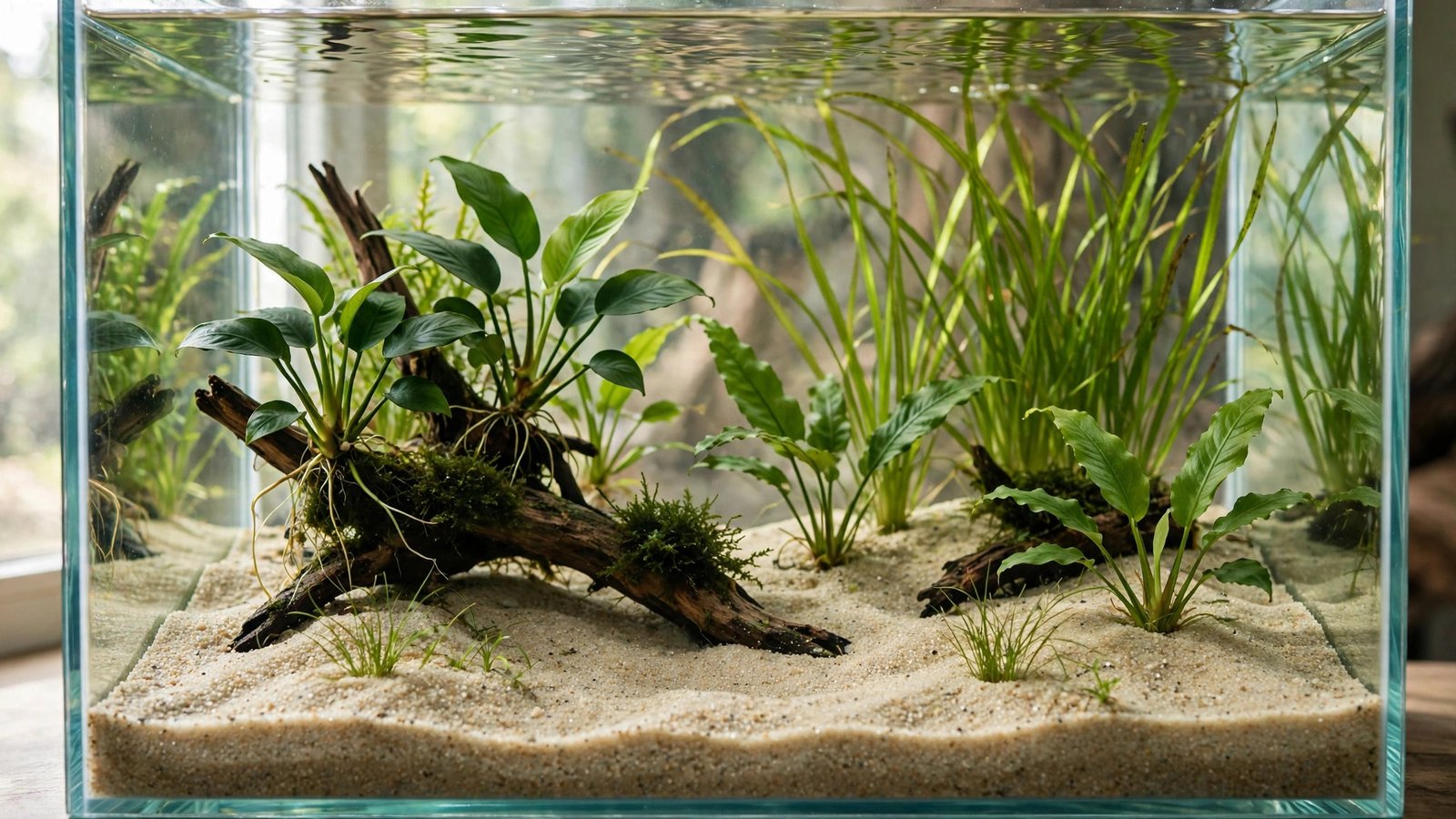
If there's one substrate the experienced hobby quietly agrees on, it's pool filter sand: a 50-lb bag for the price of a pizza, uniform grains that plant beautifully, pre-washed clean, and completely inert. It's the default recommendation for budget planted tanks, corydoras colonies, and anyone who wants a natural look without a premium price. This guide covers how to buy it, prepare it, plant in it, and get the most out of the cheapest good substrate in the hobby.
What Pool Filter Sand Is (and Why It's Perfect)
Pool filter sand is graded silica sand manufactured for swimming pool filters — typically 20-grade, ~0.45–0.55 mm uniform grains. The pool industry needs sand that filters consistently without channeling, which means the grains are unusually uniform in size and pre-washed. Those same properties make it an excellent aquarium substrate:
- Uniform grains — no powder-fine dust fraction to cause compaction, unlike play sand.
- Pre-washed — far cleaner out of the bag than any other bulk sand (though you still rinse).
- Chemically inert silica — no effect on pH, KH, or GH. What your tap makes is what you get.
- Smooth, rounded grains — gentle on corydoras barbels, loach bellies, and stingray discs.
- Natural tan/cream color — looks like a riverbed, brightens the tank, and shows off dark fish beautifully.
Buy it at pool supply stores, hardware stores, or home centers — a 50-lb bag typically costs less than a single small bag of branded aquarium sand. Any brand is fine; it's a commodity. Avoid "filter sand" blends with added clarifiers or antimicrobial treatments (rare, but check the label — you want 100% silica sand).
Preparation: The 10-Minute Rinse
Pool filter sand is the cleanest bulk substrate you'll buy, but rinse it anyway. Work in 5–10 lb batches in a bucket: fill with water, churn with your hand, pour off the cloudy water, repeat 3–5 times until the runoff is nearly clear. Compared to the 10+ rinses blasting sand needs, this is quick.
One thing not to do: don't boil it, don't bleach it, don't bake it. It's clean mineral sand — a rinse is all it needs. Chemical treatments add risk for zero benefit.
Planting in Pool Filter Sand
Pool filter sand is genuinely pleasant to plant in: stems push in with light pressure, and the uniform grains settle back around the stem base and grip it. Technique notes:
- Use planting tweezers for stems and carpets — push the plant in at a slight angle, then release and let the sand collapse around it. Straight-down planting in any sand tends to pop back out.
- It's inert — this is the big one. Sand feeds plants nothing. Heavy root feeders (swords, crypts, vallisneria) need root tabs in a grid from day one; stem plants and epiphytes need liquid fertilizer in the water column. Follow our inert substrate feeding system and your sand tank will grow indistinguishably from an aquasoil tank.
- Carpets love it. Dwarf hairgrass, Monte Carlo, and Marsilea spread readily through uniform sand — arguably easier than through coarse gravel. HC Cuba works too with CO2.
- Depth: 2–3 inches (deeper in back for heavy root feeders). Uniform grains resist compaction well, but don't exceed 3 inches in the front — see our depth guide.
The Compaction Question
"Does sand compact and kill roots?" — the hobby's perennial sand anxiety. The honest answer: uniform pool filter sand compacts far less than people fear. The horror stories come from play sand (wide grain-size distribution — fines fill every gap) or very deep beds. With 20-grade uniform sand at sensible depth:
- Water circulates adequately through the bed for root health.
- Malaysian trumpet snails — the hobby's classic solution — burrow through the top inch nightly, gently turning it. A colony of MTS is the best insurance for any sand bed and they're beneficial in every way.
- Plant roots themselves keep the bed open — a densely planted sand bed is a healthy sand bed. It's the bare, plant-free expanses that compact.
- If you're still nervous, a 0.5-inch base layer of coarse gravel under the sand improves drainage (though most keepers find this unnecessary).
Maintenance: Vacuuming Sand
You can't jam a siphon into sand the way you can with gravel — you'll suck up the bed. Instead, hover the siphon 0.5–1 inch above the sand surface and let the suction lift detritus off while the heavier sand grains fall back. It takes a slightly slower hand than gravel vacuuming, but it's effective, and the light color makes detritus easy to spot.
Stir the top half-inch gently with your fingers monthly in unplanted areas to prevent any surface crusting. In planted zones, leave the roots alone — they're doing the work. Full routine in our substrate cleaning guide.
Pool Filter Sand vs The Alternatives
| Substrate | Cost | Cleanliness | Bottom-dweller safety | Compaction risk |
|---|---|---|---|---|
| Pool filter sand | Very cheap | Excellent | Excellent | Low |
| Play sand | Cheapest | Poor (very dusty) | Good | High |
| Black blasting sand | Very cheap | Poor (needs heavy rinsing) | Good | Low |
| Branded aquarium sand | Expensive | Excellent | Excellent | Low |
Play sand is the only real competitor on price, and it's a false economy: the dust requires endless rinsing, the fines compact badly, and you end up fighting the substrate for the life of the tank. Pool filter sand costs only slightly more and eliminates every one of play sand's problems. For the dark-substrate look instead, see our black blasting sand guide; for the whole field, our best sand roundup.
What Pool Filter Sand Can't Do
Honesty requires the limits:
- No nutrients, no buffering. If you want soft acidic water for caridina shrimp, sand won't make it — you need a buffering substrate or RO water.
- Shows everything. The light color that looks so natural also shows every speck of detritus and every strand of algae. You'll vacuum more visibly-often than on black substrate (though the actual waste load is identical).
- Poor slope holder. Rounded uniform grains avalanche on steep slopes. For dramatic hills, use terraces and retaining walls, or choose a more angular substrate.
- Can look "flat" in photos. Uniform tan sand is honest but plain — aquascapers often mix in a darker gravel or add river rocks for visual texture.
A reliable pick here is Seachem Flourish Tabs.
Where to Buy and What to Avoid
Pool filter sand is a commodity — but not every bag labeled "sand" at the hardware store is the right product:
- Right: bags labeled "pool filter sand," typically 20-grade silica, from pool supply stores, Home Depot/Lowe's, or hardware stores. Brands (HTH, AquaQuartz, ZeoSand alternatives) don't matter much — it's graded silica.
- Wrong: play sand (too fine, too dusty), paver sand (often contains additives), "all-purpose sand" (ungraded, variable), sandblasting sand other than the specific coal-slag product (wrong grades are sharp), and anything with added clarifiers, antimicrobials, or fragrances.
- The label test: you want "100% silica sand" or "quartz sand" with a grade number (20-grade / 0.45–0.55 mm). If the bag won't tell you what it is, don't put it in your tank.
- Price anchor: a 50-lb bag should cost roughly what you'd pay for a large pizza. If someone's charging aquarium-substrate prices for pool filter sand, walk away — the whole point is the value.
 ★4.5
U.S. Silica Mystic White II Pool Filter Sand
Check Price on Amazon ★4.5Aquascaping With Light Sand
Light sand photographs differently than dark substrate — plan for it:
- It brightens everything. Light sand reflects light up into the tank, which makes the whole scape feel airy and makes fish colors glow. It's the classic choice for bright, natural riverbed and biotope styles.
- Contrast is your friend. Pair light sand with dark driftwood and rocks — the dark hardscape anchors the composition the way dark substrate would. An all-pale tank (light sand + light rocks) washes out.
- Path and beach effects. Aquascapers often use pool filter sand as "sand paths" or foreground beaches against darker planted areas — its natural color reads as a riverbank. Our nano hardscape guide shows small-scale applications.
- Photography tip: light sand blows out under strong tank lighting in photos — dial exposure down slightly or shoot at an angle to keep texture.
Frequently Asked Questions
Will pool filter sand affect my pH?
No. It's pure silica — completely inert. It won't lower pH like aquasoil or raise it like limestone. Your water parameters are determined entirely by your source water, which makes sand the predictable, no-surprises choice.
Can I grow demanding plants like carpeting species in pool filter sand?
Yes. Carpeting plants care about light, CO2, and nutrients — not about the substrate's brand. Dwarf hairgrass and Monte Carlo carpet readily in pool filter sand with CO2 injection, root tabs beneath, and liquid fertilizer above. The substrate is just the anchor; you're the nutrition.
How deep should pool filter sand be?
2–3 inches across most of the tank, sloping to 3–4 inches in back where heavy root feeders live. Under 2 inches, large swords and crypts can't anchor properly; over 3–4 inches in front, you invite compaction for no benefit.
Do I need a gravel base layer under the sand?
No. It's an optional refinement some keepers use for drainage, but uniform pool filter sand at sensible depth with MTS snails and plant roots does fine on its own. Skip the extra complexity unless you're running an unusually deep bed.
My sand turned brown/green on top. What is it?
Diatoms (brown, common in new tanks, fades in weeks) or film algae (green, indicates excess light/nutrients relative to plant uptake). It's growing on the sand, not from it — the sand is innocent. Reduce photoperiod, ensure plants are growing well, and siphon the surface. Otocinclus and nerite snails graze it happily.
The Bottom Line
Pool filter sand is the rare product that's both the cheapest option and one of the best: clean, safe, plantable, and permanent. Its only real demand is that you feed your plants yourself — root tabs below, liquid fertilizer above — instead of outsourcing nutrition to the substrate. Accept that deal, and a $15 bag of sand will underpin a planted tank every bit as lush as tanks running substrates costing twenty times more.