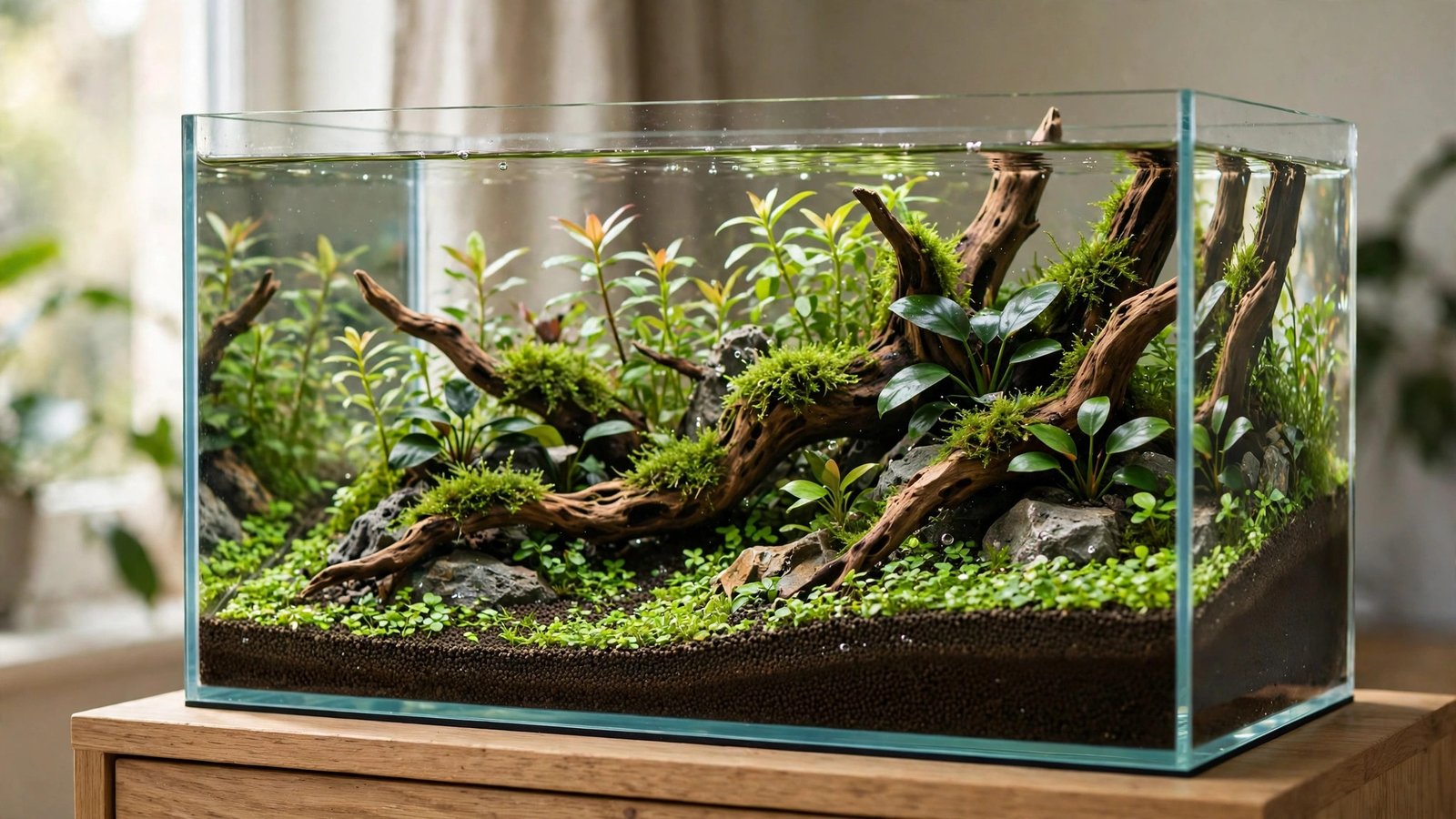
You can spend $60 on a bag of aquarium soil and still end up with melting plants, cloudy water, and ammonia readings that make you afraid to add fish. A controsoil planted tank sidesteps the worst of those headaches: UNS built Controsoil around volcanic ash with deliberately low nutrients, so you get the buffering and root-feeding benefits of an active soil without the 4–8 ppm ammonia storm that richer soils unleash.
What UNS Controsoil Actually Is
Controsoil is a baked blend of natural soil and volcanic ash from Japan, formed into hard, porous granules. The pores let water and oxygen move through the bed instead of stagnating, and the granules absorb impurities from the moment you fill the tank. Compared to peat-heavy aquasoils, Controsoil is lean — UNS keeps the built-in nutrient load low to avoid the infamous ammonia spike that forces daily water changes for weeks.
Lean doesn't mean no plant food. Controsoil still supplies iron, trace minerals, and humic substances, and its porous granules host the beneficial bacteria that convert waste into plant-available nitrogen. With demanding stems under strong light and CO2, you'll supplement with liquid fertilizer — the soil handles roots and water chemistry; you handle the water column.
Granule size matters more than most people expect:
| Granule size | Diameter | Best for |
|---|---|---|
| Normal | ~5 mm | 20+ gal tanks; thick-rooted plants |
| Fine | ~3 mm | Tanks under 20 gal; foreground plants |
| Extra Fine | ~1 mm | Nano tanks, top-offs, tiny carpets like HC |
The best approach for most scapes is a combo: Normal on the bottom for depth and drainage, with a 1-inch cap of Fine or Extra Fine where the carpet goes. Tiny carpets anchor far better in fine granules and you'll lose fewer stems on fill day. Black makes plants and fish pop; brown looks like a natural riverbed next to driftwood.
How Controsoil Buffers pH and KH
Controsoil is an active substrate — it chemically changes your water instead of just sitting there. The baked granules slowly release humic and fulvic acids, which neutralize carbonate hardness (KH) and pull pH down into the slightly acidic range. Most tanks land around pH 6.5–6.8 with KH near 0–1 dKH, even with tap water at pH 7.6 and 5 dKH.
That matters twice over. Many aquatic plants — Rotala, Ludwigia, most Cryptocoryne — absorb iron and trace nutrients more efficiently in slightly acidic water. And soft, acidic conditions are what Caridina shrimp (Crystal Reds, Taiwan Bees, Blue Bolts) need to molt and breed; they don't thrive in hard, alkaline water. That's why Controsoil ranks among the best substrates for shrimp tanks rather than as a generic fish-tank filler.
Buffering isn't permanent. Every water change with hard tap water spends some of the soil's capacity. With soft or RO water, a bed lasts 24–36 months; with hard tap water (KH 6–8) and 50% weekly changes, expect 12–18 months. When tank pH creeps back to tap-water levels between changes, the soil is exhausted.
How Much Controsoil You Need
The rule that works: ~1 inch at the front, 2–3 inches in the middle, 3–4 inches at the back where big stems and swords go. Deep-rooted plants need at least 3 inches, and the front-to-back slope creates forced perspective that makes a scape look deeper.
To calculate bags, use the standard soil formula: tank length × width × desired average depth (in inches) ÷ 60 = liters needed. The table assumes 2.5 inches average (1-inch front / 4-inch back slope):
| Tank | Footprint (in) | Soil needed | Bags to buy |
|---|---|---|---|
| 10 gallon | 20 × 10 | ~8 L | 3 × 3 L |
| 20 gallon long | 30 × 12 | ~15 L | 2 × 10 L |
| 40 gallon breeder | 36 × 18 | ~27 L | 3 × 10 L |
| 75 gallon | 48 × 18 | ~36 L | 4 × 10 L |
Always round up — running short mid-scape means a thin bed or a delayed second order, and leftover soil keeps indefinitely for top-offs. The 10-liter bag is far cheaper per liter (~$7/L vs ~$10/L for the 3 L bag), so for anything 20 gallons or larger, the big bag wins. Our guide to how much substrate a planted tank needs covers the depth-by-plant breakdown in more detail.
How to Set Up a Controsoil Planted Tank
- Do not rinse it. Rinsing crushes granules, strips the buffering compounds, and turns the bag into mud. Controsoil is sold ready to use.
- Dry-scape the slope first. Pour Normal granules straight from the bag, building the slope before any water goes in. Place mesh-bagged base layers or root tabs underneath now, not after.
- Add the fine topcoat. Spread ~1 inch of Fine or Extra Fine over areas where carpets and small foreground stems will go.
- Plant before you fill. Tweezers at 45 degrees, stems deep enough they can't float free.
- Fill slowly. Lay a plastic bag or plate over the substrate and pour onto it — never directly onto the soil. A disturbed bed can take days to clear.
- Filter from minute one. Start the filter as soon as the tank is full.
On capping: Controsoil doesn't need a sand or gravel cap, and usually shouldn't get one. Baked granules hold their own structure; a cap just slows the flow the granules encourage. The exception is a visible sand foreground for corydoras — see capping aquarium soil with sand and use a divider to keep the sand from migrating into the bed.
The First Month: Ammonia, Water Changes, and Cycling
Every baked aquasoil releases some ammonia when first wetted. Controsoil's release is mild — typically under 1 ppm, often 0.25–0.5 ppm — versus 4–8 ppm for richer soils. The cycle still has to establish, but you're not fighting a toxic soup.
Test ammonia and nitrite every other day for the first two weeks. Expect ammonia for 7–14 days, a nitrite spike around week 2–3, then both at zero by week 3–4 in most tanks. Same process as our aquasoil ammonia leach guide, with numbers tuned for Controsoil:
| Timeframe | Water changes | What's happening |
|---|---|---|
| Days 1–7 | 50% every other day (daily if ammonia >1 ppm) | Initial ammonia release; slight cloudiness for 24–48 hours |
| Days 8–14 | 50% twice a week | Ammonia falling; nitrite rising |
| Days 15–21 | 30–40% twice a week | Nitrite peak; bacteria maturing |
| Days 22–28 | 30% once a week | Ammonia and nitrite at zero; switch to normal maintenance |
Wait for zero ammonia and zero nitrite for three consecutive days before adding shrimp or sensitive fish. Established filter media can cut a week off the timeline, and heavy fast-growing plants can absorb the mild leach directly in a silent cycle. But "add livestock in 24 hours" is marketing optimism — a test kit costs less than a colony of Crystal Red shrimp, and the test kit never lies.
How Long Controsoil Lasts and the Signs It's Done
Plan on 18–36 months. Two things run out: the buffering capacity and the granule structure (breakdown from bacteria, roots, and re-scaping). Watch for:
- pH climbs back to tap-water levels between changes — the classic exhaustion signal.
- KH rises above 2–3 dKH in a tank that used to hold near zero.
- Granules crumble into mud when pinched.
- Root feeders stall — swords and crypts especially — despite unchanged light, CO2, and fertilization.
- Substrate algae that won't respond to normal maintenance.
When it's done, full replacement is cleanest (drain, scoop, restart — hold livestock in a bucket). A 1-inch top-off of new granules buys 6–12 months with zero disturbance. Either way, don't mix fresh Controsoil with inert gravel to "stretch" it — you dilute the buffering and get the worst of both worlds. A proper aquasoil refresh with a top-off and renewed root tabs can extend a bed without a teardown.
Controsoil vs ADA Amazonia vs Fluval Stratum
All are good — they solve different problems:
| UNS Controsoil | ADA Amazonia (v2) | Fluval Stratum | |
|---|---|---|---|
| Buffers to | pH ~6.5–6.8, KH 0–1 dKH | pH ~6.2–6.5, KH 0 dKH (strongest) | pH ~6.6–7.0, KH 1–2 dKH (weakest) |
| Ammonia leach | Low (<1 ppm, ~2 weeks) | High (2–8 ppm, 3–6 weeks of daily changes) | Minimal (often near zero) |
| Built-in nutrients | Moderate | Very rich | Low |
| Granule size | Normal ~5 mm / Fine ~3 mm / Extra Fine ~1 mm | Normal ~3–4 mm / Powder ~1–2 mm | ~2–4 mm, very light granules |
| Typical price per liter | ~$7–10 | ~$7–12 | ~$8–9 |
| Effective lifespan | 18–36 months | 24–36 months | 12–18 months (breaks down fastest) |
| Best for | Beginners–intermediates; shrimp + planted combos; easy cycling | Experienced aquascapers; contest-grade tanks | Low-tech and nano tanks; shrimp-only setups |
The short version: Amazonia grows plants fastest but punishes you with a brutal startup. Stratum is the gentlest startup but exhausts quickest, and its ultra-light granules shift when you replant. Controsoil sits in the middle — easy cycling, real buffering for shrimp, long usable life. For more on the other two, see our Fluval Stratum vs ADA Amazonia comparison and the best aquasoil for planted tanks roundup.
Best Plants and Shrimp to Pair With Controsoil
Controsoil shines with soft-water species built for the conditions it creates. For shrimp, it's Caridina territory: Crystal Reds and Blacks, Taiwan Bee variants, and Blue Bolts breed far more reliably at pH ~6.5 and near-zero KH. Neocaridina (Cherry shrimp) do fine too, though they're happy in plain gravel.
Root feeders show the biggest plant response: Amazon swords, Cryptocoryne wendtii and C. parva, dwarf sagittaria, and tiger lotus all explode in a fresh bed. Foreground carpets — dwarf hairgrass, Monte Carlo, dwarf baby tears — root tenaciously in the Fine and Extra Fine grades. Demanding stems like Rotala macrandra and Ludwigia 'Super Red' color up better in the slightly acidic water. Our buffering substrates guide explains the full pH/KH/GH picture for shrimp health.
Mistakes That Ruin an Active Soil Bed
- Gravel-vacuuming the bed. Hover, don't stab. Crushed granules never recover.
- Mixing it with inert gravel or sand to "save money." Inert material contributes nothing to buffering while taking up bed volume.
- Rinsing before use. Every rinse washes buffering compounds down the drain and fractures granules. Open the bag, pour it in.
- Constant re-scaping. Every uproot-and-replant abrades granules and compacts the bed. Plant once, then leave it alone for 3–4 months.
- Using it for hard-water cichlids. African cichlids need pH 7.8–8.6 and high KH — Controsoil will fight your water for a year and lose, exhausting the buffer while stressing the fish.
- Skipping early water changes because "ammonia was only 0.5 ppm."
As the bed matures, cleaning substrate around plants without disturbing roots becomes the key weekly skill — a turkey baster beats a siphon for precision work.
Frequently Asked Questions
Do I need to rinse UNS Controsoil before using it?
No — never rinse it. Controsoil is sold ready to use, and rinsing fractures the baked granules while washing away the humic compounds that do the pH and KH buffering. Expect mild cloudiness for 24–48 hours after the first fill; it clears as the granules absorb impurities.
Can I put shrimp in a Controsoil tank right away?
Wait until ammonia and nitrite read zero for at least three consecutive days — typically 2–3 weeks with Controsoil's mild leach. Some aquarists add hardy livestock within days, but shrimp — especially Caridina — are far too sensitive for that gamble. A test kit costs less than a shrimp colony; cycle first, stock second.
Normal, Fine, or Extra Fine — which granule size should I buy?
Normal (~5 mm) for tanks 20 gallons and larger with big-rooted plants; Fine (~3 mm) for tanks under 20 gallons and foreground plants; Extra Fine (~1 mm) for nano tanks and delicate carpets like dwarf baby tears. The best all-around approach is Normal for the base with a 1-inch cap of Fine or Extra Fine where you'll plant the carpet.
How long does Controsoil buffer pH before it's exhausted?
Expect 18–36 months depending on source water. Soft or RO water with light changes stretches it toward three years; hard tap water (KH 6+) with big weekly changes can spend the buffer in 12–18 months. When tank pH drifts back to tap-water levels between changes, the buffering is done — time for a top-off or replacement.
Is Controsoil better than ADA Amazonia?
Neither is objectively better — they target different keepers. Amazonia grows plants faster with its rich nutrient load, but its 2–8 ppm ammonia leach demands weeks of daily water changes. Controsoil trades some growth power for a calm startup with ammonia under 1 ppm and longer granule life. Choose Amazonia for contest scapes; choose Controsoil for shrimp tanks and saner maintenance.
Can I mix Controsoil with sand or gravel to save money?
Don't. Inert material dilutes the buffering capacity per liter of bed, so you pay for active soil and get inert-substrate performance. It also looks muddy and makes replanting messier. If budget is tight, buy the 10-liter bag (cheapest per liter) and slope the bed — deep in back, thin in front.
Set It Up Once, Enjoy It for Years
A controsoil planted tank rewards the keeper who measures twice and pours once: right grain size for the plants, a proper 1-inch to 4-inch slope, a slow first fill, and a disciplined month of water changes. Do that and you get a bed that buffers soft, acidic water, feeds roots for two to three years, and skips the ammonia nightmare of richer soils. For full specs, see the official UNS Controsoil product page. Now pour the bag — your scape is waiting.