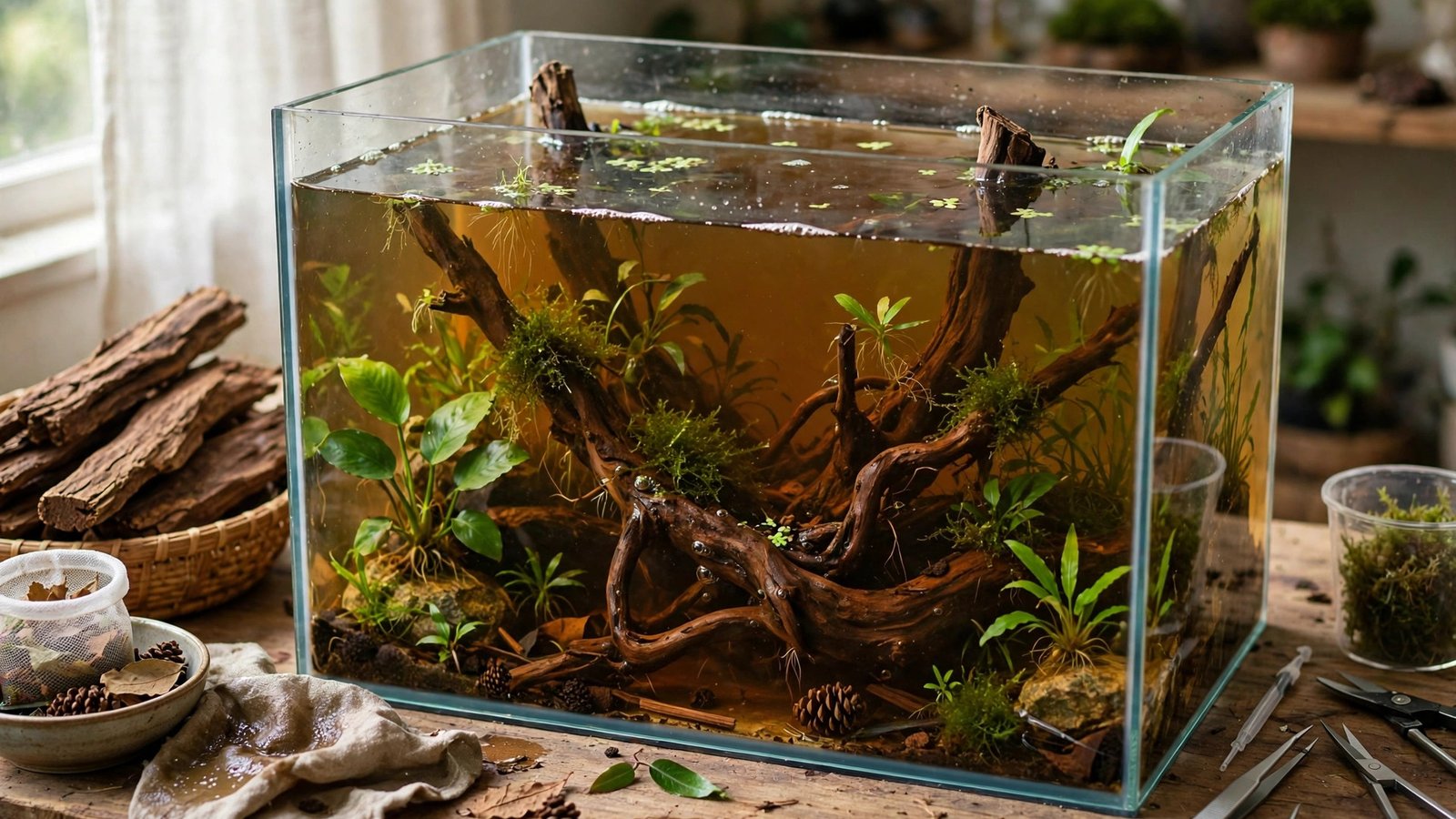
Mopani wood is the driftwood of strong opinions: jaw-droppingly beautiful two-tone grain, sinks like a stone on day one — and leaches enough tannins to turn your tank into dark roast coffee. It's the most dramatic wood in the hobby in every sense, and it rewards keepers who understand its nature. This guide covers Mopani wood's tannins, sinking, preparation, and how to build a stunning tank around it instead of fighting it.
What Mopani Is
Mopani (Colophospermum mopane) is a dense African hardwood with striking two-tone coloration — pale blonde sapwood swirled with dark chocolate-brown heartwood. No other aquarium wood looks like it; the marbled grain is genuinely beautiful and photographs spectacularly. It's extremely dense (hence the instant sinking), very hard, and very long-lived underwater — a Mopani centerpiece can serve for a decade.
The catch, and it's a big one: Mopani is the heaviest tannin leacher among common aquarium woods. A fresh piece can stain a tank dark brown within 48 hours. This isn't a defect — it's the wood's chemistry — but you must plan for it.
Sinking: Mopani's Superpower
Unlike spider wood's infamous floating phase, Mopani sinks immediately. It's one of the densest aquarium woods — you can place it in a filled tank and it stays exactly where you put it. This makes Mopani the easiest wood to aquascape with: no pre-soaking for buoyancy, no anchoring schemes, no month of waiting. Position it, step back, done. For large centerpiece wood in big tanks, this alone makes Mopani worth considering.
Tannins: The Full Story
Mopani's tannin output is legendary. Expect:
- Days 1–7: dramatic darkening — the water can go genuinely coffee-colored. This alarms every first-time Mopani owner. It's normal.
- Weeks 2–8: strong but manageable tinting with regular water changes.
- Months 3–12: gradual fade to a light amber that's actually attractive.
- Year 2+: minimal leaching from most pieces; dense thick pieces may tint faintly longer.
Our tannins guide covers the benefits (antibacterial, stress-reducing, natural blackwater chemistry) and removal methods in depth. The short version for Mopani: boil aggressively before it goes in the tank (see preparation below), run Purigen for the first months if you want clear water, and consider embracing a light amber tint — Mopani's coloration looks right in warm-tinted water.
Preparation: Non-Negotiable Steps
With light-leaching woods you can get away with a rinse. With Mopani, preparation is mandatory. Skipping it means months of dark water.
- Scrub the piece under hot water with a stiff brush — remove loose bark, dirt, and soft spots.
- Boil 2–4 hours total — in batches if the piece is large, changing the water whenever it goes dark brown. You'll be shocked how much color comes out. (If it doesn't fit in any pot, pour boiling water over it repeatedly in a tub.)
- Soak 1–2 weeks in a bucket with daily water changes. When the soak water stays light tea-colored for 48 hours, it's tank-ready.
- Inspect for soft spots — Mopani is sometimes sold with partially rotted sections. Soft, punky areas should be carved out or the piece rejected; they decay underwater and foul the tank.
Even with thorough prep, expect some tinting for months. Preparation converts the flood to a manageable stream — it doesn't eliminate Mopani's nature. Full techniques in our driftwood preparation guide.
Aquascaping With Mopani
Mopani's visual character — bold, marbled, high-contrast — demands a confident scape:
- Let it dominate. Mopani is not a background accent; it's a centerpiece. Build around one strong piece rather than scattering small bits.
- Warm-tinted water suits it. The blonde-and-chocolate grain glows in slightly amber water; in stark clear water it can look harsh. A faint tannin tint (managed, not coffee-dark) is Mopani's best lighting.
- Epiphyte magnet. The rough texture and crevices grip moss, anubias, and bucephalandra beautifully — often without glue. A Mopani root mass planted with epiphytes is a complete scape.
- Contrast with dark substrate. The pale sapwood pops against black sand or dark aquasoil; on light sand the whole composition can wash out.
- Fish pairing: Mopani + tannins + South American fish (tetras, dwarf cichlids, angelfish) is a natural biotope match — the wood comes from Africa, but the water chemistry suits Amazonian species perfectly.
Buy link in the aquascaping section: Mopani driftwood.
Mopani vs Other Woods
| Wood | Sinking | Tannins | Look | Best for |
|---|---|---|---|---|
| Mopani | Immediate | Very heavy | Two-tone marbled | Bold centerpieces, blackwater |
| Spider wood | Floats for weeks | Moderate | Branchy, chaotic | Root tangles, epiphyte hotels |
| Manzanita | Fast | Light | Smooth, sculptural | Bonsai, elegant nature style |
| Malaysian | Immediate | Heavy | Dark, gnarled | Dark dramatic scapes |
See our spider wood vs manzanita comparison and best driftwood roundup for the wider field.
Common Mopani Problems
- "My water is black." Normal for unprepared Mopani in week one. Big water changes + Purigen + patience. Next time, boil first.
- White fungus/biofilm. Mopani gets the standard new-wood biofilm — harmless, grazed by snails/shrimp, gone in weeks.
- Soft/rotting sections. Reject or carve out punky areas before the tank. Good Mopani is rock-hard throughout.
- pH drop. Heavy tannins + soft water can push pH down notably. Test during the first month if your KH is near zero; water changes manage it.
- Stained silicone. Prolonged dark staining can tint silicone amber — cosmetic, and a reason to pre-treat aggressively if pristine seams matter to you.
Mopani in Blackwater and Biotope Setups
If there's a wood that wants to be in a blackwater tank, it's Mopani. Instead of fighting the tannins, design around them:
- Amazon/Orinoco biotope: Mopani + heavy tannin tint + leaf litter + tetras/dwarf cichlids. The wood's African origin is biotope-inaccurate, but visually and chemically it's a convincing Amazon — and no judge swabs the wood for provenance.
- West African biotope: Mopani is actually correct here — it's African wood. Pair with Congo tetras, African butterflyfish, or Pelvicachromis for the rare biotope that's both authentic and stunning.
- Leaf-litter layering: catappa leaves and alder cones on the substrate extend and deepen Mopani's tannin profile while adding foraging habitat for apistos and shrimp. Replace monthly.
- Lighting for blackwater: dim, warm lighting (or floating plants diffusing bright light) completes the effect — tannin water + dappled light is the single most atmospheric combination in the hobby.
Long-Term Mopani Care
Mopani is a decade wood — here's how to keep it at its best:
- Algae on the grain: the pale sapwood shows green spot algae clearly. A soft toothbrush during water changes keeps it clean; nerite snails do the daily maintenance.
- Color evolution: the dramatic two-tone contrast softens over 1–2 years underwater — the blonde mellows toward honey, the dark chocolate toward espresso. It remains beautiful, just less stark. (If you loved the stark contrast, that's the phase to photograph.)
- Checking for soft spots annually: press suspicious areas firmly once a year. Any punky sections get carved out with a knife — Mopani doesn't "heal," but removing decay stops it spreading.
- Never let it dry out and re-submerge repeatedly. Wet/dry cycling accelerates cracking in dense hardwoods. If you break down the tank, keep the wood damp in a bag until the next setup.
Frequently Asked Questions
How long until Mopani stops leaching tannins?
With proper boiling + soaking prep: strong tinting for 1–2 months, light amber for 3–6 months, minimal after a year. Without prep: dark water for 2–4 months, noticeable tinting up to a year. Dense thick pieces leach longer than thin ones. Purigen throughout collapses the visible timeline dramatically.
Is Mopani safe for shrimp and sensitive fish?
Yes — tannins are not toxic; they're beneficial blackwater chemistry. The only caution is the pH effect in very soft water during peak leaching: test pH weekly for the first month if KH reads near zero, and water-change if pH drops below your livestock's comfort zone.
Can I use Mopani in a bright aquascape that needs crystal-clear water?
You can, but it's fighting the wood's nature — you'd need aggressive pre-treatment plus continuous Purigen. For crystal-clear aesthetics, a light leacher like manzanita or spider wood is the saner choice. Buy the wood that matches the vision.
Why does my Mopani have white fuzzy stuff on it?
Standard new-wood biofilm — bacterial/fungal colonization feeding on surface organics. Harmless to fish, ugly for 3–6 weeks, enthusiastically eaten by nerite snails, otos, and shrimp. Scrub it off during water changes if it bothers you; it'll stop coming back once the surface organics are consumed.
Can I cut or shape Mopani?
Yes — it's very hard, so use a saw rather than hand tools, and sand cut edges smooth (fresh cuts leach extra tannins initially and can have sharp splinters). Many scapers trim Mopani to fit their composition; the wood works fine reshaped.
Respect the Wood
Mopani asks for preparation and patience, and pays back with the most visually striking driftwood in the hobby — instant-sinking, decade-durable, beautifully marbled. Boil it, soak it, manage the tannins for a few months (or embrace the blackwater), and you'll have a centerpiece that anchors the tank for years. The keepers who hate Mopani are the ones who skipped prep; the ones who love it did the work upfront.