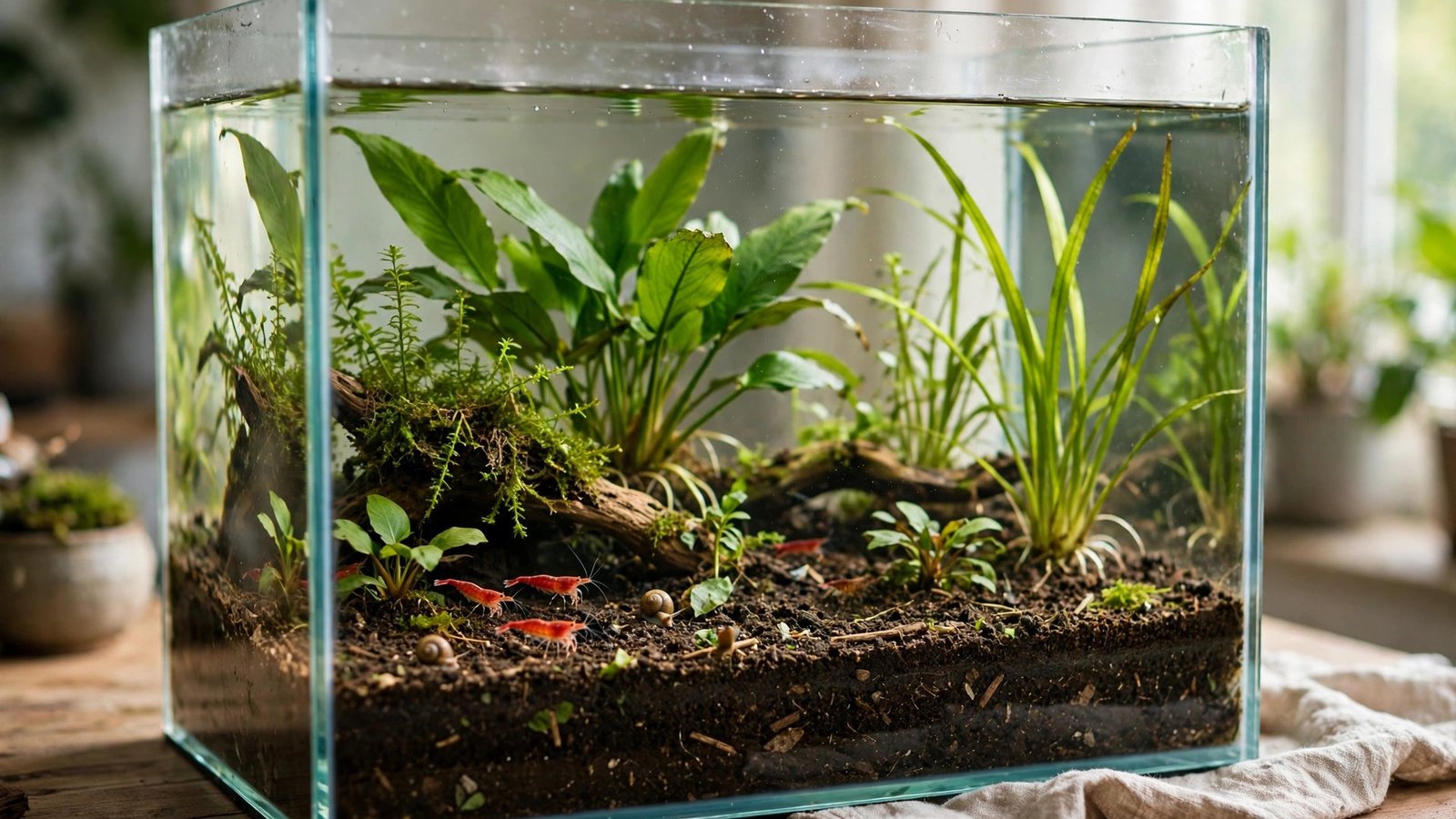
Every spring, somebody fills a planted tank with backyard soil, skips the $80 aquasoil order, and watches their plants explode. Three weeks later, someone else tries the same thing and gets a pea-soup algae bloom, dead shrimp, and an ammonia spike that never ends. Both stories are true — the difference is never luck. So can you use garden soil in an aquarium? Yes, but only if you know exactly what's in your soil and prep it properly. Here are the real risks, the non-negotiable prep rules, and when you're better off buying a purpose-made substrate.
The honest answer: yes, but your soil is a wildcard
Here's the thing most articles gloss over: "garden soil" isn't a product, it's whatever happens to be in your yard or bag. One person's loamy backyard dirt is another person's pesticide-treated lawn laced with timed-release fertilizer pellets. That variance is the entire story. Plain, additive-free soil can outgrow expensive aquasoil — plants love the organic matter and slow nutrient release. Soil dosed with weed killer can poison a tank for months. So the answer isn't yes or no; it's: yes, if you can verify what's in it, and no, if you can't. If you're not sure, compare your options in a planted tank substrate comparison and pick something verifiable instead.
Garden soil, topsoil, potting mix, aquasoil — what's actually different?
These terms get used interchangeably, and that's where most disasters start. Here's how they actually compare in an aquarium context:
| Substrate | Aquarium safety | Nutrients | Prep needed | Cost |
|---|---|---|---|---|
| Bagged garden soil | Risky — often contains fertilizer pellets, manure, or mulch | Very high (and unpredictable) | Mineralize + screen + test | $ |
| Bagged potting mix | Unsafe — perlite, vermiculite, and wetting agents float and leach | Very high | Don't bother — pick something else | $ |
| Plain topsoil (your yard) | Good if additive-free — the safest dirt option | High | Mineralize + screen | Free |
| Aquasoil (e.g. ADA Amazonia, Tropica) | Excellent — made for this exact job | High, consistent | Rinse; expect an initial ammonia cycle | $$$ |
| Inert sand or gravel | Excellent — nothing to leach | None (dose water column instead) | Rinse well | $–$$ |
The pattern: cheaper dirt means more prep, while aquasoil charges you to skip it. For the full dirt-option breakdown, see mineralized soil vs potting mix — and for the zero-risk route, plain inert substrates.
The real risks (and why "it worked for my friend" proves nothing)
Dirt-tank failures almost always trace back to one of four things:
- Timed-release fertilizer pellets. Those little blue, yellow, or white balls in bagged soils drip nitrogen and phosphates underwater for months — faster than plants can consume, which means a guaranteed algae farm.
- Pesticides and herbicides. Soil from a treated lawn or a weed-control mix can contain chemicals lethal to shrimp and sensitive fish, persisting far longer than labels suggest; the University of Minnesota Extension on herbicide carryover notes months of residual activity in soil.
- Ammonia spikes. Even clean soil releases ammonia when first submerged and microbes colonize it. Fish on day one won't survive it — fishless cycling a dirt tank is non-negotiable.
- Anaerobic compaction and gas pockets. Silty soil packed too deep goes anaerobic and builds hydrogen sulfide — rotten-egg gas that can bubble up and stress livestock. A proper cap and correct depth prevent it; see gas pockets in aquarium substrate and correct substrate depth for the numbers.
The prep rules that make garden soil work
If you've got plain, additive-free soil, this is the routine that turns it from a gamble into a reliable planted-tank substrate:
- Screen it. Push the soil through a 1/4-inch garden sieve to remove wood chips, roots, rocks — and any fertilizer pellets hiding in bagged mixes.
- Mineralize it. Soak the screened soil in a shallow tray, let it dry completely, repeat for 2–3 weeks. Wet/dry cycling lets microbes burn off easily-decomposed organics before submersion, cutting the ammonia spike dramatically. Full walkthrough: how to mineralize topsoil for an aquarium.
- Layer it 1–1.5 inches. More isn't better — deep dirt compacts and goes anaerobic.
- Cap with 1–1.5 inches of washed sand or fine gravel. Pool filter sand is the classic budget cap — cheap, uniform, and it locks the dirt down. Here's how to use pool filter sand in planted tanks.
- Fill slowly, plant heavily, fishless-cycle. Plants outcompete algae for the early nutrient release; add livestock only after ammonia and nitrite hold at zero.
Done right, a dirted tank runs for years — many hobbyists report 5+ years of strong growth without ever replacing the substrate (see our breakdown of dirted tank longevity).
When to skip garden soil and buy the bag
Use garden soil if you have verified additive-free dirt, you enjoy the prep, and you're building a low-tech tank where slow nutrient release is a feature. Buy aquasoil or go inert if you keep shrimp or sensitive fish, run CO2 with parameters you need to predict, or don't want a garage science project. Aquasoils release ammonia too — but it's a known, documented curve, not a mystery. Head-to-head: aquarium soil vs gravel.
Frequently Asked Questions
Can I use garden soil from my backyard in an aquarium?
Yes, if the soil has never been treated with pesticides, herbicides, or fertilizers. Screen out debris, mineralize it through 2–3 weeks of wet/dry cycles, lay 1–1.5 inches, cap with sand, and fishless-cycle the tank. Backyard loam is actually safer than most bagged garden soils, which frequently contain timed-release fertilizer pellets.
Why is potting mix bad for aquariums?
Potting mixes contain perlite and vermiculite that float to the surface, wetting agents (surfactants) that can harm fish and invertebrates, and heavy fertilizer charges. They also decompose rapidly underwater, causing ammonia spikes and anaerobic sludge. Plain mineralized topsoil is always a better dirt choice than any potting mix.
How thick should the soil and cap layers be?
Keep the soil layer about 1–1.5 inches and the cap another 1–1.5 inches, for roughly 2.5–3 inches total. Deeper soil goes anaerobic and risks hydrogen sulfide pockets that can poison livestock when disturbed. A thin or patchy cap is the most common cause of cloudy, soil-leaking tanks, so use coarser sand or fine gravel and pour water in gently over a plate.
Do I need to cycle a tank with garden soil?
Absolutely — this is non-negotiable. Submerged soil releases ammonia as microbes establish, even after mineralization. Set up the tank, plant it heavily, and run it fishless until ammonia and nitrite read zero for several consecutive days. Adding livestock before that point risks fatal ammonia poisoning.
How long does garden soil last as aquarium substrate?
Mineralized soil typically feeds plants for 2–5 years before the nutrient reserve tapers off. After that it behaves like an inert substrate — plants still root in it happily, but you'll need root tabs or water-column dosing. Many hobbyists never replace it; they just supplement.
Is aquasoil better than garden soil?
Aquasoil is more predictable and safer out of the bag — consistent nutrients, a known ammonia curve, and shrimp-safe formulations. Garden soil is far cheaper and can match it for growth, but every batch is a wildcard demanding screening, mineralizing, and testing. Choose aquasoil for reliability; choose soil for budget.
The bottom line
Can you use garden soil in an aquarium? Yes — hobbyists have done it successfully for decades, and there's nothing magical about expensive bags. But the honest answer comes with a contract: verify the soil is additive-free, mineralize it, screen it, cap it properly, and cycle before livestock. Skip any step and you're gambling. If that contract sounds like work, the price of a bag of aquasoil is actually pretty reasonable.