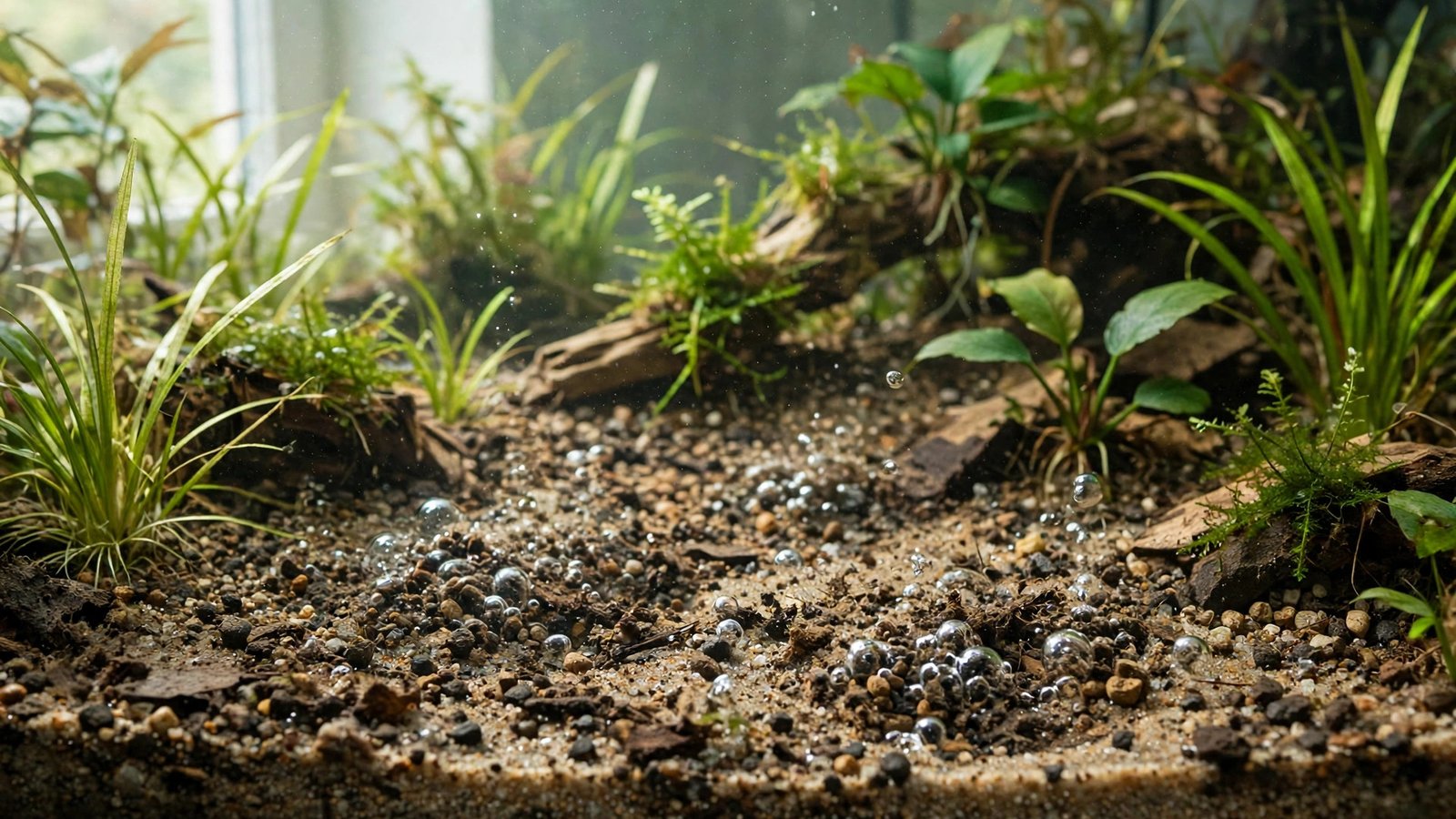
You have probably seen them: small bubbles rising from the substrate when you poke the sand, or dark patches creeping along the front glass under a deep bed of gravel. Gas pockets in aquarium substrate are a normal byproduct of how organic matter breaks down underwater, but the difference between a harmless burp of trapped air and a sulfur-smelling pocket of hydrogen sulfide is worth understanding. This guide explains why they form, how to tell which kind you are seeing, and how to clear them out without endangering your fish.
What Are Gas Pockets in Aquarium Substrate?
Deep inside a planted tank's substrate, oxygen cannot always reach. In those low-oxygen zones, bacteria break down leftover food, dead plant matter, and fish waste through anaerobic digestion — decomposition without oxygen. The byproducts of that process are gases, and when they accumulate faster than they can diffuse out through the substrate, they collect into pockets. Most of the time these pockets are small, harmless, and resolve on their own. But certain conditions let them grow large and fill with a gas that genuinely deserves respect.
Hydrogen Sulfide: The Gas Behind the Worrisome Bubbles
The gas that gives aquarists pause is hydrogen sulfide (H2S), produced by sulfate-reducing bacteria living in oxygen-free layers of the substrate. It is easy to identify by one unmistakable trait: it smells like rotten eggs. Hydrogen sulfide is toxic to fish and invertebrates at high concentrations, because it interferes with how cells use oxygen — in extreme cases it can suffocate fish even when the water itself tests fine for oxygen.
Here is the important context: in a healthy, reasonably maintained aquarium, hydrogen sulfide pockets are rare and seldom dangerous. They become a genuine concern mainly in tanks where deep, compacted substrate has sat undisturbed for a very long time while a heavy load of organic waste decays inside it.
How Gas Pockets Look (and Smell)
Gas pockets announce themselves in a few recognizable ways. Watch for any of these signs:
- Bubbles rising after a disturbance: You poke the substrate or pull up a plant and bubbles rise. With no smell, this is almost always harmless trapped air, carbon dioxide from roots, or nitrogen from ordinary bacterial processes.
- Dark or black patches under the substrate: Visible through the glass on the front panel, these darkened zones show where anaerobic decomposition is most active. Dark coloration alone is normal biology — even well-run planted tanks develop some.
- Rotten-egg smell: If disturbing the substrate releases a sulfurous stink, you have hydrogen sulfide present. This is your signal to act carefully and ventilate — not to panic, but not to ignore it either.
- Fish avoiding the bottom or gasping after a big disturbance: A sign released gases temporarily affected water quality — aerate, do a water change, and make future cleanings gentler and more frequent.
Why Gas Pockets Form in Aquarium Substrate
Gas pockets are not a sign that you did something wrong — they are chemistry doing its job in a closed system. Four conditions encourage them, and most tanks have at least a little of each.
Compacted Sand and Deep Substrate Beds
Fine sand is the classic culprit: its tiny grains pack tightly, squeezing out the water channels that would carry oxygen downward. A sand bed deeper than about two inches, left undisturbed, naturally develops anaerobic zones at its base. This is not inherently bad, but combined with heavy waste loading it creates the perfect nursery for large pockets. Choosing the right sand for a planted aquarium and keeping bed depth in range goes a long way; gravel's larger pores make it less prone to severe compaction. Getting substrate depth right for aquarium plants is one of the simplest preventive habits there is.
Dead Zones With No Circulation
Gas pockets love stillness. Under decorations, behind rock piles, and in back corners where filter flow barely reaches, organic debris settles and decays quietly for months. Nothing turns this substrate over and nothing carries oxygen in, so waste accumulates far faster than in open areas. When you eventually move that cave or rock, the released pocket can be surprisingly large.
Excess Organics and Mulm Buildup
Overfeeding is the most common organic load driver: uneaten food sinks into the substrate and rots anaerobically. Dead plant leaves left to melt, overstocked tanks, and filter neglect all add fuel. A substrate rich in decaying matter feeds the bacterial colonies that produce hydrogen sulfide, so pockets in neglected tanks tend to be both larger and more sulfurous than in lean, well-maintained ones. Regular, gentle mulm removal with a gravel vacuum is the single most effective habit against problematic pockets — see our guide on how to clean aquarium substrate without uprooting plants for a livestock-safe method.
Aquasoils and Nutrient-Rich Substrates
Commercial aquasoils and dirt-based substrates release ammonia and organic compounds as they settle in, especially during the first weeks. This nutrient pulse can feed anaerobic bacterial blooms in deep spots, which is one reason new aquasoil tanks sometimes produce noticeable bubbles and sulfur notes during cycling. It usually settles down as the tank matures and plant roots colonize the bed — one more reason to compare aquarium soil and gravel before committing to a deep aquasoil layout.
Harmless Bubbles vs. Problem Pockets: A Quick Comparison
Not every bubble warrants action. Use this comparison to decide whether to watch, adjust, or intervene.
| Sign | Harmless | Needs attention |
|---|---|---|
| Smell when disturbed | No smell, or a faint earthy odor | Rotten-egg / sulfur smell |
| Bubble size and frequency | Occasional small bubbles; tiny streams after planting | Large, frequent releases; dark substrate welling up with gas |
| Substrate appearance | Lightly darkened patches in a few spots | Extensive black zones, sludge visible through glass, slimy film on surface |
| Livestock behavior | Normal — fish swim and feed as usual | Bottom-dwellers avoid the substrate; gasping or lethargy after disturbances |
| Water parameters | Stable ammonia/nitrite, normal pH | Unexplained pH dips or ammonia spikes after substrate is disturbed |
The smell test is the simplest and most reliable: no sulfur smell means you are almost certainly looking at ordinary trapped air, carbon dioxide, or nitrogen — all harmless in the small quantities a hobby tank produces.
Preventing Gas Pockets in Aquarium Substrate
Prevention is quiet, cheap, and far easier than fixing a neglected bed. These five habits cover it.
Choose the Right Substrate and Depth
Match substrate to your tank's needs rather than defaulting to the deepest bed possible. For most planted setups, two to three inches in the front — sloping deeper toward the back — provides plenty of root space without creating a cavernous anaerobic basement. If you want dramatic depth for an aquascape, use sloped substrate for depth so the thickest areas sit where plant roots are densest and biological activity is highest. And before buying, confirm how much substrate your planted tank actually needs — many gas-pocket problems start with simply using too much. If you prefer inert options, there are plenty of aquasoils and enriched substrates engineered to stay porous and root-friendly at depth.
Enlist Substrate Stirrers: Malaysian Trumpet Snails and Friends
Malaysian trumpet snails (Melanoides tuberculata) are the classic natural solution. They burrow through the substrate at night, gently turning the top layers, breaking up compaction, and carrying oxygen deeper — essentially aerating your substrate while you sleep. A modest colony in a planted tank works continuously, preventing the dead, compacted zones where pockets form.
They reproduce readily when overfed, so control food rather than fighting the snails. Corydoras, kuhli loaches, and foraging cichlids turn the upper substrate less thoroughly as they feed. The goal is not a sterile bed — it is a lightly, constantly disturbed one. One responsibility note: Malaysian trumpet snails are invasive in some regions, so check your local rules before buying them and never release aquarium animals or plants into wild waterways.
Planting and Maintenance Habits That Keep Substrate Healthy
Plant roots are nature's substrate aerators. Deep-rooting species like Amazon swords, cryptocorynes, and vallisneria physically break up compaction and leak small amounts of oxygen around the root zone. Bare, unplanted areas — especially under hardscape — are where pockets concentrate, so plant behind and around decorations rather than leaving those zones empty.
Maintenance-wise, the rhythm that works is small and frequent: vacuum a different section of open substrate at each weekly water change rather than deep-cleaning the whole bed at once, remove dead leaves before they melt into the substrate, and feed only what your fish finish in a couple of minutes. Stability beats intensity — a bed that is lightly touched every week never develops the months-old dead zones where big pockets form.
How to Fix Gas Pockets Safely
Found pockets in your tank? The golden rule is start gentle and observe your livestock. Releasing a little gas at a time with good aeration running is safe; tearing up a neglected bed in one session is how problems happen.
The Gentle Poke Method
This is the standard, safe fix for most tanks:
- Do it during a water change, with the siphon running. Any gas or debris you release gets pulled out immediately instead of drifting through the tank.
- Increase surface agitation first — point a filter outlet at the surface or drop in an air stone. Oxygen-rich water buffers the brief dip that released gases cause.
- Use a thin tool (a chopstick, a long planting tweezer, or a dedicated substrate stick) and gently push it into the substrate, wiggling slightly. Work in small sections — one hand-sized area per minute is plenty.
- Watch the bubbles and sniff. No smell? Carry on. Rotten-egg smell? That section holds hydrogen sulfide — release it slowly, siphon aggressively, and stop after a small area. You can do more next water change.
- Observe your livestock for the rest of the day. If fish behave normally, your approach was appropriately gentle. If anyone gasps or hides, do a partial water change and aerate harder next time.
Spread the job across two or three water changes if the bed is heavily affected. Patience is the entire safety strategy.
When to Disturb vs. Leave Alone
Not every pocket needs eviction. Disturb substrate that smells of sulfur, shows extensive black sludge, or burps up gas unprompted — those are active problems. Leave alone the darkened but odorless patches deep under a mature planted bed: that is a functioning anaerobic zone, and roots have adapted around it. The danger is not anaerobic bacteria — it is anaerobic bacteria plus rotting organics plus zero maintenance.
Deep-Cleaning a Neglected Bed: The Conservative Approach
If you inherited a neglected tank with serious sulfide buildup, resist the urge to fix it in one day. Plan a multi-week campaign: each water change, gently poke and siphon one section and remove visible sludge, testing ammonia and nitrite before and after. If livestock shows stress, that section waits until next week. Adding trumpet snails and fast-growing stem plants early gives the bed a workforce that keeps working between your sessions.
Gentle siphoning releases trapped gas without tearing up the bed: a gravel siphon.
When Gas Pockets Are Actually Dangerous for Livestock
Hydrogen sulfide is genuinely toxic — but concentration and release rate are everything. A few odorless bubbles during planting are a non-event. The genuinely dangerous scenario: a long-neglected, deep, compacted bed loaded with decaying organics gets massively disturbed all at once, releasing a large pulse of sulfide. Fish gasp at the surface, bottom-dwellers flee, and sensitive invertebrates like shrimp die first.
If that happens: aerate hard immediately, do a large partial water change with temperature-matched, dechlorinated water, and run fresh activated carbon to adsorb dissolved gases. Most fish recover quickly once the pulse passes, because hydrogen sulfide dissipates fast in oxygenated water. The lesson is procedural — big releases come from big disturbances, and big disturbances are avoidable. Small, regular maintenance never produces a dangerous event.
For authoritative background on hydrogen sulfide's properties, the hydrogen sulfide overview covers its chemistry and toxicity thresholds in plain terms — useful context for understanding why concentration, not mere presence, is what matters.
Frequently Asked Questions
Are gas pockets in aquarium substrate always dangerous?
No. The vast majority are harmless pockets of air, carbon dioxide, or nitrogen produced by normal bacterial activity, and they release without any effect on your fish. Only pockets containing hydrogen sulfide — identifiable by a rotten-egg smell — deserve caution. Even then, small gradual releases during routine maintenance are safe; danger comes from disturbing a large, neglected buildup all at once.
Will Malaysian trumpet snails eliminate gas pockets completely?
They prevent the worst of them but do not make a tank maintenance-free. Trumpet snails constantly turn the upper substrate layers, breaking up compaction where they work. They are less effective in very deep beds or under heavy hardscape. Pair them with sensible depth and regular light vacuuming for the best results.
Is a black layer under my substrate always hydrogen sulfide?
Not necessarily. Darkened or black zones deep in the substrate are a normal sign of anaerobic activity and appear in many healthy planted tanks. It becomes a concern when the zones are extensive, accompanied by sludge, or release a sulfur smell when disturbed. Dark but odorless patches in a healthy tank are usually fine to leave alone.
How deep should my substrate be to avoid gas pockets?
For most planted tanks, two to three inches at the front — sloping deeper toward the back — gives roots room without excessive anaerobic volume. Fine sand beds benefit from staying closer to two inches unless snails or dense planting keep them turned. Depth alone is not the problem; depth plus compaction plus neglect is.
Can gas pockets kill my fish overnight?
Essentially no — gas pockets do not ambush fish while you sleep. They become dangerous only when released suddenly in large quantities, which requires a major disturbance of a neglected bed. Deaths attributed to gas pockets almost always follow a big rescape or aggressive deep clean of a long-ignored substrate.
Should I remove and replace substrate that has gas pockets?
Rarely. Replacing all substrate restarts your tank's biological stability — a bigger risk than the pockets themselves. Work through affected areas gradually with gentle poking and siphoning across several water changes, reduce organic loading, and add substrate stirrers. Only in extreme cases of a foul, sludge-filled bed with recurring livestock stress is partial replacement worth considering.
Keep It Moving Down There
Gas pockets in aquarium substrate are one of those topics that sound alarming until you understand the mechanics: normal decomposition, occasionally sulfurous, almost always manageable. Choose a sensible depth, keep organics lean, let trumpet snails and plant roots do their quiet work, and touch the bed gently at every water change. Do that, and the bubbles rising from your substrate will stay what they are in most tanks — harmless signs of a living, breathing ecosystem under your aquascape.