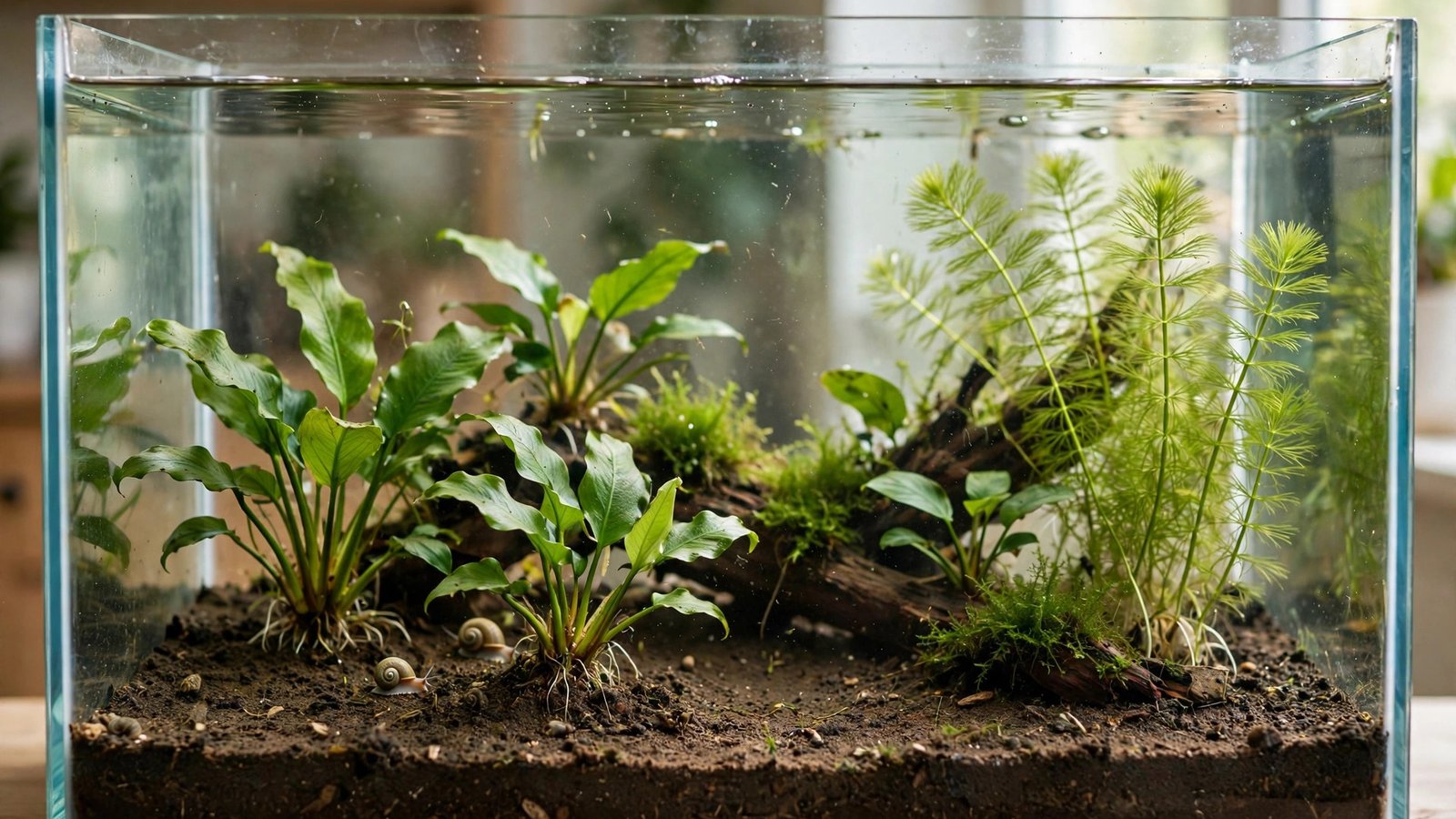
Some aquarists swear their capless dirted bowls are thriving jungles, and their photos look great. But before you pour a bag of potting soil into your tank and call it done, it's worth asking the question behind every dirt-tank debate: can you use dirt without a cap? Here's what you're skipping — and what happens when dirt meets open water with nothing between it and your fish.
What the cap layer actually does
In the standard dirted tank setup, a 1–2 inch layer of sand or fine gravel sits on top of the soil. It's not decoration. The cap is a physical filter: it holds down light soil particles, slows the release of ammonia and dissolved organics into the water column, and gives rooted plants something stable to anchor in. Think of it as the lid that keeps the chemistry where it belongs — down in the root zone.
Soil underwater behaves very differently from soil in a pot. Dry potting mixes are fluffy, full of fine silt and decomposing organic matter. The moment water hits them, they start releasing tannins, ammonia, and floating debris. A cap keeps most of that exchange happening slowly, through the soil layer, instead of exploding into your water column all at once.
So, can you use dirt without a cap? The honest answer
Yes — it's genuinely possible, and a handful of experienced hobbyists run capless dirted bowls and low-energy tanks successfully. But "possible" and "a good idea for your tank" are different things. Here's how the two approaches compare:
| Factor | Capped dirt | No-cap dirt |
|---|---|---|
| First 2–3 weeks | Slight haze, clears in days | Heavy clouding, often 1–3 weeks |
| Ammonia spike | Moderate, manageable with water changes | Often severe — fish can't go in for weeks |
| Uprooting/replanting | Minor disturbance, clears fast | Mud storm; every move is a mess |
| Anaerobic risk | Low with proper depth | Higher — exposed soil compacts and goes anoxic |
| Maintenance | Normal gravel-vac schedule | Feather-light vacuuming only, forever |
| Best for | Beginners to experts | Patient, plant-first hobbyists only |
The pattern is clear: everything the cap prevents still happens without one — you just manage it manually, for months. That's why honest answers online are split: the people who love no-cap dirt are the ones who accepted the extra work, not the ones who skipped it.
The risks of the no-cap method
Running soil naked isn't just uglier in the first weeks — it changes the chemistry of your whole tank.
Ammonia and organics flood the water column. Without a cap metering the release, decomposing soil leaches ammonia directly into the water. In a capped tank, that ammonia mostly stays in the substrate where plant roots grab it. Capless, your filter and water changes have to do all the work. Expect a real cycle — 3–6 weeks before livestock — and test with liquid kits, not strips.
Anaerobic compaction. Exposed soil slumps and compacts over time, forming oxygen-free pockets that release hydrogen sulfide — the rotten-egg smell you may notice when disturbing an old dirted tank. These anaerobic gas pockets in aquarium substrate are manageable in capped systems; without a cap, they form closer to the surface where fish forage.
Every rescape is a mud storm. Pull up a stem plant in a capped tank and you get a small puff of dust. Pull one up in a capless dirted tank and you pull up mud — clouds of it. If you rescape often, the no-cap method will make you miserable.
Algae gets a head start. Dissolved organics and phosphates in the water column are algae fuel. Capless setups that aren't planted extremely heavily from day one frequently battle diatoms and green water for the first month or two.
How to do the no-cap method (if you're determined)
If you still want to try it, there's a right way — and it borrows heavily from the Walstad playbook. Tropica's own substrate guide is worth reading alongside this: it explains why nutrient-rich substrates need a stable, undisturbed environment, which is exactly what you're sacrificing.
- Use only mineralized, additive-free soil. Organic topsoil with no added fertilizers, no perlite, no moisture-retention crystals. Learning the difference between mineralized soil vs potting mix is mandatory homework — most bagged "organic" mixes still contain things you don't want leaching into fish water.
- Keep the soil layer thin: 1 inch, max 1.5. Deep soil goes anoxic faster. Check how deep planted-tank substrate depth for aquarium plants should be and stay at the shallow end — you have no cap adding separation.
- Plant insanely heavily on day one. This is non-negotiable. Fast-growing stems (rotala, ludwigia, hornwort) in numbers that look excessive. The plants are your filter now — they're the only thing absorbing the nutrients the cap would have contained.
- Fill the tank with painful slowness. Lay plastic or a plate over the soil and pour water over it. Any direct stream digs craters and suspends the whole bed.
- Run a gentle filter and wait. 3–6 weeks of fishless cycling with 30–50% water changes twice weekly. Dirted tanks can run beautifully for years — but only if the setup phase is respected.
- Vacuum like you're defusing a bomb. Hover the siphon just above the soil surface forever. Touch the soil with the tube and you'll pay for it in clouding.
The method calls for organic additive-free potting mix to mineralize first: an organic, additive-free potting mix.
Frequently Asked Questions
Will dirt without a cap always make the water cloudy?
Nearly always at first. Exposed soil releases fine silt and tannins for 1–3 weeks, sometimes longer with unmineralized soil. It does clear if the tank is filtered and planted, but every plant you uproot or every siphon bump restarts the clouding. A cap cuts this phase to a few days.
Is a capless dirted tank safe for fish and shrimp?
Only after a full fishless cycle of 3–6 weeks with confirmed zero ammonia and nitrite. The initial ammonia spike in a capless setup is often severe enough to kill livestock outright. Shrimp are especially sensitive — don't add them until the tank has been stable for at least two months.
Can I use regular organic potting soil without a cap?
Only if it's truly additive-free — no perlite, no slow-release fertilizer pellets, no wetting agents — and ideally mineralized first. Most bagged "organic" potting mixes still contain additives that leach toxins into open water much faster without a cap. Read the ingredients panel like it matters, because here it does.
Does the Walstad method use a cap?
Diana Walstad's original El Natural method actually uses a thin gravel cap — about 1 inch of small gravel over 1–1.5 inches of soil. So even the most famous "natural dirt tank" method isn't truly capless. The capless bowls you see online are a bolder, higher-maintenance variation, not the standard method.
What happens if I add a cap later to a capless tank?
You can — and it's the most common rescue. Drain the tank down to a few inches, let the soil settle for a day, then gently add 1–2 inches of washed sand or fine gravel over a plate. Clouding clears within days. Our guide on how to cap aquarium soil with sand walks through the technique.
The verdict: skip the cap only if you know why it exists
Can you use dirt without a cap? Yes — with mineralized soil, a thin layer, extreme planting, and the patience of a monk. Should most people? No. The cap is the cheapest, simplest insurance in the entire dirted-tank method, and fighting without it costs you weeks of clouding, risky cycling, and fragile maintenance for very little payoff. Learn the capped method first, master it, and then — if curiosity wins — experiment capless in a small bowl where the stakes are low.