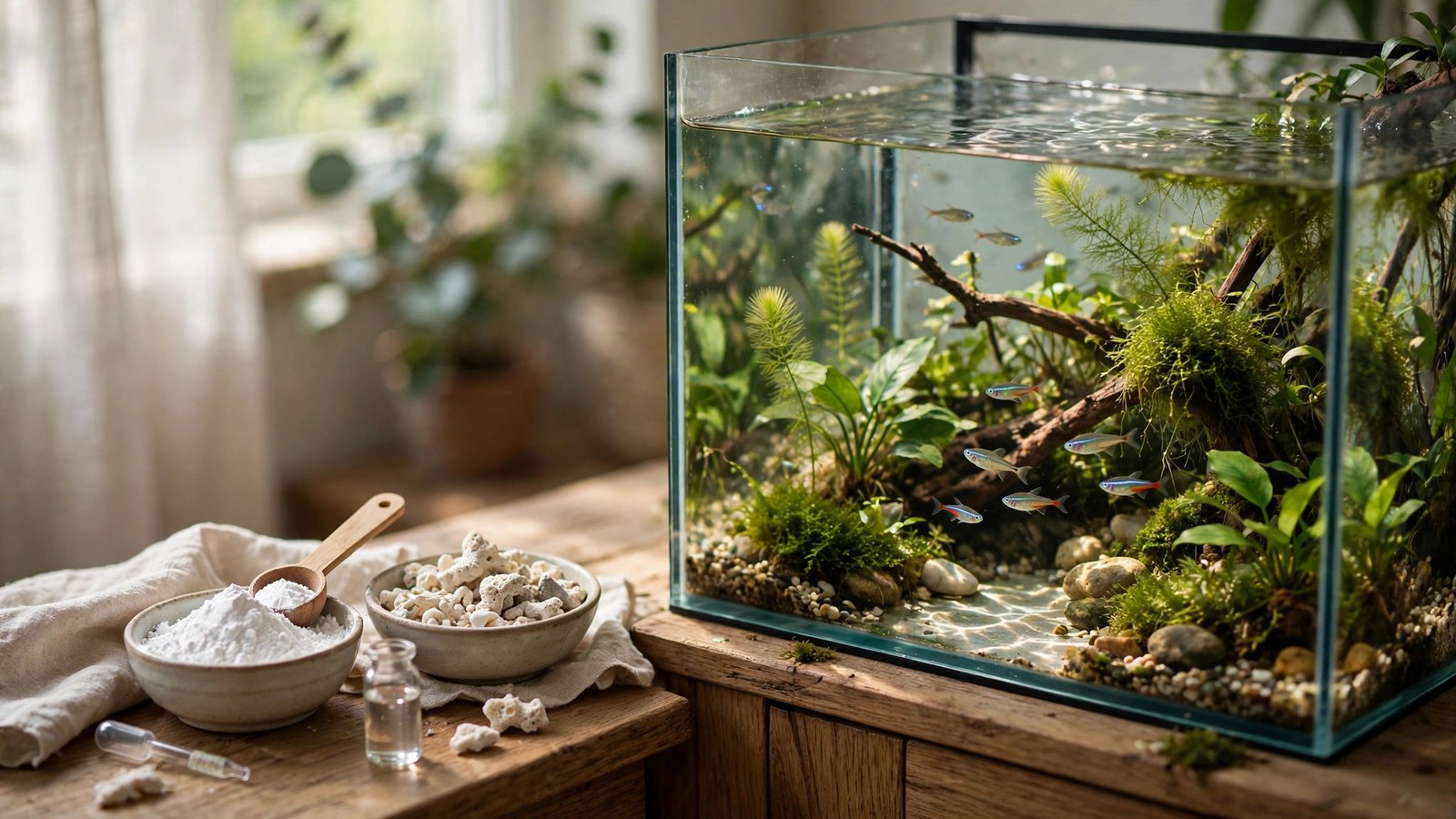
The deadliest pH crashes in planted tanks don't start with a broken filter — they start with a kitchen spoon. Someone reads that their KH is zero, dumps a heaped spoonful of baking soda in, and wakes up to a pH spike that kills everything they were trying to save. A careful baking soda aquarium KH routine avoids that: small doses, dissolved first, tested after. Below: exact dosing per gallon, how to add it without shocking a fish, and when to reach for crushed coral instead. If the chemistry is fuzzy, skim our planted tank water parameters overview first.
What Baking Soda Actually Does to Your Water
Baking soda is sodium bicarbonate (NaHCO₃), and KH — carbonate hardness — is essentially a measure of bicarbonate and carbonate ions. Add baking soda and you're handing your tank exactly the ions a KH test kit measures. Those bicarbonates neutralize the acids your tank constantly produces: fish waste, decomposing leaves, and the nitric acid nitrifying bacteria generate. That buffering keeps pH from crashing overnight. See Mississippi State University Extension's guide to pH and alkalinity for the science in plain terms.
Two things it does not do: it adds no calcium or magnesium, so GH stays untouched — snails and shrimp still need mineral sources for shells and molts. And a bicarbonate-only buffer equilibrates around pH 8.2, though your actual pH depends on starting water and dose size. For how KH, GH, and pH interact, see our buffering substrates and KH guide.
Baking Soda Aquarium KH Dosage: How Much Per Gallon
The rule hobbyists have verified for decades: one level teaspoon of baking soda (about 5 grams) per 10 gallons raises KH by roughly 3–4 dKH. Use real measuring spoons — never a dinner spoon — and subtract substrate and hardscape, since a "20-gallon" tank often holds 17–18 gallons of water.
| Tank size | +1 dKH | +2 dKH | +4 dKH |
|---|---|---|---|
| 5 gallons | ⅛ tsp | ¼ tsp | ½ tsp |
| 10 gallons | ¼ tsp | ½ tsp | 1 tsp |
| 20 gallons | ½ tsp | 1 tsp | 2 tsp |
| 40 gallons | 1 tsp | 2 tsp | 4 tsp |
| 55 gallons | 1½ tsp | 3 tsp | 6 tsp |
If the table says you need +4 dKH, that's a two-day minimum. Dose in three steps: dissolve the measured soda in a cup of tank water until clear (dry powder creates caustic hot spots); add gradually near the filter output over 30–60 minutes; then test and wait — check KH and pH within the hour, and don't dose again for 24 hours.
One interaction to know: active aquasoils constantly strip KH — that's their job — so expect to re-dose more often. Our aquarium soil vs gravel breakdown explains why KH keeps drifting down in soil tanks.
Why Sudden KH Swings Kill (and How to Avoid Them)
Fish balance the salts between their blood and the water across their gills. When KH and pH lurch suddenly, that system goes into crisis: stress hormones spike, and in bad cases the fish hits osmotic shock within hours. A stable pH of 6.4 is vastly safer than one bouncing between 6.4 and 7.6 in an afternoon. That's why the 1–2 dKH-per-day rule is the most important line in this article.
In nano tanks, one heaped teaspoon is a 10+ dKH swing in 5 gallons — work in fractions of a teaspoon. The second trap is chasing pH instead of KH — dosing again because "the pH still isn't 7.0" is how people overshoot into pH 8.5. Dose to a KH target (3–6 dKH) and let pH settle where it settles.
When Baking Soda Beats Crushed Coral — and When It Doesn't
Baking soda and crushed coral solve the same problem from opposite directions. Baking soda is a scalpel: instant, exact, fully under your control. Crushed coral is a safety net: slow-dissolving calcium carbonate that holds KH steady for months. Neither is "better" — they answer different questions.
| Baking soda | Crushed coral | |
|---|---|---|
| Speed | Minutes | Days to weeks |
| Precision | Exact, testable doses | Self-limiting, gradual |
| GH effect | None (sodium only) | Adds calcium, slightly raises GH |
| Longevity | Re-dose every water change | Lasts months |
| Best for | Quick corrections, water-change prep | Set-and-forget buffering |
Reach for baking soda for a fast, one-time correction or for prepping very soft water for a water change. Reach for crushed coral for hands-off stability. Many keepers use both: coral as the baseline buffer, baking soda for tune-ups. If your real goal is minerals for invertebrates rather than KH, baking soda won't help shells or molts — see our cuttlebone calcium guide instead.
The Honest Limits: Sodium, GH, and Re-Dosing
Here's what the quick-fix guides skip: every teaspoon of baking soda leaves its sodium behind. One correction is irrelevant; weekly re-dosing for a year lets sodium accumulate, and only water changes remove it. In soft-water tanks with regular 30–50% water changes this rarely matters. In already-hard water it can push total dissolved solids high enough to stress sensitive species — tank logs like WetWebMedia's pH and alkalinity FAQ show how fast carbonate chemistry drifts when corrections go untested.
Baking soda also can't outrun a KH-hungry setup. Active soils, heavy CO₂, and driftwood drag KH down continuously, turning chemical dosing into a weekly chore of small swings. That's the real argument for crushed coral as your long-term buffer: it dissolves faster when acids are high and slows when they're not. If you cap your soil with sand, our soil-capping guide covers how that shifts KH demand.
Frequently Asked Questions
Can I use baking soda in my aquarium?
Yes — plain, unscented sodium bicarbonate is safe when dosed correctly. Check the box lists only "sodium bicarbonate," no fragrances or flow agents. Safety is entirely in the method: dissolve first, add gradually, and never raise KH more than 1–2 dKH per day. It raises KH without adding calcium, ideal for soft-water planted tanks.
How much baking soda should I add per gallon?
About 0.1 teaspoon per gallon raises KH by roughly 3–4 dKH — ¼ teaspoon per 10 gallons gives about +1 dKH. Start with half your calculated dose, test KH after an hour, then finish if needed. In nano tanks under 10 gallons, work in ⅛-teaspoon increments. Always dose against actual water volume, not the rated size.
Will baking soda raise my pH too?
Yes — raising KH almost always raises pH, since bicarbonate buffers resist acidity. A pure bicarbonate buffer equilibrates around pH 8.2, though your reading depends on starting water and dose size. Dose to a KH target (3–6 dKH) rather than chasing a pH number. If pH climbs too high, stop dosing and let a partial water change bring it down gradually.
Is baking soda safe for shrimp and snails?
Dosed gradually, yes — shrimp and snails tolerate bicarbonate fine, and stable KH prevents the pH crashes that actually harm colonies. What hurts them is the swing, not the soda: add slowly over an hour, keep changes under 1–2 dKH per day. It adds no calcium, so pair it with a calcium source if shells or molting are the concern.
Should I use baking soda or crushed coral to raise KH?
Baking soda for fast, precise, one-time corrections — minutes, exact doses. Crushed coral for long-term, hands-off stability — dissolves on demand, lasts months. Many keepers run coral as the baseline buffer and keep soda for tune-ups. If you dose soda weekly forever, the accumulating sodium is your sign to switch.
The One-Line Rule
Baking soda is the fastest way to fix a KH problem and the fastest way to cause one. The difference is a measuring spoon, a dissolved cup of tank water, and the patience to change no more than 1–2 dKH a day.