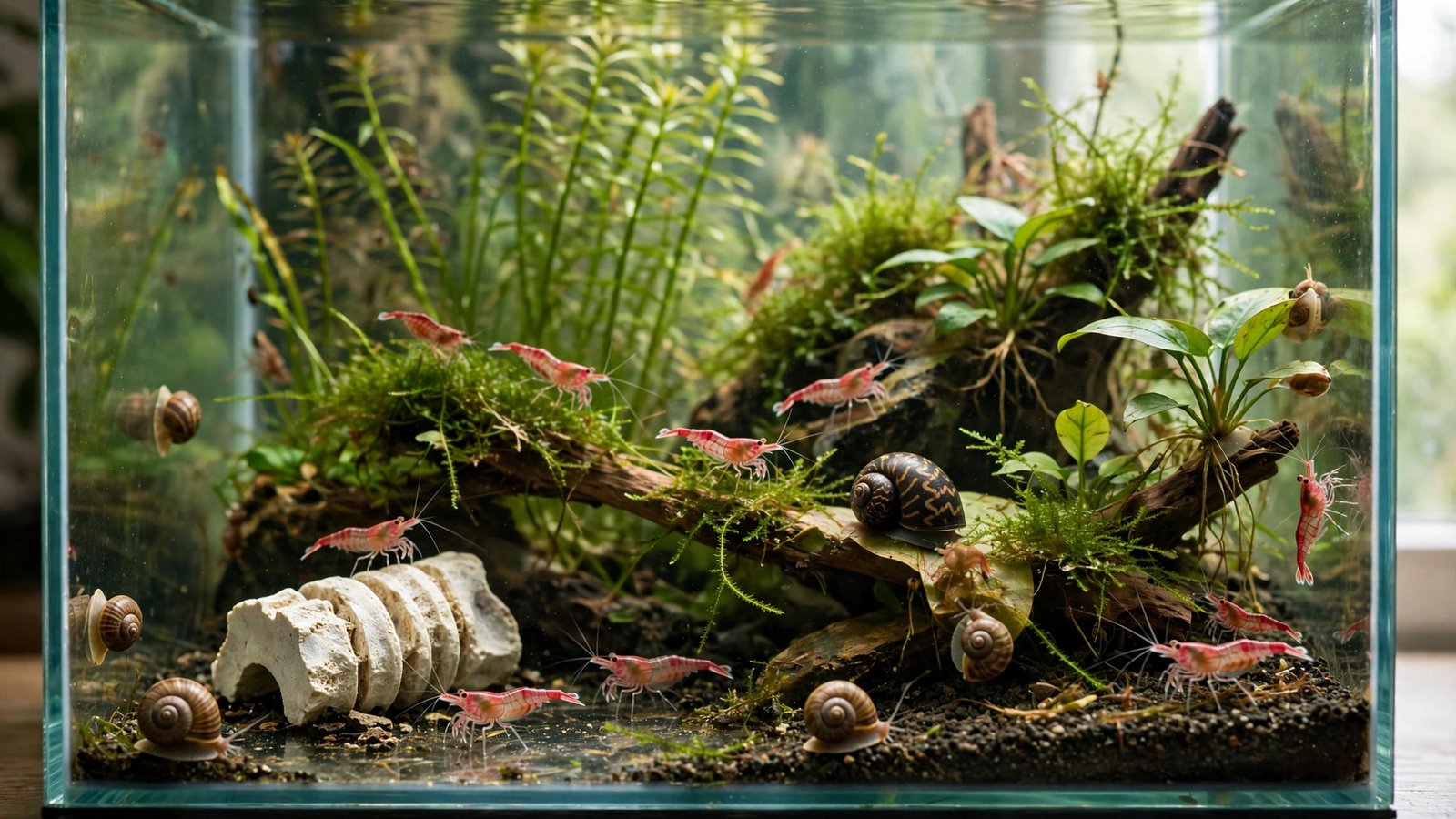
Most "calcium supplements" for aquariums are powders you dose every week — miss a week and your shrimp's shells suffer. Cuttlebone flips that logic: it's the same calcium-rich shell from the bird aisle, and in a cuttlebone aquarium setup it dissolves on its own for months without you touching it. Better still, dissolution stalls once pH reaches about 7.8, so on its own it won't push your water past that ceiling. Yes, you can put cuttlebone in an aquarium — for shrimp and snails, it's one of the cheapest, safest calcium sources in the hobby.
What Is Cuttlebone and Why Does It Work Underwater?
Cuttlebone is the internal shell of a cuttlefish — a soft, porous slab made of calcium carbonate in its aragonite form, as documented in peer-reviewed studies of Sepia officinalis shell structure. Pet stores sell it in the bird aisle, and plain cuttlebone packs online are usually far cheaper than anything labeled for aquariums. Submerged, water slowly erodes the porous structure, releasing calcium and carbonate ions into the water column for weeks to months.
That slow release is the point. Shrimp — especially neocaridina and caridina — build exoskeletons from calcium carbonate, and snails need it for shell growth. If your tank runs on soft tap water or low-GH remineralized RO water, your invertebrates may be starved of the very building material they need, even when everything else looks perfect. Starting from scratch? Read our planted shrimp tank setup guide first — it covers substrate, cycling, and stocking, and cuttlebone slots in as the calcium strategy for that kind of tank.
Is Cuttlebone Safe? The Self-Limiting pH Fact
Here is what makes cuttlebone stand out from powdered products: it dissolves only while water is below about pH 7.8. As it releases carbonate it gently raises pH and KH — and once the water hits that ceiling, dissolution stalls. It cannot run away and push your tank into alkaline territory. No dosing math, no daily measuring, no pH spike while you were on vacation.
Most shrimp and snail keepers target pH 6.5–7.8 anyway, so cuttlebone's ceiling sits at the top of — not above — the safe range. In already-hard, high-pH water, the piece simply sits inert. If your rocks are already pushing pH up, check do aquarium rocks raise pH to see which hardscape is responsible.
How to Set Up a Cuttlebone Aquarium
Adding cuttlebone takes about five minutes:
- Rinse it under warm water to remove dust and packaging residue.
- Boil 5 minutes (optional but recommended). This drives out trapped air so it sinks instead of bobbing for weeks, and softens it so invertebrates can rasp it more easily.
- Dose by tank size: roughly one 1-inch piece per 5–10 gallons. A whole cuttlebone works for 20+ gallon tanks — it just lasts longer.
- Place it anywhere. Drop it on the substrate behind the hardscape, or tuck it into your filter media compartment where flow speeds dissolution slightly.
- Leave it alone. Check monthly; replace when it shrinks to a wafer or crumbles. Expect 2–4 months per piece.
One cosmetic quirk: cuttlebone often grows a light dusting of biofilm or algae in the first weeks. Shrimp graze it off happily.
The how-to section needs a purchasable cuttlebone — nothing in the catalog fits; new researched product (verified DP page): natural cuttlefish bone pack.
Cuttlebone vs Crushed Coral vs Calcium Powders
All three raise calcium and KH, but they behave very differently:
| Cuttlebone | Crushed coral | Calcium powder | |
|---|---|---|---|
| Form | Solid porous slab | Granules (substrate or media bag) | Fine powder |
| Release speed | Slow — months | Slow — long-term | Fast — hours |
| pH ceiling | ~7.8 (self-limiting) | ~7.6–8.2 (self-limiting) | None — you set the dose |
| Best for | Invertebrate calcium in shrimp/snail tanks | Raising KH/pH across a whole tank or filter | Precise RO remineralization |
| Maintenance | Replace every few months | Top up yearly | Dose with every water change |
Crushed coral is the sibling product — see our crushed coral planted tank guide for the full breakdown. Think of it this way: crushed coral is the whole-tank pH/KH tool, cuttlebone is the invertebrate-calcium specialist. Powders win when you need precise control, like in buffering substrate tanks where a slab's slow unpredictability doesn't fit the dosing plan.
Will Cuttlebone Cloud the Water or Harm Plants?
In a normally stocked tank, no. Dissolution is slow enough that your filter handles it — you'll see a faint white dusting on the piece, not a haze in the water. It adds no ammonia, no organics, no algae-triggering nutrients.
Plants are unaffected, with one caveat: cuttlebone nudges KH upward, which can blunt the pH-drop of CO2 injection in high-tech tanks. In an aquasoil tank that buffers pH downward, a small piece won't win that tug-of-war — the soil's buffering dominates. Monitor GH alongside KH so you know whether calcium comes from the bone or your tap. For the base under all of this, see best substrate for shrimp tanks.
Frequently Asked Questions
Can I put cuttlebone in my aquarium without boiling it?
Yes — an unboiled piece is safe but will float for days to weeks from trapped air; shrimp and snails still graze the underside. A 5-minute boil is purely a convenience step so it sinks immediately. It doesn't change how calcium releases.
How long does cuttlebone last in a fish tank?
A 1-inch piece typically lasts 2–4 months in a 10-gallon tank — longer in hard water where dissolution stalls near pH 7.8, faster in soft acidic water. Replace it when it shrinks to a thin wafer or crumbles apart. A whole cuttlebone in 20+ gallons can go 4–6 months.
Will cuttlebone raise pH too high for my shrimp?
No. Dissolution is self-limiting and effectively stops around pH 7.8 — the top of the safe range for neocaridina, caridina, and common snails. Unlike powdered products, cuttlebone physically cannot overshoot the ceiling, no matter how much you add.
Is cuttlebone from the bird section safe for aquariums?
Yes, if it's plain, unflavored, and uncoated — the same calcium carbonate shell sold at a markup in aquarium branding. Avoid flavored or vitamin-fortified versions with dyes and coatings, which aren't formulated for water. Rinse before adding.
Can I use cuttlebone instead of calcium supplements for snails?
Yes. Snails rasp the soft surface directly, and for visible shell erosion, a cuttlebone piece plus calcium-rich foods (blanched kale, snail-specific pellets) works faster than either alone. Manufacturer feeding specs for pure cuttlebone products confirm its role as a natural calcium source for snails.
Do I need to remove cuttlebone during water changes or medication?
No — it doesn't interfere with water changes or most medications. The one exception: treatments that target carbonate hardness or require soft water. In that case, pull the piece temporarily and re-add it after treatment ends.
For the price of a bird-aisle staple, cuttlebone quietly handles one of the hardest-to-dose parameters in shrimp and snail keeping — no timers, no measuring spoons, no pH anxiety. Keep it in a clean hardscape spot, pair it with mineral-rich foods, and your invertebrates will show it in every molt. If your tap water is already hard and alkaline, though, save your money — the piece will just sit there, waiting for a pH below 7.8 that never comes.
Sources: cuttlebone's calcium-carbonate structure is documented in the Scientific Reports study on Sepia officinalis shell formation; product-grade calcium content data comes from Dupla's cuttlebone product specifications.